How International Buyers Verify New Suppliers Before Sending an Inquiry
An exporter of ceramic tableware from Morbi once showed me his inquiry log with genuine frustration. Forty-three quotations sent in one…
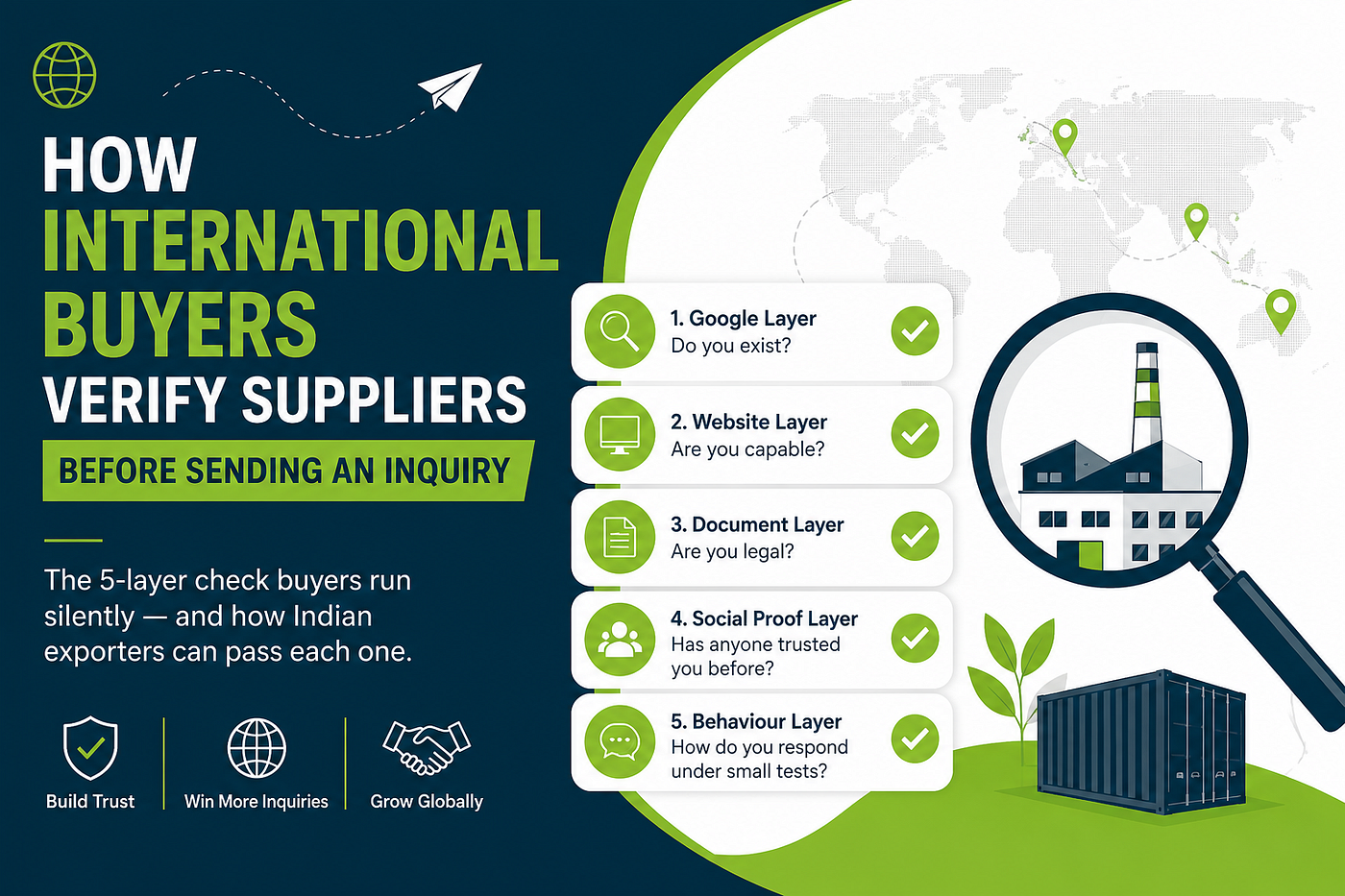
How international buyers verify suppliers before sending an inquiry using a 5-layer verification process including Google presence, company website, legal documents, social proof, and business responsiveness.
How International Buyers Verify New Suppliers Before Sending an Inquiry
An exporter of ceramic tableware from Morbi once showed me his inquiry log with genuine frustration. Forty-three quotations sent in one quarter. Four replies. Zero orders.
“Buyers are not serious anymore,” he concluded.
So we ran an experiment. I asked him to send me everything a buyer would receive and see: his quotation PDF, his email signature, his website link, his WhatsApp profile, his marketplace listing. Then I did exactly what a buyer in Hamburg or Houston does after receiving a quotation from an unknown supplier.
I Googled him.
His company name returned: a marketplace listing with a different phone number than his quotation, a website showing products he’d discontinued two years ago, no Google Business Profile, and — the killer — a scam-warning forum thread about a similarly named company from another city.
His quotations weren’t being rejected. His identity was failing verification before the quotation was ever opened seriously.
Six weeks after fixing his verification trail — nothing else, same products, same prices — his reply rate roughly quadrupled. Not because buyers became “serious.” Because for the first time, they could confirm he was.
If you’ve ever wondered why buyers don’t reply to your quotation, this article shows you exactly what happens in the silence — the five-layer verification process nearly every international buyer runs — and how to pass each layer for free.
The Silence After the Quotation: What’s Actually Happening
Here’s the part of international trade nobody explains to new exporters: the moment you send a quotation to a new buyer is the moment their risk assessment begins, not ends.
Put yourself in the buyer’s position. Accepting a new supplier means: wiring an advance to a foreign bank account, betting a delivery commitment to their own customers on your reliability, and staking their professional reputation on your quality. Buyers have been burned — by suppliers who vanished after advances, shipped substandard goods, or simply weren’t who they claimed to be.
So between receiving your quotation and replying, buyers run a verification process. It’s informal, unannounced, and mostly invisible to you. But having watched it from both sides of the table for years, I can tell you it follows a remarkably consistent pattern — five layers, checked roughly in this order:
-
The Google Layer — do you exist?
-
The Website Layer — are you capable?
-
The Document Layer — are you legal?
-
The Social Proof Layer — has anyone trusted you before?
-
The Behaviour Layer — how do you respond under small tests?
Fail any layer, and the process usually ends silently. There is no rejection email for failed verification. There is only the silence our Morbi exporter knew so well.
Let’s walk through each layer — what buyers check, what makes them close the tab, and what you can fix this month without spending money.
Layer 1: The Google Layer — “Do You Exist?”
The first check is the simplest: the buyer types your company name into Google, exactly as it appears on your quotation.
What they hope to find: a consistent, living digital footprint. A Google Business Profile with your factory pinned at the same address as your invoice. A website. Marketplace listings that match. Perhaps a LinkedIn page with real employees.
What ends the process:
• Nothing at all. Zero results for your exact company name is the fastest fail in international trade — it reads as “this company was created last month.”
• Contradictions. Different addresses, phone numbers, or company name spellings across platforms. To you it’s an old listing you forgot; to a buyer it’s a red flag they can’t afford to ignore.
• Someone else’s problem becoming yours. A similarly named company with complaints, as our Morbi exporter discovered. You can’t delete someone else’s bad reputation — but a strong, verified presence of your own pushes it down and separates you from it.
The free fix: Search your own company name in an incognito browser window this week — the exact name on your quotation. Whatever a buyer would find, you now find first. Claim and complete your Google Business Profile with your legal name, real factory photos, and your IEC-registered address. Then audit every platform where your company appears and make the name, address, and phone identical everywhere. This single afternoon of work passes more verifications than any brochure you’ll ever print.
One more thing about this layer in 2026: it’s no longer only human buyers running the check. When a purchasing manager asks ChatGPT or Perplexity to “find reliable ceramic tableware manufacturers in Gujarat,” those AI tools cross-reference the same public footprint — business profiles, websites, directories — before naming anyone. An inconsistent or absent footprint doesn’t just fail human verification anymore; it removes you from AI-generated shortlists you never knew you were being considered for.
Layer 2: The Website Layer — “Are You Capable?”
Having confirmed you exist, the buyer opens your website with one question: can this company actually produce and export what I need?
This is where a website for import export business earns its keep — or quietly loses the deal. Buyers scan for capability evidence:
• Production proof — real factory photos and, ideally, a short video. Machines, floor, packing area. Stock photos are worse than no photos; experienced buyers reverse-image-search anything that looks too polished.
• Specification depth — product pages with technical tables, grades, standards, MOQ, packing details, and HS codes. A photo with an “Enquire Now” button tells a buyer you’ve never dealt with a demanding customer.
• Export literacy — container loadability, ports you ship from, Incoterms you quote in, markets you already serve. This vocabulary signals you’ve done this before; its absence signals you haven’t.
• Signs of life — a current copyright year, recent updates, working links. A website frozen in 2022 makes buyers wonder if the company is too.
I’ve covered the full website checklist in a companion article (the seven things buyers check, in order). The headline for this layer is simple: buyers don’t need your website to be beautiful. They need it to answer their evaluation questions without emailing you. Every question your website answers is a reason for the buyer to continue; every question it leaves open is an excuse to move to the next supplier on their list.
Layer 3: The Document Layer — “Are You Legal?”
Serious buyers — and every buyer working with letters of credit, import licenses, or regulated products — verify your legal existence. This layer is where Indian exporters hold a genuine advantage most never use: India’s public verification infrastructure is excellent.
What buyers (and their agents) can check in minutes:
• IEC (Import Export Code) — verifiable against DGFT records. If your IEC isn’t displayed on your website and marketplace profiles, you’re hiding your easiest credential.
• GST number — confirms an active, tax-registered business at a stated address.
• CIN / MCA records — for private limited companies, incorporation date and directors are publicly checkable. Longevity on public record is trust you’ve already earned; display the founding year.
• Export council memberships — FIEO, EEPC, Pharmexcil, APEDA, or your sector’s council. Membership numbers beat membership logos.
• Certifications with certificate numbers — an ISO logo is decoration; an ISO certificate number a buyer can verify with the certification body is evidence.
The free fix: Create a “Company Credentials” section on your website — every registration number, membership, and certificate number in one place — and reference it in your email signature (“IEC: XXXXXXXXXX | GST: XXXXXXXXXXX”). You’re not just passing verification; you’re accelerating it. Buyers notice suppliers who make their due diligence easy, because it predicts a supplier who’ll make everything else easy too.
Layer 4: The Social Proof Layer — “Has Anyone Trusted You Before?”
No buyer wants to be your first customer. So the fourth layer hunts for evidence that others have already taken the risk and survived:
• Google reviews — even a handful of specific, credible reviews (“3 containers to Poland, on schedule, 2 years”) outweigh dozens of generic ones. Reviews from freight forwarders, inspection agencies, and long-term partners count; purchased reviews are worse than none, and buyers in developed markets spot them instantly.
• Export track record — countries served, years exporting, containers shipped. Specific numbers make claims credible; “global presence” makes them invisible.
• Third-party validation — verified marketplace badges, trade fair participation (with photos of your actual booth), inspection reports you’re willing to share.
• LinkedIn — an underrated check. A company page with real employees, and a founder who posts occasionally about shipments and production, reads as a living business. Many buyers check the founder’s profile before the company’s.
A note on honesty here, because it matters more than exporters realize: never inflate this layer. Don’t claim clients you don’t have, invent testimonials, or borrow photos. Verification is precisely the process designed to catch inflation — and a buyer who catches one exaggeration discounts everything else you’ve said, including the true parts. Modest and verifiable beats impressive and doubtful in every market I’ve ever worked.
Layer 5: The Behaviour Layer — “How Do You Respond Under Small Tests?”
Here’s the layer almost no exporter recognizes: after your public footprint passes, many buyers test your behaviour before committing to a real negotiation. These tests look like ordinary emails:
• A small technical question they already know the answer to — testing your product knowledge and honesty.
• A request for a minor spec variation — testing flexibility and whether you say “yes” to everything (a red flag) or engage seriously with feasibility.
• A deliberately vague inquiry — testing whether you ask intelligent clarifying questions or fire back a generic price list.
• A silence after your reply — testing whether you follow up professionally once or twice, or spam them daily (or worse, never follow up at all).
What passes this layer isn’t salesmanship. It’s the behaviour of a reliable trading partner: replies within 24 hours, answers that address the actual question, honest “we can’t do that, but here’s what we can do” responses, and clean, complete documents — because buyers read your proforma invoice as a preview of your shipping documents.
The free fix: Treat every small inquiry as the audition it might be. Create three or four template responses for common inquiry types — not to copy-paste blindly, but to ensure every reply includes what buyers need: confirmation of capability, one clarifying question, lead time, and a professional signature carrying your credentials. Speed plus substance passes the test; speed alone doesn’t.
The Verification Scorecard: Audit Yourself Before Buyers Do
Block one evening. Play the buyer. Score one point per “yes”:
-
Googling my exact company name shows a claimed, complete Google Business Profile with real photos
-
My name, address, and phone are identical on my website, GMB, marketplaces, and quotation
-
My website shows real production photos and product specifications a stranger could evaluate
-
My IEC, GST, and certifications (with numbers) are displayed and consistent
-
I have at least 5 specific, genuine reviews or verifiable track-record claims
-
My LinkedIn company page exists and shows signs of life in the last 60 days
-
I reply to inquiries within 24 hours with substance, not just a price list
6–7: Your verification trail is an asset. Most silence you experience now is genuine mismatch, not distrust.
3–5: You’re passing some layers and silently failing others — which explains inconsistent inquiry conversion. Fix in layer order; the earlier layers gate the later ones.
0–2: Your quotations are likely being discarded before evaluation. The encouraging news: every fix above is free, and the first two layers can be repaired in a single weekend.
Where This Fits in Your Marketing (A Note on Priorities)
Exporters often ask me where to start with marketing for import export business — ads, SEO, marketplaces, trade fairs, social media. Here’s the unfashionable answer from someone who has watched budgets burn in every direction:
Verification readiness comes before promotion. Always. Every rupee spent driving buyers toward a footprint that fails their checks is a rupee spent accelerating rejections. The sequence that works:
-
First, pass verification — the five layers above. Free, one month of evenings.
-
Then, build discoverability — SEO for import export business is mostly this: publishing genuinely useful, specific content about your products (specification guides, application notes, packing standards) that buyers and AI search tools find and cite when researching. Your verification assets — GMB, credentials, structured product pages — are simultaneously your SEO foundation. It’s the same work.
-
Only then, pay for reach — marketplaces, ads, trade fairs now convert dramatically better, because the buyers they deliver arrive at a footprint that survives scrutiny.
Most exporters run this sequence backwards — paying for traffic first, wondering why inquiries don’t convert, and concluding that “online doesn’t work for our industry.” It works. It just verifies before it buys.
The Buyer Who Never Told You Why
Return one last time to that Morbi exporter’s inquiry log. Forty-three quotations, four replies. The thirty-nine silent buyers never told him about the mismatched phone number, the outdated website, or the scam thread bearing a similar name. Silence never explains itself.
That’s the defining feature of supplier verification: it happens in the dark, renders its verdict in the dark, and leaves you to invent explanations — “buyers aren’t serious,” “our prices are too high,” “the market is slow.” Sometimes those are true. But before believing any of them, run the audit above and make sure your identity isn’t failing before your offer is ever weighed.
Your factory, your quality, your pricing — those took years to build and deserve to be evaluated. The five-layer verification trail that gets them evaluated takes about a month of evenings and costs nothing but attention.
**Buyers will keep running their silent checks either way. The only question is whether, next time, you’ve already passed before they begin.
want to know more. visit tarasaka.com for more info.**
메타데이터
- post_id
- 0f6ea05e4874
- slug
- how-international-buyers-verify-suppliers-0f6ea05e4874
- url
- https://medium.com/@tarasakaseo1317/how-international-buyers-verify-suppliers-0f6ea05e4874
- canonical_url
- https://medium.com/@tarasakaseo1317/how-international-buyers-verify-suppliers-0f6ea05e4874
- author_url
- https://medium.com/@tarasakaseo1317
- status
- ok
- fetched_at
- 2026-07-22 19:08:11




