Starmer’s Authority Unravels as Labour Turns Inward
Cabinet resignations, electoral humiliation and a restless parliamentary party have plunged Sir Keir Starmer into the gravest crisis of his…
Starmer’s Authority Unravels as Labour Turns Inward
Cabinet resignations, electoral humiliation and a restless parliamentary party have plunged Sir Keir Starmer into the gravest crisis of his premiership.
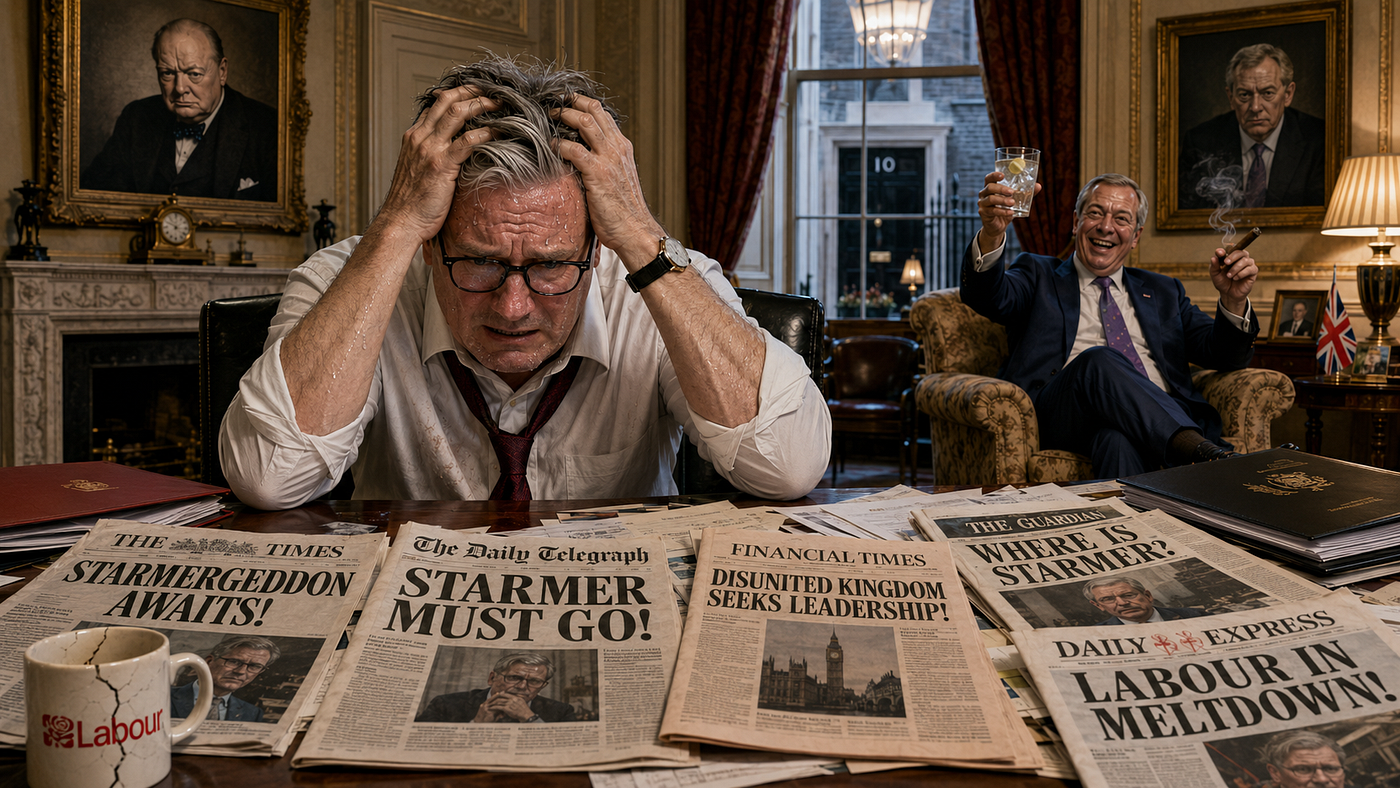
For much of his rise to power, Keir Starmer cultivated the image of a disciplined technocrat: cautious, forensic and difficult to rattle. Yet Westminster now finds itself gripped by a question that would have seemed implausible only months ago — whether the Prime Minister can survive his own party long enough to fight another general election.
What began as muttering among anxious backbenchers after Labour’s bruising local election results has evolved into something more dangerous: an organised loss of confidence inside government itself. The resignation of senior ministers, combined with the rapid emergence of rival power centres, has transformed discontent into a struggle over succession.
The mood inside Labour is no longer merely anxious. It is febrile.
A Government Losing Its Grip
The decisive moment came when Wes Streeting departed the Cabinet, abandoning collective responsibility and stripping Downing Street of one of its most prominent reformist voices. His resignation carried significance beyond the loss of a Health Secretary. It signalled that criticism of the Prime Minister had crossed from the fringes of the parliamentary party into the upper ranks of government.
Streeting stopped short of launching an immediate leadership campaign. Instead, he called for a broad contest over Labour’s future direction — language interpreted by many Westminster observers as the opening move in a wider battle over the party’s identity.
That intervention altered the political arithmetic overnight. Junior ministers can resign without imperilling a prime minister. Senior Cabinet figures rarely do so unless they sense the balance of power shifting.
Around Westminster, MPs who had privately harboured doubts about Starmer’s leadership suddenly began speaking more openly about succession.
Labour’s Electoral Shock
The origins of the revolt lie in Labour’s disastrous performance in May’s local and devolved elections. The results shattered the assumption that the governing party retained a durable electoral coalition after its landslide victory in 2024.
Instead, Labour suffered losses across England and Wales, haemorrhaging support in both traditional working-class areas and among progressive urban voters. The defeats exposed fractures on multiple fronts at once.
On the Right, Nigel Farage and Reform UK capitalised on frustration over immigration, economic stagnation and living standards. Reform’s gains in council seats alarmed Labour strategists because they suggested the insurgent party was no longer merely damaging the Conservatives; it was beginning to penetrate Labour territory directly.
Meanwhile, on the Left, voters drifted towards nationalist and Green parties in Scotland, Wales and metropolitan constituencies. Labour’s broad church increasingly resembles an uneasy coalition held together by little more than fear of electoral collapse.
For many MPs, the local elections confirmed a suspicion that had been quietly spreading for months: Starmer may have won office, but he has not persuaded the country of what his government stands for.
Rivals Begin to Circle
As the Prime Minister weakened, potential successors wasted little time positioning themselves.
Andy Burnham, long regarded as a possible future leader, appears to have found a route back into Westminster after an ally offered to vacate a parliamentary seat. A by-election would still be fraught — particularly with Reform expected to campaign aggressively — but Burnham’s possible return has sharpened speculation about a post-Starmer era.
At the same time, Angela Rayner emerged from a politically awkward investigation into her tax affairs with her position intact, removing a major impediment to any future leadership ambitions.
Neither figure has formally declared against Starmer. Neither needs to. In Westminster, leadership contests often begin long before candidates announce themselves.
The deeper problem for the Prime Minister is that Labour’s internal factions — soft Left, trade unionists, metropolitan moderates and northern populists — increasingly agree on only one point: that the present arrangement may no longer be sustainable.
The Numbers No Longer Favour Him
Downing Street insists that Starmer retains the backing of most Labour MPs. Technically, that remains true. Politically, it may no longer matter.
The number of MPs publicly urging the Prime Minister to resign or announce a timetable for departure has reportedly climbed well beyond the threshold required to trigger a formal leadership contest. Estimates vary, but the rebellion now appears substantial enough to sustain a prolonged challenge even if it lacks a single unifying candidate.
That distinction is crucial.
British political history shows that prime ministers are rarely removed solely because the numbers turn against them. They fall when authority evaporates — when colleagues, donors and officials conclude that power is already draining away.
Starmer increasingly faces that danger.
Every resignation fuels speculation about the next. Every hesitant media appearance invites fresh scrutiny. Every policy announcement is interpreted less as governing strategy than as manoeuvring for survival.
Scotland Re-emerges as a Fault Line
Compounding Labour’s troubles is the renewed constitutional question north of the border.
John Swinney has revived calls for another Scottish independence referendum, arguing that a future nationalist mandate would justify reopening the constitutional battle with Westminster.
Under existing legal arrangements, Holyrood cannot unilaterally authorise such a vote. Yet politics rarely obeys neat constitutional boundaries. Should Labour continue to weaken in Scotland, the SNP could plausibly argue that Westminster itself is entering another prolonged period of instability.
For Starmer, this creates a dual-front crisis: he must contain rebellion within his own party while simultaneously defending the integrity of the Union.
Neither task appears especially manageable at present.
The Prime Minister’s Narrow Options
The Prime Minister now confronts three possible paths.
The first is survival through force of will: reshuffling the Cabinet, reasserting discipline and persuading Labour MPs that the worst has passed. This remains the official Downing Street strategy.
The second is a formal leadership challenge, should rival factions coalesce around a single candidate capable of securing nominations and unifying the anti-Starmer bloc.
The third — increasingly discussed privately in Westminster — is a managed transition. Under such a scenario, Starmer would remain temporarily while agreeing to step aside before the next general election, allowing Labour to avoid an outright civil war.
At present, the third option appears the most plausible compromise between a wounded leader and a nervous parliamentary party.
A Premiership Entering the Danger Zone
The deeper significance of the crisis extends beyond Labour’s internal manoeuvring. It speaks to a broader instability now running through British politics.
Sir Keir entered Downing Street promising competence, sobriety and national renewal after years of Conservative turbulence. Yet less than two years later, his government risks appearing paralysed by the very instability it pledged to end.
That does not necessarily mean his premiership is doomed. British politics has repeatedly shown that leaders can recover from moments of acute weakness. But recovery requires clarity of purpose, political agility and visible authority — qualities critics increasingly argue are absent at the centre of this government.
For now, Starmer remains in office. But in Westminster, survival and strength are not the same thing.
The conversation has already shifted. The question is no longer whether Labour has entered a succession struggle, but how long the Prime Minister can contain it before events overtake him.
Saurav Dutt is an Author and Global Affairs Commentator. He is the Author of the forthcoming book To Reform a Nation: The Rise and Rise of Reform UK.
메타데이터
- post_id
- 0f71c5483c9e
- slug
- starmers-authority-unravels-as-labour-turns-inward-0f71c5483c9e
- url
- https://medium.com/@sauravdutt/starmers-authority-unravels-as-labour-turns-inward-0f71c5483c9e
- canonical_url
- https://medium.com/@sauravdutt/starmers-authority-unravels-as-labour-turns-inward-0f71c5483c9e
- author_url
- https://medium.com/@sauravdutt
- status
- ok
- fetched_at
- 2026-06-21 07:44:09