What Are the Biggest Challenges Facing the Global Fintech Market?
The fintech market has experienced rapid growth over the past decade, reshaping the financial industry with innovation, accessibility, and…
What Are the Biggest Challenges Facing the Global Fintech Market?
The **fintech market** has experienced rapid growth over the past decade, reshaping the financial industry with innovation, accessibility, and customer-centric services. Fintech companies have revolutionized the way individuals and businesses manage money, from digital payments to blockchain-based platforms. However, despite the promising outlook, the global fintech sector continues to face significant challenges. These hurdles impact scalability, compliance, and customer trust, making it essential to address them for sustainable growth. Below are some of the biggest challenges facing the fintech industry worldwide.
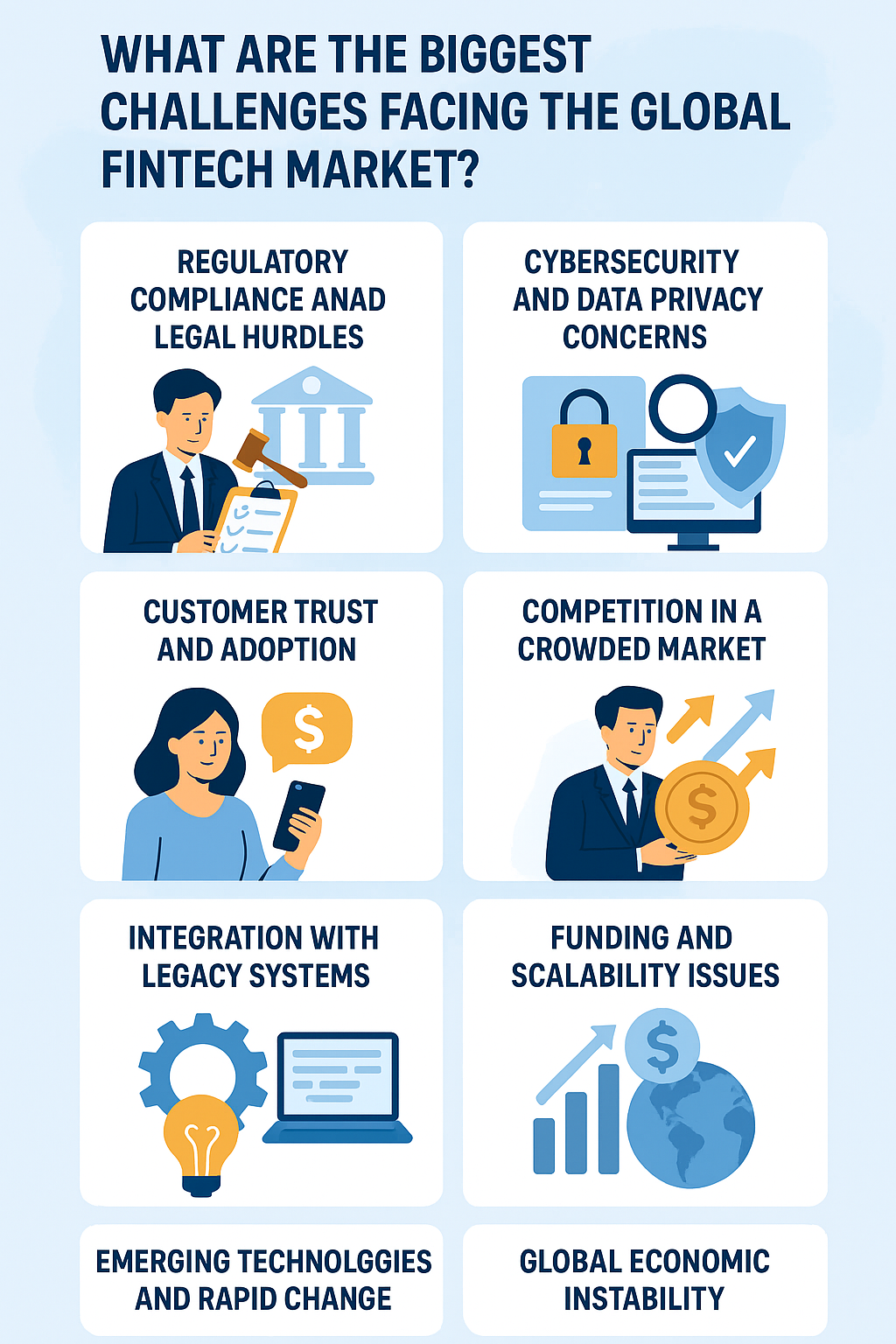
1. Regulatory Compliance and Legal Hurdles
One of the primary obstacles for the fintech market is navigating complex regulations across different countries. Financial services are heavily regulated, and governments often impose strict requirements to prevent fraud, money laundering, and security breaches. The challenge arises because fintech companies operate in a global environment where regulations vary widely.
For instance, a digital lending platform may comply with local laws in one country but face restrictions when expanding internationally. Constantly adapting to evolving regulations requires time, financial resources, and specialized expertise. Startups and even established firms must invest heavily in legal frameworks to ensure compliance, which can hinder innovation.
2. Cybersecurity and Data Privacy Concerns
As fintech services rely heavily on technology, cybersecurity becomes a major challenge. Hackers continuously target digital financial systems to steal sensitive customer data, disrupt transactions, or conduct fraudulent activities. Since fintech companies process massive amounts of financial and personal information, even a small data breach can lead to loss of trust and significant financial penalties.
Furthermore, strict data protection laws like GDPR in Europe and similar frameworks in other regions add another layer of complexity. Companies must balance innovation with safeguarding customer information while ensuring compliance with global data privacy standards. This challenge directly impacts how fintech software is developed, as it must integrate advanced security protocols without compromising user experience.
3. Customer Trust and Adoption
While fintech solutions offer convenience and efficiency, building customer trust remains an ongoing battle. Many consumers still prefer traditional banks due to the perception of safety and reliability. Gaining widespread adoption requires fintech firms to prove that their platforms are secure, transparent, and dependable.
Additionally, financial literacy plays a role in customer adoption. Not all consumers understand how digital wallets, peer-to-peer lending, or blockchain transactions work. If users perceive fintech platforms as complicated or risky, adoption slows down. To overcome this, companies must focus on education, transparency, and customer support to foster long-term trust.
4. Competition in a Crowded Market
The fintech market is highly competitive, with thousands of startups and established firms offering similar services. Payments, lending, insurance technology, and blockchain-based solutions are some of the most crowded areas. Standing out in this competitive landscape requires not just innovation but also strong branding, effective marketing, and customer-centric strategies.
Moreover, competition often leads to price wars, which can reduce profitability. Companies are forced to constantly innovate while keeping services affordable. This situation puts immense pressure on both new entrants and established players to sustain growth and maintain customer loyalty.
5. Integration with Legacy Systems
Many financial institutions still rely on legacy banking systems that are outdated but deeply embedded in their operations. For fintech companies, integrating their advanced solutions with these old systems is a complex challenge. Without seamless integration, fintech adoption within traditional financial ecosystems becomes limited.
This challenge is particularly relevant for areas such as cross-border payments, insurance, and credit scoring, where collaboration with banks and regulators is necessary. If fintech solutions fail to integrate smoothly, it can hinder scalability and delay innovation in the sector.
6. Funding and Scalability Issues
Although the fintech industry attracts significant investor interest, raising consistent funding remains a challenge. Market volatility, global economic uncertainty, and stricter investor scrutiny make it difficult for startups to secure long-term financial backing. Additionally, scaling operations across international markets requires heavy capital investment, which not all firms can sustain.
Another issue is balancing innovation with operational costs. Developing advanced **fintech software** that meets customer expectations and regulatory standards is resource-intensive. Smaller companies often struggle to scale while maintaining service quality and profitability.
7. Emerging Technologies and Rapid Change
The fintech industry thrives on technology, but keeping pace with rapid advancements can be overwhelming. Artificial intelligence, blockchain, machine learning, and open banking are transforming how fintech operates. While these technologies create opportunities, they also introduce risks and uncertainties.
For example, blockchain promises transparency and decentralization, but its regulatory acceptance varies across regions. Similarly, AI-based credit scoring systems must address concerns of bias and fairness. Companies that fail to adapt quickly may lose relevance in the ever-evolving fintech ecosystem.
8. Global Economic Instability
Economic downturns, inflation, and geopolitical conflicts directly affect the fintech market. During uncertain times, investors may reduce funding, consumers may limit digital transactions, and regulators may impose stricter measures. Global instability also impacts cross-border operations, making it harder for **fintech firms** to maintain growth momentum.
Conclusion
The global fintech market offers immense potential, but it also faces serious challenges. Regulatory complexities, cybersecurity risks, customer adoption barriers, intense competition, and scalability issues continue to shape the industry. To succeed, fintech companies must strike a balance between innovation, compliance, and customer trust.
Organizations like Xettle Technologies are working toward creating secure, user-friendly, and scalable solutions that address these concerns while driving the industry forward. By tackling these challenges head-on, the fintech sector can continue to evolve and play a transformative role in the global financial landscape.
메타데이터
- post_id
- 0f7ea449ef4a
- slug
- what-are-the-biggest-challenges-facing-the-global-fintech-market-0f7ea449ef4a
- url
- https://medium.com/@xettletechnologies/what-are-the-biggest-challenges-facing-the-global-fintech-market-0f7ea449ef4a
- canonical_url
- https://medium.com/@xettletechnologies/what-are-the-biggest-challenges-facing-the-global-fintech-market-0f7ea449ef4a
- author_url
- https://medium.com/@xettletechnologies
- status
- ok
- fetched_at
- 2026-07-30 06:14:30