QA Is Not Dead. It Just Got Promoted
There is a seductive narrative circulating in tech right now: AI will replace QA engineers. Automated test generation, self-healing…
QA Is Not Dead. It Just Got Promoted
There is a seductive narrative circulating in tech right now: AI will replace QA engineers. Automated test generation, self-healing scripts, agentic coding — surely the tester is obsolete?
The research says the opposite. The evidence — drawn from peer-reviewed papers, industry surveys, and large-scale empirical studies — points to a single, uncomfortable conclusion:
QA has never been more important, more complex, or more strategically valuable than it is right now.
Let me show you why.
The Vibe Coding Paradox: Fast Code, Fragile Systems
“Vibe coding” is a term coined in 2025 to describe a development style where programmers rely on AI assistants through intuition and trial-and-error, often without fully understanding the generated code. It is now everywhere.
A systematic grey literature review of 101 practitioner sources (Fawzy et al., arXiv:2510.00328) found a disturbing pattern: QA practices are frequently overlooked in vibe-coded projects. Most practitioners skip testing, delegate quality checks back to the AI, or simply accept model outputs without modification.
The result? A new class of vulnerable software developers — people who build a product but cannot debug it when issues arise.
Industry data reinforces this. According to GitLab’s 2026 research, 73% of respondents are concerned about the maintainability of AI-generated code, and 82% say it risks creating a new form of technical debt their organizations are not yet prepared to manage.
The Error Propagation Problem: When AI Tests Its Own Code
Here is where things get truly concerning from a scientific standpoint.
A 2026 empirical study by Konstantinou et al. (arXiv:2607.05139) introduced and validated the phenomenon of error propagation in LLM-based development. When an LLM generates faulty code and then generates tests for that same code, the faults are systematically replicated in the tests. The tests and the code become mutually consistent, masking defects rather than revealing them.
The numbers: generating tests after faulty code reduces fault detection effectiveness from 25% to just 14% compared to generating tests independently.
This is not a minor technical nuance. It is a fundamental challenge to the reliability of any workflow where the same AI system produces both the code and its verification.
A separate paper from Meta’s research team (Harman, O’Hearn & Sengupta, arXiv:2504.16472, FSE 2025 keynote) formalizes this distinction between “hardening” tests (protecting against future regressions) and “catching” tests (detecting faults just-in-time before they reach production). Their work highlights that LLM-generated tests often harden but fail to catch — they freeze current behavior without questioning its correctness.
AI-Generated Code Looks Correct. It Often Isn’t.
A quantitative analysis of 4,442 Java coding assignments (Sabra et al., arXiv:2508.14727) evaluated code produced by five prominent LLMs through SonarQube static analysis. The findings:
- All models introduced bugs, security vulnerabilities, and code smells
- Critically severe issues — hard-coded passwords, path traversal vulnerabilities — appeared across multiple models
- There is no correlation between a model’s pass rate on functional tests and the quality/security of its code
Read that last point again. A model can ace unit tests and still ship insecure, unmaintainable code. Functional correctness is necessary but wildly insufficient.
The VibeContract paper (Wang, arXiv:2603.15691) puts it bluntly: “AI-generated code can appear correct but often contains hidden logical errors and inconsistencies.”
The Recursive Collapse: AI Reviewing AI
Song et al. (arXiv:2606.28438) studied what happens when AI-generated code enters repositories, becomes training data, and creates a self-training loop. Their finding: AI self-review degenerates into a “rubber-stamp regime” where acceptance scores rise while actual benchmark correctness falls.
Human-independent verification — traditional QA, static analysis, formal methods — is not optional. It is the only thing preventing recursive quality degradation.
A large-scale empirical analysis of 278,790 code review conversations (Zhong et al., arXiv:2603.15911) found that AI agent suggestions are adopted at significantly lower rates than human reviewer suggestions. Over half of unadopted AI suggestions are either incorrect or addressed through alternative fixes by developers. When adopted, AI suggestions produce significantly larger increases in code complexity.
The New QA: From Test Executor to Quality Architect
So what does QA look like in this landscape?
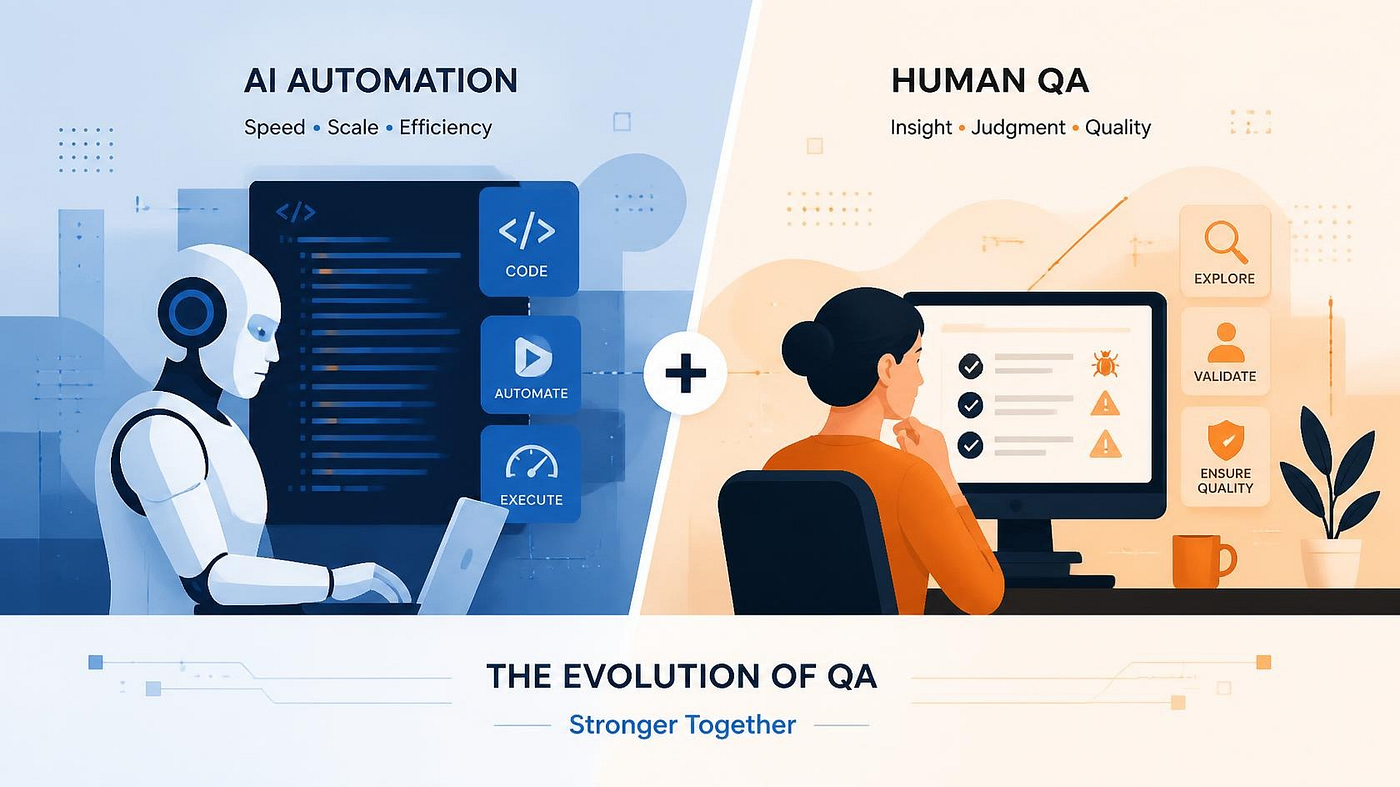
The evidence converges on a fundamental role shift. According to EPAM’s research on agentic QA, quality experts now think strategically about risk, offer expertise on business and technology alignment, and guide the behavioral tuning of intelligent test agents.
The work of Lahiri (arXiv:2603.17150) on intent formalization defines the core challenge: translating informal user intent into checkable formal specifications. This is fundamentally a human cognitive task — understanding what the system should do — and it sits squarely in the QA domain.
Azanza et al. (arXiv:2504.18985) propose a continuous evaluation framework for LLM-generated tests in industrial environments, integrating metrics for both technical adequacy (coverage, mutation scores) and practical considerations (maintainability, expert assessment). Their longitudinal study demonstrates that LLM capabilities evolve rapidly, requiring constant reassessment — exactly the kind of vigilant, adaptive oversight that defines modern QA.
The Skills That Matter Now
Based on this body of research, the QA professional of 2025–2026 and beyond needs:
Specification engineering — The ability to translate ambiguous requirements into precise, verifiable contracts. As AfterVibe (Paltenghi & Chandra, arXiv:2607.09900) argues, specifications — not code — may become the primary artifact for human review.
AI supervision and validation — Understanding when LLMs hallucinate, when tests are cosmetic rather than meaningful, and when code “works” but is insecure or unmaintainable.
Risk-based thinking — Deciding where to trust automation and where human judgment is non-negotiable. Safety-critical, data-intensive, and production-grade code demands different validation levels than prototypes.
Continuous verification design — Building systems that detect quality degradation over time, not just at a single checkpoint.
The Bottom Line
The data is unambiguous. Generative AI accelerates code production but does not — and cannot, by itself — guarantee quality. Every acceleration in code generation creates a proportional need for intelligent, human-driven verification.
QA professionals are not being replaced. They are being elevated from execution roles to strategic roles. The question is no longer “did the tests pass?” but “are we asking the right questions of the right code, at the right time, with the right level of confidence?”
That is a harder job. And a far more important one.
References
- Fawzy, A., Tahir, A., & Blincoe, K. (2025). “Vibe Coding in Practice: Motivations, Challenges, and a Future Outlook.” arXiv:2510.00328
- Konstantinou, M., Tambon, F., & Papadakis, M. (2026). “On the risk of coding before testing.” arXiv:2607.05139
- Harman, M., O’Hearn, P., & Sengupta, S. (2025). “Harden and Catch for Just-in-Time Assured LLM-Based Software Testing.” arXiv:2504.16472
- Sabra, A., Schmitt, O., & Tyler, J. (2025). “Assessing the Quality and Security of AI-Generated Code.” arXiv:2508.14727
- Song, X., Cai, Z., & Zhao, L. (2026). “When AI Reviews Its Own Code: Recursive Self-Training Collapse.” arXiv:2606.28438
- Wang, S. (2026). “VibeContract: The Missing Quality Assurance Piece in Vibe Coding.” arXiv:2603.15691
- Lahiri, S. K. (2026). “Intent Formalization: A Grand Challenge for Reliable Coding in the Age of AI Agents.” arXiv:2603.17150
- Zhong, S. et al. (2026). “Human-AI Synergy in Agentic Code Review.” arXiv:2603.15911
- Paltenghi, M. & Chandra, S. (2026). “AfterVibe: What Remains When the Conversation Ends.” arXiv:2607.09900
- Azanza, M. et al. (2025). “Tracking the Moving Target: Continuous Evaluation of LLM Test Generation in Industry.” arXiv:2504.18985
- Mathews, N. S. & Nagappan, M. (2024). “Design choices made by LLM-based test generators prevent them from finding bugs.” arXiv:2412.14137
- Bekmyradov, V. et al. (2026). “LLMs taking shortcuts in test generation.” arXiv:2604.14437
- GitLab. (2026). “Organizations Are Generating AI Code Faster Than They Can Control It.” [Press Release]
- Aleti, A. (2023). “Software Testing of Generative AI Systems: Challenges and Opportunities.” arXiv:2309.03554
메타데이터
- post_id
- 0f8bafeccb75
- slug
- qa-is-not-dead-it-just-got-promoted-0f8bafeccb75
- url
- https://medium.com/@jpfcabral/qa-is-not-dead-it-just-got-promoted-0f8bafeccb75
- canonical_url
- https://medium.com/@jpfcabral/qa-is-not-dead-it-just-got-promoted-0f8bafeccb75
- author_url
- https://medium.com/@jpfcabral
- status
- ok
- fetched_at
- 2026-08-06 16:46:06