Goal Calculator vs. Goal Planner: Why the Difference Actually Matters (Mutual Funds — India)
Note: The app is for Indian Investors, however the idea is for all investors
Goal Calculator vs. Goal Planner: Why the Difference Actually Matters (Mutual Funds — India)
Note: The app is for Indian Investors, however the idea is for all investors
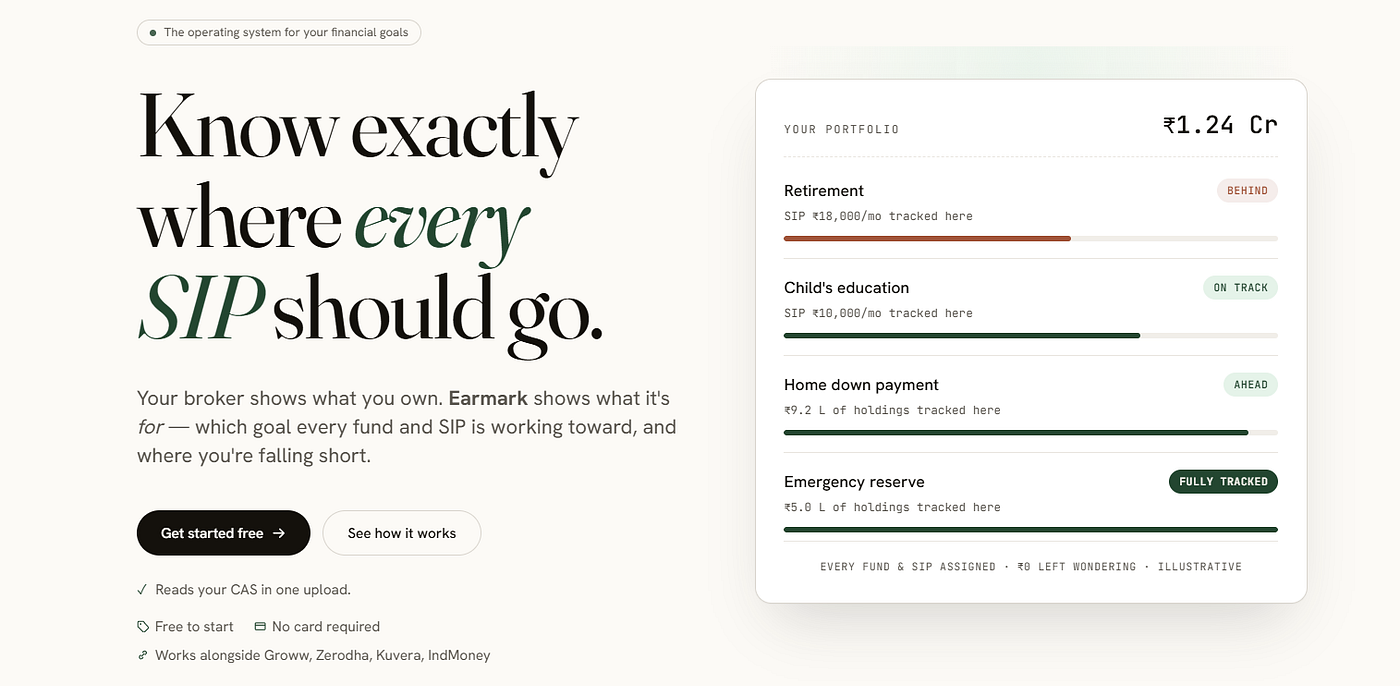
earmark.in
You want to know if you’re on track for retirement, so you open a retirement calculator, plug in your age, plug in a number you think is your current corpus, and get an answer: “You need ₹22,000/month.”
You do the same for your child’s education. Different calculator, different number: “₹15,000/month.”
Then your house down payment. “₹18,000/month.”
Add them up and you need ₹55,000/month in fresh SIPs — except you’re already investing ₹40,000/month, spread across nine mutual funds you bought over six years. Are those nine funds already counted in the three numbers above, or not? Which of them is actually retirement money, and which is house money?
The calculators can’t tell you. They were never built to.

Goal Gap Calculator
What a goal calculator actually does
A goal calculator — SIP calculator, goal-based SIP calculator, retirement calculator, whatever the flavor — answers one narrow, useful question: if I invest this much, for this long, at this assumed return, what do I end up with? Or the inverse: to reach this target, what SIP do I need?
That’s genuinely useful for a single what-if question. It’s fast, it’s free, and the math is solid.
But every input is something you typed in from memory. “Already invested toward this goal: ₹5L” — is that accurate? Is it the actual current value of specific funds, or a guess? And it evaluates exactly one goal in isolation. Run the same exercise for a second goal, and the calculator has no idea whether the ₹5L you just entered is the same ₹5L you entered for the first goal. Double-counting the same rupees against two different goals is not just possible with standalone calculators — it’s the default failure mode of using them one at a time.
A calculator is a snapshot of a hypothetical. It’s not maintained, it doesn’t know what you actually hold, and it can’t see your goals compete with each other for the same money.
What a goal planner does differently
A goal planner starts from a different place entirely: not numbers you type in, but the funds you actually hold.
It looks at your real portfolio — every fund, every folio — and maps each one to the specific goal it’s realistically serving, across all your goals at once, not one at a time. It applies real constraints while doing it: emergency money has to be liquid, a goal less than three years out can’t be sitting in volatile equity, a high-risk fund needs at least five years of runway to make sense. If a goal already has more than it needs, the surplus gets released back rather than silently overstating how “safe” that goal looks.
The output isn’t a single SIP number. It’s a live picture: which goals are funded, which are behind, which fund is doing double duty it shouldn’t be, and where every rupee you’re already investing is actually going.
That’s the difference. A calculator answers a question you ask it once. A planner keeps answering as your portfolio and your goals actually change.
The problem calculators structurally can’t solve
Here’s the real gap: most people don’t have one goal, they have four or five, and a finite pool of existing investments underneath all of them. The hard part was never “what SIP does retirement need in isolation” — it’s “which of my eleven mutual funds is actually retirement money, versus my kid’s education money, versus money that isn’t backing anything at all.”
No calculator can answer that, because it doesn’t know what you hold. It only knows what you type in.
Why this is exactly the problem Earmark solves
This is the specific gap Earmark exists to close. Upload your CAS — the consolidated statement that already lists every mutual fund you hold, regardless of which app you bought it through — and Earmark maps each fund to the goal it’s realistically funding. Not from numbers you re-enter every time, but from what’s actually sitting in your folios.
It shows you, honestly, what’s overfunded, what’s behind, and what isn’t tracked to anything yet. And it deliberately stops there — it won’t tell you to buy or sell a specific fund, because that’s a SEBI-regulated advisory activity, not a portfolio-mapping one. Think of it as the layer that tells you the truth about what you already have, not a broker and not an advisor.
If you’re only ever checking one goal at a time, a calculator is enough. The moment you have more than one goal and a portfolio built up over years, you need something that can see all of it together — that’s not a calculator problem anymore, it’s a planning problem. And it’s the one gap none of the calculators were ever designed to fill.
Check where your existing funds actually stand → https://earmark.in/

메타데이터
- post_id
- 0f9bb643ecd5
- slug
- goal-calculator-vs-goal-planner-why-the-difference-actually-matters-mutual-funds-india-0f9bb643ecd5
- url
- https://medium.com/@ritesh.kawadkar/goal-calculator-vs-goal-planner-why-the-difference-actually-matters-mutual-funds-india-0f9bb643ecd5
- canonical_url
- https://medium.com/@ritesh.kawadkar/goal-calculator-vs-goal-planner-why-the-difference-actually-matters-mutual-funds-india-0f9bb643ecd5
- author_url
- https://medium.com/@ritesh.kawadkar
- status
- ok
- fetched_at
- 2026-08-09 13:35:49



