Paying the “Hidden Ransom” for Freedom , Openness and Hype
Abstract:
Paying the “Hidden Ransom” for Freedom , Openness and Hype
Abstract:
From the perspective of 2026, the idealism of Open-RAN / O-RAN has been struck by the harsh reality of Massive MIMO performance barriers and complex integration costs. The experiments initiated by Deutsche Telekom at O-RAN Town were originally intended to dismantle vendor “walled gardens,” but they eventually morphed into a costly defensive transformation.
To gain negotiation leverage against traditional giants, operators have accepted an inverse growth in Total Cost of Ownership (TCO), compromised performance, and a weakened cybersecurity frontline. This so-called “openness” has evolved into a “controlled freedom” dominated by major vendors. Instead of the “Lego-style” mix-and-match they once pursued, the industry has ended up with a “full-course meal” that allows for a few external “side dishes” while keeping the core firmly closed.
Preface
The old article below provided a comprehensive summary of Deutsche Telekom’s (DT) O-RAN Town trials. It was written in May 2023, synthesizing insights from limited news materials and my own extensive industry experience, intended as a reference for colleagues and peers within the sector.
[embed]From DT’s O-RAN town, what they learned or gained, and what they missed? Jimmy CHOWmedium.com
During the same period, several mainstream operators, including Vodafone, were conducting similar Proof of Concept (PoC) verifications for Open RAN. Subsequently, in late December 2023, the largest Open RAN project to date was announced between Ericsson and AT&T.
But in the middle of 2025, Dish Network announced it would shut down its wireless network operations, which was the most important and model network of Open RAN in USA. In Aug. 2025, AT&T acquired the its 3.45GHz and 600MHz spectrum licenses marked the end of its long-standing ambition to be the fourth major mobile operator in the USA .
While small and medium-sized third-party “white-box” solution providers might have initially found cause for celebration, I personally found little reason to continue following a concept that my experience suggested was fundamentally flawed. However, upon reviewing recent reports And the AT&T project — which, though no longer “breaking news,” offer critical perspective — I felt it necessary to re-analyze the situation.
Why have these influential operators, who hold the most significant discourse power in the industry, embarked on a path that was destined to be fraught with difficulty and uncertainty from the outset? What have they gained, what have they lost, and what hard lessons has the entire industry learned?
This narrative reminds me of the global hype surrounding 5G before 2019. At that time, I cautioned that 5G was not yet mature and that its commercial viability would require at least another three to five years of observation and development. Indeed, several years later, we saw many CxOs of major multinational operators step down early due to the failure of 5G investments for huge financial lose. This serves as a reflection four years after that prediction: in any business model evaluation, technical maturity and a clear value proposition are both indispensable.
[embed]After the hustle and bustle, only reality remains Jimmy CHOWmedium.com
I.
A Validated Prophecy: From O-RAN Town to the “Integration Abyss”
Years ago, in my analysis of DT’s O-RAN Town, I argued that disaggregation brings not just vendor freedom, but a fragmentation of responsibility. Today, those concerns have become reality now they’re facing.
- The Vanishing Cost Advantage: While the industry initially claimed Open RAN could reduce costs by 30%, practice has shown that every penny saved on generic hardware has been diverted into an “integration tax” paid to third-party integrators or internal R&D teams.
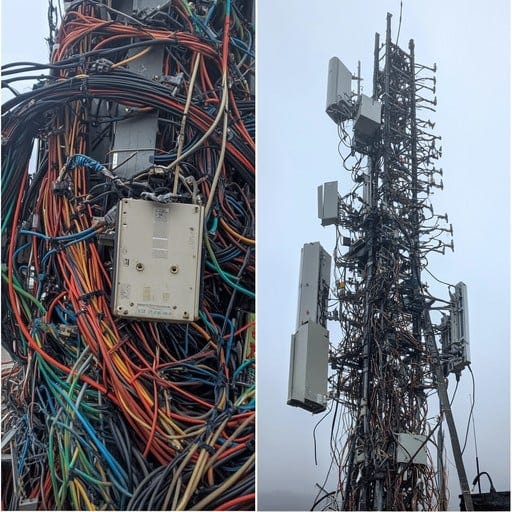
- The Burden of Integration: Previously, vendors like Huawei or Ericsson handled all tuning; now, purchasing software from Vendor A and hardware from Vendor B often leads to “finger-pointing” when issues arise, forcing operators to act as their own integrators at a high cost.
- Rising Complexity: The “Lego-style” simplicity was a myth; software patches from different vendors frequently conflict, driving system integration costs up by more than 20%.
- A “Second-Class” Performance: Despite O-RAN Town proving that multi-vendor interfaces (7–2x) can function, Cloud RAN based on general-purpose servers cannot compete with traditional ASIC chips in high-traffic urban centers or during complex 5G Massive MIMO processing.
- Spectral and Energy Inefficiency: This “openness for the sake of openness” has forced operators to accept a regression in their most vital asset: spectral efficiency. In handling 5G high-frequency and massive antenna arrays, open solutions consume 15% to 30% more energy than the “hard-soft integrated” proprietary chips from legacy vendors.
II.
AT&T and Ericsson: An “Anti-Diversity” Open Revolution?
In late 2023, AT&T announced a $14 billion contract with Ericsson. Ironically, the first move of this “Open RAN” deal was to displace Nokia and bet the entirety of the U.S. network on a single vendor: Ericsson. Ironically, even one year ago, Ericsson was still not clear or supportive on O-RAN.
- The Price of Negotiation Leverage: As depth-analyses from *Light Reading* point out, while AT&T defends its “open cloudiness,” it has essentially entered a new form of vendor lock-in. To gain leverage at the negotiating table, AT&T accepted massive short-term depreciation losses from equipment replacement and remains tethered to Ericsson as its sole “prime system integrator”.
- Financial Impact: This decision led to an additional depreciation charge of $0.17 per share in AT&T’s 2024 financial reports — a “real-money” payment for future leverage.
- Lessons Learned: True vendor diversity is extremely fragile in the face of large-scale commercial deployment. AT&T opted for a “pragmatic openness” where a core giant builds the underlying platform (EIAP), allowing niche vendors like Fujitsu to act as mere “add-ons”.
- Market Consolidation: Instead of fostering a wave of small startups, the market has been carved up by giants like Ericsson, Samsung, and Nokia. Under this “controlled openness,” it is questionable whether third-party niche vendors (such as Mavenir or Altiostar, etc.) can survive, let alone drive industry-wide innovation.
III.
Security and Risk: A Fragile Defense
The security risks I highlighted years ago have become a nightmare for operators in 2026.
- Exponential Expansion of the Attack Surface: Open interfaces (O1/O2/E2) expose previously closed base station signalling directly to standard IT protocols.
- A Broken Chain of Responsibility: In a multi-vendor environment, when network anomalies or penetrations occur, operators find themselves trapped in a “finger-pointing” mire between software, server, and hardware providers.
- Sacrificing Transparency: For a marginal psychological advantage at the bargaining table, operators have effectively sacrificed the security transparency of the network’s underlying layers.
IV.
2026 Progress: Is AI the Final Lifeline?
By the end of 2025, AT&T had completed approximately 40% of its site replacements and successfully achieved calls between Ericsson basebands and Fujitsu radios in a commercial network. However, the latest lesson is clear: Open RAN has been downgraded from a “cost-saving tool” to an “automation platform”.
The focus of competition has shifted from “open interfaces” to who can better achieve AI-driven energy savings through rApps and RIC (RAN Intelligent Controller). Operators are accepting high TCO and latent security risks simply to trade for a “programmable base” capable of running third-party AI plugins.
V.
Conclusion: A Costly “Strategic Investment”
Looking back at my analysis from several years ago when everyone were in hype, the core views remain valid: Open RAN is technologically idealized, security-wise fragile, economically extravagant, and naive in its business model and value proposition.
Operators like DT, AT&T, and Vodafone continue to push forward because they realize that without paying this “openness ransom,” they will forever lose the ability to upend the negotiating table. What they have gained is not a cheaper or more perfect network, but a procurement department with more bargaining power. For its customers, like me with a latest iPhone but enjoyed the coverage worse than 4G network.
As CFOs explain surging CAPEX/TCO to investors by citing industry-wide inflation, the strategic failures of security and decision-making are conveniently obscured. For the telecommunications industry, this may be the most expensive and helpless “adverse selection game” of the 5G era — where, ultimately, everyone loses.
Jimmy CHOW
Professional Bio / Collaboration Offer
Strategic Network Transformation & Integration Expert
I am currently open to new professional opportunities and consulting engagements.
If your organisation is navigating the complexities of multi-generation network integration (2G/3G/4G/5G) or managing the intricate network architectures and fragmented service platforms that arise from mergers and acquisitions (M&A), I offer the expertise to streamline your operations.
My focus is on driving operational efficiency and fostering competitive advantage by aligning current infrastructures with future-ready network evolution. Whether working independently or embedded within your existing team, I provide end-to-end support — from situational analysis and strategic roadmap design to hands-on implementation and seamless transition.
Let’s collaborate to transform your legacy complexities into a lean, agile, and future-proof digital foundation.
Feb. 26, 2026
메타데이터
- post_id
- 0fa481c2397d
- slug
- paying-the-hidden-ransom-for-freedom-openness-and-hype-0fa481c2397d
- url
- https://medium.com/@mountdavistechnologies/paying-the-hidden-ransom-for-freedom-openness-and-hype-0fa481c2397d
- canonical_url
- https://medium.com/@mountdavistechnologies/paying-the-hidden-ransom-for-freedom-openness-and-hype-0fa481c2397d
- author_url
- https://medium.com/@mountdavistechnologies
- status
- ok
- fetched_at
- 2026-06-23 03:48:11