Before We Teach Children to Build the Future, They Must First Understand the World They Are…
We often introduce children to STEM by starting with the tools.
Before We Teach Children to Build the Future, They Must First Understand the World They Are Building For
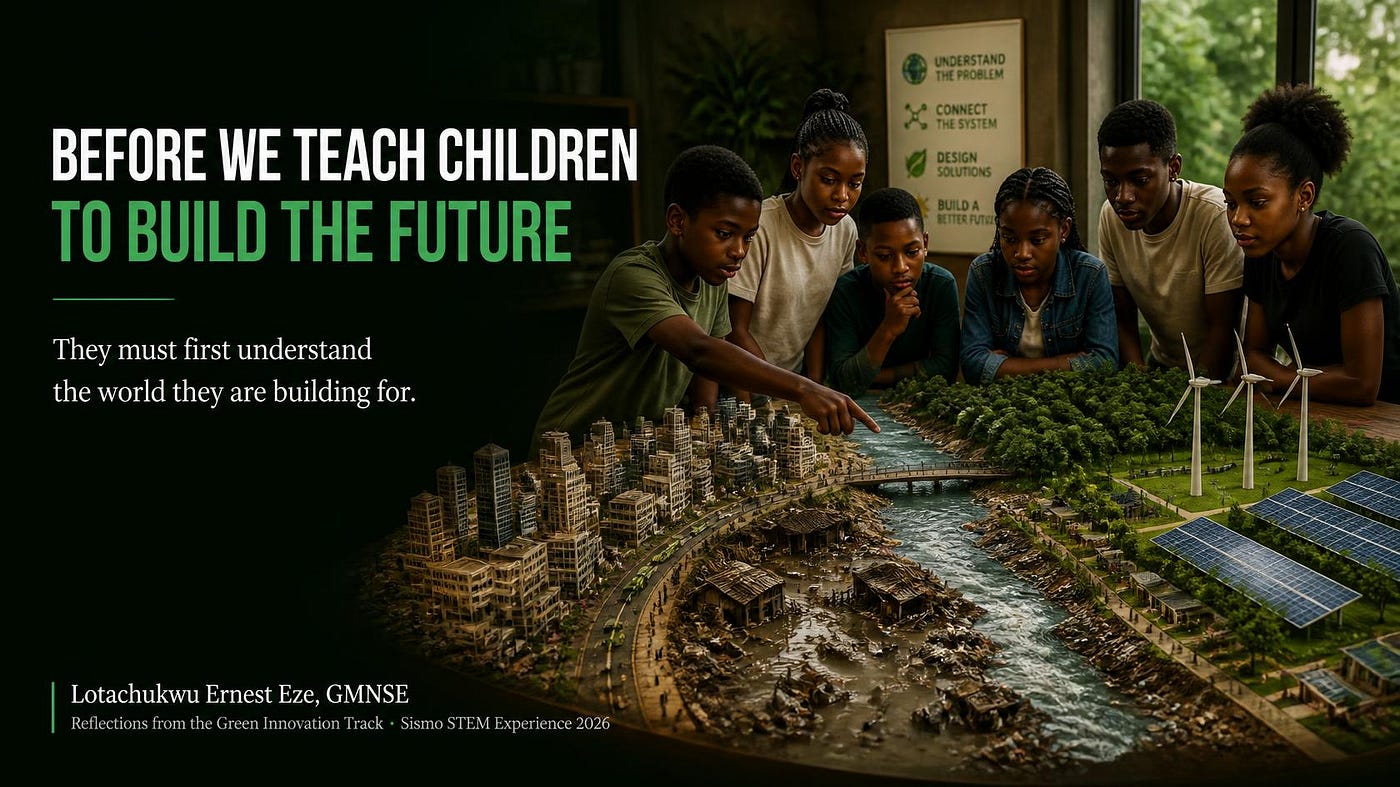
We often introduce children to STEM by starting with the tools.
We teach them to code.
We introduce robotics.
We teach mathematics.
We show them how to design.
These are valuable skills.
But there is a question that should come before all of them:
What problems are we preparing them to solve?
That question became the starting point of the Green Innovation Track at the Sismo STEM Experience 2026.
Our first session was not about building a robot, designing a website, or creating a beautiful environmental campaign.
It was about the world we live in.
And that was intentional.
The World Is the Classroom
We began with something incredibly ordinary: the weather.
Students joined the session from different countries and described what the weather looked and felt like where they were.
Hot. Sunny. Cloudy. Windy.
From there, the conversation grew much bigger.
What is the difference between weather and climate? Why are some places experiencing increasingly extreme heat? Why do some communities experience devastating floods? What happens when drains are blocked? Why are sea levels rising? What does cutting down forests have to do with climate? And what happens to the waste we throw away?
The objective wasn’t simply to give children definitions. It was to help them begin seeing connections.
Everything Connects
One of the most important ideas from the session was simple:
One action can set off a chain of consequences.
Human activities such as burning fossil fuels, cutting down forests, and producing waste contribute to rising greenhouse gas levels. More greenhouse gases mean more heat trapped in the atmosphere, contributing to global warming and long-term shifts in climate patterns. Those changes ultimately affect people, communities, and ecosystems.
Suddenly, climate change wasn’t an isolated chapter in a science textbook. It connected to transportation. Energy. Agriculture. Waste. Cities. Forests. Technology. Even something as ordinary as charging a device, switching on a light, travelling in a petrol-powered vehicle, or throwing something away became part of a much larger system.
But there was an important distinction we wanted the students to understand:
Awareness should not produce guilt. It should produce better thinking.
As we told them during the session, understanding our everyday choices helps us build better solutions — not feel guilty about them.
That distinction matters. Because the goal of sustainability education should not be to frighten children about the future. It should be to help them believe they can participate in shaping it.
From “What Is Happening?” to “What Can We Do?”
Then the questions began to change.
Instead of simply asking why is this happening?, we began asking: what can we do about it?
That is where STEM education becomes powerful.
A child who understands a waste problem can eventually ask how technology might improve waste collection. A child who understands fossil fuels can begin exploring renewable energy. A child who understands flooding can investigate drainage, urban planning, and resilient infrastructure. A child who understands environmental data can use mathematics to measure the problem. A child who understands the problem can use design and media to communicate it. A child who understands the system can eventually ask how AI, robotics, or software might improve it.
That is why Green Innovation became the foundation of the Sismo STEM Experience.
We didn’t want technology taught in isolation. We wanted children to understand why they might need to build technology in the first place.
The Questions Children Asked Mattered
Perhaps the most encouraging part of the session was listening to the students themselves.
Their reflections moved beyond repeating definitions. Students raised concerns about waste management in Nigeria, pollution and its effect on animals, unnecessary energy consumption, deforestation, rising temperatures, and renewable energy. One student even questioned the practical feasibility of implementing several sustainability solutions at national scale.
Those are important questions. Because innovation doesn’t always begin with an answer. Very often, it begins when someone looks at something everyone else has accepted and asks:
“Why does it have to remain this way?”
Our responsibility as educators is not always to immediately answer that question for a child. Sometimes, it is simply to make sure they don’t stop asking it.
This Is Why We Started With Green Innovation
The Green Track was never intended simply to produce young environmental scientists. Its purpose is broader: to develop environmentally conscious young innovators who understand environmental challenges and can begin thinking about solutions through STEM.
That philosophy flows into everything that comes afterward.
Mathematics helps them measure and analyse the problems.
Design and Media help them communicate those problems and inspire action.
Technology and Web Development give them tools for building platforms and digital solutions.
AI and Virtual Robotics allow them to explore how intelligent systems and automation might solve real environmental challenges.
But underneath all of those skills sits something more fundamental:
Understanding.
Because before we ask a child to design a solution, we should help them understand the problem. Before we ask them to innovate, we should teach them to observe. Before we ask them to build the future, we should help them understand the world they are building it for.
That was the real beginning of our STEM Experience.
Not coding. Not robotics. Not design.
A problem worth solving.
And perhaps that is where meaningful STEM education should always begin.
Learn Today. Lead Tomorrow.
Sismo Tutors: Learning with Purpose. Living with Impact.
메타데이터
- post_id
- 0fa5535005ad
- slug
- before-we-teach-children-to-build-the-future-they-must-first-understand-the-world-they-are-0fa5535005ad
- url
- https://medium.com/@sismotutors/before-we-teach-children-to-build-the-future-they-must-first-understand-the-world-they-are-0fa5535005ad
- canonical_url
- https://medium.com/@sismotutors/before-we-teach-children-to-build-the-future-they-must-first-understand-the-world-they-are-0fa5535005ad
- author_url
- https://medium.com/@sismotutors
- status
- ok
- fetched_at
- 2026-08-16 07:00:21



