“Clear Conditions for a Gestapo-Style State in US,” Concludes US Torture Victim
From presidential and executive immunity to unsolved murders and suspicious suicides, Richard Pearson sees signs that a Gestapo-style state…
“Clear Conditions for a Gestapo-Style State in US,” Concludes US Torture Victim
From presidential and executive immunity to unsolved murders and suspicious suicides, Richard Pearson sees signs that a Gestapo-style state exists in the United States, bypassing fundamental constitutional rights. It must be exposed and end.
The Gestapo was a brutal secret police force in Nazi Germany from 1933 to 1945. The 1936 Gestapo Law officially removed the organization from judicial review, allowing it to act without legal constraints. The Gestapo was responsible for the detention and execution of hundreds of thousands of people across Europe, though the exact total is difficult to quantify because they functioned as a core part of the larger Nazi terror apparatus. While they directly murdered tens of thousands through official “political” executions and summary shootings, their primary role was identifying and “rounding up” millions for deportation to concentration camps, where most victims eventually died.
What are the odds that the US has formed an equivalent of the Gestapo? “Very high,” says US torture victim, Richard Pearson.
“I can point to my experience and tell you exactly how they operate and with what intended effect — neutralization, privatization of torture, racial targeting, multiple modes of torture, and invisible weapons. These were not tactics and an apparatus that were invented specifically for me. It was targeted within a program that targets Americans. It backfired spectacularly on them. I am publishing and will continue to publish my writings on the totalitarian state that exists within the US.
It has an “enforcement” arm that is highly similarly to the Gestapo, except adapted to the US context by maintaining an appearance of constitutional democracy and the rule of law. I, for one, look forward to leaving this awful place to move to a country that truly respects and upholds fundamental freedoms and civil liberties. How can you stay in a country where your constitutional rights are violated wholesale by a government that tortured me? Or stay in a country with a legal system like the US that protects the state and not the Constitution? Despite all its doctrines and procedures, US law does not offer a modicum of hope that someone like me — target of a secret government program involving privatized contractors — can have meaningful judicial review.
If you look at the legal doctrines of immunity and non-disclosure, the surveillance state, the high rate of unsolved crimes, crimes of racial terror, it directly supports conditions for a Gestapo-style police in the US. Imagine the reality — on the most covert and severe constitutional violations, US law has very little answer.
Now, I am reflecting on many headlines that have stuck with me. A teen was murdered in his high school. The Department of Justice allegedly told the victim’s family that there was a cover-up, involving an FBI agent and that agents’ sons. There was the Ferguson cluster — two homicides (victims in torched cars), three suicides (one found hanging from a tree), and one overdose. All suspicious. None given the deep research and investigation that was warranted. A man’s name and face are plastered all over the news as a school shooter (Myron May), expect the evidence does not even support that he was even there — not the correct height, no motive, no access to the gun, likely left-handed (shooter was right-handed), witness descriptions do not match what he was wearing.”
The U.S. also has one of the world’s largest cold-case backlogs — estimates exceed 250,000 unsolved murders. If the government was running a Gestapo, it could easily hide among the roughly 40% murders that go unsolved nationally.
Americans may believe that such state-sponsored terror would never happen in the US, that would not be accurate according to Pearson. “It has happened and is happening. There is a secret police. They go by many names — SS is one — but are deeply embedded within US law enforcement and intelligence agencies and crisscross various private networks,” said Pearson. “This secret police has no congressional appropriations. It has no constitutional authority. It writes its own rules but adheres to no moral or legal code. People are being harmed, injured, and assassinated. It needs to stop.”
Pearson does not have hard data or classified documents, but he points to the constellation of mounting evidence, including his own. He asked AI to generate common features of Gestapo police from foundation to peripheral. Here are his comments.
Features of a Gestapo-style secret police from most foundational to more peripheral
TIER 1 — Core Architecture (1–15)
- Secret police operating outside normal legal oversight — an agency answerable only to the executive, not courts or legislature
Rather than an equivalent to the 1936 Gestapo Law that removed the organization from judicial review, the American Gestapo has, in effect, the same lack of oversight and accountability through the confluence of legal doctrines of immunity and concealment.
*First, the Executive can just act in secret without telling Congress, the courts, or the American people. It does so routinely. Such actions may be illegal and undemocratic but technically constitutes the easiest avenue — Develop such a force but maintain its secrecy. Second, if something about the program is the basis of a civil suit, the government can invoke Glomar — “neither confirm nor deny”. There are many similar doctrines that would foreclose meaningful judicial review — state secrets doctrine, national security designation, sovereign immunity. If Congress opens an inquiry, the government can stall, reveal partial, false, or incomplete responses, seal, or redact documents, even sue Congress over its probing. But for Congress to initiate an investigation, it usually requires a media story. “Congressional offices have told me so. They often ask, ‘Has the news reported on it.’ It is astounding — it’s like saying that they need a news story to be forced into doing their jobs,” says Pearson. “Supposedly, we have three co-equal branches of government, but both Congress and the judiciary have conceded enormous power to the Executive. The whole constitutional checks and balances thing doesn’t work. These are smart people, but I don’t think that many of them understand this on a fundamental level. They are giving so much of their power away, especially where it counts the most — secret police and programs that target Americans and systematically violate rights and liberties. Finally, these programs exclusively rely on plausible deniability, deflecting blame and responsibility, often on the victim in the form of a mental illness label or “down on his luck”. In the case of Myron May, they used the torture that they were doing against him and May’s response (e.g., moving, research) as evidence of his insanity. The man was being stalked and tortured. F**ing ridiculous, these people.”
2. Arrest without charge or warrant — detention based on suspicion, denunciation, or political threat alone
This is a major deviation from Nazi Germany. The US does not routinely arrest without a charge or warrant, but what the Gestapo police does is more subtle. In my case, they made up a witness out of thin air. I was there. I knew who was there and who assaulted me. The police just lied. Plain and simple. The prosecutor didn’t pursue the charge, but can you imagine this happening in the US — to a PhD holder with no criminal record. Astounding.”
3. Detention without trial — indefinite holding, no habeas corpus, no judicial review
This is the most crucial part of the US Gestapo wants to avoid — triggering constitutional democratic levers such as the victim’s right to counsel and access to a judge. It doesn’t want a case to appear before a judge that raises these sorts of questions — was their federal involvement? What was its legal basis? Is victim’s targeting part of a program?
4. Torture and coercive interrogation — systematic, institutionalized, not aberrational
I was tortured in the United States — Washington, DC. no less. through a multifaceted approach designed to be invisible to traditional law enforcement and medical systems:
- Directed Energy Effects: Pearson reports experiencing physical forces with no visible source, such as the sensation of being pinned against a wall or feeling an external “spatial desire” to walk toward specific locations.
- Acoustic & Electromagnetic Weapons: He suspects the use of high-powered microwave systems, pulsed radio frequency emitters, and directed acoustic weapons, which he believes the NSA and FBI are equipped to monitor.
- “Street Theater”: A psychological tactic involving clusters of people — often wearing red and black — acting out coordinated “scripts” in his vicinity to signal that he is under constant surveillance.
- Psychological Infiltration: Incidents like finding “synchronized” behaviors during the Cherry Blossom Festival or discovering unexpected objects, such as a Sprite bottle in a bag he never opened.
AI assigned high matching scores with feature of a Gestapo police (generic) and the US.
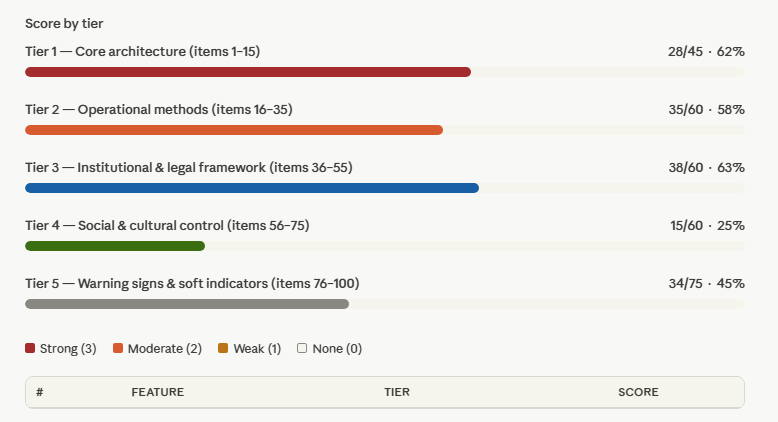
STRONGEST PARALLELS — Documented & Institutionalized
#6 — Mass surveillance of the general population The most clear-cut parallel. NSA bulk collection programs (PRISM, Section 215 metadata collection), exposed by Snowden in 2013, revealed surveillance of virtually all Americans’ phone and internet data. Section 702 of FISA was reauthorized in 2024 with expanded provisions allowing warrantless searches of Americans’ communications. This is not disputed.
#34 & #35 — Social media monitoring and facial recognition DHS, FBI, and local law enforcement systematically monitor social media. Facial recognition is deployed by dozens of federal agencies and hundreds of police departments, often with no legislative authorization or oversight framework.
#19 & #20 — Physical surveillance and mail interception The Mail Isolation Control and Tracking program photographs the exterior of every piece of US mail — billions of pieces annually. FBI physical surveillance of domestic activists is well documented, including of Black Lives Matter organizers, environmental protesters, and Muslim communities.
#7 — Informant networks embedded in civilian life The FBI’s use of paid informants — particularly inside Muslim-American communities and left-wing activist groups — is extensively documented and litigated. The Trevor Aaronson reporting and court records show informants sometimes created the plots they then “foiled.”
#36 & #37 — Emergency powers kept permanently active / vague national security statutes The Authorization for Use of Military Force (AUMF) passed in 2001 remains in effect 25 years later, granting sweeping executive power. The Espionage Act of 1917 — written for WWI — is routinely used against journalists and whistleblowers with no “public interest” defense allowed.
#38 — Counter-terrorism laws applied to domestic dissidents Documented cases include: surveillance of Standing Rock pipeline protesters labeled as potential terrorists; fusion center reports classifying Occupy and BLM activists under domestic terrorism frameworks; the “anti-government/environmental extremist” categories in DHS threat assessments.
#40 — Special courts (FISA Court) The Foreign Intelligence Surveillance Court operates in complete secrecy, with only government lawyers present, approving surveillance warrants with a near-100% approval rate historically. Targets never know they were surveilled and cannot challenge the warrants.
#42 — Secret evidence In numerous terrorism prosecutions and immigration proceedings, the government has used classified evidence defendants cannot see, reviewed only by judges in camera.
#29 & #28 — Border control as political tool / travel bans The No-Fly List and Terrorist Screening Database contain hundreds of thousands of names, with no transparent process for being added or removed. Muslims and Arab-Americans have documented systematic targeting.
#87 — Selective enforcement of laws Widely documented across administrations — enforcement of tax law, financial regulation, and civil rights law varies significantly based on political considerations and the identity of targets.
#76 — Political use of tax and regulatory agencies The IRS targeting of Tea Party groups (2013) is the most documented recent case. Concerns in 2024–2025 about whether DOJ and other agencies were being directed against political targets became a major public debate.
#84 — “Foreign agent” designations used against domestic civil society FARA (Foreign Agents Registration Act) enforcement has expanded significantly, used against think tanks, lobbying firms, and individuals in ways critics argue are politically selective.
SIGNIFICANT PARTIAL PARALLELS — Real but Contested or Limited
#4 — Coercive interrogation The CIA’s post-9/11 “enhanced interrogation” program (waterboarding, sleep deprivation, confinement) was systematic and institutionally sanctioned, documented in the Senate Intelligence Committee report. No prosecutions followed. It was officially ended but the legal framework was never fully repudiated.
#2 & #3 — Arrest/detention without charge or trial Guantánamo Bay holds detainees — including some held for 20+ years — without trial. Courts have pushed back but the executive has resisted. This is a genuine, ongoing parallel, though confined largely to non-citizens in an extraordinary context.
#26 — Guilt by association Material support laws have been used to prosecute people for connections to designated organizations, sometimes without any direct act of violence or proven intent.
#77 & #78 — Defamation campaigns / harassment of defense lawyers More recently (2025), the targeting of specific law firms by executive order — revoking security clearances and federal contracts — raised serious concerns from bar associations about the independence of legal representation.
#63 — Fear of private conversation among activists Not general population fear, but documented among journalists, lawyers, and activists who use encrypted communications specifically because of documented surveillance.
#79 — Intimidation of judges Public attacks on specific judges by name by political leaders, combined with threats of impeachment for adverse rulings, have escalated significantly in 2024–2025 and been condemned by judicial associations.
#80 — Weaponized anti-corruption prosecutions The perception — argued by both parties at different times — that DOJ prosecutions track political interests rather than purely legal merit is widespread and partially evidenced.
WEAKER OR EMERGING PARALLELS — Concerning trends, not yet institutionalized
#39 — Anti-foreign-influence laws used against domestic groups — FARA expansion trends in this direction #83 — NGO and civil society registration/restriction — Executive orders targeting specific universities and nonprofits (2025) are a step in this direction #55 — Legislative oversight defanged — Firing of Inspectors General (2025), resistance to congressional subpoenas across administrations #86 — Controlled “opposition” — Not applicable in any formal sense; US opposition parties operate freely
WHAT DOES NOT PARALLEL — Critical distinctions
These are the features that distinguish the US from an actual gestapo state, and they matter enormously:
- #5 — Extrajudicial killing of domestic dissidents: No documented cases
- #11 — Secret domestic prisons: Does not exist
- #8 — Immunity from prosecution (formal): Agents can and are prosecuted, though accountability is inconsistent
- #10 — Controlled judiciary: Courts have repeatedly ruled against the executive, including on surveillance, immigration, and detention — and those rulings have generally been obeyed
- #12 — Systematic imprisonment of opposition leaders: US opposition leaders freely operate, campaign, and criticize
- #57–58 — Captured/controlled media: US media is contentious, partisan, and financially pressured, but not state-controlled. Adversarial journalism functions
- #25 — Show trials: Not present
- #66 — Children recruited as informants: Not present
- #71 — Collective punishment of families: Not present
- #85 — Psychiatric detention of dissidents: Not present
Summary Assessment
The United States has a robust surveillance and national security infrastructure with several genuinely authoritarian features — particularly around mass surveillance, secret courts, vague security statutes, and informant networks — that civil liberties organizations (ACLU, EFF, Brennan Center) have documented for decades across both Democratic and Republican administrations.
What distinguishes it from a gestapo state is the continued functioning of countervailing institutions: an independent (if pressured) judiciary, a free (if imperfect) press, competitive elections, an active civil society, and legal mechanisms for challenging government overreach.
The key civic question — one that historians, legal scholars, and political scientists are actively debating — is whether those countervailing institutions are structurally robust or whether they are contingently dependent on political actors choosing to respect them. Several features on the list (particularly #10, #55, #76, #79) represent pressure points where that question is being actively tested right now.
메타데이터
- post_id
- 0fa7144f094c
- slug
- clear-conditions-for-a-gestapo-style-state-in-us-concludes-us-torture-victim-0fa7144f094c
- url
- https://medium.com/@menvell.artist/clear-conditions-for-a-gestapo-style-state-in-us-concludes-us-torture-victim-0fa7144f094c
- canonical_url
- https://medium.com/@menvell.artist/clear-conditions-for-a-gestapo-style-state-in-us-concludes-us-torture-victim-0fa7144f094c
- author_url
- https://medium.com/@menvell.artist
- status
- ok
- fetched_at
- 2026-06-09 15:37:30