Why Whiteboard Practice Matters
The overlooked skill that turns system design knowledge into interview-ready confidence.
Why Whiteboard Practice Matters
The overlooked skill that turns system design knowledge into interview-ready confidence.

What This Blog Covers
- The gap reading leaves
- Drawing forces real clarity
- It mirrors the actual interview
- It builds communication skills
- Practicing in 2026’s tools
- Building a practice routine
Here is a test worth running on yourself: pick a system you feel you understand — a URL shortener, say, or a chat app — and, without looking anything up, draw the entire architecture and explain every arrow out loud.
Most people who thought they understood it discover, somewhere around the third component, that their understanding was fuzzier than it felt. That gap between “I get it” and “I can draw and defend it” is exactly the gap the whiteboard exposes, and closing it is what separates people who know about system design from people who are good at it.
This guide explains why whiteboard practice is the highest-leverage way to study system design, and how to do it well.
It is written for junior developers and fresh graduates preparing for interviews in 2026.
If you want structured problems to practice diagramming against, Grokking the System Design Interview walks through real systems with the kind of diagrams you should be able to reproduce yourself.
The Gap Between Knowing and Drawing
Reading and watching are comfortable because they let you nod along without ever being wrong.
You absorb an explanation, it makes sense, and you move on feeling like you have learned something. But that feeling is recognition, not ability — the intellectual equivalent of watching someone swim and assuming you could do it too.
Drawing a system yourself removes the illusion.
The moment you have to decide where the cache goes, how the data flows from the client to the database, and what happens when a write arrives, you find out precisely what you do and do not understand.
There is nowhere to hide behind vague phrasing. This is why the whiteboard is such a powerful learning tool: it converts passive familiarity into active, tested knowledge, and it does so faster than any amount of additional reading.
The building blocks you thought you understood only become real once you can place them on a board and connect them under your own reasoning — and if those blocks still feel shaky, Grokking System Design Fundamentals is the fastest way to make them solid enough to draw from memory.
Diagramming Forces Clarity
System design is inherently a visual discipline.
Architectures are made of components and the connections between them, and a diagram is the most honest representation of whether you actually understand those connections.
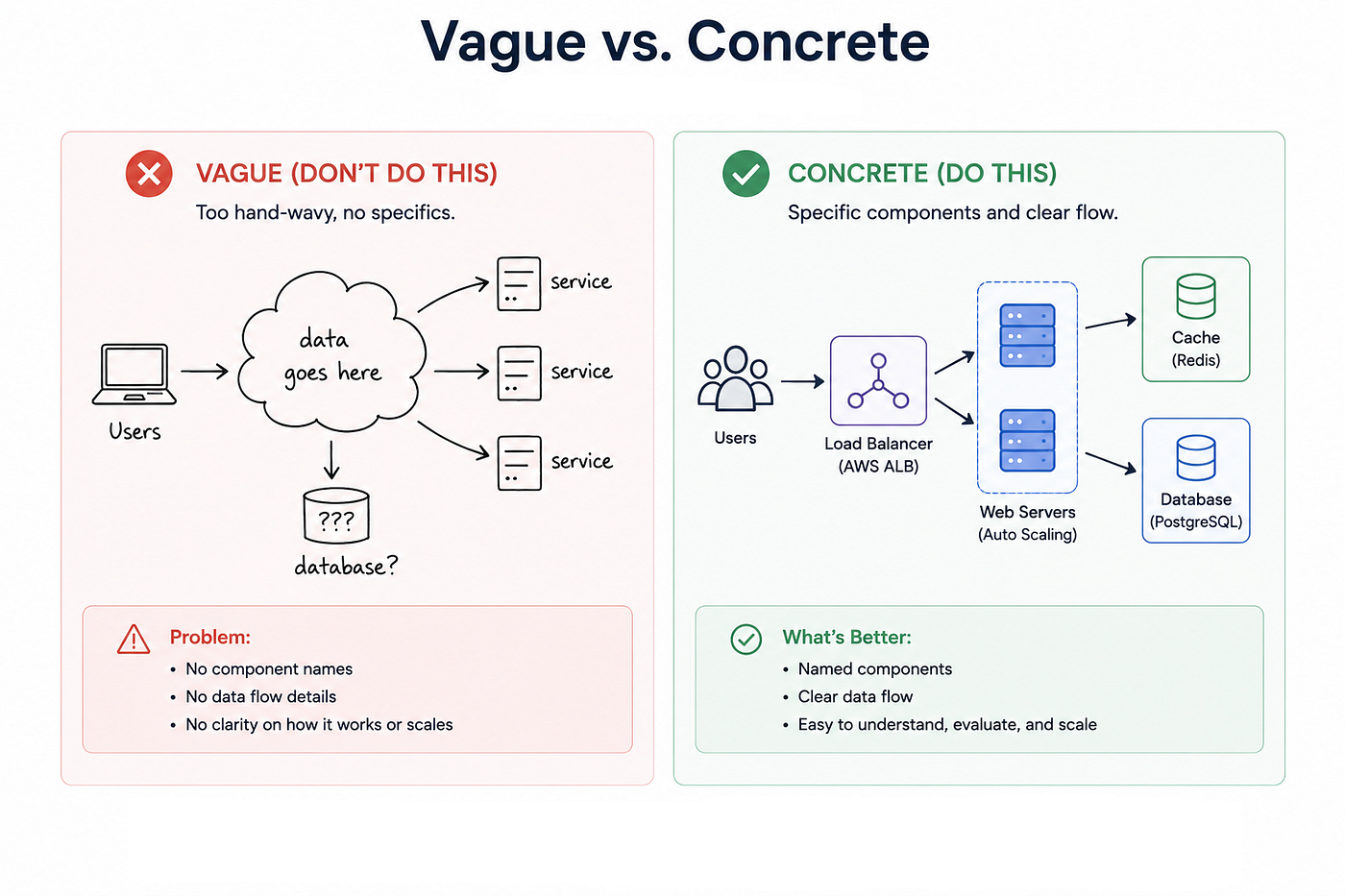
A vague diagram is a direct symptom of vague understanding.
When you draw, ambiguity has nowhere to go.
“The data gets stored somewhere” collapses into a real decision about which store, why, and how it is accessed. “It scales” becomes an actual load balancer in front of actual replicas.
The act of drawing forces you to make concrete every decision that reading let you gloss over.
This is also why drawing reveals the order of your thinking — a well-structured diagram reflects a well-structured mental model, and a chaotic one reveals gaps in how the pieces fit together.
Over time, the discipline of producing clean, legible diagrams trains you to think in clean, legible structures.
It’s How the Interview Actually Works
Beyond its value as a learning tool, whiteboarding is simply how the system design interview is conducted.
You will be asked to design a system by sketching it, whether on a physical whiteboard in person or, far more commonly in 2026, on a shared digital canvas during a remote interview.
If your only practice has been reading, the first time you ever draw a full architecture under time pressure will be during the highest-stakes moment — which is the worst possible place to discover that drawing is harder than reading.
There is a practical wrinkle worth taking seriously: because remote whiteboarding is now nearly universal, the specific tool matters.
Candidates who do best have practiced in the actual tool their loop uses, because fumbling with an unfamiliar interface in the first ninety seconds is a terrible way to begin.
Practicing on a whiteboard closes both gaps at once — it builds the design skill and the drawing-under-pressure skill together, so neither surprises you on the day.
This is the same reason mock interviews are so valuable: they put your whiteboarding under realistic conditions where the gaps show.
Working structured problems from Grokking the System Design Interview gives you a bank of real designs worth drawing and re-drawing under those conditions.
It Builds Communication and Visual Reasoning
A system design interview is as much a communication test as a technical one, and the whiteboard is your primary communication tool.
A clear diagram lets you walk an interviewer through your thinking, point to the component you are discussing, and keep everyone oriented as the design grows.
A muddled diagram loses the interviewer, and a lost interviewer cannot give you credit for reasoning they cannot follow.
Practicing on a whiteboard trains you to narrate and draw at the same time — to say “reads come in here, hit the cache, and fall through to the database on a miss” while your marker traces exactly that path. That combination of visual and verbal explanation is a skill in its own right, and it is precisely what interviewers evaluate.
It also transfers directly to real engineering work, where explaining a design to teammates on a shared diagram is a routine part of the job.
The habit you build practicing for interviews is the same habit that makes you effective in design discussions afterward.
It Exposes Gaps You Didn’t Know You Had
One of the most valuable things about whiteboard practice is that it surfaces the gaps you would never notice while reading.
You can read about consistent hashing ten times and feel comfortable, but the first time you try to draw how it distributes keys across nodes and rebalances when a node is added, you discover whether you truly understand it.
These discovered gaps are gifts. Each one is a precise, personalized study target — far more useful than a vague sense that you should “review distributed systems.”
A productive practice loop looks like this: attempt to draw a system, notice exactly where you got stuck or hand-wavy, study that specific gap, then re-draw. That cycle improves you faster than linear reading ever could, because it directs your effort at your actual weaknesses instead of the things you already know.
How to Practice on a Whiteboard Effectively
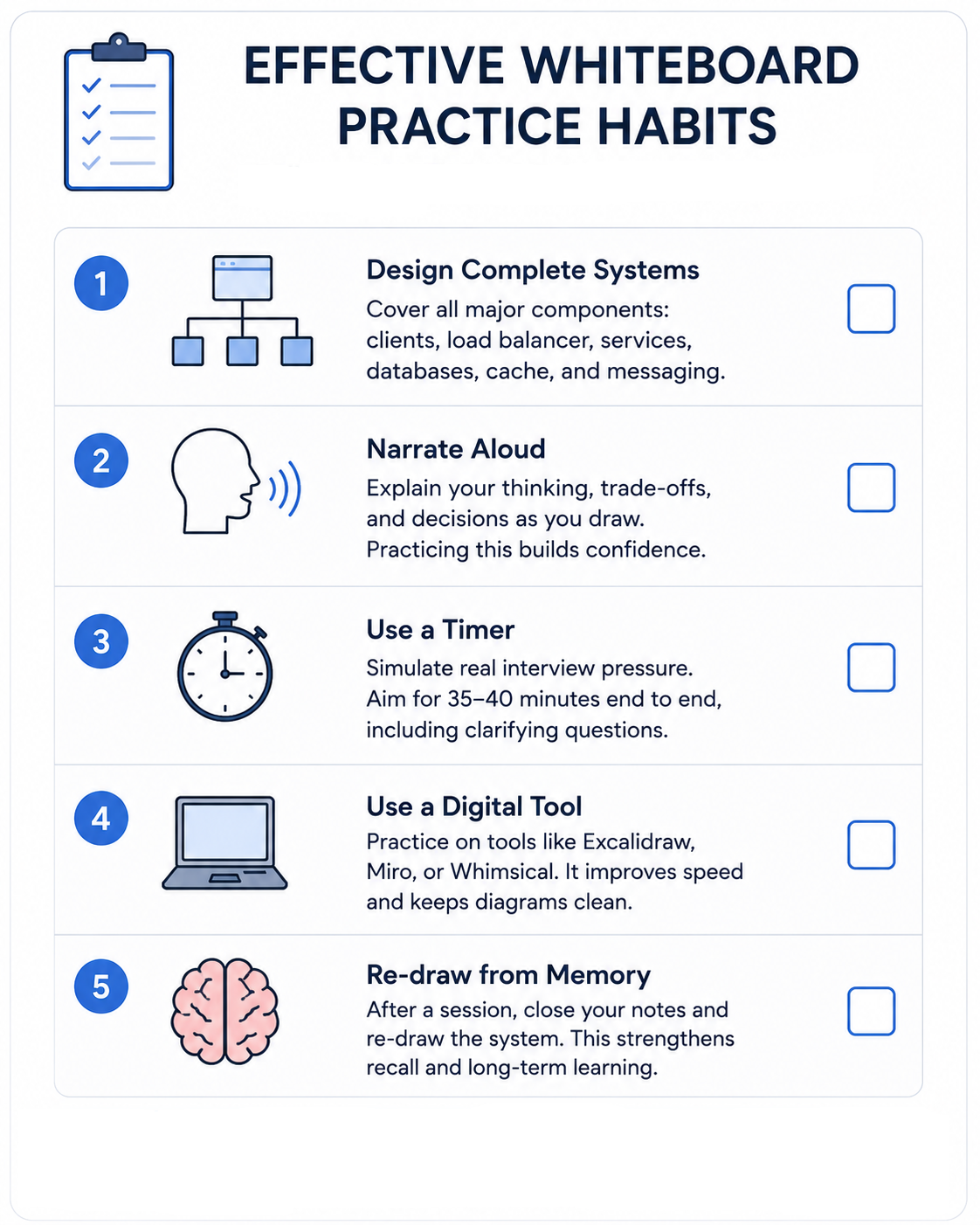
The tool can be anything — a physical whiteboard, a notebook, or a digital canvas — but a few habits make the practice genuinely effective:
- Draw complete systems, not fragments. Take a full problem — a news feed, a ride-sharing service, a ticket-booking system — and diagram it end to end, from client to storage, rather than practicing isolated components.
- Narrate out loud the entire time. Explain each component and connection as you draw it, exactly as you would to an interviewer. Silent drawing trains only half the skill.
- Work on a timer. Give yourself the real forty-five minutes so you learn to produce a coherent diagram under time pressure, not in a leisurely afternoon.
- Use a digital tool you might actually face. Since remote interviews dominate in 2026, practicing on a common digital whiteboard builds muscle memory for the interface as well as the design.
- Re-draw from memory. After studying a system, close everything and reproduce the diagram from scratch. This is the single best test of whether you have truly internalized it.
The classic problems in Grokking the System Design Interview are ideal source material for this, because each one gives you a reference design you can attempt to reproduce and then check yourself against.
Common Whiteboard Practice Mistakes
A few habits undercut the benefit, so watch for them:
- Drawing silently. If you do not narrate, you are not practicing the communication half of the skill, which is half of what the interview grades.
- Making it too pretty. Perfect boxes and neat alignment waste time you will not have in a real interview. Aim for clear and fast, not beautiful.
- Practicing only familiar problems. Comfort is not growth. Regularly attempt systems you have not designed before, because that is what the interview will actually feel like.
- Never re-drawing from memory. Copying a diagram you can see teaches you little. The learning is in reproducing it without help.
Avoiding these keeps your practice honest and pointed at real improvement rather than the appearance of it.
Building the Habit
The goal is to make whiteboarding a routine part of your preparation rather than an occasional exercise.
Working through one full system on a whiteboard several times a week, out loud and on a timer, compounds quickly.
Within a few weeks, the act of translating a vague prompt into a clear architecture stops feeling effortful and starts feeling automatic — and that automaticity is exactly what lets you stay calm and think clearly during the real interview.
Treat every whiteboard session as both a learning tool and a rehearsal. Each one simultaneously deepens your understanding, exposes a gap to fix, and trains the drawing-and-narrating skill you will use on interview day.
Few study activities do that much at once, which is why whiteboard practice is not a supplement to learning system design — it is the core of it.
Pairing the habit with a structured set of reference designs like those in Grokking the System Design Interview gives you a clear target to reproduce and measure yourself against each session.
The Bottom Line
Reading and watching build recognition, but recognition is not the skill interviews test.
Whiteboard practice converts passive familiarity into tested ability, forces the clarity that vague reading allows you to skip, mirrors how the interview is actually conducted, trains the communication that gets graded, and surfaces the exact gaps you need to fix.
In 2026, with remote whiteboarding nearly universal, practicing in a real diagramming tool matters more than ever.
Pick a system, draw it from memory, narrate every arrow, and notice where you falter — then study that spot and draw it again.
Do that consistently, using structured problems like those in Grokking the System Design Interview as your reference, and you will build the one skill that separates people who understand system design from people who can actually do it.
메타데이터
- post_id
- 0fb52a843897
- slug
- why-whiteboard-practice-matters-0fb52a843897
- url
- https://medium.com/codex/why-whiteboard-practice-matters-0fb52a843897
- canonical_url
- https://medium.com/codex/why-whiteboard-practice-matters-0fb52a843897
- author_url
- https://medium.com/@branden_floris
- status
- ok
- fetched_at
- 2026-07-17 10:42:52