WASP 94A b: Cloudy nights and Clear Days
As anyone who looks or goes outside should know, our ability to predict the weather and what actually happens with the weather aren’t…
WASP 94A b: Cloudy nights and Clear Days
As anyone who looks or goes outside should know, our ability to predict the weather and what actually happens with the weather aren’t always the same. Things like cloud formation depend on factors ranging from temperature and humidity to the presence of aerosols in the atmosphere and rotation of the world.
In another JWST study of a distant world, researchers found that from day to night, clouds can vary.
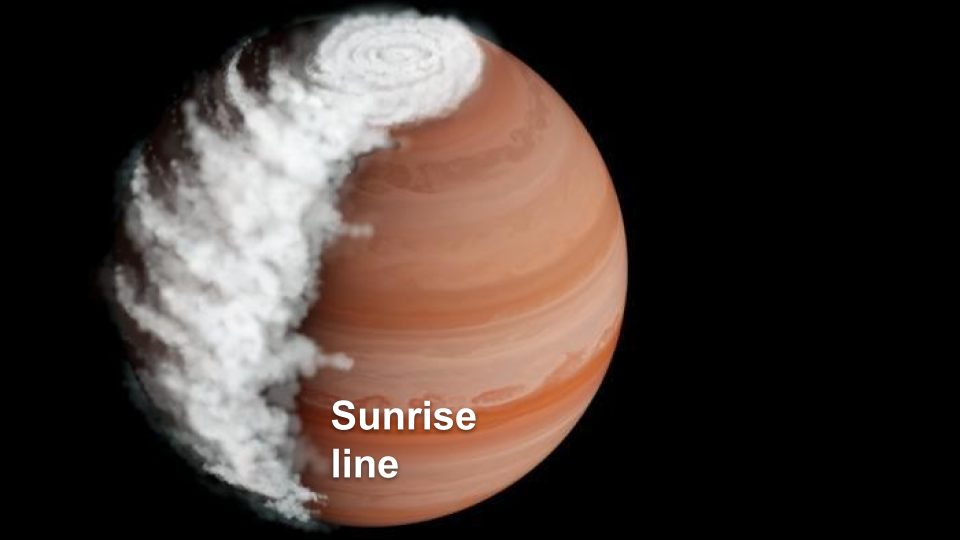
This work, published in the journal Science, looked at WASP-94A b, a hot Jupiter orbiting a hot star in a binary system. The planet orbits every 2 days and zips rapidly across the face of its host star as it goes. While watching this passage, the JWST observed star light passing through both the Sunrise and Sunset sides of the planet’s atmosphere.
According to lead author Sagnick Mukherjee (Johns Hopkins University), “With the Hubble telescope, when we used to do this type of observation, we got an average view of the whole planet with data from the clouds and the atmosphere squished together and indistinguishable. This approach with the JWST lets us localize our observations, which helped us see the cloud cycle.”
The Sunrise side was cooler and cloudy. Across the course of the day, temperatures rose, creating a hotter Sunset atmosphere, which was cloud free. According to the paper’s abstract, “We interpret this difference as being due to the formation of cloud droplets near the morning [side], which evaporate during circulation to the evening [side]. The dominant aerosols are clouds cycling between the day and night sides of the atmosphere.”
This kind of night time cloud formation and daytime cloud evaporation was also found on the hot Jupiters WASP-39b and WASP-17b. Future work will study cloud cycling across a variety of worlds. When those results are published we’ll bring them to you here on EVSN.
Sources
- AAAS Press Release via EurekAlert
- John Hopkins Press Release
- Mukherjee, Sagnick, et al. “Cloudy mornings and clear evenings on a gas giant exoplanet.” Science 392.6800 (2026): 858–862. DOI: 10.1126/science.adx5903
메타데이터
- post_id
- 0fbda317a03d
- slug
- wasp-94a-b-cloudy-nights-and-clear-days-0fbda317a03d
- url
- https://medium.com/@starstryder/wasp-94a-b-cloudy-nights-and-clear-days-0fbda317a03d
- canonical_url
- https://medium.com/@starstryder/wasp-94a-b-cloudy-nights-and-clear-days-0fbda317a03d
- author_url
- https://medium.com/@starstryder
- status
- ok
- fetched_at
- 2026-06-09 15:37:30