Our Daily Bread
Desire, habit, and supply displace necessity
Our Daily Bread
Desire, habit, and supply displace necessity

For most of human history, eating began with absence. Food meant survival, continuity, shelter against uncertainty, and some assurance that tomorrow would not arrive empty-handed. Bread, rice, beans, meat, fruit, milk, grain, roots, or whatever could be stored were more than provisions. They were evidence that life might continue without immediate interruption. A full pantry could quiet fear. A table with leftovers could prove that no one had been forced to stop before feeling satisfied. Even where scarcity is no longer an immediate threat, customs formed under its pressure remain active: gaining weight may still suggest strength, a plump child may still appear healthy, refusing food may still sound ungrateful, and leaving anything uneaten may still feel morally wrong.
The idea of daily bread belongs to that older world. Bread is not luxury, spectacle, or indulgence. It is what must be there, every day, so that life can proceed. It is nourishment, routine, sharing, and right. Yet somewhere between the ancient effort to secure enough food and the contemporary condition of uninterrupted availability, food changed its place in human life. It did not cease to sustain the body, but it accumulated so many additional functions that nourishment became only one among them. We eat to celebrate, comfort, reward, accompany, belong, remember, display, recover, pass the time, reduce anxiety, create images, and confirm social presence. Food still answers hunger, but it no longer needs hunger in order to call us.
Hunger, appetite, desire, habit, custom, and opportunity do not describe the same event. Hunger is a bodily demand, relatively indifferent to the exact object that will satisfy it. Appetite is a broader readiness to eat. Desire selects something specific: a sweet, a pizza, a burger, a particular drink. Habit turns repetition into an almost automatic sequence, such as sweetened coffee in the morning, dessert after lunch, or a visit to the refrigerator upon arriving home. Custom distributes repetition across a group: cake at birthdays, snacks at meetings, popcorn at the cinema, soft drinks at parties. Opportunity appears when food is visible, available, free, discounted, or offered by someone whose gesture is difficult to refuse. In the present food environment, all of these forces can be activated without any corresponding need for energy.
This is why explanations based exclusively on discipline remain inadequate. A person may eat because it is noon, because everyone else is eating, because there is cake at work, because the app has announced a temporary discount, because the film has started, because a demanding task has ended, or because a particular food has always accompanied a certain moment. The decision does not arise in empty space. It emerges inside a structure built from schedules, memories, prices, relationships, images, routines, and prompts that were already in place before the individual made any conscious choice.
The family is the first environment in which this grammar is learned. It teaches what counts as a meal, how much should fit on a plate, whether leaving food is acceptable, whether taking a second serving shows appreciation, whether dessert is the proper ending to lunch, and whether serving beyond necessity is a sign of care. Family recipes do not contain ingredients alone. They contain people, places, stories, and forms of affection. A grandmother’s dish, an aunt’s cake, a preparation that appears every Christmas, or a recipe repeated whenever relatives gather becomes an archive of attachment. Altering it may feel less like a nutritional adjustment than an interruption of continuity.
Celebration therefore cannot be treated as a peripheral subject. Birthdays, weddings, baptisms, graduations, funerals, religious festivals, Christmas, New Year, Easter, harvest festivals, Thanksgiving, family gatherings, and workplace celebrations are given material weight by food and drink. The banquet announces that this is not an ordinary day. It shows preparation, generosity, prestige, abundance, and belonging. In societies shaped by scarcity, serving more than guests can consume carries a further meaning: no one here will be forced to measure each mouthful.
The difficulty does not lie in the occasional excess of a feast. A feast becomes meaningful partly because it interrupts ordinary time. The contemporary shift occurs when the logic of the banquet no longer remains exceptional. Advertising, retail, and the food industry multiply minor reasons to consume as though something special were happening: Friday evening, a football match, a film, the end of work, a completed task, a difficult day, a small achievement, a deserved rest. Festival food is detached from the event that once justified it and redistributed as daily compensation. The intensity of celebration remains, but the interval between celebrations disappears.
Older ritual calendars often combined abundance with restraint. Fasting, abstinence, preparation, and waiting gave force to the feast that followed. Secular life preserved many of the meals, chocolates, drinks, and seasonal dishes, while allowing much of the counterweight to fade. The menu retained its exceptional richness; the rhythm lost its boundaries.
Work reorganized eating through another pressure: time. Long shifts, commuting, fragmented schedules, meetings, targets, and inadequate breaks reduced the energy available for planning, shopping, preparing, serving, and cleaning. Ultra-processed food and delivery did not prevail only because of flavor. They prevailed because they remove decisions, utensils, storage, skill, delay, and domestic labor. A ready meal sells more than food. It sells the disappearance of a sequence of tasks.
That convenience answers a genuine need. Home cooking has always required labor, and that labor has often been distributed unequally and left economically invisible. Any call to restore the family kitchen without asking who plans, carries, washes, cuts, cooks, serves, and cleans risks romanticizing a burden historically assigned to women. The problem is not the desire for practical solutions. The problem is that practicality was largely designed around cheap, durable, intense, repeatable, and highly profitable products.
Contemporary work often produces another contradiction: minimal physical movement combined with profound mental exhaustion. Someone may sit for most of the day and still reach the evening depleted. The body has spent little energy, while the mind has accumulated strain. Food then becomes interruption, consolation, reward, and closure. Sedentary life does not mean an absence of fatigue. It means fatigue without movement.
Fast food enters this environment first as a temporal system, not merely as a nutritional category. In a broad sense, urban societies have always developed food that could be prepared or served quickly: soups, breads, noodles, pastries, skewers, dumplings, sandwiches, and popular street meals. The modern system consolidated in the United States added standardization, assembly-line production, limited menus, franchising, disposable packaging, combo meals, drive-through service, mass advertising, and integration with the automobile.
Speed alone does not make a meal nutritionally poor. A Brazilian plate meal, Vietnamese pho, Japanese soba, Korean bibimbap, bean-filled tacos, falafel, a Chinese soup, or a French galette can arrive quickly and still retain the structure of a meal. The problem appears when speed is joined to oversized portions, sweetened drinks, processed meats, fried components, heavy sauces, and commercial incentives to enlarge the order. American fast food did not invent quick eating. It industrialized repetition and converted portion growth into a business model.
Globalization spread dishes, but it also altered their internal design. Pizza, sushi, tacos, ramen, kebab, and curry can travel across the world while preserving their names and visual signatures, even as they become larger, sweeter, saltier, fattier, and increasingly tied to soft drinks and side orders. Cultural diversity remains visible on the surface, while beneath it the same commercial architecture is reproduced: standardization, packaging, promotion, intensification, and the combo.
The problem therefore cannot be assigned to any single cuisine. Nearly every culinary tradition contains dishes that are balanced, excessive, festive, practical, elaborate, or poor. A more useful distinction lies in the architecture of the meal: vegetables, legumes, grains, broth, and protein or a chain of snacks; a bounded portion or an expandable one; water and tea or sweetened drinks; recognizable food or industrial formulation; an ordinary meal or a permanent festival.
A global food hall could embody another possibility. It could bring together speed, cultural variety, and nutritional intelligence instead of selecting only the most fried, sugary, photogenic, or profitable foods from each tradition. It could include Brazilian rice and beans, bibimbap, soba, pho, tacos with legumes, falafel, vegetable curries, Chinese soups, simple pizza, and Mediterranean plates. Its purpose would not be to display exotic options, but to show that convenience, pleasure, and dietary coherence do not have to be enemies.
The Mediterranean diet clarifies the difference between a dish and a system. It is not reducible to pasta, pizza, olive oil, or wine. Its historical strength lies in a broader arrangement: plant predominance, grains, legumes, fruit, vegetables, fish, seasonality, home preparation, social eating, and daily movement. A modest pizza accompanied by water may fit within that structure. A large pizza covered with processed meat, extra cheese, sauces, and accompanied by a sweetened drink belongs to another one. The cultural label remains while the nutritional system changes.
The transformation of food has also taken place inside the palate. Sugar, fat, and salt have always attracted human beings because they indicated energy, preservation, and valuable nutrients in conditions of scarcity. Industry learned to concentrate and combine them with aromas, textures, temperature contrasts, crispness, softness, and rapid oral breakdown. Many modern products do not need to be unforgettable. They need only to be pleasant, predictable, portable, and difficult to finish psychologically.
Fried foods combine fat, salt, heat, aroma, and the contrast between a crisp surface and a soft interior. Soft drinks combine sweetness, cold, carbonation, aroma, and speed of consumption. Snacks require little interruption. Beverages deliver energy with weak signals of satiety. Breakfast cereals, flavored yogurts, sweetened coffees, bars, and breads may operate as desserts while occupying the cultural position of breakfast or a practical snack. Dessert is no longer confined to the end of a meal. It disperses across the day.
The palate adapts to intensity. Simple food may begin to feel insufficient after repeated exposure to highly concentrated taste. Water can seem dull, older portions can seem small, and a meal without something sweet can feel incomplete. Industry does not merely respond to preference. It participates in producing it.
The physical work of eating has diminished as well. Soft, liquid, crisp, or brittle products can be consumed quickly, often before satiety signals have time to consolidate. Speed of service joins speed of purchase, chewing, swallowing, and delivery. The interval between wanting and obtaining becomes shorter, and with it disappears part of the space in which desire might weaken, be reconsidered, or take another form.
Modernity did not only industrialize food. It industrialized its arrival. The restaurant, drive-through, food truck, vending machine, convenience store, delivery platform, dark kitchen, grocery app, and automated recommendation form a sequence in which each stage removes a layer of friction. It is no longer necessary to leave the car, walk, wait, cook, wash, plan, or even formulate a fresh decision. The platform remembers previous orders, predicts timing, proposes additions, and learns the consumer’s recurring vulnerabilities.
The drive-through condenses the transformation into a single image: food reaches the body without the body leaving the vehicle. Delivery brings the same logic into the home. The dark kitchen removes even the public restaurant, leaving production, platform, and dispatch. A business may exist as a brand without dining room, façade, or gathering. Food becomes an interface before it becomes a meal.
Science fiction anticipated the direction. The flying restaurant in The Fifth Element combines food truck, drive-through, and aerial delivery. Food comes directly to the window where the consumer already is. The food replicator in Star Trek carries the process further: a request is spoken and the meal appears. Agriculture, storage, transport, and cooking disappear from perception.
The cornucopia is the ancient version of the same dream. The horn of plenty symbolizes harvest, fertility, and an inexhaustible source of food. The replicator translates that dream into technology. Between them stand the supermarket, fast food, and the app, incomplete versions of abundance on demand.
The crucial difference is that the Star Trek replicator belongs to a post-scarcity society in which access is not directly determined by purchasing power and the system does not need to increase consumption in order to increase profit. The replicator answers a request. The contemporary food economy must also manufacture the request, intensify its frequency, and prevent desire from ending. Technology does not simply serve appetite. It learns when and how to summon it.
Apparent ease hides a vast infrastructure. Behind every click are farmers, slaughterhouse workers, factory employees, warehouse operators, drivers, cooks, packers, and couriers. Food seems to materialize because the labor has been displaced outside the consumer’s visual field. The real replicator is still human.
The contemporary table has also become a display surface. Photographing dishes, posting them, tagging restaurants, and exhibiting culinary experiences turn the meal into content. Food carries value not only because it tastes good, but because it appears rare, excessive, beautiful, recognizable, or socially desirable. Towering burgers, flowing cheese, monumental desserts, decorated coffees, and extravagant buffets are designed for the camera as much as for the mouth.
There is continuity here with the ancient banquet. Once, abundance was displayed to the people physically present. Now the audience can be indefinite and digital. The table says that there is plenty, but it also says: I was here, I can afford this, I know this place, I participate in this trend. The photograph no longer merely records the occasion. It can begin to organize it. The dish is selected partly for the image it will generate.
This is not limited to the worship of excess. There is also a worship of purity, discipline, the flawless meal, the “clean” plate, the fit body, and the controlled appetite. Food can declare that someone is healthy, vegan, traditional, cosmopolitan, refined, adventurous, or morally rigorous. Eating and appearing to eat become separate practices.
Cinema exposes these symbolic functions because food condenses survival, desire, memory, power, and attachment. In The Platform, the table initially contains enough, but hierarchy, fear, waste, and the order of access turn abundance into hunger for those below. In Babette’s Feast, the banquet becomes gift, art, gratitude, and reconciliation. In Chocolat, sweetness carries desire and resistance against repression. In Ratatouille, taste restores a lost childhood. In The Menu, gastronomy becomes distinction, theater, labor, resentment, and violence.
These stories reveal that a meal can never be reduced to composition alone. A replicator might reproduce every dish served by Babette, yet it could not reproduce her sacrifice, intention, or act of giving. Matter can be copied; meaning cannot. Eating is biological, but it is also relational.
The body receives all of these layers at once. It receives a metabolism formed under scarcity, a palate trained by intensity, a family history, an exhausting work rhythm, reduced movement, continuous availability, advertising, celebration, and algorithmic suggestion. Obesity emerges as one visible result of this convergence, not as the outcome of a single defective decision.
This does not diminish the importance of diet, movement, and professional care. Food influences energy intake and nutritional quality. Physical activity supports strength, muscle, cardiovascular capacity, metabolic regulation, and functional autonomy. Nutrition professionals translate general principles into lives shaped by income, culture, work, illness, medication, preference, and cooking capacity. Sleep, stress, and continuity matter as well. Medication and surgery can alter appetite, satiety, physiology, and metabolism, but they cannot by themselves reorganize the city, the workplace, the market, or the family.
Diet, light, and zero-sugar products may reduce one component without changing frequency, portion size, or dependence on ultra-processed foods. The food industry sells stimulation and convenience; other industries sell control, compensation, exercise, medication, and surgery. No conspiracy is required. Different sectors can profit from different moments in the same process.
Personal responsibility remains real, but it is exercised inside directed conditions. The individual encounters larger portions, strategic pricing, advertising, apps, exhausting schedules, sedentary cities, and products designed for repetition. Then the consequences are returned to the individual as evidence of insufficient self-control. Risk is produced collectively and corrected privately.
Inequality makes this contradiction more visible. Sugar, refined flour, oil, starch, and industrial formulations are cheap, durable, and easy to transport. Fruit, vegetables, fish, fresh meals, and high-quality protein require refrigeration, labor, time, and more fragile logistics. The system made calories affordable before it made nourishment affordable.
Obesity is therefore not only a disease of affluence. It can coexist with food insecurity, anemia, micronutrient deficiency, and low muscle mass. A person may consume excess energy and still be malnourished. A family may alternate periods of restriction with the purchase of cheap, shelf-stable, energy-dense products. A child may experience growth impairment and later develop excess weight.
Hunger, malnutrition, and obesity are not absolute opposites. They are different expressions of abundance distributed and organized badly. Hunger appears where food fails to arrive regularly. Malnutrition appears where it arrives in inadequate quantity or quality. Obesity grows where it arrives as a continuous flow of calories, prompts, occasions, and convenience.
The world can produce enormous quantities of food and still maintain hunger because production is not access. Income, war, displacement, territorial inequality, concentration of ownership, price, infrastructure, and waste determine who participates in abundance. Supermarkets can remain full while families face food insecurity. Restaurants and apps can offer thousands of choices while entire communities depend on cheap, repetitive products.
The Platform returns here as a condensed image of the system. The table begins loaded. The problem is not the initial absence of food, but the order of access, the fear of those above, the behavior of each level, and the absence of collective limits. Abundance exists, but it never becomes shared sufficiency.
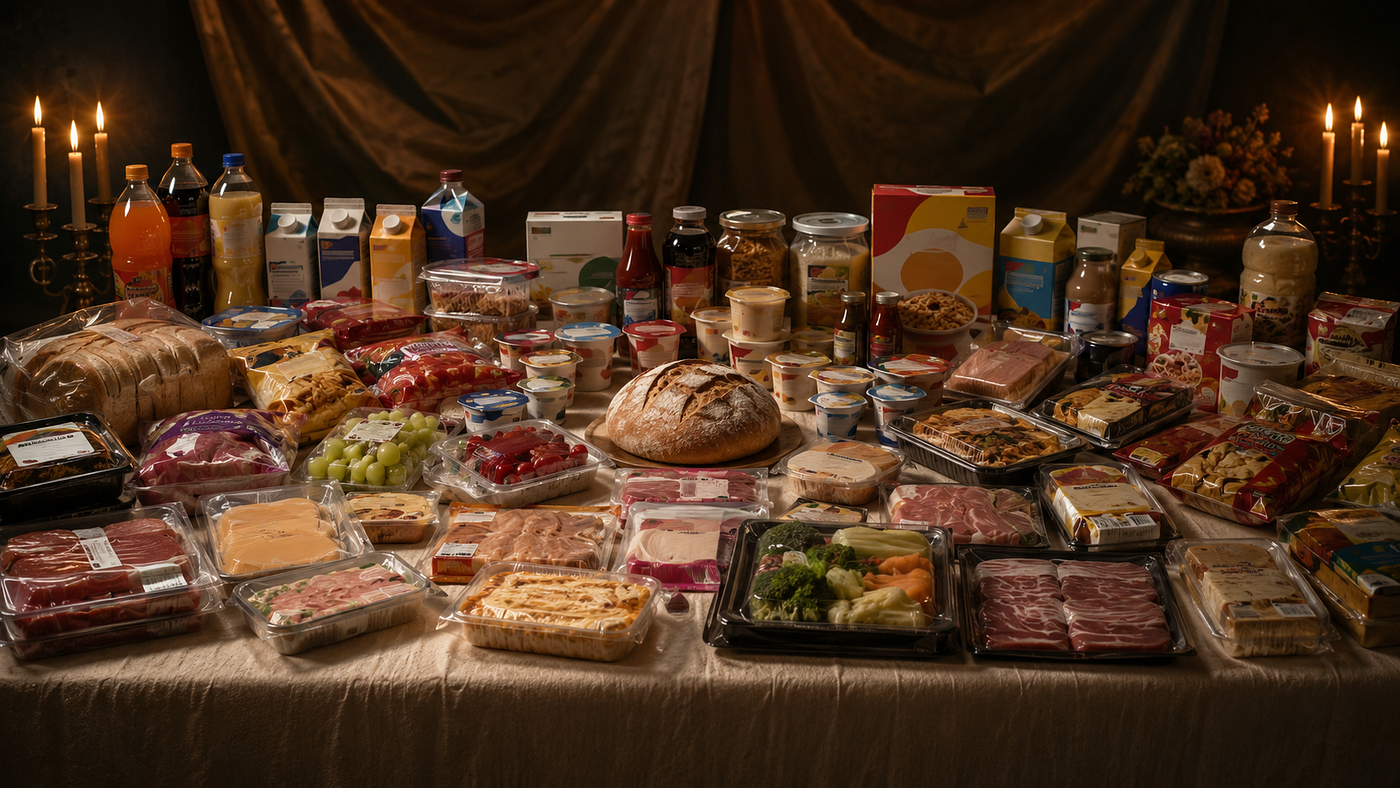
A banquet table covered in packaging reveals another dimension of the same system. There is color, volume, variety, and the promise of satisfaction, yet almost nothing has truly been served. Bread, meat, drinks, vegetables, desserts, and complete meals remain separated from the body by plastic, foil, cardboard, labels, brands, and codes. The table is full, but its plenty comes from industrial mediation rather than harvest, kitchen, or care. A simple loaf placed at its center begins to look less like one food among many than like the memory of what the table once meant.
The issue, then, is not to condemn abundance, pleasure, technology, or convenience. Humanity spent centuries struggling against hunger, uncertainty, and seasonal shortage. The problem lies in organizing that partial victory as a permanent market of stimulation without securing distribution, nutritional quality, or limit.
Food security requires that no one live in fear of not having enough. Public health does not require that everyone be continuously called upon to consume. These are two different forms of abundance. One offers access, dignity, variety, and freedom from hunger. The other converts every place, pause, emotion, and occasion into a sales opportunity.
To return to daily bread does not mean returning to poverty, scarcity, domestic drudgery, or a fictional past of nutritional innocence. It means recovering the idea of food that is sufficient, recognizable, shareable, and capable of ending. It means designing convenience without nutritional degradation, celebration without permanent festivity, technology without continuous incitement, and access without economic gates that leave part of humanity outside.
The contemporary challenge is not simply to produce more food or teach individuals to resist more effectively. It is to rebuild the relationship between body, time, family, work, city, market, and culture. Daily bread can remain pleasure, memory, and encounter, but it cannot be made responsible for soothing every anxiety, rewarding every effort, filling every pause, affirming every identity, and occupying every empty space.
Humanity has approached the cornucopia without yet learning how to distribute it, improve it, or establish limits before it. Hunger shows where abundance does not arrive. Malnutrition shows when it arrives in a poor or unbalanced form. Obesity shows what happens when it arrives as a constant stream of calories, prompts, and opportunities to consume.
Perhaps the next stage will not be the construction of an even larger cornucopia, but the conversion of abundance into shared sufficiency. An abundance that reaches people, nourishes them, preserves pleasure, and knows when to stop. Only then can daily bread again mean not whatever we are endlessly induced to desire, but what sustains life without occupying all of it.
Portuguese version available on Substack: https://open.substack.com/pub/nexhowledumampo/p/o-pao-nosso-de-cada-dia-our-daily?r=5tj4nj&utm_campaign=post&utm_medium=web&showWelcomeOnShare=true
Tags: food culture, obesity, ultra-processed foods, food security, abundance
메타데이터
- post_id
- 0fcc88314ea8
- slug
- our-daily-bread-0fcc88314ea8
- url
- https://medium.com/@nexhowledumampo/our-daily-bread-0fcc88314ea8
- canonical_url
- https://medium.com/@nexhowledumampo/our-daily-bread-0fcc88314ea8
- author_url
- https://medium.com/@nexhowledumampo
- status
- ok
- fetched_at
- 2026-08-05 22:46:39