Google and Samsung are jointly launching AI glasses
The tech giants partnered with luxury eyewear brands
Google and Samsung are jointly launching AI glasses
The tech giants partnered with luxury eyewear brands
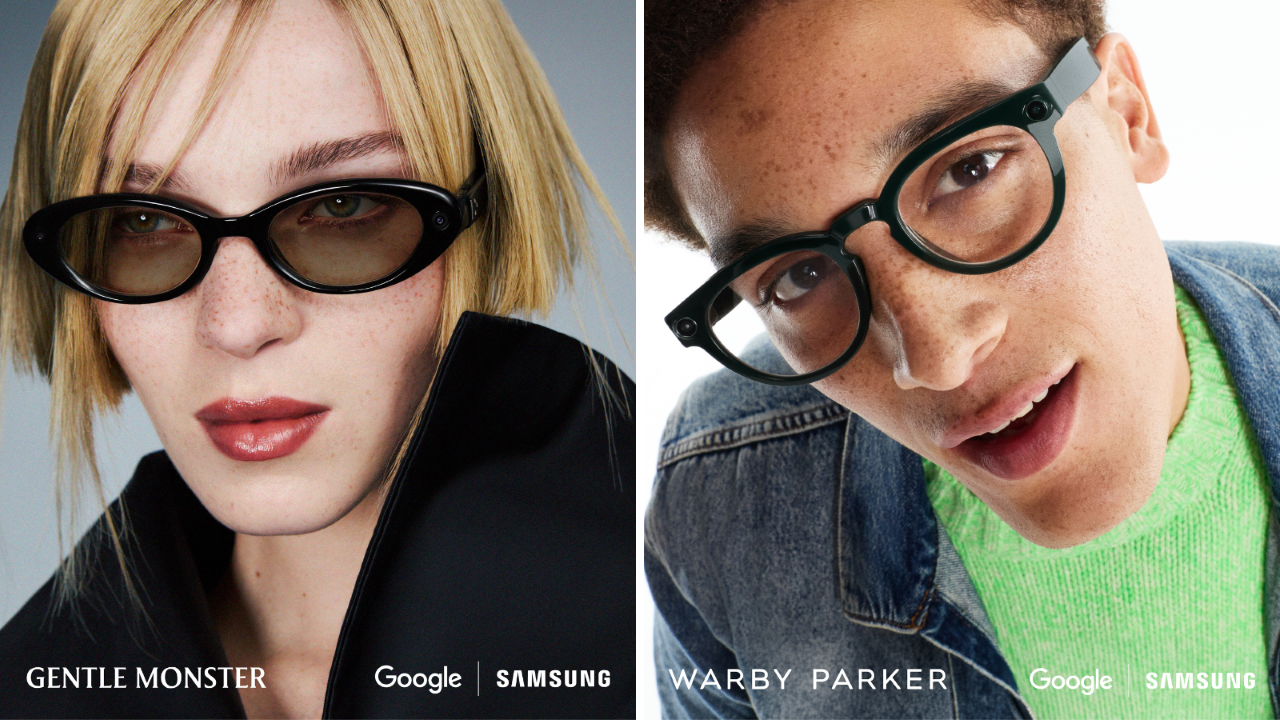
Intelligent Eyewear — Image source: Samsung
Google and Samsung have officially unveiled their first generation of joint “Intelligent Eyewear” AI smart glasses. Announced at the Google I/O 2026 keynote, the devices directly challenge Meta’s market dominance by leveraging major fashion and lifestyle brand partnerships.
By combining Samsung’s hardware expertise with Google’s advanced AI capabilities, it is now clear why Meta is eager to strengthen its position in the AI space.
Instead of designing the frames in-house, Google and Samsung have collaborated with two distinct eyewear brands to ensure the devices look like premium, everyday glasses.
This is a smart move aimed at attracting fashion-conscious consumers who value aesthetics, not just a tech gadget displayed on their face.
Gentle Monster is a South Korean luxury eyewear brand known for creating bold, chunky, and disruptive high-fashion frame designs.
Warby Parker is a popular prescription and lifestyle eyewear company recognized for its more subtle, timeless, and minimalist designs.
Most recently, Gucci joined the luxury eyewear trio through its partnership on Intelligent Eyewear.
The first release consists of audio-only glasses featuring built-in micro-speakers, a discreet camera, and microphones. The launch is officially scheduled for this Fall in selected markets.
The Intelligent Eyewear glasses run on Android XR, a specialized extended reality platform co-developed by Google, Samsung, and Qualcomm.
The AI glasses rely on a dedicated array of hardware sensors to track movement, capture the environment, and process inputs.
Because the initial Fall 2026 models are lightweight and display-free, their sensor suite focuses heavily on environmental awareness rather than advanced graphic tracking.
The core sensor suite includes:
A 12 MP Sony IMX 681 camera sensor positioned at eye level to capture high-quality photos and videos. It serves as the primary visual input for Google Gemini, allowing it to see and analyze your surroundings.
An acoustic sensor array (microphones) strategically positioned to clearly capture the wearer’s voice. According to Samsung, they use noise-filtering software to isolate commands from ambient background noise.
Inertial Measurement Units (IMUs), including built-in gyroscopes and accelerometers, to track precise head movements. This data helps tailor directional audio and mapping features as you turn your head.
Capacitive touch sensors integrated directly into the temple arms of the frames, allowing users to control media, adjust volume, or activate the AI assistant through taps and swipes.
The second release, planned for 2027 and beyond, will add a display that visually projects data into the user’s field of view.
For these display-enabled versions and the broader Android XR platform ecosystem, the sensor package will expand to support spatial computing. According to developer documentation from sources such as Samsung Newsroom and related press releases, these advanced models will also include:
Time-of-Flight (ToF) and depth sensors to map physical spaces and measure distances to objects in real time.
Infrared gaze trackers to monitor eye movement for menu navigation.
Hand-tracking sensors capable of recognizing physical gestures without the need for controllers.
The Intelligent Eyewear AI smart glasses are designed to function as a hands-free companion device for your smartphone.
Powered natively by Google Gemini AI, early previews have showcased several primary capabilities, including:
Real-time contextual assistance, allowing users to look at objects, signs, or landmarks and ask Gemini questions, request directions from their current location, or receive instant translations — a feature that could quickly become a favorite among travelers.
Audio and navigation features that provide turn-by-turn spoken directions and media playback.
Everyday convenience features such as reading incoming texts aloud, dictating message replies, and logging calendar events entirely hands-free.
Media capture capabilities that allow users to instantly take photos or record videos using a subtle camera integrated near the frame hinge.
While official launch pricing has yet to be confirmed by the manufacturers, industry leaks and supply chain reports from outlets such as The Verge suggest the audio-only version will target a price range between $379 and $499, directly competing with Meta’s Ray-Ban smart glasses pricing structure.
The war for dominance in the smart glasses market is beginning to feel very real.
메타데이터
- post_id
- 0fd282a10b70
- slug
- google-and-samsung-are-jointly-launching-ai-glasses-0fd282a10b70
- url
- https://medium.com/@susanfourtane/google-and-samsung-are-jointly-launching-ai-glasses-0fd282a10b70
- canonical_url
- https://medium.com/@susanfourtane/google-and-samsung-are-jointly-launching-ai-glasses-0fd282a10b70
- author_url
- https://medium.com/@susanfourtane
- status
- ok
- fetched_at
- 2026-06-09 15:37:30