The White Dragon: Tales from the North — Chapter 6: Histories
The following stories have been taken from Tiberius Kether’s The Icebreaker.
The White Dragon: Tales from the North — Chapter 6: Histories
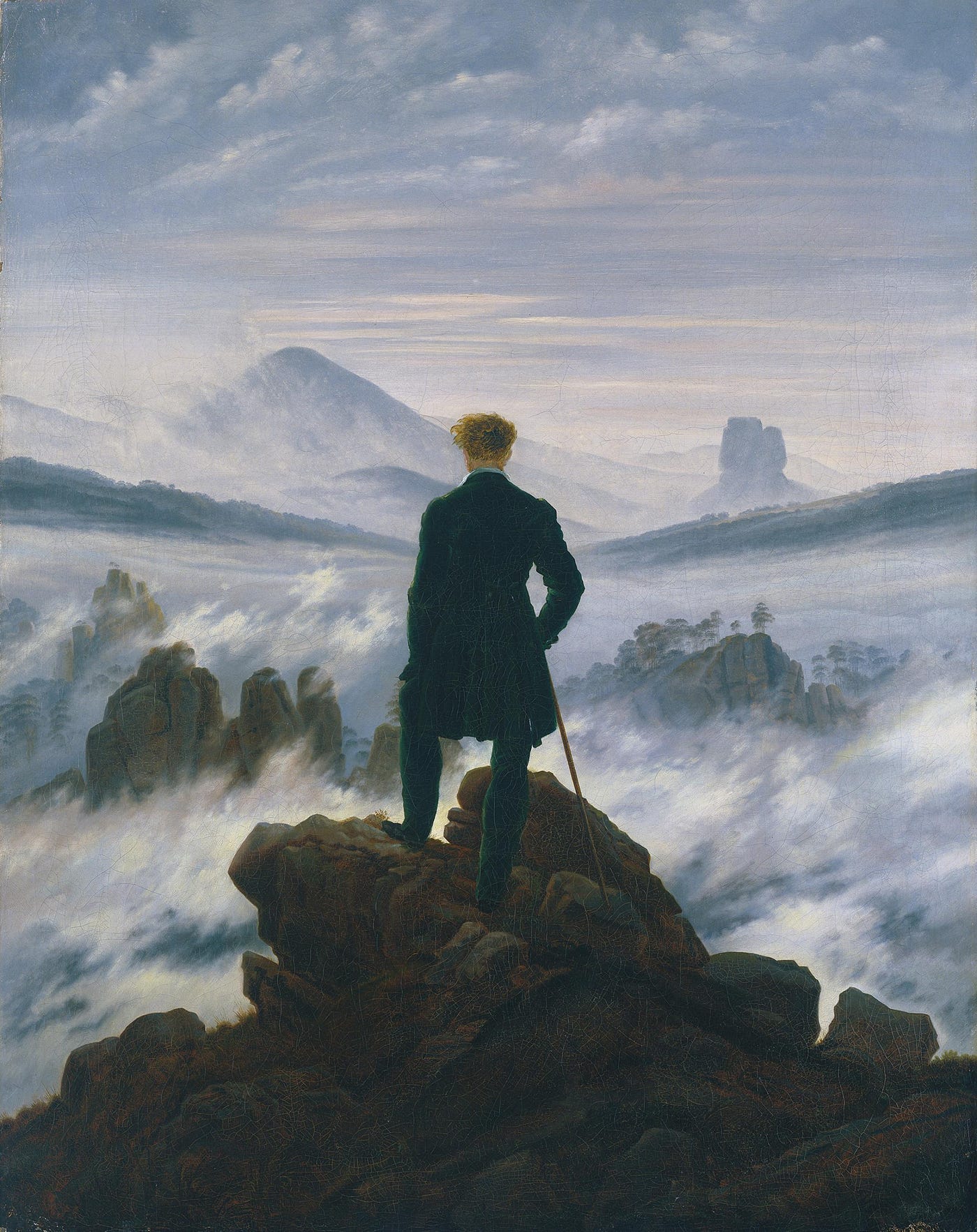
Der Wanderer über dem Nebelmeer (1818) | Caspar David Friedrich
The following stories have been taken from Tiberius Kether’s The Icebreaker.
The First of Thousands
ㅤ
ㅤㅤWhen our people pray, they pray to Fumus the God of Fire for strength. They pray to Litus the God of Light for guidance. They pray to Ekson the God of Sound for truth. Me myself have at times asked for Kadi’s blessings; all we see is what you have already seen, O God of Imagination. I even know of some who worship Those Who Balance still, Navarus and Suravan; either lost in the dark arts, or understanding something more about this thing we call existence. ㅤㅤExistence… In the prayers of the children of Ek’nata and in the prayers of the children of the universe, there is one name above all. O Mightiest of All, O Breathgiver, O Sun of Love, that name is your name, Arus, God of Life. I leave my quill, I open my arms, I pray and I bathe in your invisible restoring light. You’ve rejuvenated my soul, and now I can ask for your forgiveness. Though you will always be the Most High, you too had a father, and he too had a father, the First of Thousands! ㅤㅤFew they are, ever fewer as time goes by; wise men the lot of them. Only in the innermost room of their temples they utter that name. Who is this figure? Who is the Father of Fathers? ㅤㅤBefore even Arus came to be, there was only nothingness, and out of nothingness emerged a being, vast and powerful — existence personified. For a time, when time was yet to be defined, he wandered himself, until the first of all feelings was born in some divine cave of his mystical construct. That was loneliness, and slowly loneliness consumed his heart, his body and his mind. And what do lonely Gods do? They create life. ㅤㅤThis Great Shadow had no body, and no limbs, and no face, but it had two wings. In an act of sacrifice and true pure boundless love, he cut his left one, and out of it fashioned a scythe; the White Staff. And as it often happens, the great symphonies begin with an act of “violence”, and so began the Symphony of Life! ㅤㅤThe One-Winged separated what was into two halves, into a bright and into a dark side, and made his home on the bright side. There he gave birth to H’taed, the Firstnamed, the Force, and tasked him with the role of being the progenitor of a new race, the first race to grace the stage of existence. These people are the ones who are believed to have given the First of Thousands his august name and title. ㅤㅤWe know little of them and their achievements, of the civilization they built, one so mighty and splendorous that even in our dreams we cannot fathom a fragment of its glory. What was the nature of its people’s monotony? What were their aspirations? Their laws and their feelings, their art and their music… A golden age if there ever was one. ㅤㅤThis first of civilizations, lasted for millennia on top of millennia, a testimony to the foundations they had built, but as we well know, nothing lasts forever. Immortality and boredom can produce a wild concoction. So close to God, so close to dethrone him… ㅤㅤTowards the end of its days, their world was plagued by countless wars, each more brutal and destructive than the other. So lost they were in their ways, it is said that they had even forgotten what they were fighting for. The meaning of true atrocity and wickedness was defined during that time. I can’t bring myself to write of the beauty that was lost in those years of fire and malice. ㅤㅤA godless people the first race had become… Enough was enough. The First of Thousands appeared before them in all his terrifying and awe-inspiring splendor, and that day their race perished.
ㅤㅤOut of billions, only four survived. Three out of these four we know well, for it is they who began writing the second chapter in the history of existence. A devoted disciple of H’tead named Arus, and his two brothers, the twins Navarus and Suravan. ㅤㅤWhy was it they that survived? We don’t know why, but in a beautiful exchange I had once with a priest, he suggested to me to ponder the following question: ‘What did they sacrifice to survive?’ An act of violence…
The Birth of the Universe
ㅤ
ㅤㅤWhen Arus and his brothers woke from their sleep, they did not find themselves in the white side of existence, but in its dark one; our side. Back then, this thing we call the universe today, was but an empty and endless space. And as the First of Thousands had done long ago, the First Four, out of nothing began to build something. They poured all their powers, all their ingenuity, all their will and all their love into creating the first planet and the first sun, Sura and Rexus; their eternal dance the mechanism that moves everything. ㅤㅤIn Sura, Arus the Lifebringer, gave birth to eleven races; the second wave of life. To each of these races he granted a special power, and to some of them like the holy Eulukas, a key duty. Most famous of these children of the Most High, were the Elementians, the race of Kasier, Tokki and Fumus. Oh yes, our Gods were once mortal too; mere men with their own desires and shortcomings. ㅤㅤFor being the first to have mastered the gift Arus had given him, Kasier, a powerful warrior-priest, was made the God of Water. Next, his archrival, Tokki, a great king and restless soul, was made the God of Earth. Though many believe that it was Fumus, who was the third to be elevated to the rank of Godhood, it was instead Daaker, who was made the God of Air. A mysterious man from the southern deserts of Sura, hence one of his titles, Daaker of the Sands. ㅤㅤCompared to many other deities, we know a lot about Fumus’ life before he was made the God of Fire. Back when he was a mortal, he had a different name, Farus, and he was the King of the Firelands. During his reign, he conquered all of Sura with his army, the Flaming Legions, and fully wiped out its ten other races; making the Elementians the masters of the planet. ㅤㅤAfter Farus’ ascension, the Seven Great Gods embarked on a crusade of creation. Together they created the planets and the stars, the wonders and the laws of the universe, and all else that fills this immense and abundant space. Today, they still preside over us, and though they leave us be and play our parts, however insignificant they may be, at times, they do take interest in our affairs, and in disguise join our ranks and move the wheel of history towards a certain direction. ㅤㅤRemember, who are we to judge the High Ones? We can see only today, before them eternities span. Good is coming, as long as God reigns!
Note:
ㅤㅤBefore I continue with my account, I know that there is a large group of people in Ek’nata, that still don’t believe that there’s life on other planets. Let me tell you, there are worlds that are just floating rocks in the vast sea of existence, and there are worlds that can travel the stars and subjugate countless other worlds. The Gods have blessed us with their divine protection, and no foe has yet to appear in our skies. May it stay so until the time is right!
ㅤㅤBack to the race of Elementians, the colonies that they established all across Sura, eventually grew to become independent entities in their own right; Farus’ successors proved to be not as capable. And some of those states became kingdoms and empires, and to their populations as well, special gifts were granted. Out of these people, a few characters that left their mark on the history of the universe rose. ㅤㅤLitus, the warrior-smith who forged his light blades and bow in the fires of Rexus. The shaman Ekson, who was first to sense the existence of a more powerful being than even Arus himself. Nashnaran the God of War, who was born out of the Most High’s union with a mortal woman who later became the planet of Sanctuary-Anarit. Zograf the God of Justice, who once met a young traveling man by the name of Kadi, and granted him his massive sword, Black Sun. ㅤㅤAnd to Kadi we finally come, the man whose life is the Great Universal Epic. From a prince without a kingdom to inherit or anything else to his name, to the First Arkon of Pantherion. From being on the verge of death, to becoming the Second Emperor of Sura and the First Emperor of the Universe. From challenging the Gods, to becoming one of them! ㅤㅤThe very same retired priest who told me the story of existence, who knew way more than he let on, and who challenged my think box to ask trickier questions, also told something that from time to time resurfaces on my mind. He told me that Kadi is the last to have seen the First of Thousands in the flesh… the last to have conversed with Him in its true form. O Opener of Blind Eyes, may I one day write your story.
The Children of Ek’nata
ㅤ
ㅤㅤOur world is one of the worlds that the Seven Great Gods forged. The name we have given it in honor of their first creation, is Sura’exia. The tales say, that there are other lands in the west, beyond the Navakon, but I’ve never visited those realms, and hence I will write only of what I know, of Ek’nata and its children. ㅤㅤMany of you will find that name, Ek’nata, a strange one, an unfamiliar one, one rarely used, but it is the name of our continent, its true name. What a cruel thing, to call these blessed lands, Ek’atan instead; the Accursed Lands. Sadly, war knows not only one world, war knows all worlds. Arus gave birth to Nashnaran, and Arus gave birth to us as well… ㅤㅤThough we all are of the divine seed of the same Great Father, we do not belong to the second wave of existence, nor to its third, but rather its fifth or fourth depending on whom you ask. Of the first wave are Arus and all of those H’taed gave birth to. Of the second one, the eleven races that first inhabited Sura. To the third wave, belong the many offspring of the Elementians. To the fifth, the countless beautiful masterworks that Arus created in his crusade of life; we the Children of Ek’nata included. ㅤㅤFor a time we too belonged to the fourth wave of existence, but after Kadi’s Conquest of the Universe, his people who intermarried with the inhabitants of the worlds that they had conquered claimed that title, considering themselves of higher blood; a guileful and novel way to legitimize their rule. In truth, it doesn’t matter to which wave you belong. As long as you live, breathe and have strength to act, yours is the Universe and all that’s in it! ㅤㅤHere in Ek’nata, the Most High gave life to hundreds and hundreds of races and species. Mightiest of all were the dragons and mightiest of them was their king, Gargaleon the Red God. A terrifying beast that ruled our continent for four thousand years, until the Battle of Bryndengãl when he was overthrown. The event forever changed the history of Ek’nata, ending the Age of Dragons, and ushering in the Age of Men. ㅤㅤWe humans first emerged in Ek’tun Avan, and then spread wherever we could spread to, creating small states, which eventually became the five major kingdoms that we know today. The Righteous and Holy Kingdom of Ek’tun Avan (on whose throne for too long has sat a line of usurpers), The Kingdom of Dezúm (ruled now by our ally, Vykán Levgarián), The Triple Confederate of Haves, The United Empire of the Gravians and The Kingdom of Stravus and Kanvia; to which me myself am a citizen of. ㅤㅤNorth of the lands of the Five Kingdoms, beyond the Endless River and the White Forest, a sizable number of men live as well; sources tell that they are divided into about thirty tribes or so and no more than forty. Northeast, the land of Kitios is inhabited by the Kitians, friendly blue-skinned slender creatures, with pink fur on their backs. East, in Lavaria, which is almost as large as all our lands combined, live the Horans; a warrior culture. Horan means white orc in the tongue of Lavaria. First outcasts of their society, they rose in rebellion, annihilating the Orcs some two hundred years ago, and have since claimed dominion over those most fertile lands. ㅤㅤSeparating Graves and Haves is the immense Forestland of Okkia, where beings such as the Tarrgurrs, half-man, half-deer, or the Kashgahariis, half-stone golem, half-treant live. It has been reported that the last of the giants roam there as well. Further south, the Hattian Islands are inhabited by the Hattians, horned-creatures whose skin color ranges from the lightest to the darkest shades of purple; their hair color too can vary greatly, from a mix of aquamarine, blue and yellow, to one of dark tones or just pure white. The people of these islands are renowned for their crafting abilities, producing wonderful and intricate pieces of jewelry, and in particular the finest works of gold one can own in this world; my dear wife is as fond of them as I am of her. ㅤㅤNorthwest of my native Kanvia, lie the lands of Vitus, a realm of breathtaking natural beauties and blessed with many gifts, such as its delicious blue oranges; a glass of their juice is all I need to start my day. Naturally, one kingdom cannot have all the riches of the world, hence the Gods devised for this land to be split into two kingdoms. In the following chapters, I will delve into more detail on each of the realms of Ek’nata, their history, its people and their characteristics. Lastly, in the Frozen Desert, well nothing ever happens in the Frozen Desert…
The Culling of Zel’Tera
ㅤ
ㅤㅤMany have wondered, where did the Ahnatis come from? The answer is quite a simple one, the very same place we came from. Not all the humans that ventured west stopped in Stravus or Kanvia, some of them kept going, and eventually they reached Vitus and met its native people, the Elves. These peaceful children of Ek’nata welcomed our lost cousins in their midst and supported them in setting up their first villages and towns. ㅤㅤAs time went by, they were no longer just sharing goods or culture, they were sharing their beds as well, and so the first of the Ahnatis were born. A race blessed on one side with the longevity of the Elves, a life of easily six, seven hundred years, or on certain known occasions of remarkably more, and a few of their features too, such as their tall stature and the color of their blood, which despite all still remains blue. On the other side, among the minerals that constitute the odd treasure that we are, they inherited the will of man, and sometimes that’s all you need! ㅤㅤMore and more humans moved to Vitus, and fewer and fewer pure Elves were born. And one day that ancient folk spoke and sang no more. Their words now almost forgotten, their songs seldom heard by the leaves of Lor’Hela. ㅤㅤSad, or just the way of nature? One day we too might be gone, and maybe all that we have built might turn to nothing more than dust… May we have the luck of the Elves; Arus be praised! ㅤㅤBack in those days, some thirty-two hundred years ago, Vitus was one and ruled by the Veltrix Dynasty from their capital of Xaar. During the reign of King Foltrro’ekhon, the seeds of the Rift were planted. Foltrro the Physician… ㅤㅤWhen you see an Ahnati today, you can easily tell where they are from, based on their hair and skin color. The southerners having lighter and auburn hair tones and being olive-skinned, and the northerners having darker hair tones and being white-skinned. Foltrro began the persecution of what were called Moon Worshipers in those days; the ancestors of the North Ahnatis. ㅤㅤ‘Ye have not the right mixture in thy blood, ye are not Ahnati!’ were his infamous words. ㅤㅤAt first, the Moon Worshipers endured, but during the reign of Foltrro’s son, Ektorr, when the persecution was at its worst, a series of small-scale rebellions began; the downtrodden would no longer remain silent. One of these uprisings was led by a former house slave, who like his fellow brothers and sisters had been fed up with being treated as a second-class citizen in his own homeland. His name was Zol’atan. ㅤㅤThrough various means, Zol managed to unite the many independent Moon Worshiper groups and launched in 817 BBB what is known today as the Hilfetian Revolt. It culminated in the Culling of Zel’Tera, in which Zol’atan and his warriors killed every single soul in the loyalist stronghold of Zel’Tera. Though the fighting did still continue for a few more months, it was clear to all that from that point onwards, there was no going back to the erstwhile order of things. In 814 BBB, the Rift formally occurred and Vitus was divided into two kingdoms. ㅤㅤThe dynasty that Zol’atan founded, continues to rule North Vitus to this day. Artelon the Old, one of Zol’s descendants, son of the fourth king, is the sixth to sit on the throne of Til’Ada. While in South Vitus, after the Rift, the House of Veltrix was overthrown by one of their cadet branches, the House of Tinnit led by Vel’ahkana. Though thousands of years have passed, and the relations between the two people have improved to some degree, they are far from being fully reconciled. Both the southerners and the northerners have created myths and built religions out of the Rift and Zel’Tera. Maybe one day they will wipe each other out, and maybe one day, they will remember that the same blood runs in their shells, and love and truth can start to cure much that was lost.
Written in 2453 ABB by Tiberius, a son of the Kethers of Kanvia. Born in the year 2400, during the reign of King Maren III.
Chapter 6 of my work, The White Dragon: Tales from the North
Next week, another chapter!
For the full work, click here, or just reach out to me, and I can email you the file.
— written in 2023 AD
메타데이터
- post_id
- 0fe9c1d92003
- slug
- the-white-dragon-tales-from-the-north-chapter-6-histories-0fe9c1d92003
- url
- https://medium.com/@klajdiballanca/the-white-dragon-tales-from-the-north-chapter-6-histories-0fe9c1d92003
- canonical_url
- https://medium.com/@klajdiballanca/the-white-dragon-tales-from-the-north-chapter-6-histories-0fe9c1d92003
- author_url
- https://medium.com/@klajdiballanca
- status
- ok
- fetched_at
- 2026-07-13 06:23:13