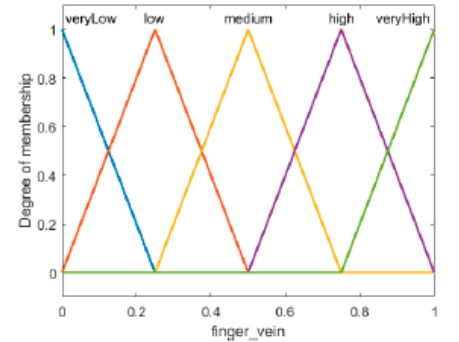
How to design a Fuzzy classifier in three hours without knowing the mathematics (part 2/6)
How to design a Fuzzy classifier (inference system) in three hours without knowing the mathematics (part 2/6)
Link for part (1/6): https://medium.com/@reh.yawar2/how-to-design-a-fuzzy-classifier-in-three-hours-without-knowing-the-mathematics-6ff552132bbe
Link for part (3/6): https://medium.com/@reh.yawar2/how-to-design-a-fuzzy-classifier-in-three-hours-without-knowing-the-mathematics-46b9e8038844
Link for part (4/6): https://medium.com/@reh.yawar2/how-to-design-a-fuzzy-classifier-in-three-hours-without-knowing-the-mathematics-d1b5d5d2e5f0
Link for part (5/6): https://medium.com/@reh.yawar2/how-to-design-a-fuzzy-classifier-in-three-hours-without-knowing-the-mathematics-part-5-6-9392ac902d45
Link for part (6/6): https://medium.com/@reh.yawar2/how-to-design-a-fuzzy-classifier-inference-system-in-three-hours-without-knowing-the-mathematics-76ef7ff4a0a1
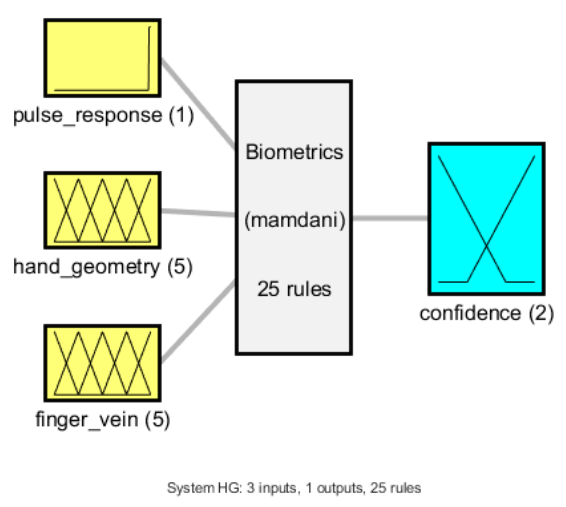
Fuzzy biometric fusion system (Figure from the paper: https://doi.org/10.3390/electronics9111916)
part (2/6)
How to use the Fuzzy thing?
To understand the concept Fuzzy Logic in order apply it on some application, let us revisit or revise the set theory concepts. Well this is that little bit of mathematics that I mentioned at the start.
Set theory vs Fuzzy set theory
In Set theory we present everything in term of sets. We can imagine a set like a box, bundle, or bin. For example, we have a set or box of certain things. Lets consider those things to be a Sun, the Moon, the Earth, and a Cow. Let us call this a universal set. Why … because this is all we have in the universe we considered. There are no more things than the one we have mentioned. Let denote this using the following expression.
X = {sun, moon, earth, cow}
Consider yourself as the powerful being that can create other sets from the universal set X. Lets suppose we derived two other sets from the universal set.
A = {moon, earth} and B = {moon, cow}
Let us combine both the sets. The combination of two sets is known as Union in the mathematical language and it is represented by the symbol ∪.
A ∪ B = {moon, earth, cow}
Now lets find the common elements in both sets. Finding the common elements in the sets is known as intersection in the mathematical language and it is represented by the symbol ∩.
A ∩ B = {moon}
Now, lets find the objects from set A that are not the part of the universe. Finding these object is known as finding complement of a set in the mathematical language and it is represented by “complement” that is A’.
A’ = {sun, cow}
Similarly, please think of B’ as a warm up exercise. We may also solve, A ∪ B’, A’ ∩ B, and A’ ∪ B’.
In Fuzzy set theory, the fundamental operations remains the same however their representation changes. For example union operation from the set can be interpreted as the maximum of two or multiple membership function values. Intersection operation can be interpreted as the minimum of two or multiple membership function values, and the complement operation as the subtraction of membership function value from 1.
In simple words the idea behind Fuzzy Logic is to reply {0, 1} with the entire interval of [0, 1]. Imagine you have a group of things, let’s call it X the universe. A fuzzy set is like a way of describing how much each thing in this group belongs to the set. Instead of saying something either fully belongs or doesn’t, we use numbers between 0 and 1 to show how much it belongs. So, for each thing in the group X, there’s a number between 0 and 1 that tells us how much it’s a part of the fuzzy set. These numbers are called “membership degrees”. This idea is a bit like saying, “to what extent does this thing fit into our group?” These membership degrees are like a more flexible version of yes or no, allowing for shades of belonging rather than just black and white crisp values.
Fuzzy set notation convention
When we talk about fuzzy sets and our group of things (universe) is a clear, limited list, we use the notation as follows:

If our group is continuous and goes on forever, we use a different notation as follows:

In both notations, there’s a horizontal bar, but it’s not a fraction line. It’s more like a separator. The top part of each term is a number that shows how much a thing belongs to the fuzzy set. The bottom part is the thing itself from our universe group.
For example, if we have something like μA(x1)/x1, it means the degree of x1 belonging of to set A is μA. The “+” signs don’t mean regular addition; it shows that we’re combining or gathering all the elements. In the continuous case, the integral sign isn’t a normal math integral; it’s just a way to show we’re dealing with continuous variables.
So, in simpler words, these notations help us talk about how things belong to fuzzy sets, whether our group is a set of finite elements in a list or goes on forever.
Fuzzy set operation
Now that we are acquainted with the fuzzy set notation, let us discuss the fuzzy set operation. These fuzzy set operations are very easy and straightforward as the set theory operations. In set theory, union of two sets can be represented as the combination of those sets. In fuzzy set theory, the union between the two fuzzy set can be represented as the maximum values from the membership values from those sets.
Similarly, the intersection between the two fuzzy set can be represented as the minimum values from the membership values from those sets.
And, complement in the fuzzy set is represented as the subtraction of the membership value from 1. This is shown as follows:
Union → max(µA(x), µB(x))
Intersection → min(µA(x), µB(x))
Complement → 1 — µA(x)
Sometimes examples can clear our understanding. So lets do this.
Lets suppose we have set two fuzzy sets as follows:


Find the following:
-
A’
-
B’
-
A ∪ B
-
A∩B
-
Verify De-morgan’s law
-
Solution
For A’, we need to subtract the numerator that is the membership function values from 1. Therefore, A’ would be

- Solution
For B’, we need to subtract the numerator that is the membership function values from 1. Therefore, B’ would be

- Solution
For A ∪ B, we need to take the maximum of both membership function value from each of the elements, shown as follows:

- Solution
For A∩B, we need to take the minimum of both membership function value from each of the elements, shown as follows:

- Solution
Lets verify De-morgan’s law. It says, (A ∪ B)’ = A’ ∩ B’ and (A ∩ B)’ = A’ ∪ B’

is equal to

And,

is equal to

I hope that at the end of this article the reader must have now the basic understanding of Fuzzy sets and notations, and Fuzzy set operations. These things are very easy to learn and these concepts have wide range of applications. The best thing is that the mathematics is very less involved in these concept, therefore it can be learned and applied in a very short time. Or I may say that the novelty of the Fuzzy Logic is that it can be designed and solved using the linguistic variables such as we humans use. Linguistic variables are the core reason that there is no “rocket calculations” involved in making and designing Fuzzy systems. We will learn more in the next article … if you have any question please leave a comment … stay tuned and have a nice day!
* From the lecture notes of my respected teacher Professor Dr. Mukhtar Ali Unar Sahib
메타데이터
- post_id
- 0ff605dffdd9
- slug
- how-to-design-a-fuzzy-classifier-in-three-hours-without-knowing-the-mathematics-0ff605dffdd9
- url
- https://medium.com/@reh.yawar2/how-to-design-a-fuzzy-classifier-in-three-hours-without-knowing-the-mathematics-0ff605dffdd9
- canonical_url
- https://medium.com/@reh.yawar2/how-to-design-a-fuzzy-classifier-in-three-hours-without-knowing-the-mathematics-0ff605dffdd9
- author_url
- https://medium.com/@reh.yawar2
- status
- ok
- fetched_at
- 2026-06-09 14:34:10