Why the Most Dangerous Food Factories Are the Ones That Always Pass Audits
There is a factory somewhere right now with a laminated certificate on the wall, a filing cabinet full of clean audit reports, and a…
Why the Most Dangerous Food Factories Are the Ones That Always Pass Audits
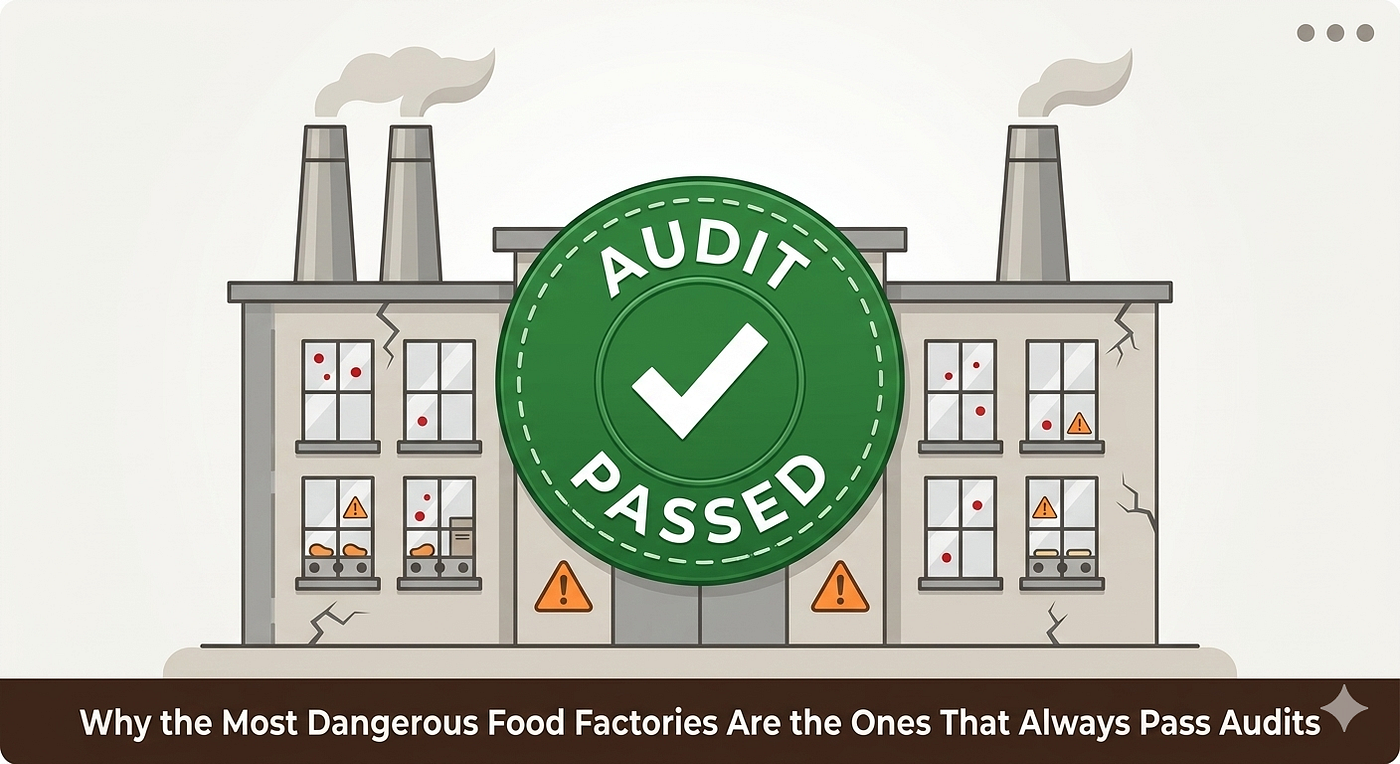
There is a factory somewhere right now with a laminated certificate on the wall, a filing cabinet full of clean audit reports, and a compliance score that would make any regulator nod with satisfaction. The floors are clean when the auditor walks in. The records are organized. The staff know exactly what to say when asked about their procedures.
And somewhere in that same factory, there is a problem nobody is looking for.
This is not a rare situation. It is one of the worst kept secrets in food manufacturing. The facilities that scare quality professionals the most are not the messy ones with obvious violations. They are the polished ones that have learned how to perform compliance rather than practice it.
When Passing Becomes the Goal
Food safety audits were designed to protect consumers. But over time, something shifted in how manufacturers relate to them. For many facilities, audits stopped being a tool for finding problems and became a test to pass.
That shift changes everything.
When passing the audit becomes the primary objective, the entire operation quietly reorganizes around it. Teams are briefed before auditor arrival. Problem areas get attention in the days leading up to a visit. Paperwork gets reviewed and corrected. The refrigerator temperatures that have been drifting get adjusted. The maintenance log that was behind gets filled in. Then the auditor walks in, sees what looks like a well-run operation, and scores it accordingly. This is not always deliberate deception. In many cases it is just human nature. People prepare for tests. The problem is that food safety is not a test with a date you can prepare for. Contamination does not check the audit calendar before it shows up.
The Score That Hides More Than It Reveals
A high audit score creates a dangerous kind of confidence. Leadership sees the number and assumes the operation is under control. Compliance managers feel the pressure to maintain it. Supervisors on the floor know that anything that threatens the score is a problem to manage quietly.
This is how small issues stop getting reported.
A line supervisor notices that the temperature log is being filled in at the end of the shift instead of in real time. They mention it once, get told not to worry about it, and never bring it up again. A sanitation team member sees residue in a hard to reach area behind a piece of equipment but cleaning that area would mean stopping the line and delaying production. It gets noted internally and never escalated. None of these individual moments look like a crisis. Together, they are exactly how outbreaks start. The score on the last audit report says nothing about what is happening at 2am on a Tuesday when the auditor is nowhere near the building.
What Auditors Often Cannot See
This is not a criticism of auditors. Most food safety auditors are experienced professionals doing a genuinely difficult job under time pressure and with limited access.
The problem is structural.
An announced audit gives a facility time to prepare. Even unannounced audits have limitations because an auditor can only observe what is happening during their visit and what is recorded in documents. They cannot see the shortcuts that happen consistently but stopped for the day. They cannot feel the cultural pressure that discourages workers from flagging problems. They cannot know which records reflect reality and which reflect what someone wished was reality.
The audit captures a moment. Food safety requires consistent behavior across every shift, every week, every season. Those are two very different things and most audit formats were not built to bridge that gap.
The Factories That Actually Worry About This
Here is what is interesting. The food manufacturers with the strongest actual safety records are rarely the ones boasting about their audit scores.
They are the ones that treat a clean audit with a degree of suspicion.
A quality director at a mid-sized bakery once put it simply. When the auditor finds nothing, we go looking harder ourselves. Because either we have genuinely solved our problems or we have gotten good at hiding them, and we need to know which one it is.
That mindset is rare. But it is exactly the kind of thinking that separates facilities where safety is a genuine operating principle from those where it is a presentation.
These manufacturers invest in internal audit programs that are intentionally harder than their external audits. They train employees to report problems without fear of consequences. They track near misses and deviations the same way they track nonconformities. They know that the value of an audit is not the score at the end. It is what gets uncovered in the process.
Corrective Actions That Close on Paper and Nowhere Else
One of the most reliable signs of a facility that performs compliance rather than practices it is what happens after a finding is raised.
In too many operations, a corrective action gets logged, a manager signs off, and the issue gets marked as resolved. Nobody follows up three months later to see if it actually changed anything. Nobody checks whether the same finding appeared in the previous audit cycle. Nobody asks why this keeps coming up.
Recurrence is one of the most telling indicators in food safety management and it gets almost no attention in standard audit programs. When the same type of finding appears in three consecutive audits, it is no longer a finding. It is a system failure. And a system failure with a closed corrective action attached to it is the most dangerous kind because everyone believes it has already been handled.
What Compliance Managers and Business Owners Need to Hear
If you are responsible for food safety in your organization, the audit certificate on the wall is not the thing that protects you when something goes wrong.
What protects you is whether your facility actually operates the way your documents say it does, every day, not just when someone is watching.
The regulatory consequences of a foodborne illness linked to your product are significant. The brand damage can take years to recover from if recovery is even possible. The human cost does not have a number attached to it.
None of that cares how well you scored on your last third party audit.
The manufacturers who sleep well at night are not the ones with the highest scores. They are the ones who have built a culture where problems surface early, where workers feel safe raising concerns, where the internal audit program is designed to be harder than the external one, and where a clean audit result is followed by a question rather than a celebration.
The Question Worth Asking
If your facility passed every audit in the last three years, ask yourself honestly whether that is because your operation is genuinely that well controlled or because your team has gotten very good at knowing what auditors look for.
If the honest answer makes you uncomfortable, that discomfort is valuable. It means you are seeing the gap that most facilities do not notice until something has already gone wrong.
The most dangerous factories are not the ones regulators are watching closely. They are the ones nobody thinks to watch at all because the paperwork is always perfect.
And the first step toward real food safety is admitting that passing audits and being safe are not always the same thing.
메타데이터
- post_id
- 0ff81fdfaf03
- slug
- why-the-most-dangerous-food-factories-are-the-ones-that-always-pass-audits-0ff81fdfaf03
- url
- https://medium.com/@AseefSA/why-the-most-dangerous-food-factories-are-the-ones-that-always-pass-audits-0ff81fdfaf03
- canonical_url
- https://medium.com/@AseefSA/why-the-most-dangerous-food-factories-are-the-ones-that-always-pass-audits-0ff81fdfaf03
- author_url
- https://medium.com/@AseefSA
- status
- ok
- fetched_at
- 2026-06-13 16:00:06