Want to Try Lifestyle Before Statins? Start With Breakfast
An evidence-based Anchor Meal experiment for testing whether food can move the needle on your next lipid panel.
Want to Try Lifestyle Before Statins? Start With Breakfast
An evidence-based Anchor Meal experiment for testing whether food can move the needle on your next lipid panel.
Image created by the author using Fotor.
What is New
If you are sitting on the statin fence, “I want to try lifestyle first” is not enough. This post turns a vague promise into an evidence-based breakfast intervention: a modular anchor-meal smoothie designed around viscous fiber, plant sterols, protein, unsaturated fats, polyphenols, nitrate-rich inputs, and measurable lipid outcomes.
Why it Matters
Lifestyle advice usually fails because it asks you to improve your entire diet at once. This approach targets one repeatable meal instead: breakfast. Build it correctly, use it daily for 8–12 weeks, and your next lipid panel can tell you whether your non-drug experiment moved the needle enough to matter.
Your Takeaways
- The Plumbing: How viscous fibers and plant sterols physically intercept cholesterol in your gut and prevent it from entering your circulation.
- The Rules: The five non-negotiable ingredient modules required to move the needle on your next lipid panel.
- The Blueprint: A modular matrix to build a personalized, evidence-based smoothie that will not trigger a glucose spike.
Table of Contents:
**Sitting on the Statin Fence [What this Smoothie Can and Cannot Do](#6158) [Every Ingredient Has a Job](#bb54) Module 1: Build the bile-acid trap Module 2: Block cholesterol at the gate Module 3: Renovate the fat-protein architecture Module 4: Add the endothelial shield Module 5: Prevent the smoothie from becoming dessert [The Modular Lipid-Lowering Anchor Meal Recipe](#df7d) [The Verdict: Test it for 12 Weeks, Then Check the Panel](#df4e) [Cited References](#3d5a)**
Sitting on the Statin Fence
There is this pain-in-the-butt place on the statin fence where you sit when your doctor tells you about your cholesterol level being too high, but your willingness to accept a lifelong statin prescription is too low to act. I understand that position. That’s why, in my preceding post, I gave you the tools and framework to make a better-informed joint decision with your doctor.
If yours is “I want to try lifestyle first”, this post is for you.
Because far too often, that decision is nothing more than a vague promise to eat better, buy oats, banish butter, and pray to the cholesterol Gods for a miraculously improved next blood test.
You may talk yourself into believing that this is a strategy. It isn’t. It’s a delay tactic fueled by influencers, supplement manufacturers, and health bloggers angling for likes, followers, and affiliate dollars.
If you want your diet choices to move the needle on your lipid profile, there is good news and bad news. The bad news is that your nutrition has to be re-engineered like an intervention. The good news is that the re-engineering doesn’t need to upend all your diet habits. Only one.
In an earlier post, I introduced the concept of the Anchor Meal. The one daily meal designed to get you covered against the nutrient deficiencies to which all the other daily meals (aka your regular diet) might expose you. The one daily meal that for most of us is the same every day: Breakfast! After all, hardly anybody wakes up every morning contemplating what to have for breakfast.
What if breakfast could be redesigned to help you:
- lower your cholesterol and triglycerides,
- deliver your daily dose of (almost) all required nutrients, and
- maintain your other meal preferences
That Anchor Meal is your personalized breakfast smoothie. It’s designed to replace breakfast, not just accompany it. You build it once, make it your daily routine, and have an evidence-based shot at meaningfully lowering your cholesterol.
I originally developed the Anchor Meal smoothie for decelerating vascular aging, not for dialing down cholesterol. The principle, however, applies mutatis mutandis. In fact, we’ll design a smoothie that combines both objectives.
So, let’s break down how to build it around viscous fiber, (plant) protein, unsaturated fats, polyphenols, nitrate-rich inputs, and what the minimum ingredient thresholds are to actually move the needle on your next blood test.
But before we start, I need to caution you about …
What this Smoothie Can and Cannot Do
It can help you run an evidence-based non-drug N-of-1 experiment. It can increase viscous fiber, displace saturated-fat-heavy breakfast choices, improve protein and micronutrient density, raise polyphenol and nitrate exposure, and give you a repeatable daily meal whose physiological effects can be checked against your next lipid panel.
It cannot override familial hypercholesterolemia, erase a high Lp(a), undo decades of atherosclerotic plaque, or replace medication in someone whose absolute cardiovascular risk is high enough to justify pharmacological LDL lowering.
In other words, this is not a statin substitute. It is a version of the 2026 ACC/AHA multisociety dyslipidemia guideline’s “lifestyle first” routes that deserves to be taken seriously because it is evidence-based, individualized, and sustainable.
Every Ingredient Has a Job
How to make a smoothie healthy would be the wrong question to ask. Every TikTok weirdo has their personal, and often wacky, idea of what constitutes ‘healthy’. The right question is: does the smoothie contain (a) the required functional modules at (b) doses high enough to matter?
In our case, that means every component must earn its place in one of the five modules that canonize the smoothie to a potentially protective anchor meal.
Module 1: Build the bile-acid trap
The bile acid trap is a sneaky workaround. The liver produces bile acids using cholesterol as “raw material”, and pumps them into the gall bladder. The latter releases the bile into the intestine once your food delivers fat and protein.
Most of the bile acids in the gut are reabsorbed and recycled by the liver, which dispatches them back into the gall bladder. Block that reabsorption, and the liver needs to replace the missing bile acids, by, you guessed it, pulling cholesterol from the blood into its bile production line [1].
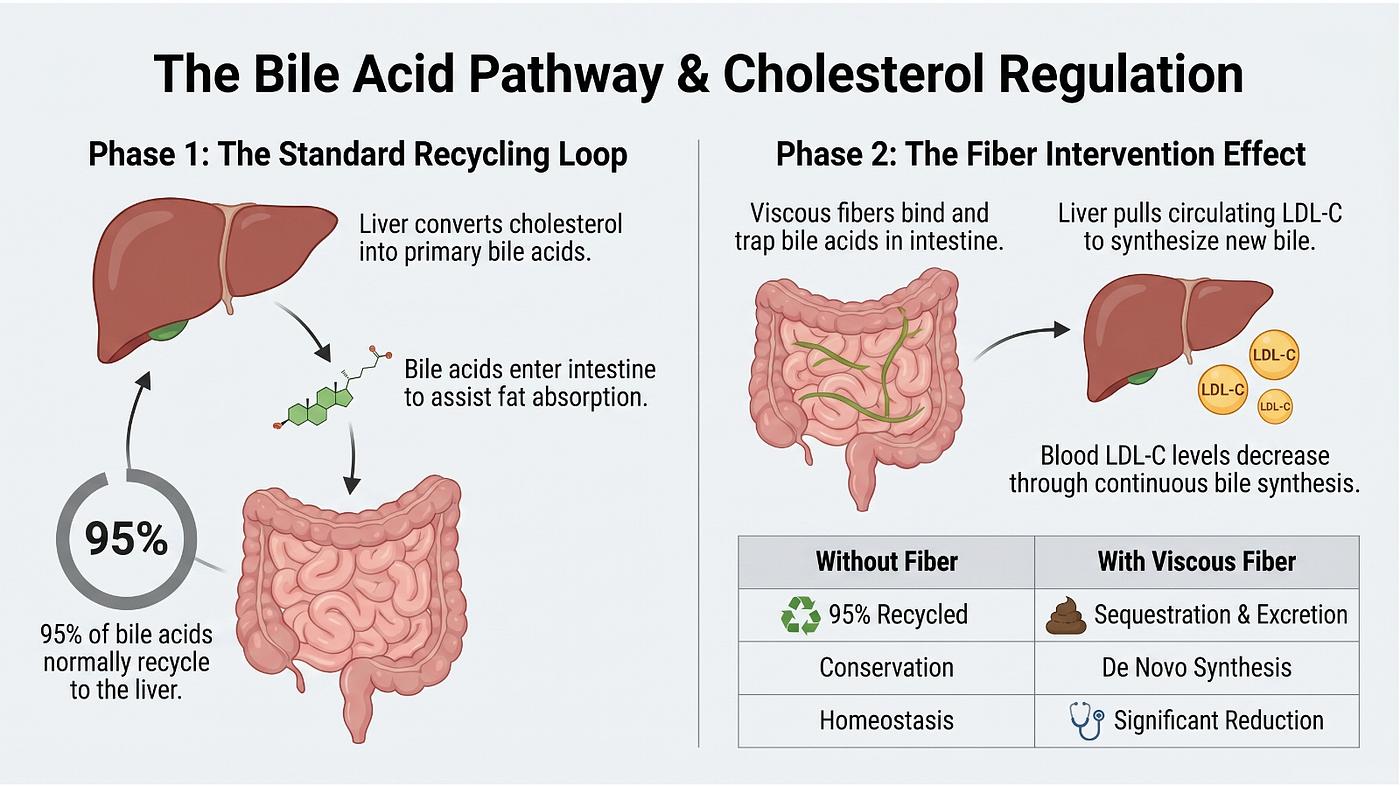
Image created by the author.
In short:
- The liver converts cholesterol into bile acids.
- Bile acids are secreted into the intestine to help absorb fat.
- Normally, most bile acids are reabsorbed and recycled back to the liver.
- Viscous fibers interfere with that recycling by retaining bile acids in the intestinal content or binding them directly.
- The liver then needs to synthesize more bile acids from circulating cholesterol, which lowers blood LDL-C over time.
The most effective traps for bile acids are viscous fibers such as the beta-glucans of oat and barley [2] and psyllium [3]. Their effect is not as dramatic as the effects of statins. The drugs directly dial down the liver’s bottleneck enzyme for cholesterol production (HMG-CoA reductase). It is the difference between compromising a factory’s recycling loop and shutting down the assembly line altogether.
Viscous fiber offers one of the few dietary mechanisms with enough evidence and biological plausibility to deserve a fixed place in our lipid-lowering anchor meal.
Of course, the dose matters. A decorative spoonful of oats makes your smoothie as therapeutic as a leaf of lettuce makes your Big Mac a Mediterranean Diet meal.
For oat or barley beta-glucan, the practical target is about 3 grams of beta-glucan per day [2]. Depending on the product, that may require a meaningful portion of oat bran, barley beta-glucan powder, or another concentrated source.
The equivalent Psyllium dose is somewhere between 5 and 10 grams. While 10 grams per day is closer to what is often used in cholesterol-lowering studies, some people need to slowly escalate their intake to tolerate it better [3].
A practical consideration: viscosity is the point, but it also affects the texture of your smoothie. Add too much, and it becomes gluey. It can also delay or reduce the absorption of some oral medications if taken too close to them. So, it is generally best to take medicines at least 2 hours before or 2 hours after psyllium.
For my lipid-lowering version of the anchor meal, this module is non-negotiable. You may choose the vehicle: oat beta-glucan, barley beta-glucan, psyllium, or a combination. But if your goal is to test whether breakfast can move LDL-C, non-HDL-C, or ApoB in the right direction, the bile-acid trap has to be there. Otherwise, you are not really designing a lipid-lowering smoothie. You are just blending a healthier breakfast.
Module 2: Block cholesterol at the gate
If viscous fiber breaks the bile acid recycling loop, plant sterols and stanols directly block cholesterol entry. They do that by competing with cholesterol for the vehicles that taxi cholesterol to the gut’s wall for uptake into the circulation.
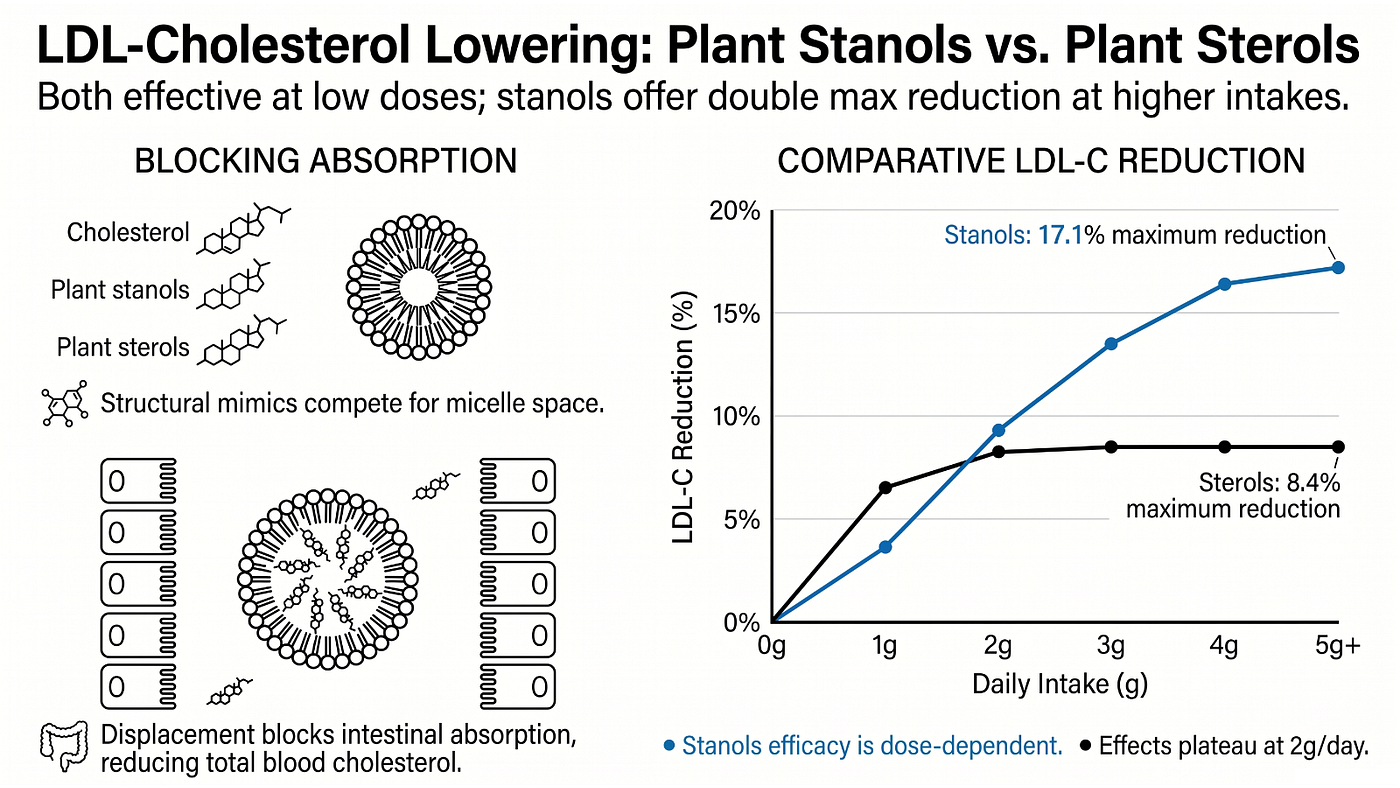
Image created by the author?
Think of sterols and stanols as botanical lookalikes of cholesterol. The taxi driver thinks it’s cholesterol, so he accepts the fare, drops the lookalike at the border, and leaves a legitimate passenger (cholesterol) stranded in the gut [4]. And “stranded in the gut” is a euphemism for “down the toilet”.
The border guards are not as blind as the taxi drivers. They recognize the ‘fake’ cholesterol and throw it back into the gut (aka the toilet destination). So, neither the cholesterol nor the sterol/stanol shows up behind the border in the circulation.
The less cholesterol enters the circulation, the more leaves with the stool, the more the liver has to compensate by pulling LDL cholesterol out of the circulation.
How large is the effect? Large enough to significantly (in statistical terms) lower blood cholesterol. The National Lipid Association boiled it down to a 7–10% reduction per 2 grams of sterols/stanols.
But throwing a few nuts, seeds, or vegetables into your blender won’t do the trick. To make this module work, you need a fortified product or a plant sterol/stanol powder to deliver that dose. If the product provides 2 grams per serving, add one serving to your smoothie. If it provides less, adjust the dose. The legitimacy of this module is in its well-established evidence [4].
There is a caveat, though (as if there ever was no caveat):
Plant sterols and stanols are not for people with sitosterolemia.
That’s a rare genetic disorder. Contrary to ‘normal’ people, carriers of a particular gene have ‘blind border guards’. They let sterols/stanols pass into the circulation as if they were ‘real’ cholesterol with the added advantage of diplomatic immunity. No obstructions at all. Since the liver can’t shove those sterols/stanols into the bile acid department, they accumulate in the blood, ramping up blood cholesterol to levels that can become indistinguishable from familial hypercholesterolemia, often leading clinicians on a diagnostic wild goose chase [5].
So, unless you are one of the very rare sitosterolemia specimens, if you want the strongest LDL-focused version of the anchor smoothie, add a properly dosed plant sterol/stanol module to the bile acid trap.
Module 3: Renovate the fat-protein architecture
It is about replacing saturated with unsaturated fat, refined with complex carbohydrates, and adding more protein and whole-food matrix.
That’s where the nuts, seeds, and plant proteins come in. They deliver unsaturated fats, fiber, minerals, phytosterols, and polyphenols in a compact whole-food package. But ‘replacement’ is the magic word. Nuts instead of a croissant are a lipid intervention. Nuts on top of that croissant are just extra calories wearing a phony halo. That’s a reminder why our anchor meal smoothie should not be an add-on to your breakfast but its replacement.
Pistachios, walnuts, and almonds are the most effective tree nuts for improving cholesterol profiles [6], [7].
Chia seeds affect cholesterol metabolism through several pathways [8]:
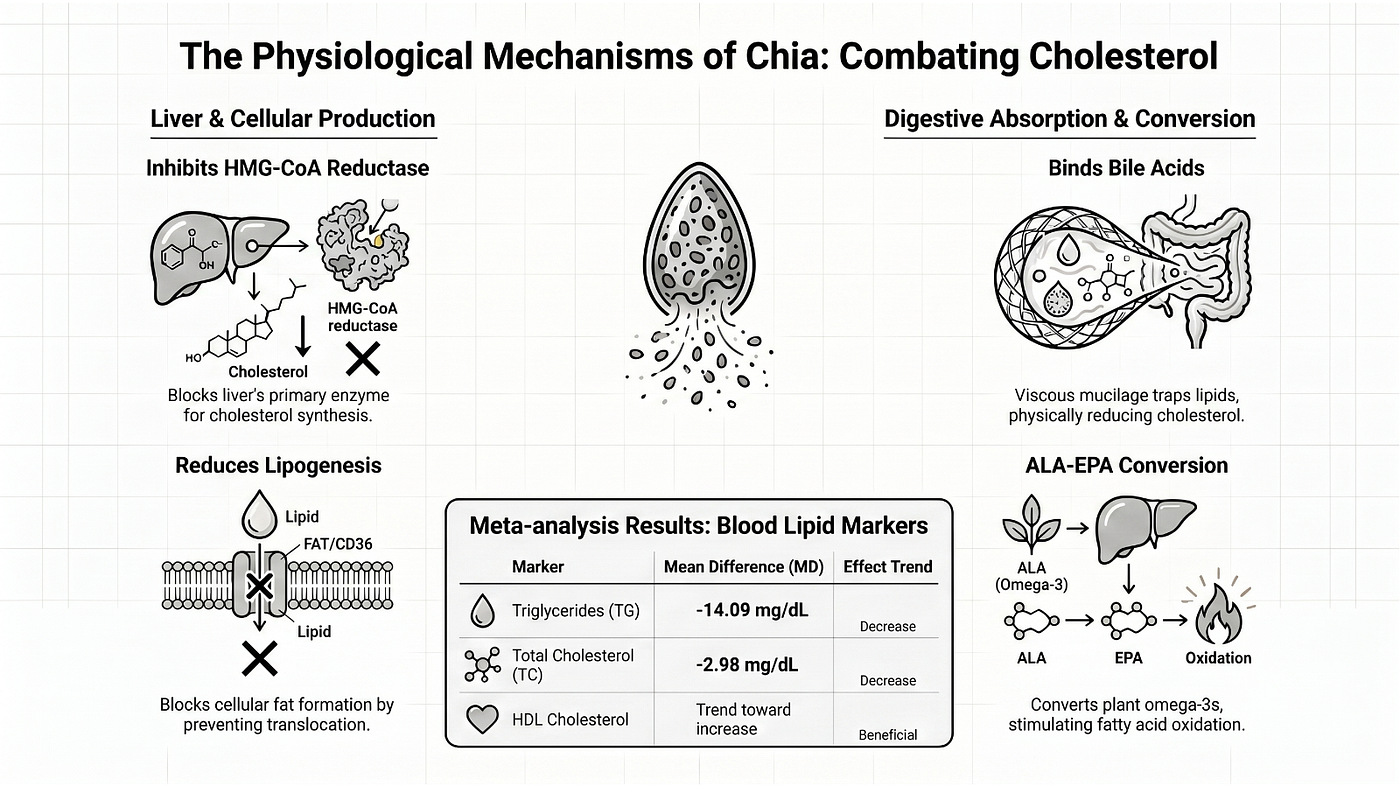
Image created by the author
Soy protein, specifically soy milk, may lower cholesterol by dialing down the liver’s synthesis of Apolipoprotein B (apo(B)), the structural protein that is part of all non-HDL cholesterol [9]. In my preceding post, I explain apo(B)’s role as a diagnostic tool to gauge the atherosclerotic payload of your cholesterol panel.
Module 4: Add the endothelial shield
The first three modules target lipids. They are about trapping bile acids, reducing cholesterol absorption, and renovating the fat-protein-fiber architecture of breakfast.
But your cardiovascular disease risk (CVD risk) isn’t driven by cholesterol only. It’s largely driven by how permissive the arterial walls are to being damaged by cholesterol. That’s a function of vascular aging (relative to chronological age). I have discussed this issue in the first post about the Anchor Meal, which I designed specifically to decelerate or even reverse that aging process (to a degree).
That post presented a smoothie focused on: polyphenol density, nitrate-rich vegetables, berries, cocoa, avocado, beetroot juice, potassium-rich foods, essential fatty acids, extra-virgin olive oil, and bioavailability tricks such as lemon juice, turmeric, and black pepper.
They are not cholesterol-lowering weapons in the same sense as psyllium, beta-glucan, or plant sterols. But the synergy is obvious. It’s about strengthening the endothelial shield while reducing the potentially damaging firepower of the blood lipids.
I will not rebuild the argument of the first post here. Please refer back to it for clarity about the smoothie’s vascular aging design and issues like how to optimize texture (think frozen fruits and avocados).
So, for this module, I keep the rule simple. A lipid-lowering anchor smoothie should include at least one nitrate-rich input, at least one dark berry or cocoa-based polyphenol source, and at least one potassium-supporting ingredient.
The next and final module exists because …
…a smoothie can be healthy in intent for everyone but disastrous in metabolic reality for some.
Module 5: Prevent the smoothie from becoming dessert
If your triglycerides are high, your waist is expanding, and your blood glucose is elevated, then the smoothie has to be designed with glycemic and caloric control in mind.
It needs enough protein to slow gastric emptying and maintain satiety. It needs viscous fiber to blunt absorption and support lipid control. And it needs low-sugar fruits, preferably berries, rather than a tropical-fruit overload.
That brings us to the actual recipe.
The Modular Lipid-Lowering Anchor Meal Recipe
The build is modular, but not infinitely flexible. If everything is optional, the smoothie stops being an intervention and becomes a buffet.
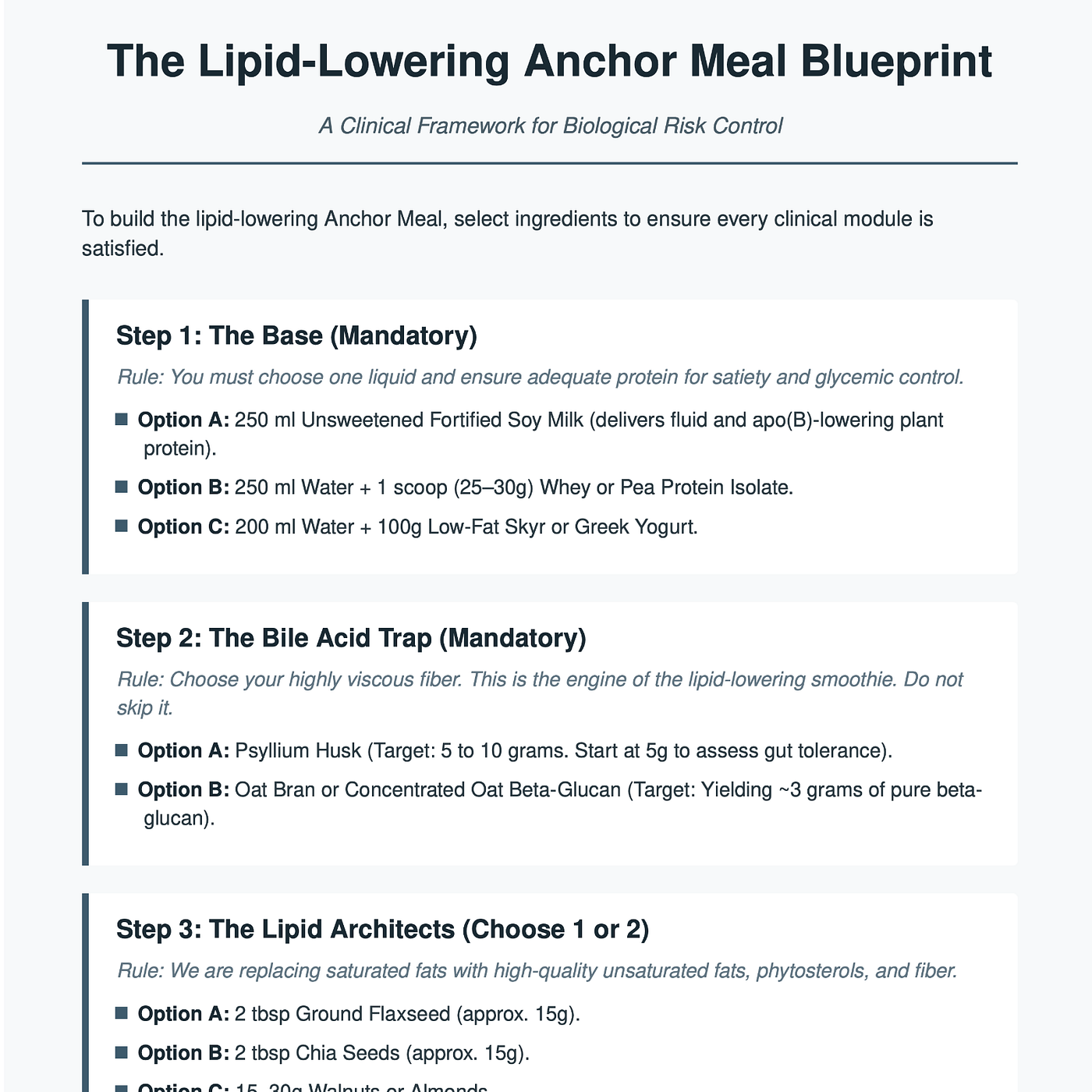
You can download the complete PDF by clicking on this image.
The non-negotiables are the functional categories: a protein base, a viscous-fiber/bile-acid trap, a vascular polyphenol/nitrate layer, and a metabolic-control structure that prevents the smoothie from becoming a liquid dessert. Within those categories, you can choose the ingredients that fit your preferences and lipid target.
The Verdict: Test it for 12 Weeks, Then Check the Panel
When you are sitting on the statin fence, opting for the “lifestyle first” route makes sense only if you treat your diet with the precision of a prescription.
The Anchor Meal is designed to help you achieve that. It’s an evidence-based attempt at lowering your cholesterol, but with a nod to the fact that most of us are irretrievably hooked on less-than-prudent dietary habits.
I conceived of the Anchor Meal smoothie as a morning vaccine against the fallout of feeding failures.
In my original post, I presented the rationale, the evidence, and the sample recipe for a smoothie aimed at decelerating vascular aging. That’s the measurable and modifiable biomarker for health and life expectancy. In that post, you’ll find a lot more information and resources about nutrient sufficiency, the interactions between smoothie components, and how to exploit these interactions for improved nutrient bioavailability.
Your Next Step: Download the Modular Anchor Meal Blueprint, start designing your personal “lifestyle first” strategy, and lock down your morning routine for the next 12 weeks. Then let’s see what your next lipid panel says.
Subscribers of my **Double Check Doc** Substack have access to the interactive AI Interrogation Room to tailor their breakfast smoothie to their metabolic constraints and biomarker profiles.
Example Prompts:
- “I am a 55-year-old postmenopausal woman with elevated LDL and pre-diabetes. Using the blueprint, calculate a 5-module Anchor Meal that hits the 3g beta-glucan threshold without triggering a postprandial glucose spike.”
- “Summarize the mechanism of the bile-acid trap based on the uploaded clinical literature.”
- “I cannot tolerate psyllium husk. Based on the matrix, what is my exact required dose of oat bran to achieve the same mechanical lipid-lowering effect?”
If you want to get notified whenever I publish something new (once or twice a week), simply subscribe here. Or on my Substack Double Check Doc


Cited References
[1] P. Gunness and M. J. Gidley, “Mechanisms underlying the cholesterol-lowering properties of soluble dietary fibre polysaccharides,” Food Funct., vol. 1, no. 2, pp. 149–155, Nov. 2010, doi: 10.1039/C0FO00080A.
[2] A. Whitehead, E. J. Beck, S. Tosh, and T. M. Wolever, “Cholesterol-lowering effects of oat β-glucan: a meta-analysis of randomized controlled trials,” Am. J. Clin. Nutr., vol. 100, no. 6, pp. 1413–1421, Dec. 2014, doi: 10.3945/ajcn.114.086108.
[3] E. Jovanovski et al., “Effect of psyllium (Plantago ovata) fiber on LDL cholesterol and alternative lipid targets, non-HDL cholesterol and apolipoprotein B: a systematic review and meta-analysis of randomized controlled trials,” Am. J. Clin. Nutr., vol. 108, no. 5, pp. 922–932, Nov. 2018, doi: 10.1093/ajcn/nqy115.
[4] K. Musa-Veloso, T. H. Poon, J. A. Elliot, and C. Chung, “A comparison of the LDL-cholesterol lowering efficacy of plant stanols and plant sterols over a continuous dose range: Results of a meta-analysis of randomized, placebo-controlled trials,” Prostaglandins Leukot. Essent. Fatty Acids, vol. 85, no. 1, pp. 9–28, Jul. 2011, doi: 10.1016/j.plefa.2011.02.001.
[5] K. Farzam and R. T. Morgan, “Sitosterolemia (Phytosterolemia),” in StatPearls, Treasure Island (FL): StatPearls Publishing, 2026. Accessed: May 28, 2026. [Online]. Available: http://www.ncbi.nlm.nih.gov/books/NBK572142/
[6] D. K. Banel and F. B. Hu, “Effects of walnut consumption on blood lipids and other cardiovascular risk factors: a meta-analysis and systematic review123,” Am. J. Clin. Nutr., vol. 90, no. 1, pp. 56–63, Jul. 2009, doi: 10.3945/ajcn.2009.27457.
[7] I. A. Martínez-Ortega et al., “Can different types of tree nuts and peanuts induce varied effects on specific blood lipid parameters? A systematic review and network meta-analysis,” Crit. Rev. Food Sci. Nutr., vol. 65, no. 8, pp. 1538–1552, Mar. 2025, doi: 10.1080/10408398.2023.2296559.
[8] L. de A. Silva, B. J. F. Verneque, A. P. L. Mota, and C. K. Duarte, “Chia seed (Salvia hispanica L.) consumption and lipid profile: a systematic review and meta-analysis,” Food Funct., vol. 12, no. 19, pp. 8835–8849, Oct. 2021, doi: 10.1039/d1fo01287h.
[9] S. Blanco Mejia et al., “A Meta-Analysis of 46 Studies Identified by the FDA Demonstrates that Soy Protein Decreases Circulating LDL and Total Cholesterol Concentrations in Adults,” J. Nutr., vol. 149, no. 6, pp. 968–981, Jun. 2019, doi: 10.1093/jn/nxz020.
[10] K. Liu, S. Hui, B. Wang, K. Kaliannan, X. Guo, and L. Liang, “Comparative effects of different types of tree nut consumption on blood lipids: a network meta-analysis of clinical trials,” Am. J. Clin. Nutr., vol. 111, no. 1, pp. 219–227, Jan. 2020, doi: 10.1093/ajcn/nqz280.
메타데이터
- post_id
- 106c19384b66
- slug
- lipid-lowering-breakfast-smoothie-106c19384b66
- url
- https://medium.com/read-or-die-hq/lipid-lowering-breakfast-smoothie-106c19384b66
- canonical_url
- https://medium.com/read-or-die-hq/lipid-lowering-breakfast-smoothie-106c19384b66
- author_url
- https://medium.com/@lutzkraushaar
- status
- ok
- fetched_at
- 2026-06-09 15:37:30