Powering High-Density, Multi-Language Streaming: Lessons from G&L’s European Parliament Project
Streaming at scale is a complex challenge, particularly for government institutions that require reliability, security, and accessibility…
Powering High-Density, Multi-Language Streaming: Lessons from G&L’s European Parliament Project

Streaming at scale is a complex challenge, particularly for government institutions that require reliability, security, and accessibility. The European Parliament needed a high-density, multi-language streaming platform capable of handling 30 live channels, each with 32 simultaneous audio tracks. This level of complexity necessitated a solution that strikes a balance between efficiency, performance, and flexibility.
Engineering a Scalable, Secure, and Efficient Streaming Solution
To meet these challenges, G&L Systemhaus, a leading systems integrator, designed an innovative hybrid cloud solution. This system leveraged NETINT VPUs for video encoding, Ampere CPUs for high-efficiency audio processing, and Akamai’s Connected Cloud for scalability. By combining on-premises and cloud-based resources, the solution ensured both reliability and cost efficiency while maintaining seamless content distribution across various platforms.
For video streaming engineers, this project offers valuable insights into high-density encoding, cloud scalability, security, redundancy, and automation. Whether working on government streaming, enterprise workflows, or large-scale OTT solutions, these lessons provide a framework for optimizing streaming infrastructure.
“Reliable must not fail. That’s a pretty hard requirement. Must not fail. No negotiation on that one.”
— Alexander Leschinsky, G&L, on government-grade infrastructure
Managing 960 Audio Streams in Real Time
The European Parliament broadcasts multi-language sessions with live interpretation, which requires up to 32 audio tracks per video stream. In total, the platform processes nearly 1,000 concurrent audio streams that must be encoded and distributed in real-time. Managing this level of audio complexity presents unique challenges, particularly when ensuring synchronization, maintaining audio quality, and optimizing resource utilization.
To address this, G&L deployed high-core-count Ampere CPUs, each with 128 cores, in single-server deployments. These CPUs were explicitly chosen for their ability to handle a large number of concurrent threads efficiently. Audio transcoding was managed directly on the CPU to maximize flexibility and maintain high throughput. Additionally, the system was designed to accommodate legacy signals that required deinterlacing before processing.
High-core-count CPUs are particularly well-suited for large-scale audio transcoding tasks where video processing units (VPUs) may not provide the necessary application support. Engineers designing similar workflows should consider leveraging CPUs for tasks that require adaptability while reserving hardware acceleration for video-intensive workloads.
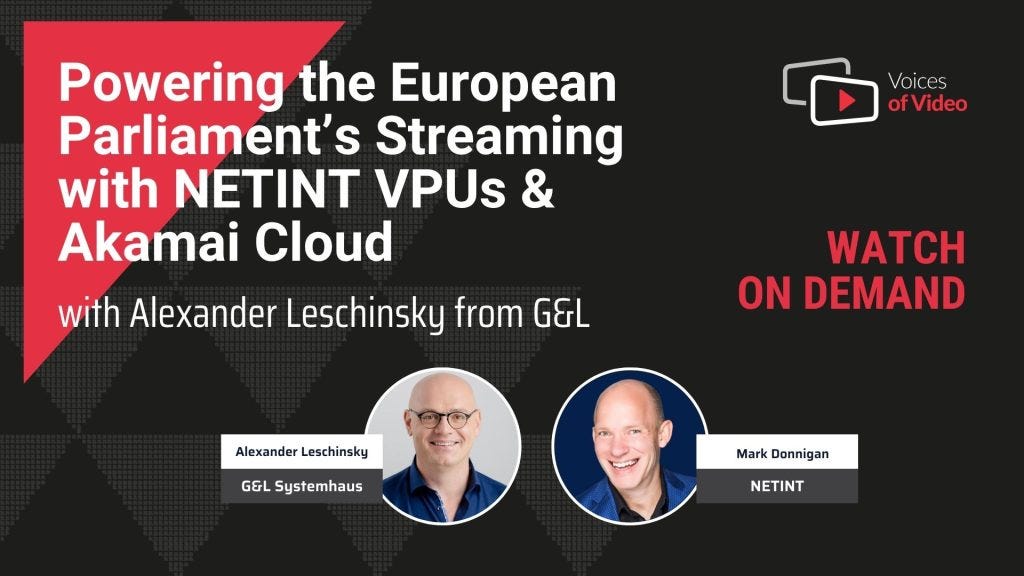
**Powering the European Parliament’s Streaming with NETINT VPUs & Akamai Cloud – Voices of Video with Alexander Leschinsky from G&L**
Why Hybrid Cloud is the Best Approach for Large-Scale Streaming
Balancing on-premises and cloud-based processing is one of the most critical decisions in modern streaming workflows. For government infrastructure, security and reliability are essential, while cloud-based architectures provide scalability and cost advantages. This requires an approach that effectively combines both environments.
G&L implemented a hybrid workflow that used on-premises NETINT VPUs for encoding and the Akamai Connected Cloud for transcoding, ABR packaging, and global distribution. This setup enabled the system to maintain the security of sensitive content while also providing the scalability necessary for fluctuating demand. Redundant on-premises and cloud workflows ensured that failover mechanisms were in place to prevent service interruptions.
Hybrid cloud architectures provide flexibility by enabling engineers to process mission-critical tasks locally while leveraging cloud resources for scalability. To achieve seamless integration, careful attention must be given to how data is transferred between environments, ensuring that no quality degradation or latency is introduced in the process.
NETINT VPUs: The Key to Efficient, Scalable Video Encoding
Encoding high-quality video at scale without overloading compute resources is a fundamental challenge in video streaming. With 30 live channels running continuously, CPU-based encoding alone would have resulted in excessive power consumption and inefficient hardware utilization.
G&L integrated NETINT VPUs to handle high-density encoding, achieving hardware-accelerated H.264 and HEVC encoding with an easy path to AV1, while reducing CPU load by up to 80%. This significantly freed up computational resources for other essential tasks, such as managing metadata and processing audio. Compared to GPU-based encoding solutions, ASIC-powered encoding provides a more energy-efficient alternative with lower operational costs by as much as 6 times.
For large-scale streaming applications, ASIC-based encoding is an effective approach for reducing power consumption and maximizing encoding density. Engineers seeking to optimize performance should evaluate the benefits of dedicated video processing hardware to offload tasks from general-purpose central processing units (CPUs).
“It’s 30 live channels… Each comes with 32 audio tracks… roughly 960 audio tracks that we have to encode and transcode. So that’s a lot. That’s a real lot.”
— Alexander Leschinsky, G&L, on government-grade infrastructure
Redundancy and Failover: Avoiding Downtime at Scale
Ensuring uninterrupted service is a critical requirement for government streaming platforms. The European Parliament’s system could not afford any downtime, making redundancy and failover mechanisms essential components of the architecture.
G&L designed a geographically redundant system with multiple failover layers. The on-premises infrastructure included NETINT-powered encoders, but if those systems became unavailable, cloud encoders in Akamai Connected Cloud could take over. A 24/7 buffering system using ring buffers ensured that no content was lost even in the event of hardware failures or network interruptions. Additionally, the infrastructure was distributed across multiple locations, including Brussels, Strasbourg, Frankfurt, and Amsterdam, to mitigate further risks associated with localized disruptions.
Streaming redundancy should be an integral part of workflow design from the beginning rather than an afterthought. Deploying multi-region architectures and implementing buffering systems can help maintain seamless service in the face of technical failures.
“Customers need results, not just raw tech. We integrate all this stuff and make it into something you can start working with.”
— Alexander Leschinsky, G&L, on government-grade infrastructure
Automating Live Clipping and Social Media Distribution
Political and government content is often consumed in short segments rather than full sessions. To enhance accessibility and engagement, the European Parliament required a way to extract and distribute specific portions of live content efficiently. Manually editing video content for social media distribution is impractical, so an automated approach was necessary.
G&L implemented a real-time clipping tool that allowed operators to select specific timestamps and generate shareable clips instantly. This automation enabled content to be published to platforms like Facebook, X, and LinkedIn while the live stream was still ongoing. Language-specific clips were also generated to ensure that different audiences could access content in their preferred language.
Automated live clipping is an essential feature for maximizing the impact of streaming content. Engineers developing similar systems should consider integrating real-time clipping and distribution tools to enhance engagement and make content more accessible across platforms.
“We would have needed many more servers if we didn’t have the ASIC acceleration of the NETINT VPUs. That’s a real game changer for us.”
— Alexander Leschinsky, G&L, on government-grade infrastructure
Building a Future-Proof Streaming Workflow
The European Parliament’s streaming platform showcases how hybrid cloud architectures, VPUs, and automation can facilitate secure, scalable, and efficient streaming in high-demand environments. Engineers designing enterprise-grade streaming workflows can apply these insights to improve performance, reduce costs, and ensure reliability.
To implement these best practices, engineers should focus on optimizing CPU resources for audio processing, adopting a hybrid cloud model to balance security and scalability, leveraging dedicated video processing hardware for efficient encoding, designing with redundancy in mind to ensure 24/7 uptime, and automating content distribution to enhance audience reach. Video streaming engineers should consider how these technologies can be integrated into their workflows to drive efficiency and scalability.
Watch the full 2025 Streaming Summit Presentation: **https://youtu.be/bptt7xF2uQs**
by Mark Donnigan
메타데이터
- post_id
- 1077458f41fa
- slug
- powering-high-density-multi-language-streaming-lessons-from-g-ls-european-parliament-project-1077458f41fa
- url
- https://medium.com/@mt_32873/powering-high-density-multi-language-streaming-lessons-from-g-ls-european-parliament-project-1077458f41fa
- canonical_url
- https://medium.com/@mt_32873/powering-high-density-multi-language-streaming-lessons-from-g-ls-european-parliament-project-1077458f41fa
- author_url
- https://medium.com/@mt_32873
- status
- ok
- fetched_at
- 2026-06-25 12:15:08