The 5 Pillars of Code Longevity: Why S.O.L.I.D. Still Matters in 2026
Building a robust system requires more than just code that “works” — it requires an architecture that can evolve. The S.O.L.I.D. principles…
The 5 Pillars of Code Longevity: Why S.O.L.I.D. Still Matters in 2026
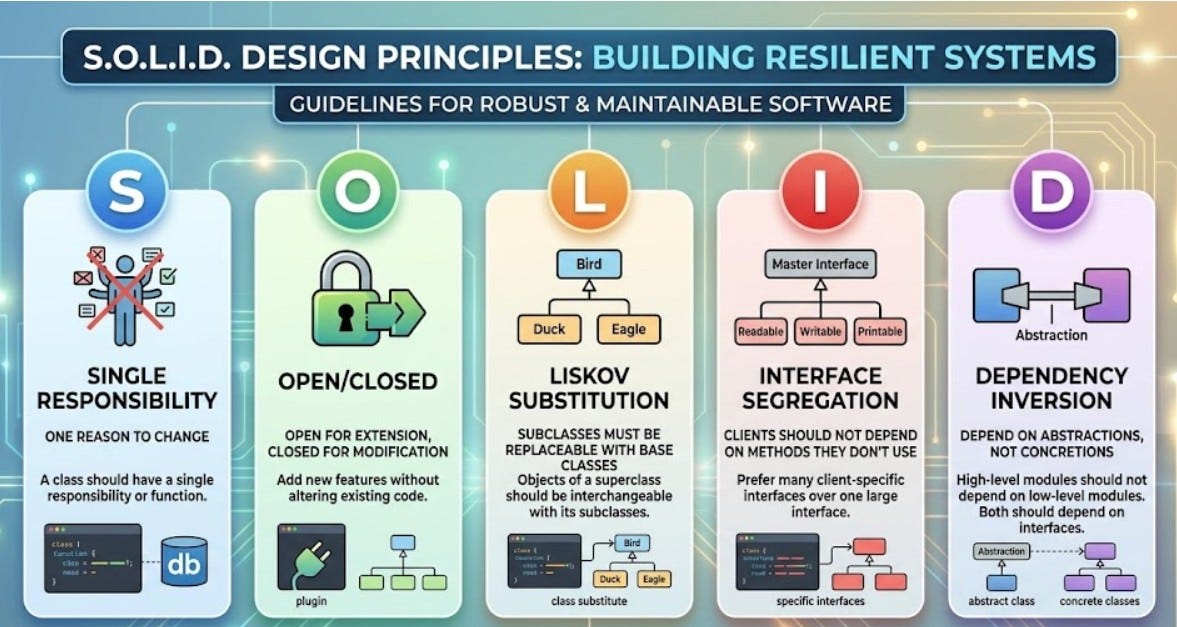
Building a robust system requires more than just code that “works” — it requires an architecture that can evolve. The S.O.L.I.D. principles are the industry standard for achieving this.
Below is a complete breakdown of each principle with real-world examples to help you transition from “coder” to System Architect.
1. Single Responsibility Principle (SRP)
“A class should have one, and only one, reason to change.”
The Problem: We often create “God Objects” — classes that handle database logic, logging, and business rules all at once. If you change your database schema, you risk breaking your logging logic.
- Bad Example: A Report class that calculates data and formats it for PDF.
- Good Example: Separate the ReportGenerator (logic) from the ReportFormatter (presentation).
2. Open/Closed Principle (OCP)
“Software entities should be open for extension, but closed for modification.”
The Problem: You shouldn’t have to rewrite existing, tested code to add a new feature. Instead, you should be able to “plug in” new behavior.
- The Solution: Use Interfaces or Abstract Classes.
- Example: If you have a PaymentProcessor, don’t use if/else for “CreditCard” or “PayPal.” Create a PaymentMethod interface and implement it for each new type. Existing code stays untouched; you just add a new class.
3. Liskov Substitution Principle (LSP)
“Objects of a superclass should be replaceable with objects of its subclasses without breaking the application.”
The Problem: A subclass should never “weaken” the behavior of its parent. If a function expects a Bird, and you pass it an Ostrich that throws an error when fly() is called, you’ve broken LSP.
- The Rule: Subclasses must be functionally compatible with their parents. If the subclass can’t do what the parent does, it shouldn’t be a subclass.
4. Interface Segregation Principle (ISP)
“Clients should not be forced to depend on methods they do not use.”
The Problem: Creating one massive “Master Interface” forces classes to implement empty methods just to satisfy the compiler.
- Bad Example: An IMachine interface with print(), scan(), and fax(). A simple printer class is now forced to “fax.”
- Good Example: Split it into IPrinter, IScanner, and IFax. Classes only implement what they actually need.
5. Dependency Inversion Principle (DIP)
“Depend on abstractions, not concretions.”
The Problem: High-level logic should not depend on low-level tools (like a specific database). If your “Business Logic” class directly creates an instance of “SQLServerClient,” you can never switch to Azure Cosmos DB without rewriting the whole core.
- The Solution: Use Dependency Injection. Pass the database interface into the constructor. The business logic doesn’t care which database is used, as long as it follows the interface.
Why Engineers Use S.O.L.I.D.
Implementing these principles ensures your system has three specific qualities:
- Maintainability: Small changes don’t cause a “ripple effect” of bugs.
- Testability: Because classes are small and decoupled, you can write clean Unit Tests.
- Extensibility: You can add the “Next Big Feature” in half the time.
Be S.O.L.I.D 😊
메타데이터
- post_id
- 10a16cfcd666
- slug
- the-5-pillars-of-code-longevity-why-s-o-l-i-d-still-matters-in-2026-10a16cfcd666
- url
- https://medium.com/@ashu667/the-5-pillars-of-code-longevity-why-s-o-l-i-d-still-matters-in-2026-10a16cfcd666
- canonical_url
- https://medium.com/@ashu667/the-5-pillars-of-code-longevity-why-s-o-l-i-d-still-matters-in-2026-10a16cfcd666
- author_url
- https://medium.com/@ashu667
- status
- ok
- fetched_at
- 2026-06-18 07:02:39






