Terakoya: A Glimpse into Education in the Tokugawa Era
These artworks in the insert, titled Bungaku Bandai no Takara (The Timeless Treasures of Literature), were painted by Issunshi Hanasato…
Terakoya: A Glimpse into Education in the Tokugawa Era
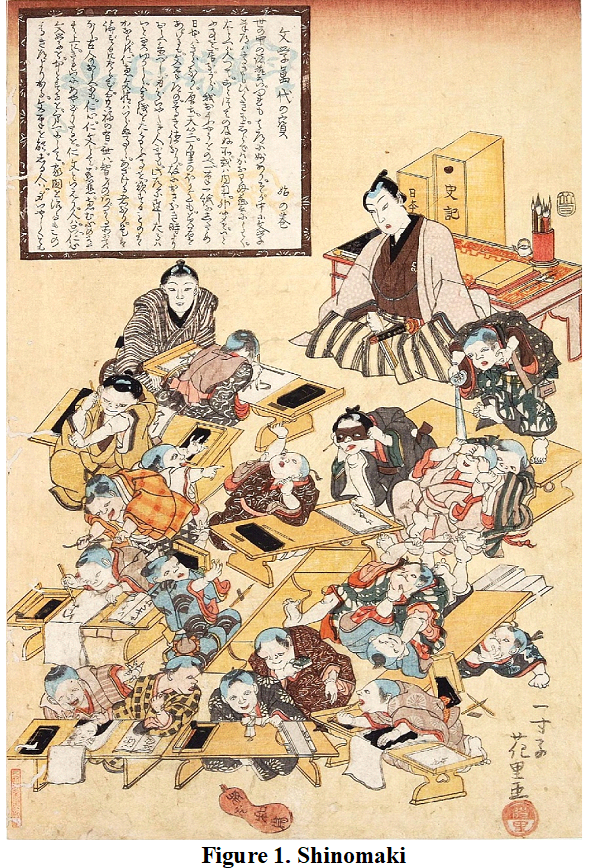
These artworks in the insert, titled Bungaku Bandai no Takara (The Timeless Treasures of Literature), were painted by Issunshi Hanasato between 1844 and 1848. They capture two classroom scenes from a terakoya, a temple school where children of peasants learned basic literacy. In these schools, students were taught how to read and write, as well as proper manners for example, how to speak respectfully to people of different social classes. Girls also learned additional cultural skills such as flower arrangement, tea ceremony, and incense appreciation. Figure 1, Shinomaki, shows a boys’ class in a terakoya, while Figure 2, Suenomaki, shows girls’ class [1,2,3].

Even though enrolling in a terakoya was not compulsory and children were free to join or leave, the terakoya program still spread widely across Japan, even reaching rural areas. This growth happened because more parents wanted their children to receive an education so they could grow into fully responsible adult members of society and eventually take over family leadership when the time came. In the spread of this education system, terakoya were not only located in temple buildings but were also sometimes held in rooms of private houses. [4,5].
In a typical terakoya, children were taught together in coed groups of different ages and different genders, unlike the separated classes shown in Figure 1 and Figure 2. Shisho (teachers) also came from various backgrounds which the majority were peasants, but some were samurai or Buddhist clergy, and in rare cases even Shinto priests or medical doctors. Each shisho prepared individualized study materials called ōraimono (copybooks), which contained various types of texts. Out of more than 7,000 known ōraimono, about 1,000 were written specifically for female students. Before using ōraimono, students first practiced calligraphy using model examples called tehon. By the end of the Edo period, many terakoya also taught abacus skills, which were important for merchants [5,6].
References
[1] [Tokyo Metropolitan Library]. 2025. The Timeless Treasures of Literature [First Volume, Last Volume] (Bungaku Bandai no Takara (Shinomaki, Suenomaki)) by Issunshi Hanasato (1844–1848). Tokyo Metropolitan Library. Retrieved November 4, 2025, from https://www.library.metro.tokyo.lg.jp/portals/0/edo/tokyo_library/english/modal/index.html?d=5375#.
[2] [Weebly]. 2025. Children in Shogunate Japan. Weebly. Retrieved November 4, 2025, from https://japan-under-the-shoguns-nusha-wheeldon.weebly.com/children-in-shogunate-japan.html.
[3] [Legends and Chronicles]. 2025. Children in Feudal Japan. Legends and Chronicles. Retrieved November 5, 2025, from https://www.legendsandchronicles.com/ancient-civilizations/feudal-japan/children-in-feudal-japan/.
[4] Scanlon D.G. October 26, 2025. Education in the Tokugawa era. Britannica. Retrieved November 5, 2025, from https://www.britannica.com/topic/education/Education-in-the-Tokugawa-era.
[5] Satoshi T. October 24, 2022. “Terakoya”: Edo-Period Education for All. Nippon.com. Retrieved November 5, 2025, from https://www.nippon.com/en/japan-topics/g01005/.
[6] [Ministry of Education, Culture, Sports, Science and Technology]. 2025. (2) Education for Commoners. Ministry of Education, Culture, Sports, Science and Technology. Retrieved November 5, 2025, from https://www.mext.go.jp/b_menu/hakusho/html/others/detail/1317227.htm.
Last updated on November 6th, 2025
메타데이터
- post_id
- 10a172fbd2ed
- slug
- terakoya-a-glimpse-into-education-in-the-tokugawa-era-10a172fbd2ed
- url
- https://medium.com/@skd.dew/terakoya-a-glimpse-into-education-in-the-tokugawa-era-10a172fbd2ed
- canonical_url
- https://medium.com/@skd.dew/terakoya-a-glimpse-into-education-in-the-tokugawa-era-10a172fbd2ed
- author_url
- https://medium.com/@skd.dew
- status
- ok
- fetched_at
- 2026-06-20 20:29:01