“My Agent is no longer a GoldFish” Explained TMEM for Entry Level Developers
Scaling Self-Evolving Agents via Parametric Memory is a paper submitted by researchers at Qwen-Character Team , Alibaba Group and Peking…
“My Agent is no longer a GoldFish” Explained TMEM for Entry Level Developers

Scaling Self-Evolving Agents via Parametric Memory is a paper submitted by researchers at Qwen-Character Team , Alibaba Group and Peking University on 3rd June 2026.
In this article, I’ve tried to explain the gist of their work so that an entry-level developer could understand it.
You can read the actual paper here: https://arxiv.org/abs/2606.04536
Lets first understand the core idea behind this paper.
Current AI agents have a “frozen brain” problem during a single session: while they can read summaries of past interactions or look up data in a database, their actual internal logic (model parameters) never changes as they work. The authors introduce TMEM (Self-evolving Parametric Memory), a framework that allows an AI agent to update its own parameters on the fly to “learn” from its current conversation or task.
So, its a big..
“PROBLEM”: Prompt-Space vs. Parametric Memory

To understand the problem this paper solves, imagine an AI agent as a student with a “frozen brain.”
Even though this student is very smart, they have a strange limitation: they can never truly learn anything new while they are working. Instead, they have to rely on sticky notes.
1. The “Sticky Note” Problem
Currently, when you talk to an AI for a long time, it uses two main tricks to “remember” things:
- Summaries: It takes pages of conversation and shrinks them down into a small paragraph (a sticky note) to keep on its desk.
- Search (RAG): It puts old information into a filing cabinet and searches for it when it gets confused.
The Problem: The AI’s actual brain (its internal logic) never changes. It is just looking at notes. If the summary is missing a tiny detail, or if the student gets overwhelmed by too many sticky notes on their desk, they start making mistakes. As soon as a note is thrown away to make room for new ones, that information is gone forever.
2. The Lack of “Internal Learning”
In real life, if you are doing a complex task — like learning a new video game or cooking a new recipe — you don’t just read the instructions over and over. You internalize the lessons. You start to know that a certain button jump-attacks or that the oven runs 10 degrees too hot.
Current AI agents can’t do this. They have to keep “re-reading” the instruction that the oven is hot every single time they check the food. They can look up what they have seen, but they cannot learn from it to change how they act in the future.
In both cases, the model parameters remain frozen. If the summary misses a detail, or the retrieval system fails to find the right snippet, the agent is stuck. It can look up what it has seen, but it cannot truly learn or adapt its behavior until someone fine-tunes it again.
The authors wanted to fix this by giving the AI a “Self-Evolving Brain.”
Instead of just writing more sticky notes, the AI in this paper can actually update its own internal settings while it is talking to you.
- It looks at its recent history.
- It “teaches” itself the most important lessons.
- It changes its own brain slightly so that for the rest of the conversation, it just knows those facts without having to read them off a note.
“Modern problems require modern solutions.” — Some really cool guy
“The Solution”: TMEM (Self-Evolving Agents)
“Don’t read TMEM as THEM. I know you did.” — I said it.
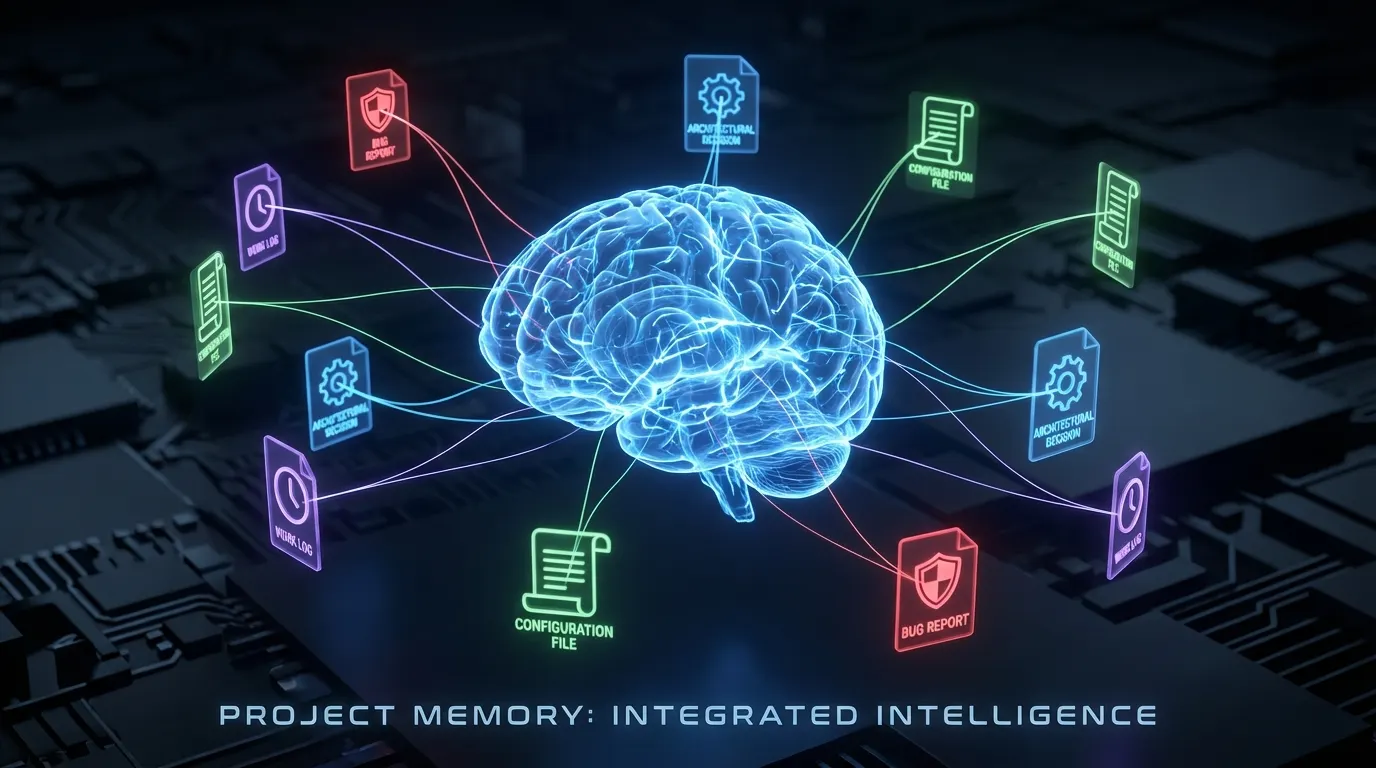
TMEM (Self-evolving Parametric Memory) is a framework designed to create AI agents that can internally learn and adapt their own behavior during a single conversation or task. Unlike traditional AI agents that rely on external notes (summaries or databases) while keeping their “brains” frozen, a TMEM-equipped agent updates its own model parameters on the fly to internalize new experiences.
Think of TMEM as a way to give an AI agent a “live” memory that actually changes how it thinks mid-conversation, rather than just giving it a notepad to look at.
TMEM allows an agent to write new experiences directly into its own parameters during a single session. It does this using a three-step cycle:
- The Trigger: The agent works normally until its “context budget” (memory limit) is full.
- The Distillation: Instead of just summarizing, the agent creates its own mini-training set. It generates “grounded QA-style supervision” — basically, it asks itself questions about what just happened and provides the correct answers based on the history.
- The Update: The agent performs a lightning-fast online update (using a technique called LoRA). This “bakes” the new knowledge into its internal weights (Δt).

For the rest of the session, the agent’s behavior is guided by its original brain plus these new “fast weights”.
“If you do not want to blow up your mind, stop HERE” — Again I said it.
How TMEM Works (Explaining for mature folks)
TMEM introduces a “parametric memory” channel (Δt) represented by fast LoRA weights (discussed later). The process follows a specific lifecycle, the one discussed in previous section.
- Interaction: Hi! Hello!
- Memory Trigger: ALERT!!! Context Full!!
- Self-Distillation: “What just happened” — Agent to itself.
- Online Update: “Let me LEARN from it” — Agent to itself (again).
- Adapted Policy: For all future steps in that session, the agent’s actions are guided by its original brain plus these new “fast weights” (πθ0+Δt), meaning it has internalized the knowledge
Key Technical Concepts for Devs
If you were implementing this, there are three “secret ingredients” that make it work:
- LoRA (Low-Rank Adaptation): You aren’t retraining the whole model (which is impossible in real-time). Instead, you are updating a very small, lightweight layer added on top of the model.
- SVD-based Initialization: Standard training starts with random numbers, which takes too long to converge. TMEM uses Singular Value Decomposition (SVD) to pre-calculate the most important “directions” in the model’s brain. This allows the agent to “learn” the new QA pairs in just a few steps.
- Self-Improving RL: The model is trained using Reinforcement Learning to not only solve tasks but to be a better teacher to itself. It learns to extract the most useful QA pairs so that its future internal updates are as effective as possible.

Why It Matters
In experiments across long-term conversations and complex web searches, TMEM consistently outperformed standard methods.
- Effectiveness: It retains fine-grained details better than summaries.
- Efficiency: It is often faster than retrieval-based systems because the knowledge is “baked in” rather than searched for every time.
- Internalization: It shifts the agent from merely consulting past experience to evolving based on it.

Follow me on X : @llcortex.ai
Follow me on Medium: @www.nishchyaverma
메타데이터
- post_id
- 10bef7d1b348
- slug
- my-agent-is-no-longer-a-goldfish-explained-tmem-for-entry-level-developers-10bef7d1b348
- url
- https://ai.plainenglish.io/my-agent-is-no-longer-a-goldfish-explained-tmem-for-entry-level-developers-10bef7d1b348
- canonical_url
- https://ai.plainenglish.io/my-agent-is-no-longer-a-goldfish-explained-tmem-for-entry-level-developers-10bef7d1b348
- author_url
- https://medium.com/@www.nishchyaverma
- status
- ok
- fetched_at
- 2026-06-09 15:37:30