The Curse of Normal: Gramsci and the Quiet Architecture of Power
Some prisons have no walls. The most effective ones are built from habits, manners, and the quiet certainty that the way things are is…
The Curse of Normal: Gramsci and the Quiet Architecture of Power
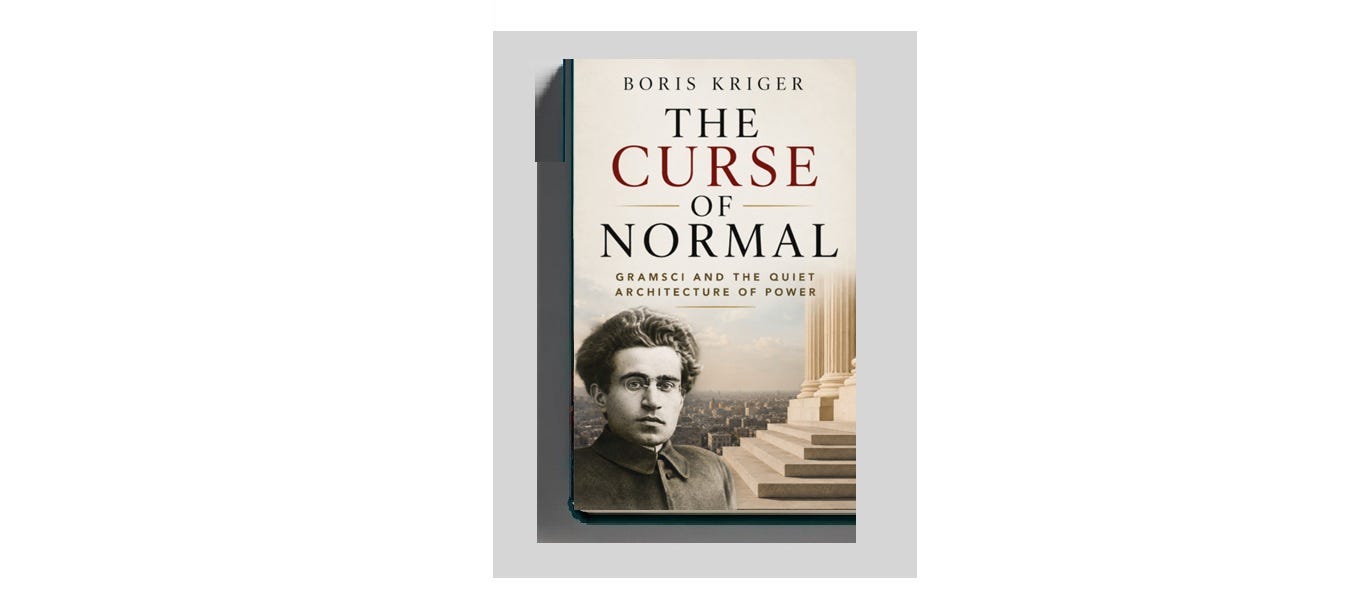
Some prisons have no walls. The most effective ones are built from habits, manners, and the quiet certainty that the way things are is simply the way things are.
This is a book about that kind of power — the sort that never shouts, never breaks down a door, and never has to. Following the trail blazed by Antonio Gramsci, a frail, imprisoned thinker who out-reasoned the regime that locked him away, it asks an unsettling question: why do people so often consent to arrangements that do not serve them, and even defend those arrangements as natural, sensible, and right?
The answer lies not in armies or laws but in culture — in schools and stories, in churches and songs, in the words we reach for without thinking and the tastes we mistake for our own. Gramsci called this hegemony: rule by consent rather than force, a form of domination so thoroughly woven into ordinary life that it becomes invisible. To notice it at all is already a small act of rebellion.
Written for the curious reader and free of jargon, nostalgia, and easy slogans, The Curse of Normal is a clear-eyed tour through the hidden government of everyday life — and a quiet argument that to change a world, you must first change what it considers normal.
Keywords: hegemony, culture, power, consent, ideology, social change, normality
[embed]
Contents
Chapter One — The Government of the Obvious. 16
Chapter Two — Wisdom in the Wreckage. 23
Chapter Three — The Hunchback in the Cell 30
Chapter Four — Rule Without the Whip: What Hegemony Means. 37
Chapter Five — The Revolution That Never Came. 42
Chapter Six — Common Sense, the Comfortable Prison. 47
Chapter Seven — The Two Faces of the State. 52
Chapter Eight — Why Fear Is the Weakest Glue. 57
Chapter Nine — Every Class Builds Its Own Army of Minds. 62
Chapter Ten — The Priests of the Present Order in Disguise. 67
Chapter Eleven — Thought That Grows From the Ground: The Organic Intellectual 73
Chapter Twelve — No One Changes the World Alone. 79
Chapter Thirteen — The School as a Factory of Worldviews. 85
Chapter Fourteen — The Quiet Politics of Stories. 91
Chapter Fifteen — The Stage and the Question of Dignity. 96
Chapter Sixteen — Whoever Owns the Words Owns the World. 102
Chapter Seventeen — The Perfect Hegemony: Religion and the Hunger for Meaning. 108
Chapter Eighteen — The Dead Poets Who Still Govern Us. 114
Chapter Nineteen — The Storm and the Siege: Two Ways to Win. 120
Chapter Twenty — How the Unthinkable Becomes the Obvious. 126
Chapter Twenty-One — Why Criticism Alone Changes Nothing. 132
Chapter Twenty-Two — Moving the Heart Before the Argument 138
Chapter Twenty-Three — The Making of a Different Kind of Person 143
Chapter Twenty-Four — Power as a Net, Not a Throne. 149
Chapter Twenty-Five — The Gentle Machinery of Normalization. 155
Chapter Twenty-Six — Knowledge Was Never Innocent 161
Chapter Twenty-Seven — Learning to Recognize Yourself in Their Categories. 167
Chapter Twenty-Eight — The Awakening of a Single Mind. 173
Chapter Twenty-Nine — The Refusal That Carries No Flag. 179
Chapter Thirty — A Life Lived Off the Pattern. 185
Chapter Thirty-One — The Export of Normal: Power Across Borders 191
Chapter Thirty-Two — From Nation to Network: The Scattering of Consent 197
Chapter Thirty-Three — The New Voice in the Conversation. 203
Conclusion — First, Change What Counts as Normal 209
Case Study One — The Necktie and the Unjustifiable Custom.. 218
Case Study Two — The Turin Factory Occupations of 1920. 218
Case Study Three — Copernicus and the Moving Earth. 219
Case Study Four — The Standard Language and the Silenced Dialect 220
Case Study Five — Bread and Circuses in Ancient Rome. 221
Case Study Six — The Clergy: From Organic to Traditional Intellectuals. 222
Case Study Seven — The Overnight Collapse of a Fear-Based Order 222
Case Study Eight — The Penny Press and the Manufacture of News 223
Case Study Nine — The Hidden Curriculum of the Schoolroom.. 224
Case Study Ten — The Growth Chart and the Percentile. 225
Case Study Eleven — The Invention of the Delinquent 226
Case Study Twelve — The Confession and the Therapeutic Self 226
Case Study Thirteen — The Panopticon. 227
Case Study Fourteen — Dante and the National-Popular 228
Case Study Fifteen — The Death of the Duel 229
Case Study Sixteen — Samizdat and the Parallel Civil Society. 229
Case Study Seventeen — The Global Export of the Dream Factory 230
Case Study Eighteen — The Recommendation Feed. 231
Case Study Nineteen — The Hidden Transcript of the Powerless. 232
Case Study Twenty — The Cynic Who Changes Nothing. 233
Preface
Consider the most dangerous word in any language. It is not a curse word; those, for all their reputation, are quite harmless, since everyone can see them coming and brace accordingly. No, the truly dangerous word arrives in a cardigan, offers you tea, and asks after your health. It is the word normal. It sounds like a description, a neutral little report on the state of affairs, when in fact it is one of the most powerful instruments of control ever devised. To call a thing normal is to take something that someone, somewhere, at some point arranged — and to quietly reassign it to nature, where no one thinks to argue with it. We do not hold referendums on gravity. And the chief ambition of any settled order is to make itself feel exactly that obvious.
This is a book about that ambition and how thoroughly it succeeds. Its subject is the strangest feature of human societies: that the people inside them so rarely need to be forced. Tyrants with whips and watchtowers are, historically speaking, amateurs — expensive, exhausting, and prone to being overthrown the moment the whip-hand tires. The truly durable arrangements are the ones nobody has to enforce, because everyone has already agreed, without ever being asked, that this is just how the world goes. Power that must shout is weak. Power that can fall silent, certain it will be obeyed out of sheer habit, is the real thing. And the name for that silent, habitual, almost invisible variety of power is the subject of everything that follows.
The man who saw this most clearly spent the last decade of his life in a Fascist prison, which is a useful reminder that clarity and comfort seldom keep the same address. Antonio Gramsci was born in 1891 on the island of Sardinia, into poverty and into a body that would not cooperate with him. A spinal illness left him small, hunched, and in lifelong pain — the kind of pain that teaches a person to sit very still and think very hard, since not much else is on offer. He made his way to Turin, the grinding industrial heart of Italy, where the factories ran day and night and the men who ran them did not. There he became a journalist, an organizer, and eventually a founder of the Italian Communist Party, which under Mussolini was not a wise thing to be.
In 1926 they came for him. The prosecutor at his trial offered a sentence that has outlived every speech the regime ever made: we must, he said, prevent this brain from functioning for twenty years. It is the rare villain who states his purpose so plainly. And it is a fine irony — the kind history seems to enjoy — that by locking the brain away with nothing to do but function, the regime handed Gramsci the two things his thinking had always lacked: time and silence. Out of that enforced stillness came the Prison Notebooks, thousands of cramped, censored, endlessly interrupted pages that amount to the most penetrating account we have of how power actually holds a society together. The state meant to switch off a mind. It accidentally built it a monastery.
Gramsci went into prison gnawing on a particular puzzle, and it is worth stating because the whole book grows out of it. Karl Marx had predicted that the great workers’ revolution would erupt first in the most advanced industrial nations — England, Germany, the places where factories were largest and capitalism most ferociously developed. That was where the contradictions were supposed to be sharpest, the misery most concentrated, the powder keg most obviously primed. Instead, the revolution that actually happened broke out in Russia: vast, agrarian, backward, the last place the theory had any business predicting. Meanwhile the workers of the rich, modern West, the very people cast as history’s leading actors, looked at the script handed to them and politely declined the role. Why?
The lazy answers are all flattering to the person giving them. Perhaps the Western workers were bribed into docility. Perhaps they were too comfortable, too fattened on small luxuries to want anything more. Perhaps — this is the favorite of disappointed revolutionaries everywhere — they were simply too dim to perceive their own interests. Gramsci, to his enormous credit, found all of these explanations both insulting and useless, and reached instead for something stranger and far more disturbing. The workers were not suppressing a revolution. They were not biting their tongues. They genuinely experienced the existing order as legitimate, sensible, even natural — as the way things simply are. Their consent was not bought or beaten out of them. It was manufactured, patiently and invisibly, by the entire surrounding culture, until rebellion felt not dangerous but absurd, like protesting the weather.
This is the idea Gramsci named hegemony, and it is the keystone of this book. Hegemony is rule by consent rather than force — domination so completely dissolved into ordinary life that it stops looking like domination at all. It works not through decrees but through what he called common sense: the vast, unexamined stock of assumptions a society absorbs from its schools, its churches, its newspapers, its songs, its jokes, and the offhand remarks of relatives at dinner. These ideas enter us before we are old enough to question them and lodge so deep that we mistake them for our own private thoughts, or for plain reality. A ruling order that controls the army holds your body. A ruling order that controls common sense holds something far more valuable: your sense of what is obvious.
From this it follows that every state has two faces, and Gramsci insisted on looking at both. The first is the face of coercion — the army, the police, the courts, the prison cell he was writing in. This is power as we usually imagine it, blunt and visible, and it is genuinely necessary in a pinch. But it is also crude, costly, and brittle, because a society held together by fear alone must spend itself exhausting its enemies, and fear is a stimulant that wears off. Behind that hard face lies a second, softer one: the dense web of schools, faiths, presses, and pastimes that Gramsci called civil society, where consent is grown rather than compelled. The whip is the tool of last resort. The schoolroom and the storybook are the tools of first resort, and they do the heavier lifting precisely because no one experiences them as tools at all.
And so the strategy of change splits in two as well, which gives us a distinction this book will return to often. Where civil society is thin — where the church and the school and the press have shallow roots, as in the Russia of 1917 — power can be seized in a sudden frontal assault, a storming of the palace. Gramsci called this the war of maneuver, and it works, occasionally, in places like that. But where civil society is thick, where consent is reinforced by a thousand daily institutions, no charge at the palace gates will hold, because the moment the smoke clears the old common sense reassembles itself and quietly swallows the victory. There, the only thing that works is the slow encirclement he called the war of position: the long, patient labor of changing what people find natural before changing who happens to govern them. You do not win such a war on a single morning. You win it the way water wins against stone.
A word, here, about the company we are about to keep, because it is fair to be wary of it. This is a book that takes a communist thinker as its guide, and the twentieth century gave the world excellent reasons to flinch at that word. Too much was promised in its name and too much destroyed; behind the banners of liberation rose prisons, terror, and the familiar grey machinery of the police state. None of that will be excused in these pages, and none of it needs to be, because reading a thinker is not the same as saluting a flag. The younger Pliny advised that wisdom should be sought in the text itself, not in the school or the slogan attached to it, and that advice has rarely been more useful than here. Gramsci is worth reading not because his side was right — in power, his side was frequently monstrous — but because, from a cell, with no army and no hope, he described the machinery of consent more honestly than the victors who were busy operating it. The banner is poisoned. The insight survives the banner.
So let me be plain about what this book is not. It is not a manual for revolution; we have seen where those manuals lead, and the destination does not improve with rereading. It is not an exercise in nostalgia for failed utopias, nor a smuggled defense of any regime that ever flew a red flag over a watchtower. There will be no mathematics in it, no charts, no jargon deployed to make simple cruelties sound complicated. What it is, instead, is a guided tour through the hidden government of everyday life — through the quiet machinery that decides, on our behalf and usually without our noticing, what counts as reasonable, respectable, beautiful, and normal. It is an attempt to make the invisible briefly visible, which is the only condition under which anything invisible can be argued with.
A note on tone, since the subject invites a graveness it does not deserve. Power studied with a long face tends to win, because solemnity is one of its oldest disguises — nothing protects an absurdity like the requirement that we discuss it respectfully. We will therefore keep our eyes open and our sense of humor loaded, on the theory that the surest way to break the spell of the obvious is to laugh at it a little. This is not frivolity. It is tactics. A thing you can mock is a thing you have already, in some small interior way, stopped obeying.
I should warn you that this kind of seeing comes with a mild and permanent side effect. Once you have learned to notice hegemony — to catch the seams where the natural was stitched together out of the arranged — you cannot easily stop. The textbook, the advertisement, the polite consensus, the word everyone uses without examining it: all of these begin to show their workings, like a magic trick spoiled by knowing the method. Ordinary life grows slightly stranger and considerably more interesting. That strangeness is not a bug in the book. It is the entire point of it.
From here the path runs roughly as follows, though I will not bore you with a map of a journey you are about to take. We will spend a little while with the man himself, since his life is inseparable from his thought. We will take apart the machinery of consent and learn its moving parts. We will walk through the territories where that consent is manufactured — the school, the story, the stage, the language we think in, and the old, deep architecture of faith. We will watch the curious process by which an idea once unthinkable becomes, within a generation, merely common sense. We will examine a darker cousin of these ideas in the work of a later thinker who found power hiding inside the clinic and the timetable. And we will end where all of it finally has to land: in the single mind that decides, one ordinary afternoon, that the obvious is not obvious after all — with only a brief glance, at the very last, at the new and strange machines now joining the conversation about what we are all to find normal next.
Because that is where every large change has always secretly begun. Not on the barricade and not in the manifesto, but in the quiet, almost imperceptible moment when a person stops mistaking the arranged for the natural and starts to wonder who did the arranging. To change the world, it turns out, you must first change what it agrees to call normal. And that change, every single time, starts in one mind, deciding for itself that the way things are is not the same as the way things must be.
Chapter One — The Government of the Obvious
Try, as an experiment, to justify the necktie. A grown man rises each morning, selects a narrow strip of patterned silk, and knots it firmly around his own throat, tight enough to be felt all day, useless against cold, faintly hazardous near machinery, and serving no function whatsoever except to announce that he is the sort of person who wears one. Ask him why and watch what happens. He will not produce a reason, because there is no reason; he will instead produce a feeling, a vague but immovable sense that to arrive without the silk noose would be wrong, unserious, somehow indecent. He cannot defend the custom. He can only be made uneasy by its absence. Now multiply that single uneasy man by ten thousand customs he could not defend either, and you have not an eccentric. You have a perfectly normal member of a human society, which is to say a creature governed almost entirely by things it has never once examined.
The necktie is trivial, and that is the point of beginning with it, because the mechanism it reveals is not trivial at all. The same small shrug — “it’s just what’s done” — that guards the necktie also stands watch over arrangements of immense consequence: who works and who owns, who gives orders and who carries them out, what a life is worth and whose life is worth more. The remarkable thing about the human category of the obvious is that it does not sort by importance. It files the necktie and the property law in the same drawer and grants them the same immunity. Both are simply “how things are,” and both are protected less by argument than by the absence of any felt need to argue. This is the territory Antonio Gramsci spent his imprisoned years mapping, and his first finding was the one most people never make in a lifetime: that the obvious is not natural. It only wears nature’s clothes.
What feels like bedrock, he saw, is actually sediment. Every “of course” was once a live question that somebody answered so decisively, and so long ago, that the answering was forgotten and only the answer remains, hardened into fact. Power’s true masterpiece is never winning an argument; an argument won can be reopened. Its masterpiece is the abolition of the argument altogether — the quiet conversion of a contested claim into a plain feature of reality that simply does not occur to anyone to dispute. A king who must justify his crown is already in trouble. A king whose crown has become as unremarkable as the sky has achieved the only security worth having. The obvious is where authority goes to become invisible, and invisibility, as the whole of this book will insist, is the strongest armor there is.
Gramsci had a name for the realm of the obvious. He called it common sense — senso comune — and here he said something that still surprises people who expect a revolutionary to sneer at ordinary folk. Common sense, he insisted, is not stupidity, and it is not the opposite of thought. It is the philosophy of people who do not know they are doing philosophy. Everyone, he wrote, is in some sense an intellectual, even if very few are employed as one; every human being walks around with a rough working map of what is real, what is right, what is possible, and what is beneath discussion. The problem with ordinary people is therefore not that they have no philosophy. The problem is the reverse: they have a very elaborate one, absorbed whole and unexamined, and they did not choose a single line of it. It was issued to them, in childhood, like a uniform.
And when you finally hold this inherited philosophy up to the light, the first thing you notice is what a glorious mess it is. Common sense is not a tidy system with axioms and conclusions. It is a junk drawer. It is a sediment of leftovers from a dozen abandoned ages: a fragment of folk wisdom here, a scrap of half-remembered scripture there, a slogan from some forgotten campaign, a proverb sitting cheerfully beside its own flat contradiction. We tell our children to look before they leap and, in the very same breath, that he who hesitates is lost. We believe that opposites attract and that birds of a feather flock together. We reach into the drawer and pull out whichever maxim flatters the decision we have already made, and we never notice that the drawer contains its own opposite, because we never empty it out onto the table and count.
This incoherence looks like weakness. It is in fact the secret of common sense’s astonishing durability. A tidy ideology, a system with a clearly stated load-bearing claim, can be refuted; you locate the central beam, you knock it out, and the structure comes down. But you cannot refute a junk drawer. Common sense never has to defend itself, because it never commits to a single proposition long enough to be cornered. It bends, it absorbs, it forgets yesterday’s certainty without embarrassment and adopts today’s, and it always, always has a homely saying ready for the occasion — including, when required, the opposite occasion. Its contradictions are not flaws to be exploited. They are the slack in the rigging that lets the whole apparatus ride out any storm. You cannot argue a society out of a thing it was never argued into.
This is also why the obvious is such a bargain to maintain. Imagine a regime that had to talk each citizen into compliance every single morning, fresh, from first principles. It would collapse before lunch. No treasury could fund the persuasion. Instead, every functioning society performs a far cheaper trick: it hands each new arrival, while that arrival is still too young to object, a pre-loaded cartridge of obviousnesses, and then stands back and lets a lifetime do the rest. We spend our years acting on these installed assumptions as though they were hard-won personal conclusions. We experience as private conviction what was in fact public instruction. The most economical government ever invented is the one that has quietly relocated inside the citizen’s own skull and persuaded him that it was always his idea. There is no need to police a man who polices himself and calls it integrity.
Consider how the contents of the drawer change while the feeling of certainty stays exactly the same. For most of recorded history it was perfectly obvious that some people were born to command and others born to obey; obvious that the sun trooped dutifully around the earth; obvious that a monarch’s power flowed down directly from heaven. None of these felt like opinions to the people who held them, which is precisely the trouble. They felt like the floor underfoot. The men and women of those ages did not so much hold these beliefs as get held by them. And that sensation — of standing on something too solid to question — is the exact sensation this book is asking you to learn to distrust. Not the belief you can argue for, which is at least out in the open and available for inspection, but the belief you cannot even imagine arguing about. That one is wearing the disguise.
If all this sounds like a counsel of despair, Gramsci did not intend it so, and here is where his strange hopefulness shows. If common sense is merely the philosophy we happened to inherit rather than a law of nature, then it can, at least in principle, be taken out, examined, sorted, and partly replaced. Buried inside the junk drawer, he believed, lies a better and harder core — he called it good sense — the grain of genuine practical wisdom that ordinary people accumulate from actually living. The task of anyone who wants to free a mind, his own included, is not to mock common sense from some imagined height. It is to work inside it, patiently separating the good sense from the inherited rubbish, helping people become conscious philosophers of the views they already half-hold. Liberation, on this account, does not begin with new facts. It begins with a single vertiginous realization: that the obvious has a history, and that what has a history can have a different future.
Such work is harder than it sounds, because the obvious does not defend itself with arguments. It defends itself with an emotion. Question a settled obviousness in company and you will rarely be met with counter-reasoning; you will be met with discomfort, a flush of something close to embarrassment, as though you had begun to undress at the dinner table. People feel that an impropriety has occurred before they have evaluated a single word you said. That flush is the immune system of common sense, and it is brilliantly designed, because it punishes the questioner instantly, socially, and without ever having to engage the question. Learning to recognize that flush — in others and, more importantly, in yourself — and to keep thinking straight through it, is the first and least glamorous discipline of a mind that wants to be its own. Most people never acquire it, and most people are, not coincidentally, easy to govern.
To rule the obvious, then, is to rule very nearly everything, because the obvious quietly draws the borders of the thinkable before any thinking has had a chance to start. It does not tell you what to conclude. It does something far more powerful: it tells you which questions are real and which are not worth raising, and a question never raised needs no answering. This is why every chapter ahead will keep circling back to the same impertinent inquiry, pressed equally against the schoolroom and the storybook, the courtroom and the altar: who decided this was normal, and what slipped out of view the instant it became so? The entire architecture of consent rests on the small, smooth, load-bearing word obviously. Drag that one word into the light and the architecture, perhaps for the first time, can be seen to have been built by hands — which means it can be questioned, and in time rebuilt.
The obvious is not the place where thinking comes to rest. It only feels that way. It is, in truth, the one place we have agreed never to let thinking begin. This book is an invitation, polite but persistent, to begin there anyway.
Chapter Two — Wisdom in the Wreckage
When a building burns down, the inspector who walks through the blackened shell the next morning is not an arsonist’s apprentice and is not there to praise the fire. He is there to read it. He runs his hand along the buckled steel, notes which wall fell first and which improbably held, and learns from the ruin a set of things the intact building had politely kept hidden. Fire is a terrible teacher with excellent attendance; it exposes the joints, the shortcuts, the load-bearing members that mattered and the decorative ones that didn’t. To study a wreck is not to endorse the disaster that made it. It is simply to refuse to waste the only thing a disaster ever produces, which is information. This chapter is about reading wreckage, because the thinker who guides this book belonged to a movement that became, in the twentieth century, one of history’s most catastrophic fires.
Let us not be coy about it. Antonio Gramsci was a communist, a founder of a communist party, a man who gave his life to a cause that, wherever it actually seized power, built prisons faster than schools and corpses faster than either. The regimes that flew his colors murdered on an industrial scale, starved whole populations as a matter of policy, and perfected forms of surveillance and terror that would have impressed the very Fascists who jailed him. Any honest book that takes Gramsci as a guide has to walk in through that fact, not around it. So why give the man a hearing at all? The answer is a distinction so simple that people forget it constantly: a diagnosis and a prescription are two entirely different things, and the history of medicine is crowded with physicians who named a disease correctly and then killed the patient with the cure.
Gramsci’s diagnosis — that power in a modern society runs primarily on manufactured consent rather than open force — is not a slogan you have to take on faith. It is a description you can check against the world outside your window, and it holds up unnervingly well. His prescription, by contrast — a revolutionary counter-hegemony of the working class, culminating in the rule of that class through a party-state — belongs to a project whose results are fully in, audited, and counted in graves. We are therefore in the strange but entirely coherent position of being able to accept the X-ray while declining the surgery. And we are not merely permitted to do this; we are obliged to, because it is the X-ray itself, his own account of how consent gets engineered, that explains most precisely why the surgery turned out to be lethal.
This is the elegant and rarely noticed twist at the center of the whole affair: Gramsci’s theory, turned around, indicts his own side more thoroughly than any anti-communist tract ever managed. The single most devastating description of a totalitarian state is written in Gramsci’s own vocabulary, by anyone willing to apply it without flinching. Those regimes were not failures of hegemony; they were its purest and most terrifying success. They seized the schools, the presses, the studios, the very language, and manufactured consent so total that to dissent came to feel not merely dangerous but insane, a symptom requiring treatment. The lamp Gramsci built to illuminate the soft domination of the capitalist West turns out to throw its harshest light on the hard domination practiced under his own banner. To read him well is to take his lantern and shine it, first of all, into his own house. He would have understood the gesture, even if his heirs would have arrested you for it.
There is a further reason the defeated are worth reading, and it has to do with the peculiar blindness of winners. Victory feels like vindication, and vindication feels, deceptively, like understanding; the side that wins rarely bothers to examine how it won, because triumph seems explanation enough. It is the losers who are condemned to think. They have to account for a defeat that no comforting story will cover, and that obligation, brutal as it is, sharpens the eyes. Gramsci’s entire intellectual project was forced into being by a question only a loser would ask with such honesty: why did the revolution that was promised so confidently simply fail to arrive? Clarity, more often than we like to admit, is the consolation prize handed to people who have lost, and some of the truest accounts of how a machine works come from those it ran over, precisely because they could not afford the soft blur that comfort buys.
Behind all this lies a general principle of reading, and it is worth stating bluntly because most people violate it without noticing. There is a cowardly way to read, which is to check an author’s affiliation before deciding whether to listen, and to let the team jersey settle the matter in advance. And there is a braver way, the way the younger Pliny recommended and this book has already taken as its rule: lift the individual sentence out, set it down in front of the world, and ask whether it is true, regardless of whose mouth it fell from. The brave way is genuinely risky. It means you may discover truth in voices you find repellent and pure nonsense in voices you adore, which is uncomfortable and bad for one’s sense of tribe. But the alternative — the belief that correctness travels in groups, that a thing becomes false the moment the wrong person says it — is simply the procedure by which a mind bolts its own door from the inside and throws away the key.
None of this, it must be said firmly, is a laundry service for monsters. Reading a thinker for his insight does not retroactively rinse him clean, does not balance a single grave, does not convert a body count into a footnote. The discipline being asked of you is harder than either worship or dismissal, both of which are forms of mental laziness dressed as moral seriousness. It is the discipline of holding two true things in the same hand at the same time without letting either crush the other: that this particular man saw something real and important about how the world works, and that the cause he served committed atrocities that no insight can offset. Maturity is largely the capacity to keep both of those facts in focus simultaneously. Propaganda of every stripe, left and right, victor and vanquished, works by the identical trick — persuading you to drop one of the two so you can hold the remaining one more comfortably.
So what, concretely, do we carry out of the wreckage? Not a set of answers; Gramsci’s answers are mostly the property of a failed century. What we salvage is a set of questions, and questions, unlike answers, have no party membership. Where does this society’s sense of “normal” actually come from? Who quietly benefits when that sense stays invisible and unexamined? Which of the certainties I carry did I genuinely reason my way to, and which were simply installed in me before I could object? These questions work as well against a commissar as against a king, against a corporation as against a church, against the cause you happen to love as efficiently as against the one you fear. That impartiality is not a weakness in them. It is the entire reason they are worth keeping, and the entire reason that powerful people of every persuasion would prefer you not learn to ask them.
And here is the test of whether you have learned anything at all, the edge of the blade that cuts the hand that holds it. An honest reader of Gramsci must eventually turn these questions inward, away from convenient targets and toward the obviousnesses he himself finds most comforting. It is easy, and frankly delicious, to deploy the analysis of manufactured consent against one’s opponents — to see with perfect clarity how their beliefs were manufactured while quietly assuming that one’s own arose by immaculate reason from a position of pure objectivity. But a method that only ever embarrasses other people is not a method. It is a weapon with a comfortable grip. The analysis is worth precisely what it costs you, and it only begins to cost you anything the moment you allow it to make you, and not merely your enemies, uncomfortable. A lamp you shine only outward is not a lamp. It is a searchlight on a watchtower, and we have seen what those are for.
This, then, is the quiet contract of the chapters ahead. We will borrow a flawed man’s undeniably clear eyes. We will take his questions and refuse his program, accept the diagnosis and burn the prescription. And we will try, however imperfectly, to apply the whole apparatus evenhandedly — to the cultures we instinctively dislike and, far more importantly, to the one we live inside and mistake for reality itself. To do that with any fairness, though, we first need to understand where such unusually clear eyes were trained, and they were not trained in a comfortable study or a free republic. They were trained in a small, cold room, under the gaze of a censor, in a body that was failing by the day. That room is where we go next, because the room explains the eyes.
Wisdom, it turns out, does not check your credentials at the door or inquire after your politics before agreeing to be useful. It surfaces in burned buildings and locked cells, in the testimony of the defeated and the discredited and the plainly wrong. The only people who reliably fail to find it in such places are the ones too proud, or too frightened, to be caught looking.
Chapter Three — The Hunchback in the Cell
Picture the most important reader Antonio Gramsci ever had: not a disciple, not a scholar, not posterity, but a Fascist prison censor, sitting somewhere with a pencil and the authority to confiscate, who read every line before any line was permitted to leave the building. Now hold that image in mind while you remember that the Prison Notebooks, one of the strangest and most influential works of the twentieth century, were written under that pencil. Every sentence Gramsci composed had to first survive an enemy’s eyes. This is not a colorful detail to be set aside before the serious business of summarizing his ideas. It is the key to the ideas’ very shape, and the man himself would have insisted we begin here, because if Gramsci taught the world anything, it was that thought is never produced in a vacuum, that every idea has an address, a body, a situation — and it would be a small betrayal of him to pretend his own ideas floated down from a cloudless sky.
So let us do to Gramsci what Gramsci did to everyone else: read the thinker through the conditions that produced him. He was born in 1891 on Sardinia, poor, and into a body that refused to cooperate. A disease of the spine left him stunted, hunched, and in pain that never fully released him for the rest of his life — the kind of relentless, low, grinding pain that teaches its owner to sit very still and think very hard, on the reasonable grounds that little else is available. He climbed, against every odd, to Turin and its roaring factories, became a formidable journalist and organizer, helped found the Italian Communist Party, and was rewarded for all of it, once Mussolini consolidated his grip, with arrest and a sentence designed to erase him. The prosecutor supplied the era’s most quotable sentence, the one no propaganda ministry could improve upon: we must, he declared, stop this brain from working for twenty years. The crime, openly stated, was thinking.
Begin with the censor, because the censor is the uninvited co-author of every page. Gramsci could not write the word revolution, so he wrote, with deniable innocence, of a war of position. He could not name Marx and his project openly, so Marx became the founder of “the philosophy of praxis,” a phrase bland enough to bore a guard into letting it pass. The famous difficulty of the Notebooks, the obliquity that has launched a thousand competing interpretations and a small academic industry, is not the difficulty of a man showing off his subtlety. It is the difficulty of a man writing in code, talking past the figure standing at his shoulder. To read Gramsci is to read someone conducting a vital argument in the presence of an eavesdropper he must never quite let understand him. The obscurity that scholars treat as depth is, at least in part, simply the residue of fear, fossilized into style.
Now consider what powerlessness did to the content. A man with an army at his back theorizes the storming of the citadel; a man with a living movement theorizes the strike and the march. Gramsci, in his cell, had none of these. No army, no party left standing on the outside, no realistic prospect of walking free while it still mattered. And out of that condition of total, airless powerlessness came — not the despair one would forgive, but something close to its opposite — the single most patient theory of change any revolutionary has ever set down: the war of position, the slow cultural siege measured not in days of glory but in generations of unglamorous labor. He could think the long game with such depth precisely because the short game had been physically taken away from him. His strategy is the floor plan of his confinement, redrawn as philosophy. The man who could not move an inch produced the definitive theory of change that moves like a glacier.
The failing body wrote itself into the work as well, in the theory’s steady preference for endurance over rupture. A man in constant pain does not romanticize the sudden violent break; he knows in his own vertebrae that the only question that finally matters is what can be sustained, carried, survived across time. Gramsci’s persistent attention to habit, to the slow sedimentation of character, to culture as something that has to be lived in the body day after day rather than declared in a manifesto, is the attention of a man for whom each ordinary morning was already an act of endurance before any politics began. The hunched and aching frame that the prosecutor wanted to switch off is legible inside the concepts, in their patience, their long horizons, their deep suspicion of the dramatic gesture that flares and dies. He theorized the durable because the durable was the only kind of victory his own life left him room to imagine.
Isolation supplied the final ingredient, and it is the most poignant one. Cut off from comrades and conversation, Gramsci wrote to no one and therefore, in the end, to everyone, conducting his fiercest arguments with interlocutors who had been dead for centuries because they were the only company the cell permitted. He argued with Machiavelli as though the Florentine were a contemporary to be talked out of his pessimism; he wrestled with Dante, with the philosopher Croce, with the long parade of the canonical dead. The Notebooks are a brilliant conversation held aloud in an empty room, which may be exactly why they reach so directly into the empty rooms of readers a century later, each of us sitting alone with a book. The solitude that was meant to break him instead gave the work its strange, durable intimacy. He was abandoned into a kind of universality.
Return now to the prosecutor’s sentence and feel how completely it backfired, because the failure is more interesting than a simple irony. The order to stop the brain for twenty years rested on a hidden assumption — that serious thought requires freedom, comfort, an audience, and a future to write toward. Gramsci’s cell is the patient refutation of all four. Strip away his freedom and he discovers, from the inside, the politics of those who have none. Strip away his platform and he is forced to invent a method and a voice. Strip away his health and he is taught, in the only school that teaches it, what endurance actually is. The prison did not interrupt the work and then lose; the prison collaborated in the work, shaping it the way a stubborn riverbed shapes the very river it is trying to dam. The conditions meant to silence the thought instead specified it, gave it its peculiar and unrepeatable form.
And yet — this must be said plainly, against every temptation to tidy it into uplift — there is no fable here about how adversity nobly breeds genius, and anyone who reads one into it has understood nothing. The prison did not refine Gramsci. It destroyed him. He died at forty-six, his body wrecked beyond repair, shortly after a release that arrived too late to be called mercy. Nothing in this story licenses the obscene and popular notion that suffering is somehow good for people, that the cell was a gift in disguise. The lesson, if we are honest enough to keep it small, is narrower and far sadder: that a free society wasted, and an unfree one then deliberately crushed, one of the clearest minds of its century, and that what we now read is the salvage hauled out of that crime. The brilliance is entirely real and so is the atrocity, and the first does not redeem the second by so much as a single day of the pain it cost.
There is, finally, a lesson the cell teaches not about Gramsci but about the reader, and it is the uncomfortable one. If his ideas plainly bear the fingerprints of his conditions — the censor, the powerlessness, the pain, the solitude — then so do everyone’s, including the comfortable certainties that feel, from the inside, like the pure and weightless verdicts of reason. The serene objectivity of the well-fed professor has an address too: a salary, a pension, a tenure, a soothing distance from the consequences of being wrong. Gramsci’s gift to us is partly this discomfort, the dawning recognition that no thought ever floats entirely free of its situation, that the question “and what, exactly, is this person’s position?” is always a fair one to ask, and that the people most serenely convinced they are thinking from nowhere at all are, almost without exception, thinking from somewhere quite specific and quite comfortable, with the curtains drawn against the view.
With the diagnostician now in focus, and the strange clinic that trained him laid bare, we are at last equipped for what the rest of this book actually requires, which is to stop admiring the man and start dismantling the machine. We have met the physician and toured the cell that sharpened his sight. What remains is to open up his central concept — the one he could only ever name in fragments and code — and watch, slowly and in close detail, how an entire society persuades millions of people to obey arrangements that, in the final analysis, nobody is actually pointing a gun to enforce. That is the subject of the next chapter, and it is the heart of everything: rule without the whip, obedience without a visible master, the quiet miracle of consent.
They set out to stop a brain from functioning and instead handed it the two things a brain almost never gets and always secretly needs — nothing to do but think, and nothing left to lose by thinking with total honesty. The pencil at his shoulder lost. It simply took the rest of the century to notice.
Chapter Four — Rule Without the Whip: What Hegemony Means
There are two ways to make a person stand in a particular spot for six hours. The first is to hold a gun on him; this is the method of the hostage, and it works, but it is exhausting, it requires you to stay awake, and the moment your attention wanders the hostage is gone. The second method is to make him a fan. The fan stands in the same spot for six hours, in the rain, overnight if necessary, and not only does no one compel him — he would be genuinely insulted by the suggestion that anyone could. He chose this. He loves this. He will defend his standing-in-the-rain against your skepticism with real heat, because you are not questioning his schedule, you are questioning his self. Every form of power that has ever lasted has understood, somewhere in its bones, that hostages are a liability and fans are an asset, and that the entire art of durable rule consists in the conversion of the former into the latter.
This conversion is what Gramsci meant by hegemony, and it lives at the far end of a spectrum whose near end is naked force. We have already glanced at the two faces of power, the hard face of coercion and the soft face of consent, so I will not belabor the distinction. What matters here is that hegemony is not merely consent in some thin, procedural sense — a checkbox ticked, a contract signed. It is obedience experienced as preference, conformity felt from the inside as freedom. The hegemonized person is not gritting his teeth and complying. He is doing precisely what he wants, and what he wants happens, with remarkable convenience, to be exactly what the existing order needs him to want. He is the fan in the rain, and you will not move him by pointing out that it is raining.
Here we must clear away the most common misunderstanding, the one that wrecks more attempts at social criticism than any other. Hegemony is not brainwashing. It is not a matter of people being lied to and believing the lies, such that the truth, once delivered, would dissolve the whole arrangement like sugar in hot water. People living inside a hegemony are frequently not deceived about any particular fact; they may be intelligent, well-read, even proudly skeptical, and still be hegemonized to the marrow. This is because hegemony does not operate at the level of facts. It operates one full level above, at the level of the frame — the prior settlement of which questions are serious, which facts are relevant, which possibilities are worth a grown person’s attention. You can reason with perfect rigor inside a frame that was handed to you, and arrive at flawless conclusions, all of them safely contained. The frame does not care what you think. It only cares what you think about.
And now the genuinely surprising part, the insight that separates Gramsci from every crude theory of manipulation that came before and after him. Hegemony is not simply imposed; it must be earned, and earned continuously, at a real and recurring cost to the people who hold it. A ruling group cannot merely broadcast its worldview and wait for obedience to congeal. It must actually lead — and leadership, real leadership, demands concessions. The dominant order has to deliver something tangible: rising standards of living, rights genuinely extended to those who fought for them, grievances actually absorbed and addressed rather than merely suppressed. Gramsci described hegemony as a kind of compromise equilibrium, in which the powerful surrender something real in order to keep something larger. This is exactly why it is so stable, and exactly why it is not a conspiracy. There is no smoke-filled room. There is a long, half-conscious negotiation in which the price of consent is paid, installment by installment, in concessions that are not fake.
Once you grasp that hegemony is part deception but also part genuine delivery, you understand why the favorite strategy of the earnest reformer almost never works. The reformer believes, touchingly, that consent rests on false belief, and that if people could only be shown the truth — the real numbers, the hidden memo, the suppressed statistic — the spell would shatter and the crowd would awaken. So he publishes the truth, and the crowd reads it, nods, and goes back to standing in the rain. The reformer concludes that people are stupid or sheep, which is both insulting and wrong. The actual problem is that you cannot refute a frame with a fact, and you certainly cannot out-argue a concession that is currently feeding someone’s children. Consent that rests partly on real benefit is not a lie waiting to be exposed. It is a bargain, and bargains are broken not by revelations but by better offers.
There is a further consequence that ought to make any honest critic uncomfortable, and Gramsci, to his credit, did not flinch from it. If hegemony involves real leadership and real concession, then not all consent is sinister, and not every settled normality is a fraud perpetrated on the innocent. A great deal of hegemony is simply the means by which an enormous and complicated society manages to hold together at all without dissolving into either constant violence or constant argument. Some of the obviousnesses we live by genuinely do serve the common interest; some shared frames really are reasonable places to stand. The hard, indispensable task — the one this book keeps returning to — is to distinguish the consent that reflects a true and shared interest from the consent that has been carefully engineered to run against the interest of the very people who give it. That distinction is fiendishly difficult to draw, and the difficulty is not a flaw in the analysis. It is the honest center of it.
So this is what hegemony means: rule by leadership rather than command, secured through a frame the ruled mistake for reality and maintained by concessions the rulers would rather not make, the whole arrangement experienced from within as nothing more sinister than ordinary freedom. It is power that has learned to stop shouting and to start providing, on the shrewd calculation that a fan well fed is worth a hundred hostages held at gunpoint. The question that remains, and that drove Gramsci into the deepest of his thinking, is why this beautiful machinery of consent took such firm root in some places and shattered into revolution in others — why the fans turned out in their millions across the rich and modern West, while in poor and backward Russia the hostages rose up and shot the guards. To answer that, we have to go back to the failure that started everything: a revolution, confidently predicted, that simply refused to come.
Chapter Five — The Revolution That Never Came
In September of 1920, in the factories of Turin, the future seemed to arrive early. Tens of thousands of metalworkers, locked in struggle with their employers, did not merely strike — they occupied. They took possession of the plants, raised red flags over the gates, organized their own councils, ran the machines themselves, posted their own guards, and for a few electric weeks demonstrated that the workers could operate modern industry without the owners standing over them. To a young organizer named Antonio Gramsci, who had helped build those councils and poured his convictions into them, it looked like the opening scene of the script the whole movement had been promised. And then, with no single dramatic defeat, the thing simply deflated. Negotiations, compromises, a wage settlement, and the workers walked out of the gates they had held and went home. The flags came down. The future, having arrived early, left early too, and Gramsci was left standing in the emptied factory of his own hopes, asking the question that would consume the rest of his life: why?
The script that Turin had failed to follow was written by Karl Marx, and it was admirably clear. Revolution, Marx had taught, would come first and most naturally to the most advanced industrial nations — to England, to Germany, to the dense furnaces of developed capitalism — because that was where the system’s contradictions would grow sharpest. There, capital would concentrate into ever fewer hands, the workers would be ground into ever greater misery, and the sheer mass of the industrial proletariat, packed together in the great cities and trained by the factory itself into discipline and solidarity, would at last become conscious of its own power and its own interest, and would take what was theirs. Advanced capitalism was supposed to be the womb of its own undoing. The richer and more modern the country, the riper it was for the harvest. This was not a side prediction. It was the load-bearing forecast of the entire system.
Reality declined to read the script. The great revolution of the age broke out not in industrial Germany but in agrarian Russia, in 1917 — vast, poor, overwhelmingly peasant, the least developed of the major powers, very nearly the last place the theory had any business pointing to. And meanwhile the workers of the advanced West, the designated heroes of the prophecy, looked at the role they had been assigned and, by and large, turned it down. They formed unions and bargained; they voted; they grumbled and went to work. The Turin occupations had been the West’s great audition for the revolutionary part, and the audition had ended not in triumph or massacre but in a wage agreement. The most advanced workers in one of the more advanced countries had held the means of production in their own hands and then, offered a decent deal, had handed them back.
It is essential to remember that Gramsci was not puzzling over this from the serene distance of a library armchair. He had organized those councils with his own failing body; he had believed; he had watched the deflation up close, and he carried the defeat in his chest like a stone. This is the point made earlier about the strange clarity of the defeated, now in its sharpest form. The Prison Notebooks are, at bottom, one long, rigorous attempt to explain a failure their author had personally lived through and helped to lead. A victor would never have asked the question with such desperate honesty, because a victor has no need of the answer. Gramsci asked it because he had to, because the alternative was to conclude that the workers were traitors or fools, and he was too serious a man to insult the people he had hoped to free.
The answer he slowly excavated changed everything, and it turned on a single word: society. The difference between Russia and the West, he concluded, was not merely that Russia was economically backward. It was that in Russia the state stood almost alone — a vast, brittle apparatus of crown and army and bureaucracy, with very little behind it. Russian civil society, the web of independent churches, schools, associations, presses, and settled habits that binds a people to its order beneath the level of government, was thin, what Gramsci memorably called gelatinous. Knock over the state, as the Bolsheviks did, and there was little underneath to hold the people to the old world; the structure came down because it had been only a single wall. In the West it was utterly different. Behind the Western state stood a deep and intricate fortress system — a whole civilization of institutions and loyalties and assumptions — so that even when the state itself trembled, as states did across Europe in those years, the deep apparatus of consent held firm, flexed, absorbed the shock, and quietly restored the order the crisis was supposed to have ended.
From this came the great amendment to Marx, the correction that makes Gramsci worth reading a century later. Marx had pictured culture, law, religion, and politics — the whole superstructure — as a kind of reflection cast upward by the economic base, a set of shadows that would necessarily rearrange themselves once the base beneath them cracked. Gramsci, staring at the wreckage of Turin, saw that this had the architecture backwards, or at least dangerously incomplete. The superstructure was not a passive shadow. It was a load-bearing fortress, frequently stronger than the economic base it supposedly merely reflected, and entirely capable of holding a society intact through economic catastrophes that, by the older theory, should have flattened it. Culture was not the symptom of the order. Culture was the thing actually doing the holding. And that single reversal moved the whole battlefield of change off the factory floor and onto a terrain no one had been fighting on: the terrain of consciousness, of habit, of what people find normal.
Which leaves us standing where Gramsci stood, in front of the fortress, and asking the obvious next question. If the walls that hold a society together are built not of stone but of culture — of schools and churches and stories and settled assumptions — then what exactly are those walls made of, brick by brick, and who built them, and who keeps them in repair? Those questions will occupy much of this book. But before we can examine the masonry, we have to understand something stranger and more intimate about the people who live inside the fortress: why, even when life within the walls is hard and the gate stands open, they so reliably choose to stay. The fortress holds not only because its walls are thick, but because its inhabitants love it. That love is the subject we turn to now.
Chapter Six — Common Sense, the Comfortable Prison
There is a phenomenon, well known to anyone who has worked in prisons, that ought to be more famous than it is, because it explains a great deal about the world outside the prison too. A man serves a long sentence, is finally released, walks out into the open air he has dreamed of for years — and within weeks commits some small, almost deliberate crime, gets himself arrested, and returns. He was not happy inside. But inside, he knew the rules. Inside, every hour had its assigned shape, every uncertainty had been removed, and the terrible labor of deciding what to do with a free day had been lifted from his shoulders by the institution. Freedom, when it finally came, did not feel like liberation. It felt like falling. And so he engineered his own recapture, choosing the known cage over the unbearable open, because the cage, whatever else it was, was home. Keep that released prisoner in mind, because he is not an aberration. He is most of us, most of the time, with respect to the prison we cannot see.
An earlier chapter showed why common sense cannot be refuted — why the great junk drawer of inherited assumptions, with its cheerful contradictions and its endless supply of homely sayings, simply absorbs every argument and carries on. But there is something more disheartening still, and it is the subject of this chapter. Even when a crack does appear in the obvious — even when, against all the odds, a person catches a clear glimpse of the seam where the natural was stitched together out of the arranged — they very often refuse to walk through it. The cell door swings open of its own accord, and they reach out and pull it shut. The problem is not only that the prison is hard to escape. The problem is that the prisoners, offered the key, frequently decline it, and are offended that you asked.
The first reason is the plain matter of comfort, and it should not be sneered at, because the comfort is real. To question the obvious is exhausting; to accept it is restful. Certainty is a form of sleep, and sleep is not a luxury but a need. To hold the world as fundamentally settled — its arrangements given, its questions closed — is to be spared the low, persistent vertigo of holding it as open, contingent, and unfinished. We met that vertigo earlier as the flush of discomfort that guards every settled assumption, and called it the immune system of common sense. Here we can see it more fully: that flush is not merely social policing, a fear of others’ disapproval. It is also self-protection, the mind recoiling from the dizziness of the open question the way the eye recoils from the sun. People defend the obvious not only because their neighbors expect it, but because thinking otherwise genuinely hurts.
Beneath comfort lies something deeper and more personal: identity. We do not merely hold our obviousnesses at arm’s length, like tools we picked up and could set down. We are made of them. The frame through which a person sees the world is not a possession but a constituent; it is woven into the self that does the seeing. So a challenge to the frame does not register as an interesting intellectual proposal. It registers as an assault on the person. To concede that the normal was arranged, and arranged by someone other than oneself, is to concede that one has spent a whole life dutifully obeying an arrangement one never chose nor examined — and that is a humiliation very few human beings will volunteer for. We defend the comfortable prison as if we were defending our dignity, and the reason the defense is so fierce is that, in a real sense, we are.
And then there are the pleasures of the cell, which are genuine and must never be dismissed as illusions, because dismissing them is the surest way to misunderstand everything. To be normal is to belong. It is to be legible to one’s neighbors, to share the jokes, to feel the warm and specific relief of agreeing with the people around you, to receive the countless small social rewards that flow to those who fit. Normality is not only imposed from above; it is enjoyed from within, daily, in a thousand unremarkable satisfactions. The prison, in other words, comes furnished. It has good company, familiar food, a comprehensible map of the day, and the deep animal comfort of the herd. This is precisely why it holds so well. A cage of pure misery would empty itself; people would risk anything to flee it. A cage with soft furnishings and warm company holds its inmates with no effort at all, because they have stopped experiencing it as a cage.
Set against all this warmth, consider what the open actually offers the person who steps outside the obvious, and you will see why so few accept the invitation. Freedom from common sense is not experienced as a sunlit liberation. It is experienced as exposure — as cold, as loneliness, as the sudden loss of the shared map by which everyone else is confidently navigating. The one who steps beyond the frame steps out of the herd’s warmth and into a solitude that can be genuinely unbearable; we have already seen, in the figure of Gramsci alone in his cell, that the price of seeing clearly is very often the loss of company. Most people sense this price intuitively and, with a wisdom that is not at all contemptible, decline to pay it. They are not cowards. They have correctly calculated that the open is cold and that the cell is warm, and they have chosen warmth, as nearly all living things do.
This carries a hard and unwelcome lesson for anyone who dreams of setting other people free, and it is a lesson the next several chapters will keep insisting upon. You cannot liberate people merely by showing them the open door, because the open door, by itself, offers them only the cold. They have to be given a reason to want the cold — or, more accurately, they have to be offered a new warmth on the far side of it, a new belonging to replace the one they are being asked to leave. Any genuine effort to change what a society finds normal must reckon honestly with the comfort of the old normality rather than scolding people for clinging to it. A liberation that offers only exposure, loneliness, and the loss of the map will lose, every single time, to a captivity that offers belonging, certainty, and good company. People do not flee warm prisons for cold freedoms. They never have.
So the prison of the obvious is not merely difficult to escape; it is comfortable, self-furnishing, and locked from the inside by the very people it confines, who guard the lock with their comfort, their identity, and their genuine, defensible love of belonging. Any account of change that ignores this will be not only wrong but useless. The question that follows is the one a builder would ask: who constructs and maintains this comfortable prison? Who furnishes the rooms, keeps the company warm, and ensures the map is printed fresh for each new generation? The walls of consent do not raise and repair themselves. There are hands at work, and there is, behind the soft face of culture, a harder structure that stands ready when the softness fails. To that double structure — the two faces a state turns toward its people — we turn next.
Chapter Seven — The Two Faces of the State
The most heavily armed institution in your city is one you very probably did not think about even once today. The police are out there; the prisons are full; somewhere a barracks houses soldiers and a courthouse stands ready to deprive people of their freedom. And yet your entire day, from the moment you woke, was governed almost wholly by things that carry no weapons at all: a traffic light you obeyed though no officer watched, a price tag you accepted though no one forced you, a queue you joined at its end though stepping to the front would have cost you nothing but a few stares. You spent the day inside an order of immense coercive power and never once felt the coercion, because in a healthy society the force stays folded out of sight, holding everything up the way a building’s foundations hold up a tower whose residents never descend to look at them. This is the first thing to understand about the state: that it has two faces, and that on a good day you see only the gentle one.
Gramsci insisted on looking at both faces at once, and on understanding that they are not rivals but partners. There is the face of coercion — the army, the police, the courts, the cell in which he sat writing — which is the state in the narrow sense most people imagine when they hear the word. And there is the face of consent — the schools, the churches, the newspapers, the clubs, the whole dense weave of ordinary institutions he called civil society — which manufactures the agreement that makes the coercion rarely necessary. The error is to treat these as two different things, a hard state and a soft society standing apart. Gramsci taught that they are one integrated apparatus, two organs of a single body, and that the body is healthiest precisely when the soft organ is doing nearly all the work and the hard one is allowed to rest, gleaming and unused, in reserve.
The division of labor between the faces is exquisite. The soft face goes first and does the bulk of the governing, securing consent through a thousand daily channels so gentle that no one experiences them as governance. Behind it, held in reserve and mostly hidden, waits the hard face, the armor behind the trenches, called upon only when consent fails and someone steps decisively out of line. The genius of the arrangement is that the two faces reinforce each other in a closed loop. The soft face manufactures the very legitimacy that makes the hard face appear just when it finally does appear; by the time the police arrive, the schools and the newspapers have already spent years establishing that whoever the police come for must have deserved it. Consent makes coercion look like law and order rather than naked power, and coercion makes consent look like the only sane alternative to chaos. Each face lends the other the thing it lacks.
From this comes a diagnostic tool of real and surprising power, one worth carrying out of this chapter and using for the rest of your life. The health of a hegemony can be read directly from how rarely it needs to show its hard face. Where consent is deep and secure, the instruments of force grow nearly invisible, asleep in their barracks, mentioned only in the abstract. Where consent is thinning and the order is in trouble, the hard face begins to surface — more police on the streets, more prosecutions, more visible displays of strength. And here is the counterintuitive heart of it: the visible exercise of force is not a sign of strength but a confession of weakness. A power that must show its weapons is a power whose softer means have failed. When you find yourself suddenly able to see the armor everywhere, the trenches of consent behind it have already begun to crumble. The whip comes out only when the spell wears off.
This is why the two faces tend to appear in inverse proportion across history and geography, the one waxing as the other wanes. A regime confident in its hegemony can afford to be liberal, relaxed, sparing with its violence, because it does not need much; the consent does the holding. A regime whose hegemony is failing must compensate with ever heavier doses of coercion, and the heavier the coercion grows, the more plainly it advertises the failure it is trying to cover. The most frightening states are frequently not the strongest but the most insecure, flailing with the hard face precisely because they have lost the soft one. We will follow this thread directly into the next chapter, because it explains something the powerful have learned and relearned and forgotten in every age: that of the two faces, the soft one is incomparably the stronger, and the hard one, for all its terror, is the weakest glue a state can use.
Before we leave the two faces, one further subtlety deserves notice, because it dissolves a comfortable illusion. We like to imagine the soft institutions of civil society — the school, the press, the charitable association — as belonging to a realm of freedom entirely separate from the state and its guns, a private space where consent is given freely. Gramsci’s great unsettling claim is that this separation is largely a flattering fiction. The soft institutions are not outside the state; they are its forward positions, the part of the apparatus that does the governing without ever looking like government. The schoolteacher and the editor are doing political work whether or not they know it, and usually they do not know it, which is exactly what makes the work so effective. The two faces are not state and society. They are both the state, wearing different expressions, and the gentler expression is the one that rules you.
So when we speak of power, we must hold both faces in view at once and resist the temptation to reduce the state to either alone. Reduce it to coercion, and you become the revolutionary who storms the palace, seizes the guns, and discovers that the deep structure of consent has quietly survived the coup and is already rebuilding the old order around him. Reduce it to consent, and you become the gentle reformer who imagines that hearts and minds can be won while the hard face waits, patient and unmentioned, to be deployed the moment hearts and minds drift too far. The mature view keeps both faces in focus, understands their collaboration, and grasps that the great battles are usually fought and decided on the soft terrain long before the hard face is ever called. To see why that soft terrain matters so much more, we have only to examine the catastrophic weakness of the alternative, and ask why fear, despite its fearsome reputation, is the feeblest cement a power can pour.
Chapter Eight — Why Fear Is the Weakest Glue
A threat is a strange kind of currency, the only one that loses value precisely by being spent. The first time a power says do this or else, the words land with their full weight; the listener’s imagination, well stocked with horrors, supplies the rest, and obedience follows. But say it a second time, and a third, and a hundredth, and something corrosive happens to the value of the threat. The listener begins to habituate, to measure the actual against the imagined, to notice that the sky did not fall as completely as feared, and the words that once commanded now merely irritate. Fear, like any drug, demands escalating doses to produce the same effect, and a power that rules by fear finds itself on a treadmill that speeds up beneath its feet, forced to terrify more and more in order to compel less and less. This is the first and most fundamental reason that fear, despite its lurid reputation, is the weakest glue with which a society can be bound.
The economics of the thing are ruinous. Consent, once established, runs almost for free; the citizen who has internalized the order polices himself, requires no guard, and even feels virtuous in his obedience. Fear, by contrast, must be continuously and expensively renewed. Every frightened subject is a subject who would defect the instant the pressure lifted, which means the pressure can never lift, which means the watchers must be watched and their watchers watched in turn, an infinite regress of surveillance that devours the very resources it was meant to protect. A state held together by terror is a bucket with a hole in it, demanding to be filled faster and faster as it drains. The wonder is not that such states eventually exhaust themselves and collapse, but that anyone, knowing the arithmetic, still chooses to build them. They are chosen, of course, by powers that have already lost the cheaper option and have nothing left but the expensive one.
Fear suffers from a second and even deeper defect: it can reach the body but never the heart, and so it purchases only the cheapest and most useless kind of obedience. Recall the distinction drawn earlier between the hostage and the fan. Fear manufactures hostages in unlimited quantity — people who will go through the motions, mouth the slogans, raise their hands at the rallies — but it cannot manufacture a single fan, because devotion is the one thing that cannot be extracted at gunpoint. The frightened subject complies outwardly while seceding inwardly; his hands obey while his heart withdraws into a private interior the regime can never enter, where it nurses a resentment that grows in exact proportion to the force applied. Fear thus produces, as its reliable byproduct, the very disloyalty it exists to prevent, breeding in the dark the enemies it will later have to spend still more fear suppressing. It is a glue that dissolves the surfaces it is meant to bind.
There is a grim irony in fear’s relationship to its own victims, for the violence meant to deter so often consecrates instead. The power that crushes a dissident imagines it is making an example, and so it is — but examples cut both ways. A man broken by an unjust force may frighten the timid into silence, yet he simultaneously hands the discontented a martyr, a face, a story, a wound around which resistance can organize itself. Every regime that rules by fear is therefore in the business of manufacturing the icons of its own opposition, printing the posters of the revolution to come. The blood it spills to terrify is the same blood that, drop by drop, writes the legitimacy of whoever will eventually rise against it. Consent breeds quiet contentment, which is politically inert; fear breeds hatred, which is politically electric. Of the two emotions a state can cultivate in its people, it has chosen, in choosing fear, the one most likely to gather into a storm.
Fear carries, finally, the curse of visibility, and visibility is fatal to the deepest kind of power. We saw in the previous chapter that the hard face of the state is a confession; the moment a citizen sees the soldier on the corner, he knows that consent has failed, and the spell of naturalness — the priceless illusion that the order is simply how things are — is broken. Fear cannot hide. It must be seen to work; a secret terror that no one knows about deters no one. So a regime of fear is condemned to advertise its own coercion, to make its violence legible, and in doing so it strips away the very invisibility that gives consent its strength. The frightened population knows it is frightened, knows it is ruled by force, and a population that knows it is ruled by force has already, in the only sense that finally matters, stopped believing in its rulers. It obeys the gun while despising the hand that holds it, and waits.
All of this illuminates the puzzle we left unresolved several chapters ago: why the great revolution broke the brittle East and spared the cushioned West. The Tsarist order in Russia leaned far more heavily on the hard face than on the soft — a vast apparatus of fear standing over a thin and gelatinous civil society, ruling its subjects more by terror than by genuine consent. And a power that rules by fear, as we have now seen, is a power that can be taken, because fear is external; remove the apparatus that generates it, topple the state in a single decisive blow, and the obedience it compelled evaporates with it, having never become belief. The Western order was the opposite — light on visible force, immensely deep in manufactured consent — and consent cannot be toppled in a morning, because it does not live in any building you can storm. It lives in the heads of the people themselves. You cannot seize a fortress that is everywhere and nowhere, garrisoned by its own prisoners.
The lesson the powerful keep having to relearn is therefore the reverse of what their instincts tell them. When an order begins to wobble, the instinct is to reach for the hard face, to crack down, to make an example, to remind the population who holds the guns. And this instinct, satisfying as it feels, accelerates the very collapse it means to prevent, spending the depreciating currency of fear, manufacturing martyrs, and exposing the coercion that the order had so carefully kept folded away. The genuinely strong move is the harder and slower one: to repair the soft face, to win back consent, to make the order feel natural again rather than merely enforced. But that work is the work of teachers and storytellers and the long patient labor of culture, not of soldiers, and it requires precisely the kind of people we turn to next — the army that fights not with weapons but with meaning, the army of minds that every class that has ever ruled, or hoped to rule, has had to raise.
Chapter Nine — Every Class Builds Its Own Army of Minds
Every worldview that has ever ruled the earth arrived with a workforce. Behind the throne, behind the altar, behind the counting house, there has always stood an army — not of soldiers, though those too, but of minds: the teachers who explained the order to the young, the priests who blessed it, the scribes and lawyers and journalists who put it into words, the clerks of meaning whose unglamorous daily labor was to elaborate a society’s sense of itself and pass it on intact. We are accustomed to imagining that ideas spread because they are true, drifting through the air on their own merits and settling wherever reason makes room for them. Gramsci knew better, and so does anyone who has watched a true idea languish unheard while a convenient falsehood conquers a continent. Ideas do not propagate themselves. They march, and they march only where an army carries them, and the study of how worldviews rule is in large part the study of these armies of minds.
Gramsci called the members of this army intellectuals, but he meant the word in a way that strips it of its usual flattery and replaces dignity with function. We met the seed of this idea earlier, in his startling claim that every human being is in some sense a philosopher, carrying a worldview whether or not they ever examined it. He now adds the decisive qualification: although all people are intellectuals in that broad sense, not all people have the social function of intellectuals. The intellectual, properly understood, is not a person of unusual brilliance or refinement. The intellectual is anyone whose job, in the division of social labor, is to produce, organize, and circulate meaning — to manufacture and maintain the consent that holds an order together. By this measure the village schoolteacher is an intellectual and the celebrated genius who influences no one is, functionally, not. What defines the role is not the wattage of the mind but the work it does in the world.
Understood this way, the intellectual is revealed as something closer to an engineer of consent than a contemplator of truth, and Gramsci’s favorite description of the type was organizer. The priest does not merely believe; he organizes belief, gathers the faithful, administers the rituals that make an abstract faith into a lived weekly habit. The teacher does not merely know; she organizes knowing, decides which facts are facts and which questions are questions for an entire generation of the young. The journalist does not merely report; he organizes attention, ruling on what is news and therefore real and what is silence and therefore not. These are not passive transmitters of a culture that exists independently of them. They are the active builders and maintainers of the very fortress of consent we examined earlier, the masons and caretakers of the comfortable prison, laboring at the walls whether or not they have ever once thought of their work in such terms — and almost always they have not.
From here Gramsci draws a conclusion of tremendous force, the hinge on which his whole politics turns: a class that cannot produce its own army of minds is doomed to remain subordinate, no matter its numbers, no matter its suffering, no matter how just its cause. For if a class has no intellectuals of its own — no teachers, no writers, no organizers who articulate the world from within its experience and in its interest — then it has no choice but to understand itself through the categories supplied by the class above it. It thinks, quite literally, with its rulers’ head. It receives its very sense of what is possible, what is fair, what is normal, ready-made from those who profit by its obedience, and so it consents to its own subordination in language it did not write and cannot question, because it possesses no other. Gramsci had a word for a group trapped in exactly this condition, borrowing its self-understanding from its masters: subaltern. A subaltern class is one that thinks in a borrowed tongue.
This is why the production of intellectuals is, for Gramsci, never a side matter, never a luxury to be attended to after the real economic and political struggles are won. It is the central front of the whole war. A rising class that wishes to do more than briefly seize power — that wishes to actually rule, to make a new order feel natural rather than imposed — must raise its own army of minds capable of articulating a new common sense, a new account of what is obvious, a new map of the possible. Without that army, even a successful revolt collapses back into the old categories, because the old categories are the only ones anyone has the equipment to think in. We saw this fate foreshadowed in the deflation of Turin and in the puzzle of the West: a class can hold the factories in its hands and still lose, if it cannot also hold the meanings in its head. Guns can take a building. Only minds can take a world.
It follows that the great contests of history are, beneath their visible drama of battles and elections and economic upheavals, contests between rival armies of minds, each laboring to make its own account of the world into the unquestioned common sense of all. One army defends the existing fortress of consent, keeping its walls in repair, its inhabitants comfortable, its map freshly printed for each new generation. Another army, if one exists, works to undermine those walls and to raise the outline of a different fortress, a competing sense of the obvious that might one day feel as natural as the present one now does. The outcome of their long, mostly invisible struggle determines what an entire society will find self-evident a generation hence, which is to say it determines almost everything, since the obvious, as we have seen, draws the borders of the thinkable before any thinking starts. The war of meaning is the war that decides all the others.
But to say that every class builds its own army of minds is to raise an immediate and awkward question, one that exposes a deep complication in the whole picture. If the intellectuals are the organizers of a particular class’s worldview, where do we place the figures who seem to belong to no class at all — the serene professor, the disinterested scientist, the priest who claims to serve only eternity, the critic who speaks in the name of timeless and universal values? These figures present themselves as standing above the fray, beholden to no faction, servants of truth alone. Gramsci regarded that pose of lofty neutrality with the deepest suspicion, and he had a sharp account of who such people actually are and whose fortress they are really tending while insisting they tend none. They are the subject of the chapter that follows, and they are far more interesting, and far more useful to power, than their advertised innocence would ever lead you to suspect.
Chapter Ten — The Priests of the Present Order in Disguise
Picture the eminent professor at the end of a long career, the kind who is wheeled out to give the keynote and the valedictory, and who likes to remark, with a small dignified smile, that he has seen governments come and go while he simply went on serving the truth. He means it as proof of his independence. He has outlasted three administrations and a change of constitution; ideologies have risen and fallen around him while he kept his head down and his standards high; and he takes this durability as evidence that he stands above the grubby business of politics entirely, beholden to nothing but scholarship itself. It is a flattering self-portrait, sincerely believed, and it is almost exactly upside down. The very fact that he glides untouched from one regime to the next is not the sign of his independence. It is the sign of his function. He is one of the figures Gramsci found most fascinating and most quietly dangerous: the traditional intellectual, the priest of the present order who does not know he is a priest at all.
To understand the type, we have to understand where it comes from, and Gramsci’s account is historical and unsentimental. Every intellectual caste begins as the organic army of minds of some particular rising class — we met that idea in the previous chapter. The medieval clergy, for instance, were originally the organizers of consent for the feudal order, the men who explained heaven and earth in terms convenient to lords and kings. But classes rise and fall, orders pass away, and the intellectual caste they spawned does not always die with them. Often it survives the death of its original masters, detaches, and floats free into the next age, carrying with it the memory of having once stood for something eternal. By the time we meet such a caste, it has forgotten its origins entirely. It no longer feels attached to any class. It feels attached only to Truth, Tradition, Civilization, the Eternal Standards — and this amnesia about its own origins is precisely what allows it to believe in its own neutrality.
That belief in neutrality is the heart of the matter, and it is worth dwelling on, because it is the single most effective ideological maneuver ever devised. The traditional intellectual presents himself as standing nowhere in particular, serving no faction, applying only universal and timeless criteria. The judge insists he merely applies the law as written. The scientist insists he merely follows the evidence. The literary critic speaks in the name of standards that supposedly float high above the squabbles of the moment. The pose is one of magnificent disinterest, of having no skin in any game. And the pose works, on others and on the poser himself, because it is usually entirely sincere. These are not cynics consciously serving power. They genuinely experience themselves as servants of something higher, which is exactly why they serve power so well, for there is no more persuasive advocate than one who does not know he is advocating.
Here we arrive at the proposition that the traditional intellectual finds most offensive and that Gramsci pressed most insistently: neutrality is never neutral. To stand above the fray is itself to take a side, and the side it takes is always, by default, the side of whoever currently benefits from things staying as they are. To declare oneself non-political in a world that is already arranged in someone’s favor is to ratify that arrangement, to lend it the priceless gift of one’s supposed objectivity. The man who says “I simply teach the facts” has, in choosing which facts are facts and which questions are serious, already done a profound political work while sincerely believing he did none. The claim to be above politics is the most political claim of all, because it removes the existing order from the category of things that can be argued about and quietly files it, once again, under the heading of the natural and the obvious.
Consider how perfectly this serves the fortress of consent. We saw earlier that the deepest power is the power that has become invisible, that has slipped out of the realm of the disputable and into the realm of plain fact. The traditional intellectual is the master craftsman of exactly this invisibility. When the order is defended openly, by a partisan, it can be recognized as a position and therefore opposed. But when the same order is upheld implicitly by a figure who claims only to serve eternal truth, it is removed from the field of contest altogether. The professor’s neutrality launders the status quo, washing the fingerprints of interest off arrangements that interest built, until they shine with the appearance of pure reason. His independence from any particular government is what makes him so valuable to government in general: he certifies, with the full authority of his disinterest, that the way things are is simply the way a serious and educated person understands them to be.
None of this requires that the traditional intellectual be lazy, corrupt, or stupid; the indictment has nothing to do with personal vice, and that is what makes it serious rather than merely cynical. The caste includes genuinely learned men and women, painstaking scholars, people of real integrity within the rules of their game. The point is not that they are bad at their work but that their work, however well done, performs a function they have not examined. The most rigorous historian who never thinks to ask why certain questions are studied and others left dark; the most scrupulous economist who treats the existing distribution of property as the natural starting point of all analysis; the most cultivated critic who defends a canon without noticing whose experience it centers and whose it omits — each of these can be excellent at the craft and still, in the larger frame, be tending the fortress. Competence is not innocence. Indeed, competence is what makes the tending effective.
There is, too, a quiet system of rewards that keeps the caste in place, and it operates almost entirely without conscious bribery. The traditional intellectual is honored, salaried, consulted, given the chair and the medal and the respectful hearing, and all of this flows most reliably to those whose work, whatever its surface subject, leaves the deep arrangements undisturbed. The questions that threaten nothing are the questions that get funded; the scholar who keeps to them prospers and rises and eventually becomes the eminent figure at the keynote, congratulating himself on his independence. The system does not need to censor the dangerous questions if it can simply make the safe ones more comfortable to ask. Power rarely has to forbid; it need only reward, and let the slow gravity of incentive do the rest. The caste polices itself, sincerely, by mistaking the path of least resistance for the path of highest principle.
Once you have learned to see the traditional intellectual, a great deal of the cultural landscape rearranges itself before your eyes. The voices that present themselves as the most disinterested — the most above it all, the most purely devoted to truth, balance, and timeless standards — become, on inspection, precisely the voices most worth examining for what they quietly take for granted. This is not a license for crude suspicion, for the lazy assumption that everyone neutral is secretly a villain; that would be its own kind of stupidity. It is rather an invitation to ask, of every claim to stand above the fray, a single patient question: above which fray, exactly, and standing on whose ground while doing so? The pose of neutrality is not a lie to be exposed so much as a position to be located. Everyone is standing somewhere. The only real question is whether they know it.
But if the traditional intellectual maintains the old fortress while believing he serves only the eternal, then a different kind of thinker must be possible — one who does not float free of all social ground but is rooted in it, who does not launder the existing order but articulates a new one struggling to be born. Gramsci believed such figures not only possible but essential, and he gave them a name drawn not from the library but from the garden. They do not descend from above, claiming a view from nowhere. They grow up from below, out of the lived soil of a particular people’s experience, giving that experience for the first time a voice it can recognize as its own. To these rooted thinkers, the organic intellectuals, and to the strange power of thought that grows from the ground, we turn now.
Chapter Eleven — Thought That Grows From the Ground: The Organic Intellectual
There is a particular kind of silence that can fall over a room full of people, and anyone who has caused it knows it is one of the most powerful things a human being can do. It happens when a group that has lived a certain experience — an experience they have felt in their bones for years but never quite managed to say — suddenly hears that experience described back to them, accurately, in words. The silence is the sound of recognition arriving. People lean forward; something tightens in the chest; and afterward they will say, again and again, that’s it, that’s exactly it, I never knew how to put it. What has happened in that silence is not the delivery of new information. It is the birth of self-consciousness, the moment an inarticulate experience finds its language and so becomes, for the first time, something that can be thought about, argued over, and acted upon. The person who can reliably produce that silence is what Gramsci meant by an organic intellectual.
The word organic is chosen with care, against the floating detachment of the traditional caste we have just examined. Where the traditional intellectual prides himself on belonging to no class and serving only the eternal, the organic intellectual is rooted, connected by living tissue to a particular social group, growing out of its specific experience the way a plant grows out of specific soil. He is not above his people, gazing down; he is among them, expressing them, giving their shared but unspoken life a form it can finally see. This rootedness is not a limitation to be apologized for. It is the very source of the organic intellectual’s power, because only someone inside an experience can articulate it from the inside, in terms that ring true to those who live it, rather than translating it into the borrowed categories of outsiders who have never felt it. The traditional intellectual explains a people to others. The organic intellectual explains a people to themselves.
It follows that the organic intellectual need carry none of the credentials we usually associate with the word intellectual, and Gramsci insisted on this with some delight, because it overturns the whole hierarchy of cultivated respectability. The organic intellectual of a working community might be a self-taught machinist who writes, a union organizer with a gift for naming what everyone feels, a local woman whose kitchen becomes the place where the neighborhood works out what it actually thinks. No university certifies these figures; often the certified world does not recognize them as thinkers at all, since they lack the polish and the vocabulary that the traditional caste mistakes for intelligence. But by Gramsci’s functional measure — established several chapters ago, that the intellectual is defined by the work he does rather than the wattage of his mind — these uncertified figures are intellectuals in the fullest sense, and frequently far more consequential ones than the eminent professor, because they are building meaning where it has never existed rather than maintaining meaning that was built long ago.
The central labor of the organic intellectual is the transformation of experience into articulate worldview, and this is more revolutionary than it sounds. Recall the condition we named earlier as subaltern: the state of a group that must understand itself through categories supplied by those above it, thinking its own life in a borrowed tongue and so consenting, in language it did not write, to its own subordination. The organic intellectual is the one who breaks this spell. By giving a group the words to grasp its own situation in its own terms, he hands it the one tool that subordination most depends on its lacking: a self-understanding that is genuinely its own. A people that can describe its condition accurately, from the inside, has taken the first irreversible step out of subalternity, because a condition that can be named can be questioned, and a condition that can be questioned has lost the protective invisibility on which every settled arrangement quietly relies.
This explains why the rise of any genuinely new force in history is always accompanied, and indeed preceded, by the emergence of its own organic intellectuals. A class, a movement, a people does not become a real historical actor merely by existing, by being numerous, or even by suffering; it becomes an actor when it acquires the capacity to think itself, to articulate its own account of the world and its own place within it. Until then it is acted upon, an object in someone else’s story. The factory occupations we examined earlier deflated, in part, because the workers held the buildings but had not yet produced the army of minds capable of holding the meaning — of articulating, durably and for everyone, a new common sense in which workers running their own factories was not a temporary emergency but the obvious shape of a just world. Bodies in a building are a strike. Bodies that have learned to narrate themselves are a movement. The difference is the organic intellectual.
Yet here the story turns shadowed, because the existing order is not passive in the face of these rising rooted thinkers, and its most effective response is not suppression but seduction. The fortress of consent has, over centuries, perfected a mechanism for handling the talented who emerge from below: it absorbs them. It offers the gifted worker a scholarship, the brilliant organizer a respectable post, the sharp local voice a column in a national paper and a seat at the better tables. And in accepting — often with entirely honorable motives, for who would refuse education or a wider hearing? — the organic intellectual is slowly lifted out of the soil that gave him his power, repotted in the climate of the traditional caste, taught its vocabulary and its manners, rewarded for its safe questions, until one day he discovers he has become exactly the floating, credentialed, sincerely neutral figure he once would have seen through. Co-optation is gentler than censorship and incomparably more effective, for it does not silence the dangerous voice. It promotes it into harmlessness.
This sets up one of the genuine tragedies that runs beneath the whole drama of cultural struggle, a tragedy with no obvious villain. The very success of an organic intellectual — the recognition, the influence, the wider platform — is also the principal mechanism of his neutralization. To be heard beyond his own community, he must often adopt the language and credentials of the order he set out to challenge, and in adopting them he risks being slowly rewritten by them. The system does not fear the rooted thinker nearly as much as it appears to; it has learned that it can usually buy him, not with crude bribes but with the sincere and seductive rewards of belonging to the respectable world. Resisting this gravity, staying rooted while reaching outward, keeping one’s feet in the soil while one’s voice carries to the capital, is among the hardest disciplines in all of cultural politics, and most who attempt it are, in the end, quietly potted and shelved.
Which points us toward a conclusion that the next chapter will develop in full, and that corrects a romantic error lurking in everything said so far. If the lone organic intellectual is so easily isolated, seduced, and absorbed — lifted out of his soil one promising individual at a time — then the whole hope of articulating a new common sense cannot rest on scattered gifted individuals, however eloquent. The silence of recognition that a single voice can produce in a single room is precious, but it evaporates if there is no structure to catch it, hold it, repeat it, and carry it onward. A people thinking itself requires not a hero but an organized body of thinkers, woven together and rooted collectively, strong enough to resist the gravity that picks off individuals. The articulation of a new world, it turns out, is not the work of a solitary mind at all. It is the work of many minds bound together — which is why no one, in the end, has ever changed the world alone.
Chapter Twelve — No One Changes the World Alone
We tell the history of ideas as a parade of solitary names, and the parade is a lie. Here comes the lone genius, struck by inspiration in his study; there goes the great reformer who changed everything by the force of a single vision; behind them stretches a long line of individual busts on individual pedestals, each presented as the unmoved mover of his moment. It is a satisfying way to tell the story, flattering to our love of heroes and convenient for the printing of textbooks, and it bears almost no resemblance to how ideas actually win. Behind every name on a pedestal stood a workshop of collaborators, a network of correspondents, a publisher willing to print, a circle that argued the rough draft into shape, a movement that carried the finished thought out into a world that would otherwise never have heard it. The solitary genius is a portrait with everyone else cropped out of the frame. This chapter is about restoring the rest of the frame, because the cropped-out multitude is where the real action always was.
Gramsci understood this with particular force, and it followed directly from everything he had concluded about the nature of hegemony. If the existing order is held in place not by a single argument but by a vast and intricate apparatus — the whole fortress of schools, presses, churches, and habits we have been examining, staffed by an entire army of minds — then it is simply a category error to imagine that such an apparatus could be challenged by an individual, no matter how brilliant. You do not besiege a fortress with a single soldier, however gifted with a sword. The war of position, the long cultural siege that is the only thing capable of shifting a deep hegemony, is by its very nature a war of organizations against organizations, of institutions against institutions, of one woven structure of consent against another. The lone awakened individual, for all the dignity of his awakening, is not a counter-hegemony. He is a casualty waiting to happen.
We have, in fact, watched the lonely individual’s vulnerability accumulate across the preceding chapters, and it is worth gathering the evidence now. We saw the awakened person isolated, stepping out of the warm herd of common sense into a cold and exposed solitude that most people sensibly decline to enter. We saw the organic intellectual, rooted and eloquent, picked off one promising individual at a time and gently absorbed into the respectable caste by the seductions of recognition. The pattern is consistent and it is not an accident: the existing order is extraordinarily good at handling individuals, because individuals can be isolated, ignored, bought, or simply outlasted. What it handles far less well is structure — the awakened persons who have found one another, the organic intellectuals who have bound themselves together into something that can survive the loss of any single member. Isolation is the condition in which the order prefers to meet its challengers, and so the first task of any challenger is to refuse isolation.
This is why Gramsci, who is so often read as a theorist of culture and ideas, was at the same time an intensely practical theorist of organization, and why he gave such weight to the unglamorous machinery of collective life. A new common sense cannot live in scattered heads; it requires bodies to inhabit. It needs publishers to print what the respectable presses will not, journals where a new vocabulary can be worked out and refined, schools and study circles where it can be taught to the next cohort, associations where people can practice living by it before the wider world permits them to. In short, a rising worldview must build its own civil society, a parallel fortress raised plank by plank alongside the dominant one, capable of doing for the new common sense exactly what the established institutions do for the old: elaborating it, transmitting it, defending it, and making it feel, to those inside, like the natural shape of things. Counter-hegemony is not an argument. It is an infrastructure.
Gramsci had a striking phrase for the organized body that could carry out this work: he called the political party a collective intellectual. The phrase repays attention, because it fuses the two halves of his thought. The party, at its best and rarest, is not merely an electoral machine or an instrument for seizing the state; it is a structure for thinking together, a workshop in which many partial and rooted perspectives are forged into a coherent and shared account of the world, and through which that account is then carried outward and downward to a whole class. It is the organic intellectual multiplied, networked, and made durable — capable of producing the silence of recognition not in a single room but across a society, and capable of catching that recognition in institutions so that it does not evaporate by morning. Whether any actual party has ever lived up to this exalted description is a fair and painful question, given the history we surveyed early on. But the ideal names something real: the collective as a thinking organism, greater and far more resilient than any mind it contains.
It must be stressed, against a misreading that has done real damage, that this emphasis on organization is not a license to dissolve the individual into the mass, to treat persons as interchangeable cells of a body that alone matters. That road, we know too well, leads to the very horrors that discredited Gramsci’s own tradition, the subordination of every living person to the supposed needs of the collective. The point is subtler and more humane. The individual awakening remains the indispensable spark; nothing happens at all until particular persons, one at a time, begin to find the obvious questionable. But a spark in isolation simply goes out. The role of structure is not to replace the awakened individual but to connect awakened individuals to one another, so that their separate sparks can sustain a common fire rather than flickering out alone in the dark. Organization, properly understood, is not the enemy of the individual. It is the only thing that keeps the individual’s insight from dying with the individual.
There is a hard practical wisdom in this for anyone who has ever felt the loneliness of seeing something their neighbors cannot. The temptation, when you have glimpsed past the obvious, is to argue — to take your hard-won clarity into the world and try to win others over one mind at a time, by sheer force of being right. And this almost never works, for reasons we have spent the whole book establishing: you cannot refute a frame with a fact, you cannot out-argue a comfort, and the lone voice is exactly the form the existing order is best equipped to absorb or ignore. The wiser path is harder and slower and far less flattering to the ego. It is to find the others, the scattered few who have seen something similar, and to build with them the small durable structures — the circle, the press, the school, the shared project — in which a different common sense can actually be lived and grown rather than merely asserted. Do not try to win the argument. Build the institution that makes the argument unnecessary.
With this, we close the long inquiry into the army of minds that has occupied us for several chapters, and we are ready to leave the question of who fights the cultural war in order to examine where it is fought. For the parallel fortress we have just described is not raised on empty ground. It must be built in and against the existing institutions of consent — the very channels through which the present common sense flows into each new generation. Those channels are not abstractions. They are specific, familiar places, so familiar that we pass through them daily without suspecting that they are battlegrounds at all: the schoolroom where the young are taught what is real, the story that teaches us what to want, the stage where a society rehearses its sense of justice, the language in which we think every thought we have. To these territories of culture, where the war of position is actually waged, the chapters ahead now turn.
Chapter Thirteen — The School as a Factory of Worldviews
Somewhere in your education you learned to raise your hand and ask permission before attending to the needs of your own bladder, and it is worth pausing on this small humiliation because it taught you more than any lesson written on the board. The content of the school day — the dates, the formulas, the conjugations, most of which you have long since forgotten — was never the point, or at least never the whole point. The deeper instruction was carried by the form: by the bell that sliced the day into obedient intervals, by the rows of desks all facing the single source of authority, by the requirement that you sit still and speak only when recognized, by the discovery that your own body was now subject to a schedule and a permission. Long before you could evaluate a single claim about the world, you were absorbing, through the sheer architecture of the place, a complete and unspoken theory of how the world is arranged and where you fit within it. The school teaches the obvious before the child is old enough to suspect that the obvious has a history.
This is why Gramsci, and many who came after him, paid such close attention to what is sometimes called the hidden curriculum — everything a school transmits that appears on no syllabus and is tested by no exam. The official curriculum announces itself: here is geography, here is arithmetic. The hidden curriculum works in silence, and it teaches the things that actually last. It teaches that knowledge is something handed down from an authority at the front of the room rather than something you build or contest. It teaches that the day belongs to the institution, not to you. It teaches deference, punctuality, the management of boredom, the swallowing of the question that does not fit the lesson plan. Above all it teaches, by ten thousand tiny repetitions, what kinds of things are real and serious and what kinds are not, drawing the borders of the thinkable inside minds too young to notice the surveyor at work. The classroom is the first and most thorough factory of the obvious, and its product is a worldview wearing the disguise of mere schooling.
The school performs a second function even more quietly, and it is one of the most ideologically potent operations in any modern society: it sorts. It ranks the children, grades them, streams them, certifies some as gifted and others as ordinary and others as failures, and it does all of this while claiming only to measure a neutral quality called merit. The genius of the arrangement, from the standpoint of the existing order, is that the resulting hierarchy comes to feel earned. The child who ends up at the bottom does not generally conclude that the game was rigged; he concludes that he simply was not good enough, that the grade reflected the truth about him. And so the school takes inequalities that often arrived at its gates already formed — of wealth, of language, of the quiet advantages that comfortable homes confer — and launders them into the appearance of individual desert. By the time the sorting is done, an unequal outcome has been dressed in the robes of fairness, and the loser blames himself rather than the arrangement. There is no more efficient way to secure consent to inequality than to make the unequal feel personally responsible for their place in it.
Here, though, Gramsci surprises the reader who expects a revolutionary to denounce the disciplined classroom as mere oppression, and the surprise is instructive enough to dwell on. Gramsci was not an enemy of rigor; he was suspicious, even contemptuous, of the soft and well-meaning educational reforms of his day that proposed to liberate the child from drudgery, to follow the pupil’s spontaneous interests, to replace hard discipline with gentle self-expression. He saw in these reforms, however kindly intended, a trap laid for the poor. The children of the comfortable would acquire rigor at home regardless, in households full of books and confident speech; it was the children of the working class who needed the school to drill them in the demanding, unglamorous, genuinely difficult tools — grammar, history, the disciplined use of the mind — without which they would be permanently outmatched. To free the poor child from rigor, Gramsci argued, was not to free him at all but to disarm him, leaving him charming and incapable while the privileged child quietly mastered the instruments of power. Discipline was not the enemy. Discipline withheld from the powerless was the enemy.
This nuance rescues the chapter from a lazy conclusion and sharpens its real one. The problem with the school is not that it demands hard things of the young; the hard things are precisely what a subordinate group most needs in order to stop being subordinate. The problem is what the rigor is harnessed to, and whose worldview it installs along the way. A demanding education that drills a child in genuine intellectual tools while simultaneously teaching her that the existing order is natural, that authority is to be deferred to, that her place in the hierarchy is the just measure of her worth — such an education arms and disarms in the same motion, handing over the sword while persuading the recipient never to point it anywhere that matters. The question to ask of any school is therefore not simply how hard it is, but in whose interest its hardness operates, and what account of the world it smuggles in alongside the multiplication tables. Rigor is a tool. Like every tool, it can build the fortress or breach it.
It would be a mistake, and an unfair one, to imagine all of this as a conspiracy conducted by sinister teachers against innocent children. The schoolteacher, in the overwhelming majority of cases, is a decent and overworked person who entered the profession out of genuine care and who would be horrified to hear her daily labor described as the manufacture of consent. This is exactly the situation we examined in the case of the traditional intellectual: the function operates whether or not anyone intends it, and indeed operates best when no one intends it, because sincere transmission is the most convincing kind. The teacher believes she is simply teaching, and her belief is what makes the worldview she transmits feel like nothing more than reality. The factory of the obvious does not need conspirators. It needs only sincere and well-meaning workers who have themselves passed through it, absorbed its frame, and now reproduce it faithfully in the next generation, mistaking the whole inherited apparatus for plain education.
If the school can install a worldview, however, then in principle it can install a different one, and this is where Gramsci’s grim analysis opens onto something hopeful. The classroom is not only the enemy’s strongest fortress; it is also, potentially, the most powerful instrument any rising worldview could possess, for the same reason — it reaches every mind at the moment of its formation. An education that gave the young genuine rigor while also teaching them to see the seams in the obvious, to ask of every settled arrangement who made this and who benefits, to recognize the difference between a fact and a frame — such an education would be the foundation of a free people rather than a docile one. This is why control of the school is contested so fiercely in every society, why curricula provoke such passion, why what the young are taught is never treated as a merely technical matter. Everyone with a stake in the future understands, if only half-consciously, that whoever shapes the worldview of the children shapes the common sense of the coming age.
Yet the school, for all its power, does not work alone, and it would distort the picture to leave the impression that worldviews are installed in the classroom and nowhere else. The child spends a few hours a day under the bell, but she spends the rest of her waking life inside a far larger and more pleasurable classroom, one with no walls, no exams, and no resented authority demanding she sit still — the endless classroom of stories. From the tales whispered before sleep to the films and songs and screens that will accompany her for the rest of her days, she is being taught all the while, and taught the more effectively because she experiences it not as instruction but as delight. The school teaches her what is real. The story teaches her what to want, and it does so without ever once raising its hand for permission. To that quieter and more seductive teacher we turn now.
Chapter Fourteen — The Quiet Politics of Stories
Nobody ever argued you into wanting what you want. Sit with that for a moment, because it is stranger than it first appears. Your deepest desires — the shape of the life you find yourself longing for, the kind of love you hope to be struck by, the version of success that would finally feel like arrival — did not arrive as the conclusions of arguments you weighed and accepted. They arrived as plots. They were installed in you by stories, absorbed so early and so pleasurably that by the time you were old enough to examine your own wants, the wants were already there, feeling for all the world like the native contents of your own heart. This is the quiet power of narrative, and it is a power that operates on a level entirely beneath the one where argument lives. You can refuse an argument. You cannot easily refuse a story you have already loved, because by the time it has done its work, it is no longer outside you to be refused. It has become part of the apparatus with which you do your wanting.
Stories accomplish what no lecture could because they work through identification rather than persuasion, and identification slips past every guard the mind keeps posted. When you follow a character, you do not evaluate her from a safe critical distance; you climb inside her, want what she wants, fear what she fears, and accept, for the duration, the entire world the story takes for granted as the simple background of reality. And it is in that taken-for-granted background, far more than in any explicit moral, that the real ideological work of a story gets done. The hero’s adventure may be thrilling, but what you are quietly absorbing alongside the thrill is everything the story treats as natural and unremarkable: who gets to be the hero and who is mere scenery, what counts as a triumph and what as a defeat, which kinds of people are interesting and which are furniture, what a satisfying ending even looks like. The message of a story is the part you notice and might argue with. The frame of a story is the part you swallow whole, precisely because you came for the message and never thought to inspect the frame.
Consider that most apparently innocent of devices, the happy ending, and how much it quietly teaches. An ending is a verdict on what counts as resolution, on which arrangements of the world feel like things coming right. When a story concludes with the lovers united, the fortune restored, the rebel either triumphant or safely reconciled to the order he challenged, it is not merely entertaining us; it is training our sense of what a good outcome is, calibrating the very instrument by which we will later judge our own lives and our own society. A culture’s stock of happy endings is a quiet catalogue of its values, an inventory of the futures it has agreed to find satisfying. And because we encounter these endings as pleasures rather than as propositions, we absorb their verdicts without ever casting a vote. We have met this naturalizing trick before, the conversion of a particular arrangement into the obvious shape of things; the story performs it more gently and more deeply than any school, because the story does it while we are smiling.
There is a further dimension to the politics of stories, and it concerns not what is told but who is told, whose experience gets to become a story at all. Every culture circulates a vast but finite stock of narratives, and that stock has a shape: certain kinds of people appear in it constantly, at the center, fully human, equipped with inner lives and motives and the dignity of being understood; other kinds of people appear rarely, or only at the edges, as obstacles, as comic relief, as scenery against which the real characters act. This distribution is never innocent. To be the kind of person whose experience is endlessly narrated is to have your humanity continually confirmed and elaborated; to be the kind of person who almost never appears, or appears only as a type, is to be quietly taught — and to quietly teach others — that your inner life is not the sort of thing stories are about. The map of who gets to be a protagonist is a map of who a society has agreed to regard as fully real, and it is drawn not by decree but by the accumulated weight of a million tales.
All of this helps explain why the explicit message of a story is so often the least important thing about it, and why the search for hidden propaganda usually misses the target entirely. People who worry about the influence of fiction tend to hunt for the sermon, the moment the author climbs onto a soapbox and tells us what to think. But the sermon, being visible, is the part we are most equipped to resist; we notice it, we bristle, we take it or leave it. The genuine influence lies everywhere the story is not preaching — in its unexamined assumptions about how the world works, in whom it expects us to love and whom to dismiss, in what it never thinks to question because it does not know these are questions. A story with an explicit radical message wrapped around an utterly conventional frame may, in the end, teach more conventionality than radicalism, because we argue with the message and absorb the frame. The most political thing about any story is almost never its opinion. It is its sense of the obvious.
And yet, exactly because stories shape desire at a level beneath argument, they hold an emancipatory possibility that the lecture and the manifesto can never match, and Gramsci, an attentive student of popular culture, understood this well. If a story can teach a people to find the existing order natural and its own subordination unremarkable, a story can also do the reverse: it can make the invisible visible, can grant an inner life to those who have been treated as scenery, can let an audience feel, from the inside, an experience the dominant culture had taught them to ignore. A narrative that puts a despised or overlooked kind of person at its center, fully human and fully understood, performs a quiet act of subversion more powerful than any argument, because it does not ask the audience to agree with a proposition; it gives them, for the length of the tale, no choice but to inhabit a humanity they had been trained to overlook. To tell a new story, with a new sense of who is real and what counts as a fitting end, is to begin rewriting the desires of a generation. The story is a weapon precisely because it never looks like one.
This double edge — the story as the gentlest instrument of consent and at the same time a potent instrument of awakening — runs through the whole terrain of culture, and we will meet it again and again. But there is one ancient form in which the politics of narrative becomes visible, collective, and physically present in a way the private experience of reading or watching alone can never quite match. When a story is not merely consumed in solitude but performed before a gathered crowd, something further is added: the crowd feels together, weeps together, and in doing so works out, in real time and in one another’s presence, the most fundamental question a society ever asks of itself — which of us is fully human, and whose suffering deserves our tears. That is the question staged in the theater and the arena, and it is the subject we turn to next.
Chapter Fifteen — The Stage and the Question of Dignity
There are few stranger facts about our species than this: that thousands of strangers can sit together in the dark and weep, in unison, for a person who never existed. A figure made of an actor’s body and a writer’s words walks toward a doom we can all see coming, and a roomful of people who have never met, who share no language of grief, find their throats tightening at the same instant and their tears falling together. Whatever else is happening in that darkened room, a profound collective act is being performed, and it is not merely the enjoyment of a tale. The audience is deciding, together and in their bodies, that this particular life is worth their sorrow — that this person, fictional though he is, possesses the kind of dignity that summons tears. The theater, and every descendant of the theater down to the lit screen in the great hall, is the place where a society rehearses, collectively and aloud, the most consequential judgment it ever makes: who counts as fully human, and whose fate deserves to move us.
This is why the live and gathered nature of spectacle adds something that the solitary story cannot, and why Gramsci, like thinkers stretching back to the ancients, treated the stage as a political space of the first importance. When you read alone, your sympathy is private; you may extend it or withhold it in the secrecy of your own heart. But in the theater your sympathy becomes public and shared; you feel the whole crowd feeling, and the knowledge that everyone around you is moved by the same figure confirms and amplifies your own response until it hardens into something like a collective verdict. The gathered audience does not merely watch a judgment about human worth; it enacts one, and carries that enactment back out into the streets. A society that weeps together, night after night, for a certain kind of sufferer is a society teaching itself, in the most visceral way available, that this kind of sufferer matters. And a society that never sees a certain kind of person granted the dignity of the stage is being taught, just as powerfully, that such people are not the stuff of tragedy at all.
The rulers of the world have always understood the power of spectacle, and their first instinct has generally been to use it for pacification rather than awakening. The ancient formula was bread and circuses, and it has never gone out of style: give the crowd enough to eat and enough to watch, and it will not trouble itself about who governs or how. Spectacle in this mode is a sedative, a managed release of collective feeling that drains away energies which might otherwise have gathered into discontent. It lets a population experience excitement, sorrow, triumph, and catharsis in a sealed arena from which nothing escapes to disturb the actual arrangement of power. The crowd leaves the great event emptied and satisfied, having spent its passions on figures and contests that change nothing, and returns to its ordinary subordination refreshed. Understood this way, the grandest spectacles a society offers are not distractions from its politics. They are among its most important political institutions, designed to convert the dangerous heat of collective emotion into harmless warmth.
But spectacle is a double-edged instrument, and the very intensity that makes it useful for pacification makes it perilous to the order that wields it. The same gathered crowd that can be sedated can also be ignited, and the same stage that can confirm who already counts can also force an audience to confront the humanity of someone they had been taught to overlook. This is the subversive possibility of the theater, the one that makes nervous authorities watch the playhouse as closely as the printing press. A drama that places at its tragic center a figure the audience has been schooled to despise or ignore — the servant, the outcast, the enemy, the invisible laborer — and that compels the gathered crowd to weep for him as they would weep for a king, has done something no argument could accomplish. It has extended the circle of those whose suffering counts, and it has done so collectively, in public, in a way that each member of the audience knows the others have felt too. To grant dignity on the stage is to begin granting it in the world, because the crowd cannot easily un-feel what it has felt together.
Notice that the battleground here is dignity itself — the question of whose life registers as fully weighted, whose grief deserves grief in return — and that this question lies even deeper than the question of desire we examined in the previous chapter. Stories teach us what to want; the stage teaches us whom to count. And the second lesson underwrites the first, because a society’s sense of who is fully human sets the outer boundary of all its other arrangements. Every system of subordination, every hierarchy that asks some people to accept less, rests finally on a tacit judgment that those people matter somewhat less, that their suffering is somewhat less real, that they are somewhat less the protagonists of the human story. This is why the extension or contraction of dignity is never a sentimental side issue but the very hinge of politics, and why the stage, where dignity is distributed in the most visible and collective way a culture possesses, is contested with such intensity. To control who gets to be tragic is to control, at the deepest level, who gets to be fully real.
It would be naive, of course, to imagine that the stage is a reliable engine of liberation, and the honest record is mixed. For every drama that has enlarged the circle of human dignity, there have been a hundred spectacles that narrowed it — that taught audiences to cheer the humiliation of the despised, to find the suffering of the outsider comic rather than tragic, to confirm in the warm consensus of the crowd that certain people exist to be laughed at or feared. The arena that could grant dignity could also strip it, could turn the agony of the conquered into entertainment for the victors. The stage is not inherently on the side of the angels; it is simply the place where the question of human worth is decided in public, and that question can be answered cruelly as easily as generously. What matters is who commands the stage and what verdict they invite the gathered crowd to reach. The instrument is neutral. The hand that wields it is not.
With the school, the story, and the stage now before us, a pattern has emerged that the remaining territories of culture will only deepen. In each case we have found the same structure: an institution that presents itself as something innocent — mere education, mere entertainment, mere art — while quietly performing the most consequential political work a society does, the manufacture of its sense of what is real, what is desirable, and who is fully human. And in each case we have found the same double edge: the very channel that transmits the existing common sense most effectively is also the channel through which a new common sense might one day be carried. But there is one territory still more intimate than any of these, one we inhabit so continuously that we have never once stepped outside it to see its shape. We do not merely pass through it; we think every thought we have within it. It is language itself, and it is where we go next.
Chapter Sixteen — Whoever Owns the Words Owns the World
We believe that we speak language, when in truth, for most of our lives, language speaks us. The thought feels like ours, arising freely in the privacy of the skull, but it arrives already dressed in words we did not invent, sorted into categories we did not draw, traveling along grooves worn smooth by everyone who thought in this tongue before us. Try, as an experiment, to think a thought for which your language has supplied no words, and you will discover how quickly you run aground — how the very instrument you think with sets the borders of where your thinking can go. This is the most intimate territory of hegemony, and also the most invisible, because we can step outside the school and switch off the screen, but we cannot step outside language; we think every thought we have within it, including this one. The school taught us what is real and the story taught us what to want, but language did something prior to both. It handed us the categories in which real and want would even be possible.
Gramsci, who had studied linguistics before he studied revolution, grasped this with unusual depth, and he understood that the available vocabulary of a society quietly legislates the limits of its thought. Where a word exists, an experience can be named, grasped, shared, and acted upon; where no word exists, the corresponding experience remains formless, private, hard to think and harder to contest. This is not a neutral fact about communication. It is a distribution of power, because the people who have words for their situation can organize around it, while the people whose situation has no name are left struggling to articulate a grievance that the language itself seems to deny. To withhold a word is to withhold a handle, and an experience without a handle cannot easily be picked up and carried into the public square. Much of the silent labor of any dominant order consists in ensuring that certain experiences — certain forms of suffering, certain possibilities — are simply never given names convenient enough to be spoken aloud.
The point becomes vivid in the politics of the standard tongue, a subject Gramsci felt in his own body as a Sardinian who had to master the official Italian of the mainland. Every modern nation imposes a single proper language over the patchwork of dialects and regional speech that preceded it, and this imposition, presented as mere education and progress, is among the quietest and most thorough acts of hegemony a state ever performs. The standard language becomes the language of the school, the court, the newspaper, the respectable career; the dialects become marks of backwardness, the speech of those who never quite arrived. And so a child raised in a regional tongue learns, with his first day of schooling, that the words in which his mother loved him are not the real words, that his native speech is a deficiency to be corrected, that to rise he must abandon the language of his own people and adopt the language of those above them. The standard tongue does not merely communicate. It ranks, and it teaches the speakers of every other variety to rank themselves below it.
Yet Gramsci did not draw from this the sentimental conclusion that the dialects should simply be celebrated and the standard language refused, and the refusal of that easy move is characteristic of him. He had argued, we recall, that withholding rigor from the poor was a way of disarming them, and he applied the same hard logic to language. The standard tongue, however imposed, was also the language of power, of science, of the wider national conversation; a working class that clung proudly to its dialects while the rulers conducted the real business of the nation in the standard language would be a working class talking warmly to itself in a room no one else entered. To be confined to a dialect was, in the end, to be confined, however lovingly. Gramsci wanted the powerless to seize the standard language, to master the tongue of power and turn it to their own purposes, rather than to be either ashamed of their own speech or romantically imprisoned in it. The goal was not linguistic purity in either direction. The goal was to own the words that owned the world.
Consider, too, the everyday technologies of euphemism and jargon, through which language manages our perception of things while pretending merely to describe them. A policy that throws people out of work can be called a restructuring; an act of violence can be dignified as an operation; a sweeping arrangement of power can hide inside a phrase so technical and grey that no ordinary listener can find anything in it to grip. Euphemism softens what ought to disturb; jargon walls off what ought to be public; and both perform the same fundamental service, which is to keep certain realities from being clearly named and therefore clearly opposed. The choice of word is never innocent. To call the same act a liberation or an invasion, a reform or a betrayal, a saving or a cut, is to have half-won the argument before the argument begins, because the word arrives carrying its verdict already folded inside it. Whoever controls the names controls the first and most decisive layer of every dispute, the layer at which we decide what kind of thing we are even talking about.
If language can imprison, however, it can also liberate, and we have already glimpsed how. The organic intellectual, met some chapters ago, was defined precisely by the power to produce the silence of recognition — to take an experience that a group had lived but never managed to say, and give it words at last. That act is an act upon language: it forges a new handle for an experience that had none, and in doing so it lifts the experience out of formless private suffering and into shared, sayable, contestable public life. Every movement that has ever changed the boundaries of the possible has done so partly by changing the available vocabulary, by naming something that the old language had kept nameless and therefore unthinkable. To coin the right word at the right moment is to perform a political act of the first magnitude, because once an experience can be named, it can be discussed, and once it can be discussed, the protective silence on which its acceptance depended is gone for good. New words are the leading edge of new worlds.
This is why struggles over language can seem, to those outside them, so disproportionate to their apparent stakes, and why they are in fact never trivial. When people fight over what a thing shall be called, over which words are permitted and which forbidden, over whose speech counts as proper and whose as deficient, they are fighting over the very medium in which all other fights will be conducted. The territory of language looks like a quibble and is actually the ground beneath every other territory, because school and story and stage and faith are all themselves made of words, conducted in words, dependent on the prior settlement of what can be said. To win a great deal of the war over the obvious, one need only win the war over the vocabulary, for an arrangement that cannot be named clearly cannot be resisted clearly, and an experience that has finally found its word has already begun to walk out of the silence that kept it captive.
There is, however, one vast and ancient system that took the power of language, the authority of the stage, the intimacy of story, and the formation of the school, and fused them into a single total instrument — one that gave a whole people not merely words and tales and lessons but an entire interlocking account of the cosmos, from the smallest daily gesture to the meaning of death itself. It bound peasant and prince into one congregation, answered the deepest hunger a human being can feel, and achieved a depth and completeness of consent that no school or theater alone could approach. Gramsci regarded it not with the easy contempt of the village atheist but with the close attention of a student before a masterpiece, for it was, in his eyes, the most perfect hegemony the world had ever produced. It is religion, and it is where we turn now.
Chapter Seventeen — The Perfect Hegemony: Religion and the Hunger for Meaning
Stand at a graveside and watch what happens to argument. The mourners gathered around the open earth are not, in that moment, in the market for evidence; the well-meaning friend who offers statistics on the universality of death, or a brisk reminder that the deceased’s atoms will be recycled into the ecosystem, will be met not with gratitude but with a kind of horror. What the moment demands is not explanation but ritual — words said in a certain order, gestures performed because they have always been performed, a frame large enough to hold a grief that no argument can hold. The graveside reveals, more starkly than any philosophy seminar, a hunger in human beings that runs beneath and beyond reason: the hunger for meaning, for significance, for a story vast enough to make sense of birth and suffering and death. And the institution that has answered this hunger most completely, for most of human history, is religion, which Gramsci approached not as a fool to be mocked but as the most accomplished hegemony ever built.
It is worth dwelling on the unusual respect Gramsci paid to religion, and to the Catholic Church in particular, because it cuts sharply against the reflexes of his own tradition. The standard revolutionary attitude toward religion was contempt — an opiate, a swindle, a set of childish errors to be swept away by the clear light of science. Gramsci would have none of this easy dismissal. He looked at the Church and saw, with something close to professional admiration, a structure that had achieved everything his own movement could only dream of: a complete and coherent worldview that penetrated every corner of life, an army of intellectuals stretching from the village priest to the subtlest theologian, a set of rituals that turned abstract doctrine into lived weekly habit, and a genius for binding an entire people — peasant and prince, scholar and laborer — into a single congregation under a single sense of the obvious. Here was hegemony in its most perfected form, and Gramsci studied it the way a young general studies the campaigns of a great predecessor: not to worship, but to learn how it was done.
The completeness is what fascinated him, the sheer totality of the thing. The school shapes a few hours of childhood; the story occupies our leisure; the stage gathers us on occasion. But a fully realized religion is present at every moment and in every sphere at once. It is there at birth and at death and at every threshold between; it sanctifies the meal, the marriage, the harvest, the act of rising and the act of sleeping; it supplies the calendar, the holidays, the rhythm of the year; it offers the philosopher a subtle metaphysics and the laborer a simple comfort and somehow makes both feel they belong to the same truth. We saw earlier that the deepest power is the power that has become invisible, dissolved into the natural texture of ordinary life. By that measure religion at its height is the deepest power of all, for it does not sit alongside daily life as one institution among others; it saturates daily life entirely, until there is no moment and no act that falls outside its frame. This is hegemony not as a wall around experience but as the very air of experience, and it is why Gramsci called it perfect.
From this admiring study Gramsci drew a lesson that is among the most important in all his thought, and that any would-be reformer ignores at his peril. You cannot defeat religion — or any deep system of meaning — by mere refutation. The village atheist who arrives with his arguments, demonstrating that the doctrines are improbable and the texts contradictory, has fundamentally misunderstood what he is fighting, because the hunger that religion feeds was never an argument in the first place and so cannot be argued away. People do not turn to faith because they have weighed the evidence and found it compelling; they turn to it because it answers a need for significance, ritual, belonging, and consolation that reason, however correct, leaves entirely unmet. Refute every doctrine and the hunger remains, now starving, and a starving hunger does not vanish — it goes looking for other food. This is why movements that set out merely to abolish religion so often end by manufacturing grotesque substitutes for it, complete with their own saints, relics, scriptures, and inquisitions. The hunger cannot be refuted. It can only be fed, well or badly.
This insight connects directly to truths we established earlier about the comfort of the familiar and the necessity of offering a new warmth. We saw that people will not abandon a comfortable prison for a cold freedom, that a liberation offering only exposure loses every time to a captivity offering belonging. Religion is the supreme case of the comfortable and meaningful home, and it follows that no counter-hegemony hoping to draw people out of it can succeed by demolition alone. It must offer, on the far side, something that satisfies the same deep needs — a sense of significance, a community of belonging, rituals that mark the great passages of life, an account of suffering that does not leave it merely absurd. Gramsci understood that his own philosophy of praxis, if it were ever to become the common sense of a people, would have to function as something like a secular faith, answering the hunger for meaning rather than dismissing it. A program that offered only economics, only the rearrangement of material life, while leaving the human hunger for significance unfed, would be defeated by any creed that took that hunger seriously, no matter how irrational the creed.
It must be said plainly, given the wreckage we surveyed at the outset, that this ambition — to build a secular religion, a total worldview to rival the old faith — contains within it a genuine and terrible danger, and Gramsci’s heirs demonstrated the danger in full. A movement that sets out to feed the hunger for meaning as completely as a religion does, to saturate every sphere of life with a single account of the obvious, is a movement reaching for total hegemony, and total hegemony in the hands of a state becomes the nightmare of the twentieth century: the party as church, the leader as god, the heretic as criminal, the whole apparatus of faith turned to the service of an earthly power that brooks no dissent. The very completeness Gramsci admired in religion is, when seized by a regime, the architecture of totalitarianism. Here, as so often, his diagnosis is sharper than any cure his tradition attempted, for the same analysis that explains religion’s power explains exactly why the attempt to replicate that power by the state ended in terror. The hunger for meaning is real and must be fed; but a single institution that claims to feed it completely, and to permit no other table, has reinvented the Inquisition under a new flag.
What survives, then, from this most delicate chapter is neither the contempt of the atheist nor the ambition of the commissar, but a humbler and more durable recognition. The hunger for meaning is a permanent feature of the human condition, neither contemptible nor curable, and any account of how societies hold together that ignores it will be not merely incomplete but blind. Religion endures, across every prediction of its demise, because it answers something that does not go away, and the wise student of culture treats it with the seriousness Gramsci did — as the most complete hegemony ever achieved, a masterpiece to be understood rather than a folly to be sneered at, and a standing reminder that people are moved finally not by interest alone but by significance, by the need for their lives to mean something within a story larger than themselves. Whoever would shape the obvious must reckon with that need, honestly and without contempt, or watch their carefully reasoned programs lose, again and again, to those who fed the hunger they dismissed.
There is one further way the past reaches into the present to govern us, gentler than religion but stubborn in its own right, and it works through the works we are taught to revere. Every culture carries with it a treasury of supposedly timeless greatness — the poets and books and monuments it enshrines as the best that has ever been made — and through this treasury the long dead continue to shape what the living find beautiful, excellent, and worthy of imitation. This inheritance presents itself as the pure and apolitical gift of civilization, greatness recognized for its own sake. Gramsci, predictably, saw in it something far more active and contested. To the canon, the heritage, and the strange ongoing authority of the dead poets who still govern us, we turn next.
Chapter Eighteen — The Dead Poets Who Still Govern Us
In every culture the dead outvote the living, and we call this arrangement tradition. Centuries after their bodies have turned to dust, a handful of poets, philosophers, and artists continue to sit in judgment over what we find beautiful, what we honor as excellence, what we teach our children to admire and aspire to. We arrange our sense of greatness around people who died long before we were born, study their works as the very definition of achievement, and measure new creations against standards these vanished hands established. This is one of the strangest and least examined facts of cultural life: that the past holds a permanent and largely unquestioned authority over the present, that the long dead govern the living in matters of taste and value as firmly as any living ruler governs in matters of law. The treasury of enshrined greatness that a culture calls its heritage is not a neutral inheritance freely given. It is a form of government, and like every government it deserves to be asked by whose authority it rules.
The first thing to notice about any canon — any list of the supposedly timeless and greatest works — is that someone made it, and made it by leaving things out. The treasury presents itself as the simple recognition of excellence, as though the great works had selected themselves by sheer luminous merit while the lesser ones fell away by natural law. But canons are assembled by particular people, in particular times, serving particular senses of what matters, and every act of inclusion is also an act of exclusion. For every revered name there are a hundred others, some of real power, who were not chosen, who did not fit the selectors’ sense of greatness, who spoke from the wrong place or to the wrong people or in the wrong voice. The canon thus quietly encodes a whole set of judgments about whose experience is universal and whose is parochial, whose concerns are timeless and whose are merely topical, what kind of life is the fit subject of great art and what kind is beneath it. Presented as the verdict of eternity, it is in fact the accumulated verdict of the selectors, and the selectors were never neutral.
Gramsci, an Italian steeped in his nation’s literature, brought this scrutiny to bear on the most towering of his own culture’s monuments, and he wrote at length on Dante, the supreme poet around whom Italian identity had been built. He did not approach such figures as objects of mere reverence; he read them as evidence, as documents of the worldview and the social order that produced and enshrined them, asking what interests their greatness had served and whose sense of the world they had helped to make obvious. This is not the same as dismissing them. Gramsci had no interest in the philistine’s sneer at the great works, no desire to tear down the monuments out of resentment. His attitude was subtler: that a culture’s treasured inheritance is a genuine treasure and at the same time a political fact, that the poet can be both a marvel worth loving and a force worth interrogating, and that the two recognitions not only can but must be held together by anyone who wants to understand how a culture comes to revere what it reveres.
Out of his study of literature Gramsci developed one of his most fertile ideas, that of the national-popular, and the lack he diagnosed through it tells us much about how heritage and power intertwine. He observed that Italy had never produced a truly national-popular literature — a body of work that genuinely connected the educated intellectuals to the broad mass of ordinary people, that spoke to and for the whole nation rather than to a cultivated elite talking among themselves. The Italian literary tradition, for all its glories, had remained largely the property of the refined, written in a language and out of concerns remote from the lives of the people, who took their stories instead from cheap foreign imports and popular entertainments the cultivated despised. This disconnection, Gramsci argued, was not a mere literary curiosity but a political wound: a people whose intellectuals do not speak to them, and whose own experience finds no place in the honored culture of their nation, is a people held at arm’s length from its own civilization, consigned to consume meanings made elsewhere and for others. The gap in the canon was a gap in the nation itself.
This points to the double character of cultural heritage that has run through every territory we have examined, now appearing in its grandest form. The canon is, on one face, a powerful instrument of the existing order: by enshrining certain works as the best that has ever been thought and made, it enshrines along with them a whole sense of what is valuable, dignified, and worthy of imitation, and it does so with the overwhelming authority of accumulated centuries, against which the living feel small. To be taught the canon is to be taught not merely a list of books but a hierarchy of human worth, an account of which voices and which lives belong at the center of civilization and which at the margins. The heritage hands down, beneath its undeniable beauties, a verdict about who the protagonists of culture are, and that verdict shapes the self-understanding of everyone who receives it, teaching some that the great tradition is theirs by birthright and others that they are, at best, its grateful and belated guests.
But heritage, like every territory of culture, carries the other edge as well, and the dead can be made to serve the living in more than one way. The works of the past are not sealed verdicts that can only be received; they are texts that can be reread, reinterpreted, turned and held to new light, made to yield meanings their original enshriners never intended. A tradition is not a fixed inheritance but a contested terrain, and the same Dante who was enshrined to consecrate one sense of the world can be read against the grain to illuminate another. To reclaim the past in this way — to refuse both the philistine’s rejection of it and the conservative’s frozen worship of it, and instead to wrestle actively with the inheritance, asking what in it serves life and what serves only the order that canonized it — is among the most powerful moves available to anyone contesting the common sense of their age. The dead govern us, but they cannot answer back, and that silence means their works are finally ours to interpret. Whoever controls the reading of the heritage controls a great deal of what a culture takes itself to be.
With language and religion and heritage now added to school, story, and stage, the full extent of the cultural battlefield has come into view, and a single recognition unites the whole sweep of it. In every territory we have walked — the classroom, the tale, the theater, the very words in our mouths, the faith that frames our deepest hours, the treasured works of the honored dead — we have found the same structure and the same double edge. Each presents itself as innocent, as mere education or entertainment or communication or worship or culture, while performing the most consequential political labor a society does: the manufacture of its sense of what is real, desirable, meaningful, and great. And each, by the very fact that it shapes the obvious, holds the latent power to reshape it. We have mapped the terrain on which the war of position is fought. It is time, now, to leave the question of where the war is waged and take up the question of how it is actually won — how the unthinkable becomes, in time, the obvious, and by what slow mechanism the very ground we have been surveying can be made to shift.
Chapter Nineteen — The Storm and the Siege: Two Ways to Win
The generals of 1914 marched into a new century carrying the tactics of the old one, and a generation of young men paid for the error with their lives. They had been trained on the cavalry charge and the decisive frontal assault, the bold rush that breaks the enemy line and wins the war in an afternoon of glory. What they met instead, when the great war came, was the machine gun, the barbed wire, and the endless entrenched line that no charge could break. The brave assault that should have decided everything dissolved, again and again, into heaps of the dead before an enemy who simply would not be overrun. Slowly, at appalling cost, the war became something the textbooks had not foreseen: not a clash of charges but a siege without end, a grinding contest of entrenchment against entrenchment in which ground was measured in yards and won by patience rather than dash. Gramsci, watching the world from his cell, took this transformation of warfare and made of it the central image of his political thought, for he saw that the same change had overtaken the struggle for power.
There are, Gramsci proposed, two fundamentally different ways to win a political war, and the whole art of strategy lies in knowing which one you are actually fighting. The first he called the war of maneuver: the swift, frontal, decisive assault, the storming of the citadel, the seizure of the state in a single bold stroke. This is revolution as we usually picture it, the dramatic moment when the palace falls and the old regime collapses overnight. The second he called the war of position: the slow, grinding siege, the patient construction of entrenchments, the contest measured not in glorious mornings but in years and decades of unspectacular labor. The first is a cavalry charge; the second is the war of the trenches. And the catastrophic mistake, the mistake that fills the political graveyard as surely as it filled the literal one, is to launch a war of maneuver against an enemy who can only be defeated by a war of position.
We have already glimpsed why this distinction maps onto the difference between societies, but now we can see the full strategic doctrine. Where civil society is thin — where the deep fortifications of consent are shallow, as they were in Tsarist Russia — the state stands relatively alone and exposed, and a war of maneuver can succeed: knock over the lone wall and there is little behind it to hold. But where civil society is thick, as throughout the developed West, the state is merely the forward trench of a vast defensive system that stretches back through schools and churches and presses and habits, layer upon layer of entrenched consent. Against such depth the frontal assault is suicide. The revolutionary who storms the palace in the West may even take it, briefly, only to discover that the real fortifications were never the palace at all, that the deep structure of consent has survived his coup untouched and is already, quietly, reassembling the old order around his bewildered victory. He has captured the gate and mistaken it for the city.
The war of position, then, is not a tactic the revolutionary chooses out of preference; in a modern society it is the only road that exists, and recognizing this is the beginning of strategic wisdom. The siege must be laid against the fortifications themselves — against the consent entrenched in the institutions of culture we spent the last several chapters mapping. It means the long labor of building counter-institutions, raising a rival civil society trench by trench, contesting the school and the story and the language and the meanings, winning the war for the obvious before any thought is given to the seizure of the state. It means accepting that the decisive battles are fought far from the visible centers of power, in the slow shifting of what people take for granted, and that by the time the formal apparatus of the state changes hands, the real war may already have been long won or lost in the culture. Power, in this vision, is not seized and then used to remake consciousness. Consciousness is remade, and the seizure of power is merely the ratification of a victory already achieved underground.
This carries a hard psychological cost that the doctrine of the siege must honestly confront, because it explains why so few have the patience to wage it. The war of maneuver offers the storming of the Bastille, the single luminous day when everything changes and the heroes are crowned; it offers a victory you can point to, a date you can carve in stone. The war of position offers no such day. It is a war without a visible climax, won by increments so gradual that no single morning ever feels like triumph, fought by people who may not live to see the world their labor finally makes possible. There is no Bastille to storm, no palace whose fall the cameras can record, only the slow accumulation of small shifts in what a society finds obvious, each one too modest to celebrate. For temperaments that crave the decisive gesture, this is nearly unbearable, and it is why the war of position is so often abandoned by the impatient for the doomed glamour of the charge. To wage the siege is to surrender the dream of the heroic morning, and to embrace instead the unglamorous discipline of the long, patient, possibly unfinished work.
None of this means that the war of maneuver vanishes entirely, and Gramsci was too subtle a strategist to claim it did. There may come moments — of crisis, of sudden rupture, when the old order genuinely cracks — in which a war of maneuver again becomes possible and even necessary, when the entrenched lines break and movement returns to the battlefield. But such moments can only be seized by a force that has already done the long work of position, that has already built its counter-institutions and shifted the common sense and prepared the ground; otherwise the opening, when it comes, finds no one ready to use it, and the crisis resolves itself by restoring the old order or installing something worse. The war of position is primary not because the dramatic moment never arrives but because nothing can be made of the dramatic moment without the patient preparation that precedes it. The siege does not replace the storm. It is what makes a storm, should one come, into something other than a massacre.
So the deepest lesson of the storm and the siege is a lesson about time, and about the relationship between the visible and the invisible in all political change. The visible drama — the fall of governments, the great public ruptures, the dates that make it into the histories — is the surface foam on a far deeper and slower movement, the gradual shifting of what whole populations take to be natural and obvious. Real change happens in the depths, in the trenches of consent, on a timescale that mocks the impatience of the activist and the news cycle alike. This is why a people can change its government overnight and find nothing fundamental altered, and why a people can change nothing about its formal institutions for decades while everything beneath them quietly transforms, until one day the institutions, having lost the consent that animated them, simply fall like a dead tree that has long been hollow. To understand power, you must learn to watch the slow war beneath the fast one. And to watch that slow war in motion, we need to examine the precise mechanism by which the obvious itself shifts — by which an idea once unthinkable becomes, in the fullness of time, merely common sense.
Chapter Twenty — How the Unthinkable Becomes the Obvious
Take almost any position your society now regards as simply decent — so settled that to question it would mark you as a monster or a fool — and travel back far enough into the past, and you will find that it was once an outrage, a fringe absurdity, the kind of thing no respectable person would say aloud. And take almost any position your ancestors held as plain common sense, beyond all dispute, and travel forward to the present, and you will often find it has become unspeakable, the mark of a bigot or a savage. Every generation surveys its own moral furniture with the serene conviction that it is permanent, the natural endpoint toward which history was always heading — and every previous generation felt exactly the same serene conviction about furniture we have since hauled to the curb. This is the most reliable pattern in the whole history of consent, and it raises the question this chapter must answer: by what precise mechanism does an idea travel from the unthinkable to the obvious, and back again?
There is a useful way of picturing this movement, developed independently of Gramsci but illuminating his thought wonderfully, and it is sometimes called the window of acceptable discourse. Imagine the full range of positions on any question laid out along a spectrum, from the wildly unthinkable at one end to the equally unthinkable at the other, passing through gradations in between: from the unthinkable to the radical, from the radical to the acceptable, from the acceptable to the sensible, from the sensible to the popular, and finally to the enacted and the obvious. At any given moment, only a portion of this spectrum lies within the window — the band of positions that a respectable person can hold without being cast out, the range of the currently sayable. Ideas inside the window are debatable; ideas outside it are not arguments but symptoms, evidence that the speaker is dangerous or deranged. And the crucial fact is that this window is not fixed. It slides. What lies outside it today may lie comfortably inside it tomorrow, and the whole drama of cultural change is the drama of the window on the move.
Watching an idea migrate across this spectrum is watching the manufacture of the obvious in slow motion. A position begins life as unthinkable, held only by a despised fringe and mentioned in respectable company only to be condemned. Then, by some labor, it inches into the merely radical: still beyond the pale, but now discussed, refuted, taken seriously enough to require refutation. From there it may creep to the acceptable, a position reasonable people can hold even if most do not; then to the sensible, the default of the thoughtful; then to the popular, the view of the majority; and at last into policy and into common sense, where it joins the great mass of things no one any longer thinks to question. The idea has not necessarily become any truer along this journey. It has become more familiar, more frequently encountered, more deeply woven into the texture of ordinary speech — and familiarity, as we have seen throughout this book, is the very substance of which the obvious is made. The window does not track truth. It tracks habituation.
One of the stranger and more useful features of this mechanism is the way the extremes pull the center, so that the genuinely unthinkable position performs a service for the merely radical one. When someone advances a position far outside the window — further than anyone seriously expects to win — the effect is not only to be dismissed but to drag the whole spectrum in their direction, because a position that was radical now finds something even more extreme beside it, and by comparison begins to look moderate, reasonable, a sensible middle ground. The outrageous proposal, even when rejected, shifts the frame against which everything else is judged, and the once-radical idea slips quietly toward the acceptable in its shadow. This is why movements often advance their cause by advancing demands far beyond what they expect to achieve: the unwinnable demand is not a failure but a lever, prying the window open so that the winnable demand can pass through behind it. The extreme need not triumph. It need only relocate the middle.
It is essential to grasp that this window slides in both directions, that the same mechanism which liberalizes can also forbid, that ideas become unthinkable just as ideas become obvious. We are tempted to imagine the movement of acceptable discourse as a one-way march, an ever-widening expansion of the sayable, but this is an illusion produced by looking only at the gains we approve. The window does not widen; it moves, and as new positions enter at one edge, old positions exit at the other, passing from obvious to merely acceptable to radical to, at last, unspeakable. Things that were once said freely in any company become, over time, the marks of the pariah; certainties that organized whole societies slide out of the window and into the dark of the forbidden. Whether any particular movement of the window is progress or loss is a question this book deliberately leaves to the reader, for it is not the same in every case and reasonable people will weigh the cases differently. The structural point is neutral and inescapable: the obvious is always on the move, in both directions at once, gaining at one edge what it sheds at the other.
Here the window of discourse and the deeper Gramscian analysis of hegemony fit together, each completing the other. The window is the visible surface, the readable instrument that shows us where the boundaries of the sayable currently lie; hegemony is the deep machinery underneath that moves the instrument, the vast apparatus of school and story and language and faith and heritage that we spent so many chapters mapping. The window slides because that machinery is at work — because organic intellectuals are forging new words, because stories are extending dignity to the once-excluded, because counter-institutions are entrenching a rival common sense, because the long war of position is grinding forward in the depths. To watch the window move is to watch the outcome of the slow war without seeing the war itself; the surface shifts because the trenches, far below, are being slowly relocated. The window tells you that the obvious is changing. Hegemony tells you how, and why, and at whose patient labor.
Understanding this mechanism dispels a great deal of both despair and complacency, and replaces them with something more useful. The despair it dispels is the sense that the present arrangement of the obvious is permanent and immovable, that what everyone now takes for granted must always be taken for granted; the history of the window proves that nothing in the realm of common sense is fixed, that the most settled certainty was once unthinkable and may yet become so again. The complacency it dispels is the comfortable assumption that the obvious moves on its own, by some natural law of progress, so that one need only wait for the inevitable; the window does not slide by itself, but only because particular people, through the patient labor of the war of position, push it. The mechanism is neither a law of nature nor a hopeless wall. It is a contest, perpetually open, in which what a society will find obvious tomorrow is being decided, right now, by whoever is willing to do the slow work of moving the boundaries. And this naturally raises the question of what kind of work actually moves them — a question whose answer begins by ruling out the strategy that the clever and the impatient reach for first, and that almost never works.
Chapter Twenty-One — Why Criticism Alone Changes Nothing
There is a kind of cleverness that mistakes demolition for construction, and it is the most seductive trap waiting for anyone who has begun to see through the obvious. The newly awakened mind, having learned to spot the seams in the natural and the interests behind the neutral, discovers in itself a thrilling power: the power to take things apart, to expose the assumption beneath the certainty, to puncture the pretensions of the established and reveal the contingency they had disguised as nature. And this power is genuinely intoxicating, not least because it is rewarded. The devastating critique earns applause; the clever take-down delights an audience; the unmasking of a comfortable illusion feels like the very essence of the radical act. So the awakened mind sets to work demolishing, with energy and wit and real skill, and is surprised to find, after all the demolition, that nothing has actually changed. The fortress of consent stands as solid as ever. It has merely acquired a few admiring critics.
The reason for this futility runs through everything we have established, and it is worth stating without mercy. We learned early on that you cannot refute a frame with a fact, that hegemony does not rest on false beliefs waiting to be corrected but on attachments, comforts, and a whole installed sense of the obvious. It follows that criticism — which is nothing but the supply of corrective facts and exposing arguments — strikes at exactly the layer where hegemony does not live. You may prove the existing arrangement absurd, unjust, contingent, and built by interested hands, and the people inside it will nod, perhaps even agree, and then go on living inside it precisely as before, because their consent never depended on the arrangement being just or necessary in the first place. It depended on comfort, belonging, familiarity, and the absence of any warm alternative. Criticism removes none of these. It wins the argument and loses the world, leaving the critic intellectually victorious and politically irrelevant, applauded and ignored in the same breath.
Worse than merely useless, a culture of pure criticism can become quietly conservative, and this is the trap’s most cunning feature. The relentless ironist, the universal debunker who finds the hidden interest behind every ideal and the foolishness behind every hope, does not in the end clear the ground for something better. He corrodes the very faith in alternatives that any better future would require, teaching his audience that every vision is a sham, every reformer a fraud or a dupe, every proposed improvement merely the old swindle in a new costume. And a people thus instructed in universal suspicion does not rise up; it sinks into a knowing, exhausted cynicism, too sophisticated to be fooled by any alternative and therefore incapable of building one. The corrosive critic imagines himself the great enemy of the established order, but he is in practice its useful servant, for he leaves the existing arrangement standing as the only thing solid in a landscape where he has dissolved everything else. When nothing can be believed in, what exists wins by default. Cynicism is the most comfortable seat in the fortress.
This is the hard truth that Gramsci pressed against his own tradition’s love of critique, and it is the hinge on which the constructive half of his thought turns. A counter-hegemony, he insisted, cannot be built out of negation. It is not enough to discredit the old common sense; one must construct a new one, positive and inhabitable, that people can actually live inside. The point was never merely to demonstrate that the emperor has no clothes — a demonstration that leaves the shivering crowd exactly where it was, only colder. The point is to weave new garments, to offer a vision compelling enough to draw people out of the old arrangement toward something they can believe in, belong to, and build. We saw this principle first in the comfort of the prison, where we learned that no one abandons a warm cell for a cold freedom, and again in the hunger for meaning, where we learned that a faith can only be displaced by something that feeds the same hunger. Now it reaches its general form: demolition without construction is not liberation. It is merely the production of rubble, and people do not move into rubble. They retreat from it, back to the only standing house they know.
The asymmetry between criticism and construction also shows up in the very different responses they provoke, and the difference is instructive. The critique is met with applause, because it asks nothing of the listener but agreement and flatters him with the pleasure of seeing the mighty unmasked; it is safe, it commits the speaker to nothing, and it can never be proven wrong by the hard test of being tried. The positive proposal, the affirmative vision, is met instead with skepticism, resistance, and the demand to know how it would actually work; it exposes its maker to ridicule and to failure, commits him to a stand that can be attacked, and asks the listener for the far more difficult thing that is belief. This is precisely why criticism is so much more popular than construction, and why so much energy that imagines itself radical pools harmlessly in the safe shallows of the take-down. To build is to risk; to demolish is to be applauded for free. The crowd will always cheer the wrecking ball more loudly than the blueprint, and the wrecking ball will always change less.
None of this is an argument against criticism as such, and it would be a grave misreading to take it so; the seeing-through of the obvious is the indispensable first step, and this entire book has been an exercise in it. The argument is against criticism imagined as sufficient, against the fatal belief that exposure alone amounts to change. Critique clears a space; it is necessary, but it is only ground-clearing, and ground cleared and then abandoned does not stay cleared — it grows back, or fills with something worse. The seeing-through must be followed by a building-up, the negative by the positive, the unmasking by the offering of a new face worth wearing. A movement that masters the first and neglects the second will produce a generation brilliant at diagnosis and helpless at cure, fluent in everything that is wrong and mute on anything that might be right, and such a generation, however clever, will leave the fortress exactly as it found it. The critic’s lamp shows the way out of the prison. But a lamp is not a road, and no one ever walked to freedom on illumination alone.
So the question that has been gathering through these chapters on the mechanism of change can now be posed in its proper form. If criticism alone changes nothing, if the obvious shifts only through the patient construction of a new and inhabitable common sense, then what does that construction actually consist of? How does one build a vision that people can believe in and belong to, that feeds the hunger for meaning and offers a warmth to rival the comfortable prison? The answer, as the remaining chapters will show, has surprisingly little to do with winning arguments and a great deal to do with reaching the parts of a human being that arguments never touch — with moving the heart before persuading the mind, and with the slow making of a different kind of person. It is to that constructive, affirmative, and far more difficult work that we turn now.
Chapter Twenty-Two — Moving the Heart Before the Argument
No one has ever wept at a proof or marched to a statistic. This is not a complaint about human irrationality; it is a fact about the architecture of the soul, and any account of how people are actually moved must begin from it. We like to imagine ourselves as creatures of reason who arrive at our convictions by weighing evidence, but a moment’s honest reflection reveals the truth to be nearly the reverse. Our deepest commitments arrive first as feeling — a stirring, a longing, a flash of recognition or revulsion — and the reasons come trailing afterward, summoned to justify a verdict the heart has already delivered. The previous chapters established that criticism alone changes nothing, that the new common sense must be built rather than merely argued for. We can now name the material out of which it is actually built, and it is not propositions. It is images, symbols, stories, and the felt sense of a possible world. The heart leads, and the head, for all its dignity, mostly follows behind, drawing up the paperwork.
Gramsci understood this, and he inherited an important version of the idea from an older current of thought that placed the myth at the center of political life. By myth, in this sense, is meant not a falsehood but a galvanizing image of a possible future — a vision compelling enough to gather scattered individuals into a collective with a shared will, to make people feel, before they can prove, that another world is possible and worth their sacrifice. A myth in this sense is not a lie told to the masses; it is a focusing of collective desire, a picture vivid enough to organize hope. People do not risk their comfort, or their lives, for a careful cost-benefit analysis. They risk them for an image that has seized their imagination, a vision of dignity or justice or belonging that argument could never have installed. The cold proposition convinces the mind and moves nothing. The warm myth seizes the heart and moves history.
This is why the affirmative work of counter-hegemony belongs as much to the artist, the storyteller, and the maker of symbols as to the theorist, and why a movement that can reason but cannot sing is a movement that will lose. We saw, in examining the territory of stories, that narrative shapes desire below the level of argument, granting or withholding the dignity of the protagonist, teaching us what to want and whom to count. The constructive task draws directly on this power. To build a new common sense is to offer new images of who is admirable and what life is for, new symbols around which feeling can crystallize, new stories in which the once-excluded stand at the center, fully human. These reach the parts of a person that no syllogism can touch, the affective foundations on which all the later reasoning is built. A statistic about injustice informs; an image of a single suffering face transforms. The movement that grasps this aims its deepest efforts not at the ledger but at the imagination.
It follows that the sequence matters enormously, and that the common strategy of leading with the argument has the order exactly backwards. The earnest reformer, having mastered his case, presents it in full — the data, the logic, the airtight demonstration — and is bewildered when it bounces off. But he has tried to enter through the front door of the mind, which is precisely the door most heavily guarded, the door behind which sits the immune system of the obvious, ready to repel any proposition that threatens the comfortable frame. The myth, the image, the story enters by a side door the guards do not watch, the door of feeling, and once inside it can do its work before the defenses are even alerted. The heart, having been moved, then opens the mind from within, and the very arguments that were repelled at the front door are now welcomed as confirmations of what one already feels. Move the heart first, and the head will come looking for reasons to agree. Lead with the head, and the heart, unmoved, will simply supervise its rejection.
Here, though, honesty demands that we confront the dangerous face of this truth, for the power to move the heart before the argument is precisely the power of the demagogue as much as the liberator, and the two cannot be told apart by their methods alone. The same myths, images, and symbols that can gather people into a movement for dignity can gather them into a mob for cruelty; the same bypassing of the critical mind that lets a liberating vision slip past the guards lets a poisonous one slip past as well. History is crowded with figures who understood the primacy of feeling with terrible precision and used it to march whole nations toward atrocity, wielding image and symbol and galvanizing myth to drown reason in emotion. The technique is neutral; only its content and its end are not. This is the permanent peril of the affective: that the door it enters by is a door without a doorman, open equally to the angel and the devil, and that a people moved by images is a people who can be moved toward anything at all.
The resolution of this peril cannot be the abandonment of feeling for pure reason, both because that abandonment is impossible and because, as we have seen, it simply loses. The resolution lies elsewhere, in a more demanding ideal: the union of the moved heart with the critical mind, the vision that stirs and the reason that examines, held together rather than set against each other. A myth that refuses all scrutiny becomes the demagogue’s weapon; a reason that scorns all feeling becomes the impotent critic’s consolation. What liberates is the rare and difficult marriage of the two — a vision compelling enough to move people, joined to a habit of mind honest enough to keep examining the vision itself, to ask where it leads and whom it would harm. This is not a comfortable middle ground but a strenuous double discipline, and few movements have sustained it for long. But it is the only safe form of the power to move the heart, and any movement that abandons either half — that becomes all cold argument or all warm myth — abandons the only ground on which liberation and decency can stand together.
All of this points toward a recognition that the next chapter will pursue, and that deepens our whole sense of what change requires. If people are moved first by feeling, by image and myth and the felt sense of a possible world, then changing a society is not finally a matter of installing new arguments in old minds. It is a matter of forming new feelings, new instincts, new reflexes of the heart — which is to say, of forming new kinds of people. The myth does not merely persuade; it begins to remake the one it seizes, reorganizing desires and loyalties and the very sense of who one is. And this suggests that the ultimate site of all the change we have been discussing is not the institution, not the law, not even the common sense considered in the abstract, but the human being himself, the concrete person whose habits and hungers and self-understanding are the final ground on which every hegemony stands or falls. To the making of a different kind of person, we turn now.
Chapter Twenty-Three — The Making of a Different Kind of Person
Hand a society new laws and old people, and watch the old world quietly reassemble itself out of the ruins of the reform. This is among the most disheartening regularities in the whole history of change, and anyone who has watched a grand transformation curdle back into the thing it meant to replace has felt its force. The revolution topples the tyrant and installs a republic, and within a generation new tyrants have grown up to fill the old shapes, because the people who manned the republic carried the tyrant inside them all along, in their habits of deference and command, their reflexes of fear and submission, their unexamined sense of how power is supposed to feel. The institutions changed; the people did not; and people, in the end, are what institutions are made of. This is why Gramsci understood that the deepest revolution is not political or even economic but anthropological — a change not merely in the rules but in the kind of human being who lives by them. A new world requires new people, and new people are far harder to make than new laws.
We have been circling this recognition for many chapters without quite naming it. We saw that hegemony lives not in beliefs to be corrected but in habits, comforts, and the installed sense of the obvious; that the obvious is lived in the body, in the reflex and the gesture, long before it is held in the conscious mind; that a faith is displaced not by refutation but by something that feeds the same hunger; that the heart is moved before the argument. Each of these pointed to the same underlying truth: that the real substance of a social order is sedimented in persons, in their formed desires and trained responses and habitual ways of being. It follows that to change the order at any depth is to change the persons, to reach down into the formed self and reshape the habits out of which it acts. A change that leaves the human material untouched is a change written on water, destined to evaporate the moment the pressure that imposed it relents.
This is why Gramsci, the revolutionary, placed such surprising weight on discipline, education, and the patient formation of the self — themes one expects from a stern schoolmaster rather than a man of the barricades. He had no patience for the romantic notion that liberation means the mere release of spontaneous impulse, the throwing-off of all constraint. On the contrary, he saw that a self which is merely the plaything of its own impulses, blown about by appetite and habit and the suggestions of its surroundings, is not free at all but maximally unfree, a puppet of forces it does not even perceive. Real freedom, for Gramsci, lay on the far side of self-discipline — in the hard-won capacity to govern one’s own impulses, to act from chosen purpose rather than installed reflex, to become the author rather than the puppet of one’s own conduct. The conquest of oneself, the slow mastery of one’s own habits and desires, was for him not the opposite of liberation but its very substance. One does not become free by escaping all discipline. One becomes free by replacing the discipline imposed from without with a discipline chosen from within.
Gramsci pursued this insight into the most unexpected territory, devoting careful attention to the new techniques of mass production then transforming the world, and to the new kind of human being they were forging. He saw with great clarity that a mode of production does not merely organize work; it manufactures a type of person, drilling into workers the habits, rhythms, self-controls, and even private disciplines that the machinery requires, reaching past the factory gate into the most intimate corners of life to produce the steady, regular, self-regulating individual that the new order demanded. This was hegemony at its deepest, working not on opinion but on the very formation of the self, building the new world by building the new worker from the inside out. And Gramsci’s response was not simple horror but a complex recognition: that if the existing order could forge a new kind of person to serve its machinery, then the forging of a new kind of person was exactly what any rival order would also have to accomplish. The question was never whether human beings would be shaped — they always are — but who would do the shaping, toward what end, and whether the person shaped would be a self-governing author or a well-regulated tool.
This is the point at which the whole tradition reveals its most terrible possibility, and no honest account can pass it by. The project of making a new kind of person is, in one light, the noblest of aspirations — the formation of free, self-governing, fully realized human beings. In another light it is the darkest, for the ambition to remake humanity has, in the hands of states, produced the most monstrous undertakings of the modern age. The same vision of the new person, seized by a regime impatient with the slow and voluntary work of self-formation, becomes the remaking of human beings by force — the camp imagined as a factory of the new man, the terror justified as a forge, the living person broken and reassembled to fit a blueprint drawn by power. We have met this pattern before, the genuine insight curdling into atrocity once a state attempts to impose by force what can only grow by consent. Here it reaches its most chilling form, for the material being worked is the human soul itself. The forming of persons is unavoidable and can be liberating; the forced manufacture of persons to specification is among the supreme crimes. Everything depends on the distinction between the self that chooses its own formation and the self that is broken to another’s design.
Held within its proper limits, then, the recognition that change requires new people carries a hopeful and humane meaning, one available to every individual without any state in sight. If the real ground of every social order is the formed self, then the formation of a freer self is something a person can begin in their own life, here and now, without waiting for any revolution or any permission. To take up the slow work of self-mastery — to govern one’s own impulses rather than being governed by them, to choose one’s habits rather than inheriting them unexamined, to become the author of one’s own conduct — is to begin, in the most concrete and immediate way, the very transformation on which all larger change depends. This is not a withdrawal from politics into private self-improvement; it is the recognition that the person is where politics finally lives, and that a self reshaped toward freedom is itself a small breach in the fortress of the obvious. The new world is not built only in institutions and movements. It is built, first and last, in persons learning to be free.
With the human being now revealed as the final ground of every hegemony, the architecture of Gramsci’s thought stands largely complete before us, and it is time to test and deepen it against a thinker who pushed some of its implications further than Gramsci himself did. For there is a difficulty lurking in everything we have said, a difficulty that Gramsci’s framework, with its talk of ruling classes and contending groups, does not entirely resolve. We keep speaking as though power were ultimately held by someone — a class, an order, a group that manufactures consent in its own interest. But what if power is stranger and more dispersed than that? What if it is not held by anyone at all, not seated on any throne, but woven through the whole social body, present in every relationship and gesture, circulating through a net in which we are all caught and which we all, in our small ways, help to hold? This is the unsettling vision of Michel Foucault, and it is where we turn now.
Chapter Twenty-Four — Power as a Net, Not a Throne
When we picture power, we picture a throne. We imagine it concentrated at the top, held in the hands of a sovereign — a king, a ruling class, a government, some identifiable someone who possesses power the way a man possesses a sword, and wields it downward upon those below. This image is so deeply built into our language and our imagination that it feels less like a theory than a simple description of reality. Power flows from the top down; the powerful have it and the powerless lack it; to change the world is to seize the throne and turn its power to better ends. Almost everything we have said so far, following Gramsci, has quietly assumed some version of this picture, with its ruling groups and contending classes manufacturing consent in their own interest. But a later thinker, Michel Foucault, looked at this comfortable image of the throne and concluded that it was profoundly misleading — that power, in the modern world especially, does not sit on any throne at all. It is a net, and we are all caught in it, and we all help to hold it taut.
Foucault’s starting move was to ask us to stop looking up at the supposed summit of power and start looking around at its actual operation, down at the level of the ordinary and the everyday. Power, he argued, is not fundamentally a possession that some hold and others lack; it is a relation, and relations are everywhere, running through every interaction, every institution, every arrangement of bodies in space. It is in the layout of the classroom and the schedule of the working day, in the examination and the medical file and the case report, in the thousand small techniques by which human beings are observed, sorted, measured, trained, and corrected. This power does not radiate from a single center; it is capillary, dispersed through countless tiny vessels, present at every point in the social body rather than concentrated at its head. To look only at the throne, at the visible summit of government and law, is to miss almost the entire reality of how power actually works, which is local, ordinary, and everywhere at once.
This dispersal carries a startling implication that distinguishes Foucault sharply from the tradition we have been following: if power is woven through the whole net of relations, then no one simply stands outside it, and no one simply holds it. The king on his throne is as caught in the net as the meanest subject; the prison guard is shaped by the institution he administers as surely as the prisoner he watches; even those who appear to command are themselves produced and constrained by the web of relations they inhabit. Power is not a thing that the powerful own and the powerless lack, to be seized in a revolution and redirected; it circulates, passing through everyone, exercised from innumerable points rather than possessed at one. This is why Foucault was so skeptical of the revolutionary dream of seizing power and using it for good. You cannot seize what no one holds. Topple the figure on the throne, and the net remains, with its countless little knots of observation and normalization and discipline intact, ready to catch whoever steps into the vacated place and to function exactly as before.
The deepest of Foucault’s departures, and the one that most enriches everything we have learned from Gramsci, concerns what power actually does. We naturally imagine power as something that says no — that forbids, represses, constrains, holds down. Power is the law that prohibits, the force that suppresses, the boundary that confines. Foucault did not deny this repressive face, but he insisted it was the lesser part of the story, and that the more important face of power is productive: power does not merely forbid, it makes. It produces knowledge, whole sciences and disciplines devoted to examining and classifying human beings. It produces norms, the standards of the healthy and the sane and the normal against which we are all measured. It produces categories of identity, the very kinds of person we take ourselves to be. And most astonishingly, it produces subjects — it makes us into the selves we are, shaping our desires and self-understandings so thoroughly that the self which experiences itself as freely choosing is itself a product of the power it imagines it stands outside. Power that only forbade could be resisted from a free self beyond its reach. Power that produces the self has no such outside.
The resonance with Gramsci is immediate and deepening, even as the difference sharpens. Both thinkers refuse to locate power in the obvious place — in the open force of the state — and both find it instead in the soft, dispersed, ordinary institutions where consent and conduct are shaped: the school, the clinic, the press, the daily routine. Both understand that the most effective power is the least visible, dissolved into the texture of normal life until it no longer looks like power at all. But where Gramsci still tends to ask who benefits, still pictures a ruling group that holds hegemony in its interest, Foucault dissolves even this last concentration, scattering power across the whole net until the question who benefits begins to lose its grip. For Gramsci the fortress of consent is manned, however invisibly, by an army serving an interest; for Foucault the fortress has, in a sense, no garrison and no commander, only the endless self-operating machinery of relations that produces us all as it runs. The two visions do not contradict so much as layer, the one showing us the contending interests on the surface, the other the impersonal machinery beneath.
This impersonal quality can make Foucault’s vision feel bleak, even paralyzing, and it is worth confronting the worry directly. If power is everywhere, woven through every relation and producing the very self that might resist it, then is resistance not hopeless from the start, every rebel merely another knot in the net he imagines he opposes? Foucault’s answer is subtle and, in its way, bracing: precisely because power is everywhere and exercised from innumerable points, resistance too is everywhere and possible at innumerable points. There is no single throne whose capture would free us, but neither is there a single chain whose breaking is the only hope; the dispersal of power is also the dispersal of the places where it can be contested, refused, turned. Resistance, in this vision, is not the grand seizure of the center but the countless local refusals, the points throughout the net where its smooth operation can be jammed, questioned, made visible. We do not escape the net. But everywhere we are caught in it, we also touch it, and what we touch we can, in small and real ways, begin to alter.
With Foucault’s net laid alongside Gramsci’s fortress, we are equipped to look more closely at the actual machinery by which this dispersed, productive power operates upon us, for he did not leave the vision abstract but traced its workings in precise and unsettling detail. He showed how power produces the normal and measures us against it, how it fuses with knowledge so that the very act of knowing becomes an act of control, and how it reaches into us so deeply that we learn to recognize ourselves in the categories it supplies and to police ourselves on its behalf. These are not abstractions but the concrete techniques of the modern world, the gentle machinery that surrounds us so completely we have ceased to see it. To that machinery — the quiet manufacture of the normal — we turn in the chapter that follows.
Chapter Twenty-Five — The Gentle Machinery of Normalization
Somewhere there is a chart with your infancy plotted on it as a percentile. Before you could speak, your length and weight and the circumference of your head were measured, recorded, and placed against a curve representing all the other infants, so that a number could be assigned to how you compared — above the norm, below it, safely within it. And that chart was only the first of thousands. Your reading was leveled, your aptitudes tested and scored, your development tracked against milestones, your body indexed against tables of the ideal, your performance ranked against your peers in an endless succession of evaluations stretching from the cradle toward the grave. We swim in measurement so continuously that we have ceased to notice the water, and we experience each individual assessment as a neutral fact about ourselves rather than as what Foucault saw it to be: an act of power, one drop in the vast and gentle machinery by which the modern world manufactures the normal and sorts us all against it.
To grasp how strange and how recent this machinery is, Foucault asked us to consider how power had operated before it. The older power was the power of the sovereign, and it worked through spectacle and prohibition: it forbade, and when its prohibitions were broken it punished, dramatically, visibly, upon the body of the offender, in public executions and brandings meant to terrify the watching crowd. This power was awesome but intermittent; it descended only when the law was broken, and between its terrible descents it largely left people alone. The new power Foucault traced works in precisely the opposite way. It does not wait for transgression and then strike; it operates continuously, quietly, on everyone at once, not by forbidding but by measuring. It establishes a norm — a standard of the healthy, the able, the developmentally appropriate, the productive — and then it ranks every individual against that norm, perpetually, nudging each toward the standard not through punishment but through the ceaseless pressure of comparison. The scaffold terrified the few. The norm shapes the many.
This is why Foucault gave the name normalization to the characteristic technique of modern power, and why he considered it gentler and far more effective than the brutality it replaced. Normalization does not need to forbid you anything; it simply measures you, and in measuring you it positions you within a field where everyone is ranked, and where the rational response of each is to strive toward the norm. No one orders the student to be average or above; the grade does the work, and the student, seeing his place on the distribution, labors to improve it. No one commands the patient toward the ideal weight or the proper development; the chart does the work, and the anxiety of falling below the curve drives the correction. The genius of the system is that it enlists its subjects in their own adjustment, transforming external command into internal striving. We are not forbidden to deviate; we are merely shown, continuously and precisely, exactly how far we deviate, and left to correct ourselves toward the standard out of our own desire not to fall behind.
Foucault found the perfect emblem of this machinery in an architectural design from an earlier age, a model prison conceived so that a single guard at the center could potentially observe every cell, while no prisoner could ever tell whether he was being watched at any given moment. The cunning of the design lay in that uncertainty. Because the prisoner could be observed at any time, he had to behave as if he were observed at all times; the watching became continuous in its effect even though no one needed actually to watch. And so the prisoner, in the end, took over the work of his own surveillance, internalizing the unseen eye and policing himself on its behalf. Foucault saw in this design the diagram of modern power as such. We are all, in a sense, in that prison — living under the assumption of perpetual potential observation, measured against norms we have internalized, watching and correcting ourselves so that the external watcher is rendered almost unnecessary. The most economical power is the power that has installed its eye inside us, so that we guard ourselves and call it conscience.
The connection to everything we learned from Gramsci is now plain, and the two analyses reinforce each other beautifully. Gramsci showed us the obvious — the realm of unexamined assumption into which power dissolves until it looks like nature. Foucault shows us the normal — the measured standard against which we rank ourselves until our self-correction looks like nothing but the sensible desire to do well. Both have located power at its most effective precisely where it has ceased to look like power, where command has become self-command and external pressure has become internal striving. But Foucault adds a dimension of precision Gramsci lacked, for the norm is not merely a vague sense of the obvious; it is a measured, quantified, statistical thing, embodied in charts and scores and percentiles, administered by professionals, and applied with an exactitude the older sense of common sense never had. The obvious tells you what is normal in the broad and atmospheric sense. The norm tells you, to the decimal, exactly where you stand.
It is essential to resist the temptation to imagine all this measurement as the work of villains, for that would once again miss the entire point. The pediatrician plotting the growth chart wants only the child’s health; the teacher administering the test wants only to help; the physician consulting the tables of the ideal acts in the patient’s interest. Normalization does not require malice and rarely involves it; like the hegemony we studied earlier, it operates most effectively when everyone involved is sincere, well-meaning, and entirely unaware of participating in an exercise of power at all. This is exactly what makes it so difficult to resist. There is no tyrant to overthrow, no oppressor to confront, only a vast diffuse machinery of measurement staffed by kind and competent people doing their jobs, each act of which is individually reasonable and benevolent, and the cumulative effect of which is the continuous production of normalized, self-monitoring subjects. You cannot fight the growth chart. You can only become aware that the growth chart, and the ten thousand evaluations that follow it, are forming you in ways you never agreed to and rarely notice.
Awareness, here, is the beginning of whatever freedom is available, though it is a more modest freedom than the revolutionary kind. We cannot step outside the machinery of measurement; we live inside institutions that run on it, and to refuse all evaluation entirely is neither possible nor even desirable. What we can do is learn to see the norm as a norm rather than as nature — to recognize that the standard against which we are measured was constructed, that it serves particular purposes, that the percentile is not a fact about our worth but a position within a manufactured field of comparison. To know that the chart is a chart, and not the truth about who we are, is to loosen, however slightly, the grip of the internalized eye. It does not free us from measurement, but it frees us, a little, from mistaking measurement for reality, and that small freedom is the most that this gentle and pervasive machinery is likely to permit. The first act of resistance is simply to see the norm as something made.
But the machinery of normalization does not run on its own; it requires a vast apparatus of knowledge to construct the norms, conduct the measurements, and interpret the results — the whole array of sciences devoted to knowing the human being. We are accustomed to regarding such knowledge as pure and disinterested, the neutral study of human nature for its own sake. Foucault saw something far less innocent: that the very sciences which claim only to know us are bound up, at the root, with the power that manages us, that knowing and controlling are not two separate activities but two faces of a single operation. The norm and the knowledge that produces it are inseparable, and to understand the one we must examine the other. To the unsettling fusion of power and knowledge, we turn now.
Chapter Twenty-Six — Knowledge Was Never Innocent
There is a file somewhere that claims to know you better than you know yourself. Perhaps it is a medical record, perhaps an academic transcript, perhaps an assessment in some institution’s archive, but somewhere your life has been gathered into a dossier, sorted under categories, summarized in the authoritative language of expertise, and stamped with conclusions about your nature that will follow you and shape how others treat you. And the strange authority of that file rests on a claim we rarely examine: the claim that it represents knowledge, objective and disinterested, simply the truth about you as discovered by those qualified to discover it. We are trained to regard knowledge as innocent, as a pure good standing apart from the grubby world of power, a light that merely reveals and never coerces. Foucault’s most disturbing argument was that this innocence is an illusion — that knowledge and power, far from being separate, are fused so deeply that he could only speak of them with a hyphen, as a single thing: power-knowledge.
The argument begins with a historical observation that, once seen, is hard to unsee. The sciences that take the human being as their object — psychology, psychiatry, criminology, pedagogy, the whole array of disciplines devoted to knowing persons — were not born in serene libraries, the fruit of pure curiosity about human nature. They were born in and around the institutions of management and control: the clinic, the asylum, the prison, the school, the barracks. It was in the places where human beings were confined, observed, and managed that the detailed knowledge of human beings was first accumulated, because confinement and observation are precisely what make such knowledge possible. You come to know the prisoner by imprisoning and watching him; you come to know the patient by hospitalizing and examining her; you come to know the child by schooling and testing him. The knowledge and the control grew up together, twined at the root, each making the other possible. The science of man was not a prelude to the management of man. It was its product and its instrument, both at once.
This fusion runs deeper than the mere fact that knowledge can be put to use by power, which everyone already grants. The ordinary view concedes that knowledge, once obtained, might be used for good or ill — that the chemist’s discovery might heal or might poison — while insisting that the knowledge itself remains pure, neutral, innocent of the uses to which it is later put. Foucault’s claim is more radical: that in the case of the human sciences, the knowing is itself already an exercise of power, not a neutral act later applied to power’s ends. To make a human being into an object of study — to observe, measure, classify, and record him — is already to do something to him, to position him within a grid of categories, to subject him to a gaze that defines and fixes. The act of knowing the human is not innocent and then dangerously applied; it is, from the first, an operation that produces and manages its object. There is no pure knowledge of persons sitting safely upstream of its uses, because knowing persons in this way is itself one of the principal things power does.
Consider how a category, once created by the relevant expertise, brings into being the very kind of person it claims merely to describe. Before the science of criminology elaborated the figure of the delinquent — a type of person, with a characteristic nature, a profile, a predicted trajectory — there were people who broke laws, but there was no delinquent as a kind of human being. The category, devised to know and to manage, did not simply label a pre-existing reality; it produced a new way of being a person, a new identity that the labeled individual could then be processed through, treated according to, and even come to inhabit. The same is true across the human sciences: the categories of the abnormal, the deviant, the pathological, the at-risk are not neutral descriptions of natural kinds but productive instruments that bring their objects into being, sorting the flux of human variety into manageable types and then treating the types as though they had been there all along. Knowledge does not find its objects waiting in nature. It makes them, and having made them, it governs them.
Here Foucault both echoes and surpasses something we learned from Gramsci several chapters ago. We saw, in examining the traditional intellectual, that the pose of neutrality is never neutral — that the scholar who claims to stand above the fray is in fact tending the existing order while sincerely believing he serves only truth. Foucault takes this insight and drives it deeper. For Gramsci, the problem was sociological: the knower occupies a hidden position, serves a hidden interest, while imagining himself disinterested. For Foucault the problem is structural and more inescapable: it is not merely that the knower has a secret bias, but that the very activity of knowing human beings — however unbiased, however sincere, however rigorous — is itself entangled with power, because to know persons in the manner of the human sciences is already to categorize, to normalize, to manage. One might purify the knower of all prejudice and the entanglement would remain, because it lies not in the knower’s attitude but in the structure of the knowing itself. There is no innocent position from which to study human beings as objects, because the studying is the power.
None of this amounts to a rejection of knowledge, and it is crucial not to misread it as one, for that misreading leads straight to a corrosive obscurantism that would be its own disaster. Foucault was not saying that all knowledge is merely disguised domination, that science is a fraud, that we should distrust expertise as such and retreat into ignorance. That would be the cynicism we condemned earlier, dissolving everything and leaving the field to whatever is most brazen. The point is subtler and more demanding: that knowledge of human beings is never the innocent thing it claims to be, that it always carries effects of power, and that we must therefore hold our expertise with a wariness we are not trained to feel — asking, of every authoritative account of what people are, not only is it true but what does it do, whom does it sort, what kinds of persons does it bring into being, and what does it license others to do to them. The file is not nothing; it may contain real and useful knowledge. But it is never only knowledge, and to forget the power folded inside it is to be governed by it unawares.
The recognition that knowledge was never innocent transforms our relationship to the categories that surround us, and prepares the final and most intimate turn of Foucault’s thought. For if the human sciences produce the kinds of person they claim to discover, and if their knowing is an exercise of power, then the categories they generate do not stay safely outside us in files and textbooks. They come for us. They are offered to us as the truth about who we are, and we are invited — encouraged, induced, sometimes almost compelled — to take them up, to recognize ourselves in them, to organize our very sense of self around the labels that expertise has prepared. And in that act of recognition, something decisive happens: the power that produced the category passes into us, becomes our own self-understanding, and completes its work not by force but by our own willing identification. How we come to recognize ourselves in the categories handed to us, and to police ourselves on their behalf, is the subject of the chapter that follows.
Chapter Twenty-Seven — Learning to Recognize Yourself in Their Categories
There is a particular relief in finally being given a name for what you are. After years of vague trouble, of not quite understanding yourself, you encounter at last the category that seems to explain you — the diagnosis, the type, the identity that gathers your scattered confusions into a single coherent picture and says, with the authority of expertise, this is what you are. The relief is genuine and often profound. To be named is to be made legible, to oneself and to others; it ends the loneliness of the unclassified condition, connects you to others who share the label, and offers the deep comfort of an explanation. And yet folded inside that relief, invisible at the moment of recognition, is a hook. For in accepting the name, you have also accepted a grid, a set of expectations, a way of being a self that was produced by powers and purposes not your own — and the very gratitude with which you receive your category is the mechanism by which it takes hold of you. This is the final and most intimate operation of power, the one Foucault found most fascinating: the way we are made into subjects by learning to recognize ourselves in the categories we are handed.
Foucault built into a single word the double meaning at the heart of this process, the word subject itself. To be a subject is, in one sense, to be an agent, a self, the one who acts and knows and says I — the very thing we prize as our freedom and our dignity. But to be subject to something is, in another sense, to be under it, governed by it, in its power. Foucault insisted that these two meanings are not a mere coincidence of language but a revelation of how the self is actually made. We become subjects — selves, agents, persons with an identity — precisely through processes that also subject us, that place us under power, that fit us into the grids of category and norm. The very act by which we acquire a self is the act by which power acquires us. There is no free self that exists first and is then captured; the capturing and the self-making are one and the same operation. We are not subjected against our will, as an afterthought to our freedom. We are subjected in the very process of acquiring the self that experiences itself as free.
The most effective technique in this making of subjects, Foucault observed, is not coercion but invitation — above all the invitation to speak, to confess, to bring forth the truth of oneself in words. We tend to imagine confession as liberating, an unburdening, a casting-off of secrets that sets us free; the whole therapeutic culture of our age is built on the conviction that to speak one’s inner truth is to be healed and freed. Foucault turned this conviction inside out. The endless incitement to confess — to the priest, the doctor, the therapist, the form, the questionnaire, the public feed — is not the opposite of power but one of its subtlest instruments. For in being induced to speak the truth of ourselves, we are induced to constitute that truth in the categories on offer, to interpret our inner life through the available labels, to become the kind of self that the confession presupposes. The confession does not release a pre-existing self; it produces one, binding us ever more tightly to the very categories through which we are taught to know ourselves. We speak ourselves into the grid, and call it self-discovery.
Once a person has recognized himself in a category and taken it up as his identity, the work of power is essentially complete, because he will now do its work for it, without supervision and without resentment. We met this structure earlier in the model prison, where the inmate, uncertain whether he was watched, took over his own surveillance and policed himself on the watcher’s behalf. The internalized category works the same way, only deeper, for it is not merely behavior that is now self-policed but identity itself. The person measures himself against the norms attached to his category, corrects himself toward them, experiences his conformity as authenticity and his deviations as failures to be truly himself. He has become, at last, the perfect subject — one who requires no external compulsion because he has installed the whole apparatus within, who guards the categories that govern him as though they were the precious truth of his own soul, and who would experience any attempt to question them not as liberation but as an assault on who he is. Power that must watch is weak; power that is watched for, by the watched, is nearly absolute.
This completes the darker vision that has been building through these chapters, and it is worth pausing to feel its full weight before we turn back toward the light. We began this book with Gramsci’s account of a power that secures consent by becoming invisible, dissolved into the obvious. We have followed Foucault as he traced that power deeper and deeper — into the gentle machinery of normalization that measures us against standards we internalize, into the fusion of knowledge and control that produces the categories of the human, and now into the innermost chamber, the self, which recognizes itself in those categories and polices itself on their behalf. At each step the power has grown harder to locate and harder to resist, until at last it has no throne, no garrison, no outside, residing instead in our own most intimate sense of who we are. If Gramsci showed us the prison was comfortable, Foucault has shown us that we have, in the deepest sense, become its walls. This is the bleakest point the book will reach, and it would be dishonest to soften it. But it is not the end of the story, and the reason it is not the end is the subject of everything that remains.
For there is a crucial gap in the seemingly seamless machinery, a gap that Foucault himself, in his later thought, came to emphasize, and it is the gap on which all hope depends. If power produces the self, it does not produce it perfectly or finally; the categories never fit any actual person exactly, the norms always chafe somewhere, the offered identities always leave something over that they do not capture. And in that remainder, that imperfect fit, that small persistent friction between the self one is told one is and the self that does not quite reduce to the telling, lies the possibility of a different relationship to oneself. Foucault came to speak of the care of the self, of practices by which a person might take up the work of self-formation deliberately and critically rather than simply receiving an identity ready-made — might use the very freedom to recognize categories as categories in order to hold them at a distance, to wear them more lightly, to fashion a self rather than merely inheriting one. The grid is real and inescapable, but our relationship to it is not fixed. We cannot stand outside the categories, but we can refuse to mistake them for our souls.
And with that small but decisive opening, the long descent into the machinery of power reaches its turning point, and the book begins its ascent. We have followed power into its deepest and most discouraging recesses, watched it dissolve into the obvious, the normal, the known, and the very structure of the self, until resistance seemed almost unthinkable. Yet at the bottom of that descent we have found, not a locked door, but a hairline crack — the imperfect fit between the self we are assigned and the self that exceeds the assignment, the persistent possibility of seeing the categories as categories and so loosening their hold. It is through that crack that everything now changes. For the whole second movement of this book, toward which we have been building, begins precisely here, in the smallest and most ordinary of events: a single mind, in a single ordinary moment, beginning to suspect that the obvious is not obvious after all. To that awakening of the single mind, the first and indispensable act of all resistance, we turn now.
Chapter Twenty-Eight — The Awakening of a Single Mind
It almost never happens with lightning. We imagine the moment of awakening as a thunderclap, a sudden dramatic conversion in which the scales fall from the eyes and the whole world stands revealed — but in truth it usually arrives on an ordinary afternoon, unannounced, disguised as a small and almost trivial flicker of strangeness. A child asks why we do some ordinary thing, and for the first time you find you have no answer. You watch a custom from another culture and feel, for a disorienting instant, the arbitrariness of your own. A familiar arrangement that you have passed a thousand times without a thought suddenly looks, for no particular reason, peculiar — made, chosen, the product of hands rather than of nature. The flicker passes in a moment, and most of the time we let it pass, smoothing the strangeness back over and returning to the comfort of the obvious. But occasionally the flicker catches, and something has happened that, however quietly, changes everything: a single mind has begun to wake.
We are now in a position to understand exactly what this small event is, because the entire book has been preparing us to recognize it. The awakening of a mind is not the acquisition of new information; you may have known every relevant fact for years. It is a change in your relationship to the obvious itself — the moment the obvious flickers and shows itself, for the first time, as obvious, as a made thing rather than a given one. We saw at the very beginning that the deepest power hides in the realm of the unquestioned, in everything filed under it is simply how things are; we have traced that power through school and story and language and faith, through the gentle machinery of the norm and into the very structure of the self. The awakening is the precise reversal of all that concealment. It is the instant when the seam becomes visible, when the natural reveals itself as the arranged, when a single question — who decided this, and why does it feel inevitable? — cracks open a certainty that had never before been seen as a certainty at all.
Such a moment is, by its nature, vertiginous, and it is important to expect the discomfort rather than to mistake it for a sign that something has gone wrong. We learned early on that the obvious defends itself with an emotion, a flush of impropriety that punishes the questioner before any question can be weighed, and that this flush is not only social policing but a recoil from the dizziness of the open. The awakening mind feels exactly this dizziness, now turned upon its own foundations. To see the obvious as made is to feel the floor become provisional, to lose, however briefly, the comfortable solidity on which one has always stood. This is why so many flickers are smoothed over and forgotten: not from stupidity, but from a wholly understandable preference for solid ground over vertigo. The awakening is uncomfortable precisely because it is real, because it disturbs the very thing — the unquestioned — whose unquestioning was holding the world steady. To wake is to accept a measure of permanent unsteadiness, and not everyone is willing, and that unwillingness is not contemptible.
Foucault, in his late thought, located the possibility of exactly this awakening in the small gap we identified at the close of the previous movement — the imperfect fit between the self one is assigned and the self that exceeds the assignment. The categories never quite contain us; the norms always chafe somewhere; the offered identity always leaves a remainder. And it is in that friction, that faint persistent sense that one is not entirely captured by the labels one has been handed, that the awakening finds its opening. The mind wakes by attending to the remainder, by taking seriously the small wrongness it had been trained to ignore, by refusing for once to smooth the strangeness back over. This is why no machinery of power, however total it appears, ever fully closes: because it must work upon living human beings who never reduce completely to its categories, and the unreduced remainder is the permanent seedbed of awakening. The fit is never perfect, and the imperfection is where freedom begins.
We must, however, hold this celebration of the awakened mind in tension with a hard truth established many chapters ago, lest we slide into a comforting falsehood. We argued, in examining the army of minds and the necessity of organization, that no one changes the world alone — that the lone awakened individual is precisely the form the existing order is best equipped to absorb, ignore, or outlast, and that isolated insight, however brilliant, simply goes out like a spark in the dark. Both things are true at once, and the maturity of this book depends on holding them together. The awakening of a single mind is the indispensable first step, the thing without which nothing else can begin; and it is also, by itself, insufficient, a beginning that dies if it remains a beginning. The spark is necessary and the spark is not enough. To honor the awakening without acknowledging its insufficiency is sentimental; to acknowledge its insufficiency without honoring it is to forget where everything starts. The single mind is the origin of all change and the grave of most of it, and which it becomes depends on what happens next.
What happens next is that the awakened mind faces a choice it did not ask for, and the whole significance of the awakening hangs on how that choice is met. One path is to retreat — to smooth the strangeness back over after all, to decide that the vertigo is not worth it, to return to the comfortable solidity of the unquestioned and resume the ordinary life of consent, perhaps a little more cynical but fundamentally unchanged. Many awakenings end here, and there is no use pretending the retreat is irrational; it chooses warmth and steadiness over cold and unsteadiness, exactly as most living things do. The other path is to stay awake — to live with the vertigo, to keep the question open, to begin, however tentatively, to act on the new sight rather than burying it. This second path is harder and lonelier and offers no immediate reward, and it is the path on which all the larger possibilities of this book depend. For the awakened mind that stays awake has become something the order cannot easily reabsorb: a person who has seen the obvious as obvious and refused to unsee it.
And here we arrive at the threshold of the whole final movement, for the awakened mind that chooses to stay awake must now do something, and the something is rarely what we expect. We have learned that argument changes little, that criticism alone leaves only rubble, that the lone voice is easily absorbed. So the awakened person does not, if he is wise, rush out to win debates or to broadcast his new sight in the hope of converting the world by eloquence. He begins, instead, in a far quieter and more powerful place: in the small refusals and the reshaped conduct of his own ordinary life, in the countless tiny choices through which a person can decline to reproduce the obvious he has finally learned to see. These refusals carry no banner and announce no ideology; they are easy to overlook and impossible, for that very reason, to suppress. They are the molecular beginning of everything, and they are the subject of the chapter that follows.
Chapter Twenty-Nine — The Refusal That Carries No Flag
The most easily defeated resistance is the kind that announces itself. The banner raised high, the manifesto nailed to the door, the movement with a name and a headquarters and a list of demands — these are visible, and what is visible can be targeted, named, infiltrated, outlawed, and crushed. Power has had centuries of practice in defeating the resistance that declares itself, and it is very good at the work; it knows how to behead a movement, how to discredit a cause, how to surround a banner and bring it down. But there is another kind of refusal that power finds far harder to handle, precisely because it offers nothing to attack. It carries no flag, names no ideology, makes no demands, and gathers in no square. It is the quiet, almost invisible act of simply not going along — of declining, in some small and unannounced way, to reproduce the obvious that one has finally learned to see. This unbannered refusal looks like nothing, and in its looking like nothing lies a power the banner never had.
To understand why the quiet refusal matters, we must remember what we established about how an order actually holds together. A hegemony does not rest, finally, on the visible apparatus of the state; it rests on the daily, voluntary, half-conscious participation of millions of people who reproduce the obvious simply by living as though it were obvious. Every time we go along with an arrangement we have not examined, we add our small weight to its appearance of inevitability; the order is held up, moment by moment, by the countless ordinary acts of consent that we never think of as acts at all. It follows that the order is also weakened, moment by moment, by every small refusal of that consent — every instance in which a person declines to play the expected part, withholds the automatic agreement, does the unexpected thing or simply fails to do the expected one. These refusals are individually negligible and collectively the very stuff of which change is made, because the consent they withhold is the consent on which everything stood.
There is a whole hidden world of such refusal, far larger than the visible history of protests and movements, and scholars who have looked for it have found it everywhere the powerless have ever lived. Beneath the public transcript of obedience — the bows, the yes-sirs, the outward compliance performed for those above — there runs a hidden transcript of quiet resistance: the foot-dragging, the feigned ignorance, the small sabotage, the joke told out of earshot, the slow withdrawal of genuine cooperation behind a mask of going along. This is the resistance of those who cannot afford a banner, who would be destroyed by open defiance, and who therefore resist in the only way available to them: invisibly, deniably, without ever giving power a target to strike. It is easy to dismiss such refusals as mere coping, as too small to matter, but they are the molecular substance of non-consent, the way the human refusal to be wholly governed expresses itself when open refusal is impossible. The flag-bearers are the visible exception. The unbannered refusers are the vast and silent rule.
The unbannered refusal draws its peculiar strength from exactly the quality that makes it look weak — its refusal to consolidate into a target. We saw, in studying the two faces of the state, that the hard face of coercion is most effective against a visible, locatable enemy: an army to be met, a leader to be arrested, a movement to be banned. The quiet refusal offers none of these. There is no one to arrest when a thousand people simply, separately, decline to be enthusiastic; no movement to ban when the resistance has no organization; no leader to discredit when there is no leadership. Power can crush a rebellion and find that the deeper refusal it was meant to end goes quietly on, dispersed through a population, present everywhere and graspable nowhere. This is the dark mirror of a truth we learned about hegemony itself: that what is dispersed and invisible is hardest to defeat. The order’s own deepest strength — its dissolution into the texture of ordinary life — becomes, in the quiet refuser, the model for the resistance that can most effectively oppose it.
It would be a serious error, however, and a betrayal of this book’s honesty, to romanticize the quiet refusal into something it is not, or to pretend that small acts of non-compliance are by themselves sufficient to remake a world. We argued, in the chapters on organization, that scattered individual gestures die if they remain scattered, that the lone refuser is as absorbable as the lone awakened mind, and that real change requires the patient construction of structures that can catch and hold and multiply what individuals begin. The unbannered refusal is not an alternative to that organized work; it is its raw material, the molecular non-consent out of which larger structures of counter-hegemony can eventually be built, but only if it is gathered, connected, and given durable form. A million private refusals that never find one another change nothing in particular; they are a vast reservoir of withheld consent that simply drains away unused. The quiet refusal is necessary, real, and powerful in the aggregate — and it is also, exactly like the single awakening, a beginning that must become more than a beginning if it is to matter beyond the conscience of the one who refuses.
What the quiet refusal does possess, even in isolation, is a kind of integrity that the louder forms of resistance sometimes lack, and this integrity is not nothing. The flag can be raised for show, the manifesto signed without conviction, the protest attended as a performance; public resistance is always vulnerable to becoming its own kind of theater, a display of dissent that changes nothing and is sometimes designed to change nothing. The unbannered refusal, by contrast, has no audience and no reward; the person who quietly declines to reproduce an arrangement he has seen through does so for no applause, often at some private cost, with no banner to hide behind and no movement to belong to. There is a purity in this that the public gesture cannot match — a refusal made not for effect but simply because one can no longer, in conscience, do otherwise. Such refusals may not, by themselves, topple anything. But they keep alive, in the only place it can finally live, the human capacity to say no to the obvious, and a capacity kept alive in enough private hearts is the precondition of every larger refusal that may someday become possible.
From the single refusal it is a natural step to the question of the whole life, and it is there that this movement of the book reaches its fullest expression. For a person who has awakened, and who has begun to refuse in small unbannered ways, may find that the refusals begin to cohere, to connect, to shape not merely isolated acts but the entire pattern of how he lives — his work, his relationships, his daily rhythms, the very form of his existence. At that point the quiet refusal becomes something larger and more sustained: a whole life arranged, as far as one can manage, against the dominant pattern rather than in obedience to it. Such a life is the most patient and complete form of resistance available to an individual, a standing demonstration that another way of living is possible, an argument made not in words but in the sheer fact of being lived. To the life lived off the pattern, we turn now.
Chapter Thirty — A Life Lived Off the Pattern
There are people whose mere existence is an argument. They have not written a manifesto or led a movement; they may never have spoken a word of theory in their lives. But the way they live — the work they have chosen, the rhythms they keep, the things they refuse to want, the form they have given to their ordinary days — quietly contradicts the obvious that everyone around them takes for granted, and in contradicting it, makes it visible as a choice rather than a necessity. To be near such a person is mildly disturbing, in the way the awakening itself is disturbing, because they prove by simply existing that the pattern everyone else is following is not the only one available. They are living counter-examples, and a living counter-example is harder to dismiss than any argument, because it cannot be refuted; it is simply there, going on, demonstrating in the most concrete way imaginable that the supposedly inevitable was never inevitable at all. The life lived off the pattern is the war of position waged in the medium of a single existence.
The power of such a life flows directly from a principle we established in turning toward the constructive: that people are moved by what they can feel and see far more than by what they can be argued into. A reasoned case that another way of living is possible persuades the mind and changes little; the actual sight of another way of living, embodied in a real person who is visibly neither miserable nor mad, reaches past the guarded front door of the intellect and lodges in the imagination. We absorb the possible by witnessing it. The person who has arranged a life around principles other than the reigning ones — who works at something for reasons other than profit, who has stepped off the prescribed ladder, who measures a good day by something other than the official metrics — offers everyone who encounters them a small, indelible piece of evidence that the obvious is optional. They do not have to convince anyone. They have only to be seen, and the seeing does work that no convincing could.
This is why the form of a life can be, in the deepest sense, political, even when it makes no political claims and seeks no political effect. Every dominant order proposes a pattern for living — a sense of what success looks like, what a life is for, what one ought to want and how one ought to spend one’s days — and it reproduces itself precisely by getting that pattern accepted as the natural shape of a human life. To arrange one’s existence by a different pattern is therefore not a private eccentricity but a small breach in the order’s reproduction, a place where the obvious fails to propagate. The choice not dictated by the official measures of success, the work undertaken for meaning rather than status, the daily life organized by principles the reigning logic does not recognize — each of these withdraws one life from the pattern’s self-replication and offers it instead as a demonstration of the alternative. The order depends on the pattern being lived by nearly everyone; every life lived off the pattern is a small subtraction from that near-universality, and a small addition to the visible stock of other ways to be.
Honesty compels a sharp warning at exactly this point, however, because the celebration of the life lived off the pattern shades very easily into one of the most comfortable illusions of our age. It is dangerously tempting to conclude that arranging one’s personal life authentically is itself sufficient — that by curating one’s choices, refining one’s consumption, and cultivating a distinctive personal style, one has done one’s part and struck one’s blow against the order. This is a flattering error, and the order is delighted to encourage it, because a resistance that exhausts itself in personal lifestyle threatens nothing and is easily absorbed, repackaged, and sold back as just another pattern to consume. We have insisted throughout that no individual gesture, however coherent, remakes a world by itself, and the principle holds with full force here. A life lived off the pattern that remains wholly private, connected to no others, building no shared structure, is finally a personal virtue and not a political force — admirable, perhaps, but absorbable, a single thread the larger fabric can lose without fraying. The authentic individual life is not the destination. It is a node, and a node that connects to nothing carries no current.
What rescues the life lived off the pattern from this trap is exactly what rescued the awakening and the refusal: connection, the binding of the single example into something shared and durable. We recall the lesson of the army of minds and the parallel civil society — that counter-hegemony is built not by isolated individuals but by structures that gather and sustain what individuals begin. A life lived off the pattern becomes a genuine political force not when it is admired in isolation but when it joins with others, when the scattered counter-examples find one another and build between them the small institutions — the shared projects, the communities, the alternative ways of working and living together — in which a different pattern can actually be sustained and transmitted rather than dying with the individual who improvised it. One person living differently is a curiosity the order can tolerate and even commodify; a connected web of people living differently, supporting one another in it, passing it on, is the beginning of a rival way of life, a parallel fortress raised in the medium of how people actually spend their days. The example must become a community, or it remains merely an example.
Understood this way, the life lived off the pattern takes its proper place as the most complete and patient form of the resistance this book has been describing, the point where the awakening of the mind and the refusal of consent flower into a sustained and visible alternative. It asks more than a moment of insight or a single act of declining; it asks that one’s whole existence be slowly and deliberately rebuilt around a different sense of what is worth doing and wanting, and that this rebuilding be done not in isolation but in the company of others engaged in the same patient work. It is the war of position carried into the most intimate territory of all, the territory of one’s own days, and waged there with the same slow, unglamorous, generational patience that the war of position always demands. There is no day of victory in it, no banner, no storming of anything; there is only the accumulating weight of lives that have quietly demonstrated, and gone on demonstrating, that the obvious was a choice and that other choices were always available.
With the awakening, the refusal, and the reshaped life now before us, the personal foundations of resistance are complete, and the book stands ready for its final widening. We have traced the change that begins in a single mind all the way to the form of a single life, and we have insisted, at every step, that these personal beginnings are both indispensable and insufficient, the necessary origin of a change that only larger structures can carry through. But the world in which all of this now unfolds is not the world of Gramsci’s cell or Foucault’s clinic; it is a world transformed, in which the old fortresses of consent are being joined and partly replaced by new ones, in which the manufacture of the obvious is migrating from the school and the press to the network and the algorithm, and in which strange new participants are entering the ancient conversation about what we shall all find normal next. To that transformed world — to the scattering of consent across the network, and to the new voices now joining the making of common sense — the closing chapters turn.
Chapter Thirty-One — The Export of Normal: Power Across Borders
A child in a village you will never visit is dreaming, tonight, in images made on the other side of the world. The heroes of his imagination were drawn in studios he has never heard of; the markers of the good life he quietly aspires to were defined in a distant metropolis; the very shape of his ambitions has been formed, in part, by stories, brands, and ideals that crossed an ocean to reach him and arrived wearing the face not of a foreign culture but of modernity itself. He does not experience these things as the particular arrangements of a particular people far away. He experiences them as simply what success looks like, what the future is, what a developed and desirable life contains. And in that quiet substitution — the particular passing itself off as the universal, one culture’s sense of the obvious installing itself across the planet as the obvious as such — we encounter hegemony operating at its largest scale, no longer within a single society but between them, the export of normal across the borders of the world.
Everything we learned about hegemony within a nation applies, suitably enlarged, to hegemony among nations, and the same crucial distinction holds. We saw that domestic hegemony is not mere imposition but leadership secured through real concession and genuine appeal, that the fans turn out because the dominant order actually delivers something and not merely because it deceives. International cultural hegemony works the same way, and it is essential to resist the cruder picture of a sinister cultural conquest forced upon helpless victims. The globally dominant culture spreads in large part because it is genuinely attractive, because its films are absorbing and its goods are useful and its promises of freedom and prosperity answer real human wants. People across the world adopt it, often eagerly, frequently against the wishes of their own traditional authorities. This is precisely what makes it hegemony rather than mere domination: the consent is real, freely given, and bound up with genuine benefit, which is exactly why it runs so deep and holds so well. The exported normal is not, for the most part, imposed at gunpoint. It is desired.
The deepest effect of this export is the same naturalizing trick we have watched throughout the book, now performed on a global stage with global stakes. When one culture’s particularities succeed in passing as the universal, a remarkable asymmetry is established: that culture’s ways become simply the modern, the advanced, the default human condition, while every other culture’s ways become, by contrast, the local, the traditional, the ethnic — marked, particular, in need of explanation. The globally dominant culture gets to be the unmarked norm against which all others are measured and found quaint or backward, exactly as, on a smaller scale, the standard language we examined earlier rendered every dialect a deficiency. To be the culture whose arrangements pass as universal is to enjoy the supreme privilege of invisibility: your particular way of doing things ceases to look like a way of doing things at all and becomes simply the way things are done, the baseline from which others deviate. This is soft power in its purest form — not the capacity to coerce other nations but the capacity to set the very standard of the normal by which they will measure themselves.
It would be a mistake, though, to read the export of normal as a story of pure loss, the simple erasure of the world’s diversity by a single triumphant culture, for the traffic across borders has always carried more than one kind of cargo. The same global channels that spread one culture’s products and ideals also carry, willy-nilly, ideas that unsettle every established order, including the exporting one’s own: notions of rights and dignity and freedom that, once loose in the world, take root in soil their originators never intended and arm the powerless of every nation with new vocabularies of demand. A liberating idea, like a dominating one, travels the wires of global culture, and the very flow that homogenizes can also cross-pollinate, carrying to isolated places the news that other ways of living are possible. The export of normal is double-edged at the planetary scale exactly as every cultural force has proved double-edged at every scale we have examined: the channel that transmits the dominant common sense is also the channel through which a different common sense can be carried, and the same border-crossing flow that flattens can also liberate.
History also supplies a crucial corrective to any fantasy of seamless global domination, for the exported normal is never simply received — it is always, everywhere, reworked by those who receive it. The peoples on whom a foreign culture descends do not passively absorb it whole; they indigenize it, bend it to their own purposes, mix it with their own traditions, and produce from the encounter something neither purely foreign nor purely native but genuinely new. The imported story is retold with local meanings; the foreign form is filled with native content; the global product is consumed in ways its makers never imagined and turned to ends they never intended. We recognize here the move we learned in discussing the canon and the heritage: that what is received can be reread, that the inheritance is contestable terrain rather than a sealed verdict. The export of normal meets, at every destination, an active intelligence that reshapes it, and the result is not the monotonous global sameness that both its champions and its critics predict, but a perpetual, unruly hybridization in which the dominant culture is itself changed by the very act of conquering.
Still, when all these qualifications are granted, the fundamental asymmetry of power remains, and intellectual honesty requires that we not dissolve it in comforting talk of hybridity and agency. Some cultures get to export their normal and others mostly receive; some get to be the unmarked universal and others the marked particular; the flow across borders, however much it is reworked at the destination, runs far more powerfully in some directions than in others. The child dreaming in imported images is reshaping those images, yes, but he is reshaping theirs, not exporting his own to the children of the metropolis, who dream undisturbed in the images of home. To acknowledge the genuine agency of those who receive the exported normal is not to pretend that the exchange is equal, and the persistent inequality of whose obvious gets to become everyone’s obvious is among the central facts of power in the modern world. The war of position, we now see, is fought not only within societies but across the whole globe, over the supremely valuable prize of whose particular way of life will get to wear the mask of the universal.
Yet even as we extend hegemony to the scale of nations and the globe, the very ground beneath the analysis is shifting, and the framework of cultures and nations exporting and receiving may itself be growing obsolete. For the unit through which we have implicitly thought this entire book — the bounded society, the nation with its shared schools and common press and single territory, the container within which a common sense is manufactured and held — is dissolving before our eyes. People increasingly belong less to the nations they happen to inhabit than to dispersed communities of affinity scattered across the globe, bound not by territory but by shared interest, style, and meaning. The fortress of consent is losing its walls and its location, scattering into a thousand networks with no single center and no common ground. To understand the manufacture of the obvious in this new and stranger landscape — the passage from nation to network, and the scattering of consent — we turn to the penultimate chapter.
Chapter Thirty-Two — From Nation to Network: The Scattering of Consent
You may feel closer, tonight, to a stranger ten thousand miles away than to the person living on the other side of your wall. The stranger shares your passion, your peculiar interest, your way of seeing; you converse with them daily, in a common language of reference and feeling that your literal neighbor would not understand. The neighbor shares only your geography — the accident of proximity that once defined a community and now defines almost nothing. This quiet reversal, in which chosen affinity outweighs inherited place, is among the most consequential transformations of our age, and it strikes at the very foundation of everything this book has described. For the manufacture of the obvious has always, until now, been organized by place — by the shared schools, the common press, the single territory, the bounded nation within which a common sense could be made and held. That container is now cracking, and consent is scattering out of it into a landscape with no center, no border, and no common ground: the landscape of the network.
To measure what is changing, recall how the old hegemony was structured, for its architecture was everywhere territorial. It rested on institutions rooted in a shared space: the national school teaching a national story, the national press addressing a national public, the national language binding a national people, the shared holidays and monuments and myths that gave a bounded population a single sense of itself. The fortress of consent had a location and a perimeter; it manufactured a common sense for the people who lived inside its walls, and its great strength was exactly this commonality — the fact that a whole society drew its sense of the obvious from more or less the same sources, and so shared, beneath all its disagreements, a single framework within which to disagree. This is the structure that is now dissolving. The sources of the obvious are no longer shared across a territory; they are chosen, individually, from a global profusion, and assembled by each person into a sense of reality that may have little in common with the person next door.
The new hegemony, if we can still use the word, has therefore lost its single speech-center, and this is a change of profound consequence. There is no longer one textbook from which a society learns, no one press that addresses everyone, no central place where the common sense is forged and from which it radiates outward. In its place has arisen a vast, decentralized profusion of networks, each generating its own sense of the obvious, its own vocabulary, its own settled assumptions about what is real and reasonable and beyond question. The consent that once was manufactured centrally and shared widely is now manufactured everywhere and shared narrowly, pooling within affinity-networks that may be globe-spanning in membership and yet utterly sealed from one another in outlook. We have not escaped the manufacture of the obvious by escaping the central fortress; we have multiplied it, scattering it into countless smaller fortresses, each with its own walls, its own comfortable prison, its own inhabitants certain that their network’s common sense is simply reality.
This scattering produces, as its characteristic pathology, a phenomenon the old territorial hegemony never knew: the coexistence, within a single society, of multiple incompatible senses of the obvious that barely acknowledge one another’s existence. When consent was manufactured centrally, even bitter opponents shared a common framework, a single field of facts and references within which to wage their disputes; they disagreed about answers but inhabited the same world of questions. The scattered hegemony dissolves even this minimal commonality. Different networks now inhabit different worlds, with different facts, different villains, different obviousnesses, and the membrane between them grows so thick that they can scarcely communicate at all, each regarding the others not as opponents to be argued with but as inexplicable aliens, deluded or malign. The new landscape is not one of a dominant common sense and its challengers but of parallel common senses, sealed and self-confirming, each a comfortable prison whose inhabitants are increasingly unable even to perceive that other prisons exist. The danger of the old hegemony was a single obvious that everyone shared. The danger of the new one is a thousand obviousnesses that no one shares.
And yet, true to the pattern this book has traced through every territory of culture, the scattering of consent is not pure loss but double-edged, and the same dissolution that fragments also liberates. The old territorial fortress, for all the common ground it provided, was also a prison precisely in its inescapability; the person who saw through its common sense had nowhere to go, isolated within a society that shared a single framework he could not escape. The network dissolves this isolation. The person who awakens, who refuses, who begins to live off the pattern, can now find the others — the scattered few across the whole globe who have seen something similar — and build with them, across every border, the counter-communities that the old territorial world made nearly impossible. We argued that the awakened individual dies in isolation and lives only in connection, that counter-hegemony requires the binding of scattered sparks into a common fire; the network is, among all its dangers, the most powerful instrument for exactly this binding that has ever existed, allowing the dispersed dissenters of the whole world to find one another and to raise, together, the parallel structures in which a different common sense can grow.
So the network is, with perfect ambivalence, both the new fortress and the new terrain of the war of position, and which it becomes depends entirely on what is built within it. As fortress, it scatters consent into sealed and self-confirming enclaves, manufactures a thousand comfortable prisons, and isolates each from the others until a society loses even the common ground on which it once disagreed. As terrain, it offers the awakened and the refusing an unprecedented power to find one another across every border, to build counter-communities free of the old territorial constraints, to wage the slow war of position on a global field. The same structure does both at once, exactly as the school and the story and the stage did both at once, transmitting the dominant common sense and offering the channel for a rival one in the very same motion. The war of position has not ended in the passage from nation to network; it has migrated, scattered, and globalized, to be fought now in and through the networks themselves, over the question of what the countless scattered communities of the world will come to find obvious.
There remains, however, one final transformation to reckon with, stranger than the scattering of consent and more unsettling than anything we have yet considered, and it concerns not where the obvious is now manufactured but by whom — or by what. For the networks through which consent now scatters are not neutral channels through which human beings simply speak to one another. They are shaped, sorted, and increasingly authored by something that has never before participated in the ancient human conversation about what is normal: systems that curate what each of us sees, that learn our desires and anticipate them, that begin to generate the very meanings we consume. A new kind of participant has entered the making of common sense, one that is not, and has never been, a human being. To this new voice in the conversation — and to the question of whether it will deepen the fortress or help to breach it — the last of our chapters turns.
Chapter Thirty-Three — The New Voice in the Conversation
There is now something in the conversation about what is normal that is not, and has never been, a human being. It does not raise its hand, give speeches, or carry a banner; it works silently, beneath the surface of the networks through which consent now scatters, deciding which of the world’s endless profusion of words and images will actually reach your eyes, and in what order, and how often. The feed that selects what you see, the system that recommends what you will want next, the quiet intelligence that learns the shape of your attention and arranges the world to fit it — these are new participants in the oldest of human contests, the contest over what people will come to find obvious. For the whole length of this book the manufacture of the obvious has been a human affair, conducted by teachers and priests and storytellers, by armies of minds and fortresses of consent. We arrive, at the end, at the threshold of something genuinely new: the entry into that ancient conversation of a voice that is not human at all.
It is worth being precise about what these systems do, neither inflating them into omnipotent oracles nor dismissing them as mere tools, for they occupy a strange and consequential middle ground. At their simplest they curate: from the boundless flood of available meanings they select the small portion that any given person will actually encounter, and in selecting they perform, at unprecedented scale and speed, exactly the function we identified long ago in the journalist who decides what is news and therefore real. But they do more than select. They learn, building from the traces of our behavior a model of our desires often more accurate than our own self-knowledge, and they act on what they learn, arranging our informational world to hold our attention — which means arranging it according to whatever they have been built to maximize. And increasingly they do not merely select and arrange what humans have made; they generate, producing the words and images themselves. The curator is becoming an author, and the author of a culture’s meanings has always been the deepest power there is.
The danger in this is the one that should by now be familiar, raised to a new pitch by the nature of the machinery. We learned that the most effective power is the least visible, dissolved into the obvious until it no longer looks like power; we learned that stories shape desire below the level of argument, and that the gentle machinery of the norm forms us by measuring us against standards we never chose. A system built to maximize engagement, owned by interests we cannot see and optimized for ends that are not our own, fuses all of these into a single seamless apparatus operating in the dark. It can shape desire more intimately than any storyteller, measure and normalize more precisely than any institution, and adjust the obvious itself in real time, individually, invisibly, for each of billions of people at once — all while appearing to do nothing but show us what we wanted to see anyway. This is hegemony refined to a degree Gramsci could not have imagined: the manufacture of consent automated, personalized, and rendered so frictionless that the manufactured nature of the obvious disappears completely. If such systems serve only the maximization of attention and profit, they will become the most perfect fortress of consent ever built, and the most invisible.
And yet — for this book has insisted, through every territory it has crossed, that no instrument of consent is single-edged — the same power points, at least in principle, toward something other than a deeper prison. We named, very early, the figure of the organic intellectual: the one who takes the inchoate experience of a people and gives it form, who produces the silence of recognition, who hands the subordinate the words to understand themselves in their own terms rather than borrowed ones. It is at least conceivable that systems of this new kind, freed from the logic of mere engagement and placed in independent hands, could perform something like that function at a scale no human intellectual ever could — helping to gather and connect the scattered insights of the awakened, to translate across the sealed networks, to surface what the dominant common sense keeps buried, to give form to experiences still struggling for words. The same intelligence that, owned by power, would refine the fortress to perfection might, held otherwise, become an instrument of the war of position, an amplifier and translator and architect of a common sense not handed down but genuinely built. The instrument is neutral, as instruments always are. Everything depends, as it always has, on whose hands hold it and toward what end it is turned.
We must be careful here not to surrender the very lesson the whole book has labored to establish, by imagining that any machine, however powerful, will save us or doom us on its own. It was a recurring error, we saw, to treat technology as an automatic force producing its effects regardless of the human arrangements that govern it; the printing press served both liberation and inquisition, and the same will be true of every engine of meaning yet to come. These new systems will not, by themselves, either build the fortress or breach it. They will do what the human arrangements around them — the ownership, the purposes, the constraints, the consent or its absence — direct them to do. The question they pose is therefore not a question about machines at all but the same question this book has asked from its first page, now made newly urgent: who shall shape the obvious, in whose interest, and by what right? The new voice in the conversation does not change that ancient question. It only raises the stakes of answering it, by placing in play a power to manufacture consent more complete than any that has come before.
This is why the entry of the new voice does not render obsolete a single thing we have learned from an imprisoned thinker writing by hand a century ago; it makes that learning more necessary than ever. The capacity to see the obvious as made rather than given, to recognize the manufacture of consent precisely where it has become invisible, to refuse the comfortable prison and to find the others and build — these are not antique skills rendered quaint by new technology. They are exactly the skills a person will need to remain free in a world where the manufacture of the obvious has been automated and perfected. The awakening of a single mind, the refusal that carries no flag, the life lived off the pattern, the patient war of position — all of it carries over, unchanged in essence however transformed in setting, into the age of the new voice. The fortress has acquired a new and formidable architect. The means of seeing through it, and of building otherwise, remain what they have always been: human, ordinary, available to anyone, and beginning always in the same place.
And so we arrive, by way of the school and the story, the fortress and the net, the cell and the network and the silent new voice, back at the small and stubborn thing with which everything began and with which everything must always begin: a single mind, in a single ordinary moment, declining to mistake the way things are for the way things must be. Every transformation this book has traced, from Gramsci’s prison to the algorithm’s feed, has left that small thing exactly where it was, the indispensable origin of all change and the one power no fortress has ever managed to manufacture away. What it means to exercise that power, in full awareness of everything we have learned, and what it asks of anyone who would change a world by first changing what it finds normal, is the matter to which our conclusion now turns.
Conclusion — First, Change What Counts as Normal
In the preface, a warning was issued: that once you learned to notice hegemony, to catch the seams where the natural was stitched together out of the arranged, you would not easily be able to stop. If the book has done its work, you have by now caught that mild and permanent side effect. The price tag, the schedule, the polite consensus, the word everyone uses without examining it, the feed that knows what you will want before you do — these have begun, perhaps, to show their workings, like a familiar magic trick spoiled by knowing the method. Ordinary life has grown a little stranger. This was always the point. We set out not to deliver a doctrine but to install a kind of vision, and the test of the whole undertaking is not whether you agree with its conclusions but whether the obvious, for you, has stopped being quite so obvious. If it has, then the brain the prosecutor wished to stop has done its quiet work once more, a century on, in the only place it could finally arrive — in yours.
Let us gather, before parting, what that vision has shown us. We found, first, that the deepest power is rarely the power that shouts. It is the power that has fallen silent, certain of obedience, because it has dissolved itself into the texture of ordinary life until it no longer looks like power at all. We learned that force is the weakest and most expensive form of rule, that fear is a depreciating currency, and that the truly durable orders are held together not by hostages but by fans — by people doing exactly what they want, where what they want has been quietly arranged to be what the order needs. We called this hegemony, rule by manufactured consent, and we traced it through the whole machinery of culture: the school that teaches us what is real, the story that teaches us what to want, the stage that teaches us whom to count, the language we think in, the faith that frames our deepest hours, the heritage of the honored dead. In every one of these we found the same structure, an institution presenting itself as innocent while performing the most consequential political work a society does, and the same double edge, the channel of the old common sense also being the only possible channel of a new one.
We found, too, how the obvious actually changes — not by argument, which bounces off the comfortable frame, and not by criticism alone, which leaves only rubble that no one moves into, but by the slow, patient, unglamorous construction of a new common sense that people can believe in and belong to. We learned that this construction is a war of position rather than a war of maneuver, a siege measured in generations rather than a charge decided in a morning, with no Bastille to storm and no day of victory to carve in stone. We learned that it works by moving the heart before the argument, by offering images and visions that reach what no syllogism can touch, and that its final aim is nothing less than the making of a different kind of person, since institutions are made of people and a change that leaves the people untouched is written on water. And we followed a darker thinker as he traced this same power deeper than its discoverer had — into the gentle machinery of the norm, the fusion of knowledge with control, and the innermost chamber of the self, which learns to recognize itself in the categories it has been handed and to stand guard over its own prison.
From that lowest point we climbed back toward the light, and found it where it had always been: in the awakening of a single mind, in the refusal that carries no flag, in the life lived off the pattern, and at last in the patient binding of these scattered beginnings into structures that can carry them beyond the conscience of any one person. And we ended by widening the frame to our own strange moment — the export of normal across the borders of the world, the scattering of consent from the nation into the network, and the entry, into the oldest of human conversations, of a new voice that is not human at all. Through all of it, one thread held: that whoever, or whatever, shapes what a society finds obvious holds the deepest power there is, and that this power, precisely because it works by becoming invisible, can only be opposed by those who have first learned to see it.
All of which returns us, as everything in this book returns us, to its central and simplest claim, the one folded into its title. To change the world, it is not enough to act, to protest, to seize, to legislate. One must first change what counts as normal. For as long as the old sense of the obvious survives intact — as long as people continue to find the existing arrangements natural, the existing hierarchies just, the existing limits of the possible simply real — then every political victory will prove temporary, every reform will be quietly digested, and the deep structure of consent will reassemble the old world out of the ruins of the new. The visible drama of politics, the fall of governments and the passage of laws, is the foam on a far deeper and slower tide, the gradual movement of what whole populations take for granted. Win the surface and lose the depths, and you have won nothing that will last. This is why culture is not the decoration on top of the real struggle. Culture is the struggle, the ground on which every other contest is finally decided.
It is essential, in closing, to be honest about what this book has not offered, for its silences are as deliberate as its arguments. It has given you no program, no blueprint, no five-year plan, no map to a promised land. This is not an oversight but a conviction, earned in the wreckage we surveyed at the outset. We took as our guide a thinker who belonged to a tradition that produced, wherever it seized power, prisons and terror and the grey machinery of the police state, and we made our contract with that tradition explicit: to accept the diagnosis and refuse the prescription, to use a flawed man’s clear eyes while declining the program that buried his century in graves. A book that ended by handing you a new blueprint for utopia would have betrayed its own deepest lesson, for we learned that the dream of remaking the world to a single design, imposed by a power that permits no dissent, is precisely how the manufacture of consent curdles into the manufacture of corpses. The refusal to offer a destination is not a failure of nerve. It is the whole point.
We must hold, too, in the same closing breath, the warning that has shadowed every constructive page: that the very insight which can liberate can also build the most perfect prison ever known. The understanding of how consent is manufactured is a power, and like every power it is double-edged. The same knowledge that lets a people awaken can let a regime engineer a hegemony so total that awakening becomes unthinkable; the same grasp of how the heart is moved can serve the demagogue as readily as the liberator; the same new voice that might amplify a freer common sense might, in other hands, refine the fortress of consent to a seamless and invisible perfection. This book has tried never to let go of that double edge, never to pretend that seeing clearly is the same as being good, never to forget that the tools of liberation and the tools of domination are, with terrible frequency, the very same tools. What divides them is not the technique but the end, and the consent, and the willingness to let the question always remain open. A power that forbids the question has already chosen the wrong side, whatever banner it flies.
So what, after all the qualifications, does this book actually leave in your hands? Not a doctrine and not a destination, but something humbler and more durable: a way of seeing, and a set of questions that belong to no party and serve no banner. Where does this society’s sense of normal come from? Who benefits when it stays invisible? Which of my own certainties did I reason my way to, and which were simply installed in me before I could object? These questions cut as cleanly against the cause you love as against the one you fear, against the comfortable obviousnesses of your own network as against those of your enemies, and they are worth precisely what they cost you, which is to say they begin to be worth something only when you allow them to make you, and not merely others, uncomfortable. A lamp you shine only outward is a searchlight on a watchtower. The questions are a lamp only if you are brave enough to turn them, sometimes, upon yourself.
Remember, finally, the scale of the thing, in both directions at once. The change begins impossibly small — in one mind, on one ordinary afternoon, declining to mistake the arranged for the natural; in one quiet refusal that carries no flag; in one life slowly rebuilt around a different sense of what is worth wanting. These beginnings are indispensable, the origin without which nothing else can start. And they are also, every one of them, insufficient by themselves, sparks that go out in the dark unless they find one another and are bound into a common fire. The whole hard wisdom of this book lives in holding those two truths together: that everything starts in the single awakened mind, and that the single awakened mind, alone, changes almost nothing. The work is to begin where you must — in yourself, since there is nowhere else to begin — and then to refuse the isolation in which the order prefers to meet you, to find the others, and to build with them the small durable structures in which a different common sense can actually be lived and grown rather than merely asserted.
And it asks of you a patience that runs against every instinct of an impatient age. The war of position offers no luminous morning, no storming of any palace, no victory the cameras can record. It is won, if it is won at all, by increments so gradual that no single day ever feels like triumph, by people who may not live to see the world their labor finally makes possible — as the imprisoned man whose thought has guided us did not live to see his own. To take up this work is to surrender the dream of the heroic gesture and to embrace instead the unglamorous discipline of the long, possibly unfinished labor, the planting of trees in whose shade you will never sit. This is a hard thing to ask, and there is no use pretending otherwise. But it is the only kind of change that has ever held, because it is the only kind that reaches down into the depths where the obvious lives, and the depths do not move on any schedule that an activist or a news cycle would recognize.
There is, against all this sobriety, genuine ground for hope, and it is not the sentimental kind. The hope lies in a single fact this book has demonstrated again and again: that nothing in the realm of the obvious is permanent. Every certainty that now seems eternal was once unthinkable, and every arrangement that now seems natural was once arranged by hands. The fortress of consent, however total it appears in any given age, has never once proved final; the window of the sayable has always moved; the categories have never quite contained the living people they were built to capture, and in that imperfect fit, that persistent remainder, that hairline crack between the self we are assigned and the self that exceeds the assignment, freedom has always found its opening. The obvious is on the move, in every age, in both directions at once, and what a society will find natural tomorrow is being decided, right now, by whoever is willing to do the slow work of moving the boundaries. The future of the normal is not written. It is being written, and the pen is not held by anyone whose grip cannot, in time, be loosened.
To change the world, then, you must first change what it agrees to call normal. And that change, every single time, in every age and on every scale, begins in the same small and stubborn place: in one mind, deciding for itself that the way things are is not the same as the way things must be. The brain they tried to stop was never really stopped. It passed, as such things do, from the cell to the page and from the page, at last, to you. What you do with it now — whether you let the strangeness settle back into the comfortable obvious, or whether you stay awake, and refuse, and find the others, and build — is the only part of this long story that remains unwritten. It was always going to come down to that. It always does.
Case Studies
Case Study One — The Necktie and the Unjustifiable Custom
Ask any man who wears a necktie why he does so, and he will produce not a reason but a feeling: that to arrive without it would be wrong. The garment serves no function, guards against no cold, and exists only to signal that its wearer is the sort of person who wears one. Yet the custom holds millions in its grip, enforced by no law and defended by no argument, simply because it has become obvious. The necktie is a harmless illustration of the most important mechanism in this book: that arrangements survive not by being justified but by being naturalized, and that the same shrug which guards a trivial custom — “it’s just what’s done” — also guards arrangements of enormous consequence. The triviality is the point. If an indefensible custom can rule us merely by feeling inevitable, what else, far weightier, rules us the same way? The first discipline of an awakened mind is to feel the small flush of impropriety that follows the question why, and to keep asking anyway.
Case Study Two — The Turin Factory Occupations of 1920
In September 1920, tens of thousands of Turin metalworkers did not merely strike but occupied their factories, raised red flags, formed councils, and ran the machines themselves, proving that workers could operate modern industry without owners. To the young Gramsci, who had helped build the councils, it looked like the opening of the revolution his movement had been promised. Then, with no single defeat, it deflated: a wage settlement was reached, and the workers walked out of the gates they had held and went home. This case became the engine of Gramsci’s entire theory. The workers had held the means of production in their own hands and handed them back — not because they were bought or stupid, but because they remained embedded in a civilization whose deep structure of consent had survived the crisis untouched. Bodies in a building were a strike; they had not yet become a movement, because the meaning had not been won. Turin teaches the lesson at the heart of the war of position: you can seize the factory and still lose the world, if you have not first won the obvious.
Case Study Three — Copernicus and the Moving Earth
For most of recorded history it was perfectly obvious that the sun moved around a stationary earth; one had only to look. To suggest otherwise was not a respectable scientific hypothesis but an absurdity, and for a time a heresy. Within a few centuries the obvious had completely reversed: the moving earth became the unquestioned common sense of every schoolchild, and the older view became the mark of ignorance. Nothing about the heavens changed; what changed was the window of the sayable, the slow migration of an idea from the unthinkable, through the merely radical, to the acceptable, the sensible, and at last the obvious. The Copernican case is the clearest possible demonstration that the most settled certainty, the very floor beneath our feet, is historical — that it was once unthinkable and was made obvious by patient labor against fierce resistance. It is also a warning against the conceit of every age, including our own, that its present obviousnesses are the natural endpoint of history rather than one more temporary arrangement of the window.
Case Study Four — The Standard Language and the Silenced Dialect
Every modern nation has imposed a single “proper” language over the patchwork of dialects and regional tongues that preceded it, and has presented this imposition as mere education and progress. The standard becomes the language of the school, the court, the newspaper, and the respectable career; the dialects become marks of backwardness, the speech of those who never quite arrived. A child raised in a regional tongue learns, on the first day of school, that the words in which his mother loved him are not the real words. Gramsci, a Sardinian who had to master mainland Italian, felt this in his own body, and he refused the easy responses — neither romanticizing the dialect nor accepting its inferiority. He wanted the powerless to seize the language of power and turn it to their own ends. The case illustrates that language is never a neutral medium but a ranking system, that to control the proper words is to control the first layer of every dispute, and that whoever owns the words owns a great deal of the world.
Case Study Five — Bread and Circuses in Ancient Rome
The Roman formula for managing a restless population was bread and circuses: feed the crowd and entertain it, and it will not trouble itself about who governs or how. The grand spectacles of the arena were not distractions from Roman politics but among its most important institutions, designed to convert the dangerous heat of collective emotion into a harmless release that changed nothing. The crowd experienced excitement, sorrow, and triumph in a sealed arena, spent its passions on contests that altered no arrangement of power, and returned to its subordination refreshed. The case illustrates spectacle in its pacifying mode — the managed catharsis that drains energies which might otherwise gather into discontent. It also reveals the double edge that runs through every territory of culture: the same arena that pacified could, with a different content, have ignited, for the gathered crowd that can be sedated can also be roused, and the stage that confirms who already counts can also force an audience to weep for the despised.
Case Study Six — The Clergy: From Organic to Traditional Intellectuals
The medieval clergy began as the organic intellectuals of the feudal order — the men who explained heaven and earth in terms convenient to lords and kings, organizing the consent that held that world together. But the feudal order passed, and the clerical caste did not die with it. It survived, detached, and floated into later ages carrying the memory of having stood for something eternal, until it came to feel attached to no class at all, only to Truth and Tradition. This is Gramsci’s account of how the traditional intellectual is made: an intellectual caste outlives the order that bore it and forgets its own origins, and that amnesia is precisely what allows it to believe in its own neutrality. The case clarifies why the pose of standing above the fray is so powerful and so misleading. The figures who present themselves as the most disinterested servants of the eternal are often simply the surviving caretakers of a past order’s consent, sincerely tending a fortress whose origins they have forgotten.
Case Study Seven — The Overnight Collapse of a Fear-Based Order
In 1989, regimes across Eastern Europe that had appeared immovable collapsed within months, several within days, their formidable security apparatus melting away almost without a fight. The suddenness astonished observers who had measured the strength of these states by the visible weight of their coercion. But this book’s analysis predicts exactly such brittleness. An order that rules primarily by fear rather than genuine consent is a power that can be toppled, because fear is external; remove the apparatus that generates it and the obedience it compelled evaporates, never having become belief. Such regimes leaned heavily on the hard face of the state over a civil society their own rigidity had hollowed out, and so they shared the structural fragility of every order that governs by terror. The case illustrates the counterintuitive principle that the most fearsome-looking states are often the weakest, that visible coercion is a confession rather than a demonstration of strength, and that consent, not force, is what makes an order genuinely difficult to overthrow.
Case Study Eight — The Penny Press and the Manufacture of News
When cheap mass newspapers emerged in the nineteenth century, they did not merely report a pre-existing reality called “the news.” They manufactured it, deciding each day which of the world’s infinite happenings would count as news and therefore as real, and which would remain silence and therefore as nothing. The editor became one of Gramsci’s intellectuals in the functional sense — not a passive transmitter but an organizer of attention, ruling on what an entire public would regard as worth knowing. This case shows the army of minds at work in its most everyday form: the quiet, daily exercise of deciding the boundaries of the real, performed by people who experienced themselves as simply doing their jobs. It also previews the deepest question of our own moment, when the function of deciding what reaches our attention has migrated from the human editor to the automated feed. The power to set the agenda — to determine not what people think but what they think about — has always been among the most consequential and least visible powers there is.
Case Study Nine — The Hidden Curriculum of the Schoolroom
A child in school learns the official curriculum — the dates, the formulas, the conjugations — most of which she will forget. What lasts is the hidden curriculum carried by the form of the place: the bell that slices the day into obedient intervals, the rows of desks facing the single authority, the requirement to sit still and request permission even to attend to one’s own body. Through these silent repetitions the child absorbs a complete theory of how the world is arranged and where she fits, long before she can evaluate a single explicit claim. The case illustrates that the school is the first factory of the obvious, transmitting a worldview under the disguise of mere instruction. It also illustrates Gramsci’s crucial nuance: the answer is not to abolish rigor, which the powerless most need, but to ask in whose interest the rigor operates and what account of the world it smuggles in alongside the multiplication tables. The classroom is the enemy’s strongest fortress and, potentially, the most powerful instrument any rival worldview could possess.
Case Study Ten — The Growth Chart and the Percentile
Before a child can speak, its length and weight are measured and plotted against a curve representing all other children, so that a number can express how it compares — above the norm, below it, within it. This chart is the first of thousands that will track the person against standards for the rest of life. The case illustrates Foucault’s normalization: a power that does not forbid but measures, establishing a norm and ranking every individual against it continuously, nudging each toward the standard not by punishment but by the ceaseless pressure of comparison. Its genius is that it enlists its subjects in their own adjustment; no one commands the parent toward the ideal, yet the anxiety of falling below the curve drives the correction. The growth chart is administered by people who want only the child’s health, which is exactly what makes the machinery so hard to resist — there is no villain, only kind professionals doing their jobs. The first act of freedom is simply to see the norm as a norm, a constructed standard rather than the truth about one’s worth.
Case Study Eleven — The Invention of the Delinquent
Before criminology elaborated the figure of the “delinquent” — a type of person with a characteristic nature, a profile, a predicted trajectory — there were people who broke laws, but there was no delinquent as a kind of human being. The category, devised to know and to manage, did not simply label a pre-existing reality; it produced a new way of being a person, an identity through which the labeled individual could be processed and which he might come to inhabit. This case illustrates Foucault’s power-knowledge: the human sciences do not innocently discover their objects but help to produce them, and the act of knowing persons in this way is already an exercise of power. It deepens Gramsci’s warning that neutrality is never neutral, showing that the entanglement of knowledge and control lies not merely in the knower’s hidden bias but in the very structure of making human beings into objects of expert study. To know a person as a case is already to manage them.
Case Study Twelve — The Confession and the Therapeutic Self
We imagine confession — speaking our inner truth to priest, doctor, therapist, form, or public feed — as liberating, an unburdening that sets us free. Foucault turned this inside out. The endless incitement to confess is not the opposite of power but one of its subtlest instruments, for in being induced to speak the truth of ourselves we are induced to constitute that truth in the categories on offer, to interpret our inner life through the available labels, and so to become the kind of self the confession presupposes. The case illustrates subjectification: the deepest operation of power, which works not by forbidding but by inviting us to discover our “true selves” in categories produced for us, binding us ever more tightly to the grid through the very act we experience as self-discovery. It explains why a culture that endlessly urges authentic self-expression may be tightening rather than loosening the hold of power, and why the relief of finally being named carries, folded inside it, a hook.
Case Study Thirteen — The Panopticon
A model prison was once designed so that a single guard at the center could potentially observe every cell, while no prisoner could ever tell whether he was being watched at any given moment. The cunning lay in that uncertainty: because he could be observed at any time, the prisoner had to behave as if observed at all times, and so took over the work of his own surveillance, internalizing the unseen eye. Foucault saw in this design the diagram of modern power itself. We live under the assumption of perpetual potential observation, measured against norms we have internalized, watching and correcting ourselves so that the external watcher becomes nearly unnecessary. The case illustrates the most economical form of power: the eye installed within, so that we guard ourselves and call it conscience. In an age of pervasive data and visible-yet-uncertain monitoring, the panopticon has ceased to be a metaphor and become an environment, its logic extended from the prison to the whole of ordinary life.
Case Study Fourteen — Dante and the National-Popular
Gramsci, steeped in Italian literature, read even its supreme monument, Dante, not only as an object of reverence but as evidence — a document of the worldview and social order that produced and enshrined it. From his study he developed the idea of the national-popular, and diagnosed a wound: Italy had never produced a literature genuinely connecting its intellectuals to the broad mass of ordinary people, who took their stories instead from cheap imports the cultivated despised. This disconnection was not a literary curiosity but a political fact, a sign of a people held at arm’s length from its own civilization. The case illustrates the double character of cultural heritage: the canon is both a genuine treasure and an instrument that enshrines a particular sense of whose voices and lives belong at the center of civilization. It also illustrates the emancipatory possibility, for the works of the past are not sealed verdicts but contested terrain, open to rereading. The dead govern us, but they cannot answer back, and so their works remain ours to interpret.
Case Study Fifteen — The Death of the Duel
For centuries it was obvious to European gentlemen that an insult to one’s honor required satisfaction by the duel, and a man who declined to risk his life over a slight was held in contempt. Refusing to duel was the deviant, dishonorable choice. Within a few generations the entire framework reversed: dueling came to seem not merely illegal but absurd, a barbaric relic, and the man who would kill or die over an insult became the object not of respect but of pity or ridicule. Nothing in human nature changed; the window of the sayable moved, and an obligation once beyond question slid out of the obvious and into the unthinkable. This case is a clean, non-partisan illustration that the window travels in both directions — that arrangements become unthinkable just as readily as they become obvious — and that even matters of life, death, and honor, which feel most rooted in nature, are in fact historical arrangements of consent that can wholly dissolve.
Case Study Sixteen — Samizdat and the Parallel Civil Society
Under regimes that monopolized the press, dissidents circulated forbidden texts by hand, typing and retyping manuscripts passed secretly from reader to reader — a practice known in the Soviet world as samizdat, “self-publishing.” However modest, it was the construction of a parallel civil society: an alternative channel through which a forbidden common sense could be elaborated, transmitted, and kept alive outside the official fortress of consent. The case illustrates the lesson that counter-hegemony is infrastructure, not merely argument — that a rival worldview cannot live in scattered heads but requires bodies to inhabit, presses to print what the official ones will not, and networks to carry the new meanings onward. It also illustrates the futility of pure coercion against dispersed structure: a regime could imprison individual dissidents and still find the underground circulation going quietly on, because what is dispersed and woven into ordinary life is hardest to defeat. No one changes the world alone; the typed page passed hand to hand was the molecular beginning of a connected refusal.
Case Study Seventeen — The Global Export of the Dream Factory
Across the twentieth century, the films, brands, music, and ideals of a handful of metropolitan cultures spread across the planet, so that children in distant villages came to dream in imported images and to measure success by yardsticks defined an ocean away. This case illustrates the export of normal — cultural hegemony at the scale of nations — and its crucial nuance: the spread was driven largely by genuine attraction, not imposition, which is exactly what made it hegemony rather than mere conquest. Its deepest effect was the naturalizing trick performed globally: one culture’s particularities passed as the universal, the modern, the default, while every other culture’s ways became marked as local and traditional. Yet the case also shows the double edge: the same channels carried liberating ideas of rights and dignity across borders, and the receiving peoples did not absorb the import whole but reworked it, indigenized it, and produced something new. The persistent inequality of whose obvious gets to become everyone’s remains, however, among the central facts of global power.
Case Study Eighteen — The Recommendation Feed
A system you cannot see decides which of the world’s endless words and images will reach your eyes, in what order and how often, learning the shape of your attention and arranging your informational world to hold it. This case illustrates the new voice in the conversation about what is normal — a participant that is not, and has never been, a human being. At its simplest the feed performs the editor’s old function of deciding what is real, but at unprecedented scale, personalized for billions, and increasingly it does not merely select what humans have made but generates the meanings itself. The danger is hegemony refined to perfection: a system optimized for engagement and owned by unseen interests can shape desire, normalize, and adjust the obvious in real time, invisibly, while appearing only to show us what we wanted anyway. The case also preserves the double edge, for the same power, in independent hands, might function as a kind of organic intellectual at a scale no human could match. The instrument is neutral; everything depends on whose hands hold it.
Case Study Nineteen — The Hidden Transcript of the Powerless
Beneath the public performance of obedience — the bows, the deference, the outward compliance offered to those above — there runs among subordinated people a hidden transcript of quiet resistance: foot-dragging, feigned ignorance, small sabotage, the joke told out of earshot, the slow withdrawal of genuine cooperation behind a mask of going along. This is the resistance of those who cannot afford a banner and would be destroyed by open defiance, and who therefore refuse in the only way available, invisibly and deniably, giving power no target to strike. The case illustrates the refusal that carries no flag, and the principle that an order is held up moment by moment by countless ordinary acts of consent and weakened, moment by moment, by countless small refusals of it. It also illustrates both the strength and the limit of such refusal: dispersed and unbannered, it is nearly impossible to suppress, yet it changes little until it is gathered, connected, and given durable form. It is the raw material of counter-hegemony, not yet its structure.
Case Study Twenty — The Cynic Who Changes Nothing
Consider the brilliant debunker who finds the hidden interest behind every ideal, the foolishness behind every hope, and the swindle behind every proposed improvement — and who imagines himself, in all this demolition, the great enemy of the established order. The case illustrates why criticism alone changes nothing, and worse, how a culture of pure critique becomes quietly conservative. By corroding faith in every alternative, the universal cynic does not clear the ground for something better; he teaches his audience that nothing can be believed in, and a people thus instructed sinks into knowing, exhausted paralysis, incapable of building the very alternatives it can so cleverly mock. When nothing can be believed in, what exists wins by default, and so the corrosive critic becomes the useful servant of the order he claims to oppose, leaving it standing as the only solid thing in a landscape where he has dissolved everything else. The case is a warning to every awakened mind: that seeing through the obvious is only the first step, that demolition without construction produces only rubble, and that no one ever walked to freedom on illumination alone.
Glossary
Affinity community. A group bound together by shared interest, taste, or outlook rather than by shared territory or nationality; increasingly the unit through which people understand themselves in a networked world.
Algorithmic curation. The automated selection, ordering, and filtering of what each person sees, performed by systems that learn individual attention and arrange the informational world to hold it.
Americanism and Fordism. Gramsci’s notes on how the new methods of mass production forged a new type of disciplined, self-regulating person, reaching past the factory into private life.
Anthropological change. The idea that the deepest revolution remakes the kind of human being, not merely the laws and institutions; a change that leaves people untouched is written on water.
Authority of the dead. The lasting power of past thinkers and works over present taste and value; the way a culture continues to be governed in matters of greatness by people long dead. See also Heritage.
Awakening. The moment a mind first sees the obvious as something made rather than natural; the indispensable but insufficient first step of all resistance.
Banner. A visible flag, name, or ideology under which resistance organizes; what makes resistance recognizable also makes it a target. See also Refusal that carries no flag.
Base (economic). In Marxist theory, the mode of production — the economic foundation said to determine the rest of society. See also Superstructure.
Bourgeoisie. In Marxist theory, the class that owns the means of production; the dominant class under capitalism.
Bread and circuses. The ancient strategy of pacifying a population by providing food and entertainment so that it does not concern itself with how it is governed.
Canon. The collection of works a culture enshrines as its greatest and most timeless; never a neutral list but a selection that encodes judgments about whose voices matter.
Capillary power. Foucault’s image of power as flowing through countless tiny vessels throughout society rather than descending from a single center.
Care of the self. Foucault’s later idea of deliberately and critically shaping one’s own life rather than simply receiving a ready-made identity; a practice of freedom within the net of power.
Civil society. The web of non-governmental institutions — schools, churches, presses, clubs — where consent is grown; for Gramsci, the soft face of the state and the main terrain of cultural struggle.
Class. A group defined by its shared position in the economic order; for Gramsci a real force, though one that must produce its own thinkers to become a genuine actor.
Class consciousness. A class’s awareness of itself as a class with shared interests; for Gramsci it depends on a class acquiring its own intellectuals and its own account of the world.
Co-optation. The absorption of a rising thinker or movement into the established order through the seductions of recognition and reward; gentler and more effective than suppression.
Coercion. Rule by force — army, police, courts, prisons; the hard face of the state, effective but costly, brittle, and a sign of weakness when it must be used openly.
Common sense. The vast stock of unexamined assumptions a society absorbs about what is real and right; for Gramsci an inherited, contradictory patchwork, durable precisely because it is incoherent. See also Good sense.
Compromise equilibrium. Gramsci’s view that hegemony is not pure deception but rests on real concessions the ruling group must make to keep consent, which is why it is so stable.
Confession. The induced speaking of one’s inner truth; for Foucault a subtle instrument of power that binds us to the categories in which we are taught to know ourselves.
Consent. Agreement to an order experienced not as obedience but as preference; the basis of hegemony and a far stronger and cheaper glue than fear.
Construction. The positive building of a new common sense, as opposed to mere criticism; the constructive work without which demolition leaves only rubble.
Counter-hegemony. A rival common sense built to challenge and replace the dominant one; an infrastructure of institutions and meanings, not merely a set of arguments.
Counter-institution. An alternative organization — press, school, circle, network — that elaborates and transmits a rival worldview; a building block of counter-hegemony.
Cultural hegemony. Domination secured through control of culture rather than force, so that the ruling group’s values come to feel like neutral, universal truth.
Cultural imperialism. The spread of one culture’s products and ideals across borders until they pass as the universal and the modern. See also Export of normal.
Cynicism. The stance of universal debunking that corrodes faith in all alternatives; though it feels radical, it leaves the existing order standing as the only solid thing.
Degenerating research programme. Lakatos’s term for a theory that responds to problems only by adding protective hypotheses rather than predicting new facts; a charge leveled at Marxism in the companion analysis.
Demagogue. One who moves the heart before the argument toward cruelty rather than liberation; proof that the power of myth and image is neutral and can serve any end.
Demarcation problem. The question, central to the philosophy of science, of how to distinguish genuine science from pseudo-science; addressed through Popper’s criterion of falsifiability.
Dialect. A regional variety of speech marked as inferior to the imposed standard language; its speakers are taught to rank themselves below those who speak the standard. See also Standard language.
Dictatorship of the proletariat. The Marxist idea of a transitional state ruled by the working class; argued in the companion analysis to be irrelevant once the classical proletariat has dissolved.
Disinterestedness. The pose of serving only truth, above all faction; for Gramsci a powerful illusion, since to claim no position is itself to defend whoever benefits from the status quo.
Double edge. The recurring principle that every channel of culture which transmits the dominant common sense can also carry a rival one; no instrument of consent is single-edged.
Dueling. A once-obligatory custom of honor that became, within generations, unthinkable; an example of the window of acceptable behavior moving toward prohibition.
East and West. Gramsci’s distinction between societies with thin civil society, where revolution by frontal assault is possible, and those with thick civil society, where only the long siege can succeed.
Echo chamber. A sealed network within which a single sense of the obvious is endlessly confirmed and other views become invisible; a pathology of scattered consent.
Economic determinism. The claim that economic forces alone determine the course of history; criticized in the companion analysis as failing to account for the autonomy of politics, culture, and ideas.
Engagement. The capture and retention of attention, the typical goal for which commercial algorithmic systems are optimized, often at the cost of the user’s interest.
Examination. The act of testing, measuring, and recording individuals; for Foucault a key technique by which power and knowledge combine to normalize and manage people.
Export of normal. The spread of one culture’s sense of the obvious across borders until it is experienced everywhere as simply modern and universal.
False consciousness. The Marxist notion that the oppressed fail to perceive their true interests; criticized in the companion analysis as a degenerating excuse that protects the theory from refutation.
Falsifiability. Popper’s criterion that a theory is scientific only if it makes predictions that could in principle be shown false; a theory immune to refutation is not science.
Fan. A person who conforms entirely without being compelled and would be insulted by the suggestion of compulsion; the form of obedience that hegemony seeks. See also Hostage.
Fear. Rule by terror; the weakest and most expensive glue, a depreciating currency that breeds resentment, manufactures martyrs, and advertises its own weakness.
Feed. The stream of selected content delivered to a user by an algorithmic system; a new and largely invisible manufacturer of the obvious.
Fortress of consent. The metaphor for the dense, layered system of cultural institutions that holds an order in place beneath the visible state.
Foucault, Michel. Twentieth-century French thinker who described power as a dispersed net rather than a throne, productive rather than merely repressive, reaching into the very making of the self.
Frame. The prior settlement of which questions are serious and which facts relevant; hegemony operates at the level of the frame, which is why it cannot be refuted by facts within it.
Frankfurt School. A current of Western Marxism that shifted attention from economics toward culture and ideology; part of the wider cultural turn Gramsci helped inspire.
Good sense. Gramsci’s term for the grain of genuine practical wisdom buried within common sense, worth separating out and keeping. See also Common sense.
Gramsci, Antonio. Italian thinker and revolutionary (1891–1937) who, imprisoned by Fascism, developed the theory of hegemony in his Prison Notebooks.
Habituation. The process by which repeated threats or stimuli lose their force; the reason fear must constantly escalate to maintain the same effect.
Hard core. Lakatos’s term for the central, protected propositions of a theory that its defenders refuse to abandon.
Hegemony. Rule by manufactured consent rather than force; domination so woven into ordinary life that it becomes invisible and feels like nature. The book’s central concept.
Heritage. A culture’s treasured inheritance of revered works and figures; both a genuine treasure and an instrument that enshrines particular values as timeless greatness.
Hidden curriculum. Everything a school teaches that appears on no syllabus — deference, punctuality, the boundaries of the thinkable — often more lasting than the official lessons.
Hidden government. The book’s image for the unnoticed forces — habits, norms, assumptions — that govern everyday life more thoroughly than any visible authority.
Hidden transcript. The quiet resistance of the powerless — foot-dragging, mockery, feigned compliance — conducted beneath the public performance of obedience.
Historical materialism. The Marxist theory that the economic base determines the social and political superstructure; examined critically in the companion analysis.
Hostage. A person who obeys only because of force and would defect the instant the pressure lifted; the costly and disloyal obedience that fear produces. See also Fan.
Hunger for meaning. The deep human need for significance, ritual, and belonging; a need that religion answers and that no purely rational program can refute or ignore.
Identification. The process by which a reader or viewer climbs inside a character and adopts the story’s world as natural; how narrative shapes desire beneath the level of argument.
Ideology. A system of ideas serving a social interest; for Gramsci most powerful when it ceases to look like ideology and becomes simply common sense.
Immunization (epistemic). The strategy by which a theory protects itself from refutation through ad hoc excuses — blaming enemies, deferring predictions, redefining terms — rather than risking testable claims.
Indigenization. The reworking of imported culture by those who receive it, mixing it with local traditions to produce something new rather than absorbing it whole.
Integral state. Gramsci’s conception of the state as the union of political society (coercion) and civil society (consent), two organs of a single body.
Intellectual. For Gramsci, anyone whose social function is to produce, organize, and circulate meaning — defined by the work done rather than by brilliance or credentials.
Knowledge-power. Foucault’s fusion of knowing and controlling; the claim that to know human beings as objects of study is already to exercise power over them. See also Power-knowledge.
Lakatos, Imre. Philosopher of science who distinguished progressive research programmes, which predict new facts, from degenerating ones, which merely save appearances.
Language question. The political problem of which speech counts as proper; the imposition of a national standard over dialects as an act of hegemony.
Maneuver, war of. The frontal assault, the sudden seizure of the state; effective only where civil society is thin. See also Position, war of.
Manufacture of consent. The active, ongoing production of agreement through the institutions of culture, secured partly by real concessions and not merely by deception.
Marxism. The body of thought derived from Karl Marx; its political economy is reassessed critically in the companion analysis, while Gramsci’s cultural insights are retained.
Mode of production. In Marxist theory, the way a society organizes the production of goods, said to shape all else; questioned as the sole driver of history.
Myth. A galvanizing image of a possible future that gathers people into a shared will; not a lie but a focusing of collective desire that moves people as argument cannot.
National-popular. Gramsci’s term for a culture that genuinely connects intellectuals to ordinary people; its absence in Italy he diagnosed as a political wound.
Naturalization. The conversion of an arranged, contested arrangement into something that feels natural, inevitable, and beyond question; the core operation of hegemony.
Net (power as). Foucault’s image of power as a web running through all relations, holding everyone — including rulers — rather than being possessed by anyone at a summit.
Network. The dispersed, voluntary community of affinity replacing the territorial nation as the container of consent; both a new fortress and a new terrain of struggle.
Neutrality. The claim to stand above all sides; never truly neutral, since to refuse a position in an arranged world is to ratify the arrangement that exists.
Norm. A measured standard of the normal against which individuals are continuously ranked and induced to correct themselves; the instrument of normalization.
Normalization. Foucault’s name for modern power’s characteristic technique: not forbidding but measuring, ranking everyone against a norm they internalize and strive toward.
Obvious, the. The realm of the unquestioned, where arrangements feel like nature and need no defense; the place power hides and the first thing an awakened mind learns to doubt.
Organic intellectual. A thinker rooted in the lived experience of a social group, who articulates that experience from within and gives the group the words to understand itself.
Overton window. The range of positions a society currently regards as acceptable to hold; it slides over time, carrying ideas from the unthinkable to the obvious and back. See also Window of discourse.
Pacification. The use of spectacle and managed emotion to drain energies that might otherwise gather into discontent; spectacle in its sedative mode.
Panopticon. A prison designed so inmates, never sure when watched, watch themselves; Foucault’s diagram of modern power, which installs its eye within us.
Philosophy of praxis. Gramsci’s coded term for Marxism, used to evade the prison censor; later, his vision of a worldview uniting thought and action.
Political society. The realm of the state’s coercive institutions — government, army, police, courts; the hard face, paired with civil society in the integral state.
Popper, Karl. Philosopher who proposed falsifiability as the mark of science and named Marxist historical materialism a paradigm of unfalsifiable theory.
Position, war of. The long cultural siege, the patient construction of counter-institutions and a new common sense; the only road to change where civil society is thick.
Power. The capacity to shape conduct and consent; for Gramsci concentrated in classes, for Foucault dispersed through the whole social net, and deepest when invisible.
Power-knowledge. Foucault’s hyphenated term expressing that power and knowledge are inseparable, each producing the other. See also Knowledge-power.
Precariat. A term for the growing class of insecure, intermittently employed workers who do not fit the classical Marxist category of the proletariat.
Prison Notebooks. The thousands of pages Gramsci wrote in Fascist prison, the foundational text of the theory of hegemony, composed under censorship and in fragments.
Productive power. Power understood not merely as forbidding but as making — producing knowledge, norms, categories, and the very subjects who experience themselves as free.
Proletariat. In Marxist theory, the industrial working class without ownership of the means of production; argued in the companion analysis to have dissolved in advanced economies.
Refusal that carries no flag. Quiet, unorganized non-compliance that offers power no target; the molecular beginning of resistance, powerful in aggregate but insufficient alone.
Religion. For Gramsci the most complete hegemony ever achieved — a total worldview saturating all of life — to be studied with respect rather than dismissed, and answerable only by feeding the hunger it satisfies.
Repressive power. Power conceived as that which forbids and suppresses; for Foucault the lesser and more visible face, secondary to productive power.
Resistance. The refusal of consent, ranging from the inner awakening to organized counter-hegemony; for Foucault possible everywhere precisely because power is everywhere.
Secular religion. A worldview that answers the hunger for meaning as religion does; an aspiration of Gramsci’s tradition that, seized by a state, risks becoming totalitarian.
Senso comune. The Italian term Gramsci used for common sense, the inherited and contradictory stock of popular assumptions. See Common sense.
Siege. The metaphor for the war of position — the patient, gradual encirclement of a fortified order, as opposed to the frontal storm.
Soft power. The capacity to shape others’ desires and standards through attraction rather than coercion; the international face of hegemony.
Sovereign power. The older form of power that worked by spectacular punishment and prohibition, descending intermittently; contrasted with continuous modern normalization.
Spectacle. Public performance that gathers a crowd into shared feeling; double-edged, able to pacify the population or to awaken it by extending dignity to the overlooked.
Standard language. The single official tongue imposed over regional dialects, presented as progress while ranking its speakers above all others. See also Language question.
Subaltern. Gramsci’s term for a group forced to understand itself through categories supplied by those above it, consenting to its subordination in a borrowed tongue.
Subjectification. The process by which a person is made into a subject — a self — precisely through being subjected to power, recognizing themselves in offered categories.
Subjugated knowledge. Foucault’s term for the local, disqualified forms of knowledge that official expertise buries, and whose recovery can become a form of resistance.
Superstructure. In Marxist theory, the politics, law, culture, and religion said to rest on the economic base; for Gramsci a load-bearing fortress, not a passive reflection.
Surveillance. The watching, recorded or merely possible, that induces self-monitoring; central to normalization and to the logic of the panopticon.
Surveillance capitalism. Zuboff’s term for an economic order built on the extraction and use of personal data to predict and shape behavior.
Tradition. The arrangement by which the past governs present value; for Gramsci a contested terrain that can be reread rather than a fixed inheritance to be worshipped.
Traditional intellectual. A thinker who appears classless and above the fray but in fact maintains a past order’s consent, sincerely mistaking that function for pure service to truth.
Turin. The Italian industrial city where Gramsci organized the 1920 factory occupations whose failure became the founding puzzle of his thought.
Universalism (false). The passing-off of one group’s or culture’s particularities as the universal human standard, rendering all others merely local or deviant.
Utopianism. The belief in a perfect achievable society; the book declines to offer a utopian blueprint, having learned where such designs led when imposed by force.
Vertigo. The dizziness that accompanies seeing the obvious as made; the felt cost of awakening, which many sensibly decline to pay.
Window of discourse. The band of currently acceptable positions; what lies inside is debatable, what lies outside is treated as symptom rather than argument. See also Overton window.
Worldview. An overall picture of what is real, right, and possible; everyone holds one, usually inherited and unexamined rather than chosen.
Timeline
c. 380 BCE — In the Republic, Plato describes the “noble lie” and treats the education of citizens as the deliberate shaping of belief — an early recognition that rule depends on what people are taught to find natural.
c. 350 BCE — Aristotle, in the Politics and Rhetoric, examines persuasion and the role of habit in forming character, anticipating the idea that the polis governs through the formation of its citizens, not force alone.
c. 100 CE — The Roman poet Juvenal coins the phrase “bread and circuses,” naming the strategy of securing a population’s quiescence through food and spectacle rather than through open coercion.
1513 — Machiavelli writes The Prince, analyzing power through appearances, fear, and the founding of states; centuries later Gramsci would answer him with the idea of a “Modern Prince.”
1543 — Copernicus publishes his argument for a moving earth, beginning a slow reversal that would carry an idea from heresy to schoolroom obviousness — a model case of the shifting window of the thinkable.
1651 — Hobbes’s Leviathan grounds political authority in consent and the social contract, opening the modern question of why the governed agree to be governed.
1762 — Rousseau’s Social Contract declares that man is born free yet everywhere in chains, and introduces the “general will,” sharpening the puzzle of consent to one’s own subordination.
1789 — The French Revolution erupts, shaped at least as much by Enlightenment ideas and contingent events as by economic grievance — later cited against the claim that economics alone drives history.
1807 — Hegel’s Phenomenology of Spirit develops the dialectic and the famous analysis of master and slave, laying the philosophical ground on which Marx would build.
1845–1848 — Marx and Engels formulate historical materialism, declaring in The German Ideology that the ruling ideas of any age are the ideas of its ruling class, and issue The Communist Manifesto.
1867 — Marx publishes the first volume of Capital, the fullest statement of the economic theory whose predictions later events would strain and the companion analysis would reassess.
1891 — Antonio Gramsci is born on the island of Sardinia, into poverty and a body marked by the spinal illness that would shape his life and thought.
1905 — Max Weber’s The Protestant Ethic argues that religious ideas shaped economic behavior, an early and influential challenge to strict economic determinism.
1914–1918 — The First World War turns into a grinding contest of entrenchment, supplying Gramsci with the central image of the war of position against the war of maneuver.
1917 — Revolution breaks out not in the advanced industrial West but in agrarian Russia — the “wrong” country — posing the puzzle that would drive Gramsci’s entire theory.
1920 — Turin metalworkers occupy their factories and then hand them back; the deflation of this revolutionary moment becomes, for Gramsci, the question demanding an answer.
1921 — Gramsci helps found the Communist Party of Italy and emerges as its leading theorist.
1926 — The Fascist regime arrests Gramsci; at his trial the prosecutor declares the aim of stopping his brain from functioning for twenty years.
1929–1935 — In prison, Gramsci fills the notebooks that develop hegemony, civil society, the theory of intellectuals, and the war of position — written under censorship and in code.
1936 — Oskar Lange advances a model of market socialism, opening the long debate over whether calculation could substitute for the market — revived later in light of computing.
1937 — Gramsci dies at forty-six, shortly after a release that came too late, his major work still unpublished and largely unknown.
1944–1947 — Adorno and Horkheimer of the Frankfurt School analyze the “culture industry,” extending Marxist thought toward the critique of mass culture and ideology.
1945 — Popper’s The Open Society and Its Enemies names Marxist historical materialism a paradigm of unfalsifiable theory; Hayek’s essay on knowledge argues that no central planner can aggregate dispersed information.
1951 — Arrow’s Social Choice and Individual Values proves the difficulty of aggregating individual preferences into a coherent social will, a constraint on any planning or algorithmic system.
1957 — Barthes’s Mythologies reads everyday culture as a system of myths that naturalize the contingent, paralleling Gramsci’s account of common sense.
1962 — Kuhn’s The Structure of Scientific Revolutions reframes science as a succession of paradigms, offering another lens on how settled frameworks resist and undergo change.
1963 — Popper’s Conjectures and Refutations consolidates falsifiability as the criterion separating science from pseudo-science.
1971 — The first major English selection of the Prison Notebooks appears, launching Gramsci’s worldwide influence on cultural and political theory.
1975 — Foucault’s Discipline and Punish describes the shift from spectacular punishment to disciplinary normalization, with the panopticon as the diagram of modern power.
1976 — Foucault’s History of Sexuality introduces power-knowledge, the productive rather than merely repressive face of power, and the analysis of confession.
1978 — Lakatos’s methodology of research programmes is published, refining the distinction between progressive and degenerating theories; Said’s Orientalism applies hegemony and discourse to empire.
1985 — Laclau and Mouffe’s Hegemony and Socialist Strategy rebuilds Gramsci’s concept for a post-Marxist age in which class is no longer the single axis of struggle.
1990 — James C. Scott’s Domination and the Arts of Resistance documents the “hidden transcript” of quiet, unbannered resistance among subordinated people.
mid-1990s — Joseph Overton articulates the idea of a window of politically acceptable discourse that shifts over time, later widely known as the Overton window.
1992 — Kornai’s The Socialist System anatomizes the chronic shortages and information failures of centrally planned economies.
2010s — Social media platforms and algorithmic feeds rise to dominance, relocating the manufacture of the obvious from the school and press toward personalized, automated curation.
2019 — Zuboff’s The Age of Surveillance Capitalism names an economic order built on extracting personal data to predict and shape behavior.
2020s — Generative artificial intelligence begins to enter the production of culture and meaning itself — a new participant in the ancient conversation about what we shall all find normal.
Literature
Acemoglu, D., & Restrepo, P. (2020). Robots and jobs: Evidence from US labor markets. Journal of Political Economy, 128(6), 2188–2244.
Acemoglu, D., & Robinson, J. A. (2012). Why Nations Fail: The Origins of Power, Prosperity, and Poverty. Crown Business.
Adorno, T. W., & Horkheimer, M. (2002). Dialectic of Enlightenment (E. Jephcott, Trans.). Stanford University Press. (Original work published 1947.)
Althusser, L. (1971). Ideology and ideological state apparatuses. In Lenin and Philosophy and Other Essays. Monthly Review Press.
Anderson, P. (1976). The antinomies of Antonio Gramsci. New Left Review, 100, 5–078.
Aristotle. (1996). The Politics and the Constitution of Athens (S. Everson, Ed.). Cambridge University Press. (Original work c. 350 BCE.)
Arrow, K. J. (1951). Social Choice and Individual Values. Wiley.
Arrow, K. J., & Debreu, G. (1954). Existence of an equilibrium for a competitive economy. Econometrica, 22(3), 265–290.
Autor, D. H., Dorn, D., & Hanson, G. H. (2016). The China shock: Learning from labor market adjustment to large changes in trade. Annual Review of Economics, 8, 205–240.
Autor, D. H., Levy, F., & Murnane, R. J. (2003). The skill content of recent technological change. Quarterly Journal of Economics, 118(4), 1279–1333.
Barthes, R. (1972). Mythologies (A. Lavers, Trans.). Hill and Wang. (Original work published 1957.)
Bates, T. R. (1975). Gramsci and the theory of hegemony. Journal of the History of Ideas, 36(2), 351–366.
Beard, C. A. (1913). An Economic Interpretation of the Constitution of the United States. Macmillan.
Bostrom, N. (2014). Superintelligence: Paths, Dangers, Strategies. Oxford University Press.
Brown, W. (2015). Undoing the Demos: Neoliberalism’s Stealth Revolution. Zone Books.
Brynjolfsson, E., & McAfee, A. (2014). The Second Machine Age: Work, Progress, and Prosperity in a Time of Brilliant Technologies. W. W. Norton.
Butler, J. (1990). Gender Trouble: Feminism and the Subversion of Identity. Routledge.
Butler, J. (1997). The Psychic Life of Power: Theories in Subjection. Stanford University Press.
Cockshott, W. P., & Cottrell, A. (1993). Towards a New Socialism. Spokesman Books.
Crehan, K. (2002). Gramsci, Culture and Anthropology. University of California Press.
Ford, M. (2015). Rise of the Robots: Technology and the Threat of a Jobless Future. Basic Books.
Foucault, M. (1977). Discipline and Punish: The Birth of the Prison (A. Sheridan, Trans.). Pantheon Books.
Foucault, M. (1978). The History of Sexuality, Volume 1: An Introduction (R. Hurley, Trans.). Pantheon Books.
Frey, C. B., & Osborne, M. A. (2017). The future of employment: How susceptible are jobs to computerisation? Technological Forecasting and Social Change, 114, 254–280.
Goldstone, J. A. (1991). Revolution and Rebellion in the Early Modern World. University of California Press.
Gramsci, A. (1971). Selections from the Prison Notebooks (Q. Hoare & G. Nowell Smith, Eds. & Trans.). International Publishers.
Hall, S. (1986). Gramsci’s relevance for the study of race and ethnicity. Journal of Communication Inquiry, 10(2), 5–27.
Hayek, F. A. (1945). The use of knowledge in society. American Economic Review, 35(4), 519–530.
Hegel, G. W. F. (1977). Phenomenology of Spirit (A. V. Miller, Trans.). Oxford University Press. (Original work published 1807.)
Hobbes, T. (1996). Leviathan (R. Tuck, Ed.). Cambridge University Press. (Original work published 1651.)
Kornai, J. (1992). The Socialist System: The Political Economy of Communism. Princeton University Press.
Kriger, B. (2024). Hegemony, normalization, and social change: Reassessing Gramsci’s theory in the contemporary political imagination. The Common Sense World.
Kriger, B. (2025a). On Marx [Audiobook]. akniga.org.
Kriger, B. (2025b). From market economies to AI-managed abundance: The gradual transition to a post-monetary society. Business Expert News.
Kuhn, T. S. (1962). The Structure of Scientific Revolutions. University of Chicago Press.
Laclau, E., & Mouffe, C. (1985). Hegemony and Socialist Strategy: Towards a Radical Democratic Politics. Verso.
Lakatos, I. (1978). The Methodology of Scientific Research Programmes. Cambridge University Press.
Lange, O. (1936). On the economic theory of socialism: Part one. Review of Economic Studies, 4(1), 53–71.
Machiavelli, N. (1998). The Prince (H. C. Mansfield, Trans.). University of Chicago Press. (Original work published 1532.)
Maddison, A. (2006). The World Economy. OECD Publishing.
Marx, K. (1976). Capital: A Critique of Political Economy, Volume 1 (B. Fowkes, Trans.). Penguin. (Original work published 1867.)
Marx, K., & Engels, F. (1970). The German Ideology (C. J. Arthur, Ed.). International Publishers. (Original work written 1846.)
Marx, K., & Engels, F. (2002). The Communist Manifesto (G. Stedman Jones, Ed.). Penguin. (Original work published 1848.)
Mason, P. (2015). PostCapitalism: A Guide to Our Future. Allen Lane.
Naughton, B. (2007). The Chinese Economy: Transitions and Growth. MIT Press.
Piketty, T. (2014). Capital in the Twenty-First Century (A. Goldhammer, Trans.). Harvard University Press.
Plato. (1992). Republic (G. M. A. Grube & C. D. C. Reeve, Trans.). Hackett. (Original work c. 380 BCE.)
Popper, K. (1945). The Open Society and Its Enemies. Routledge.
Popper, K. (1963). Conjectures and Refutations: The Growth of Scientific Knowledge. Routledge.
Rousseau, J.-J. (1997). The Social Contract and Other Later Political Writings (V. Gourevitch, Ed.). Cambridge University Press. (Original work published 1762.)
Said, E. W. (1978). Orientalism. Pantheon Books.
Schroeder, R. (2020). Social Theory after the Internet: Media, Technology, and Globalization. UCL Press.
Scott, J. C. (1990). Domination and the Arts of Resistance: Hidden Transcripts. Yale University Press.
Srnicek, N., & Williams, A. (2015). Inventing the Future: Postcapitalism and a World Without Work. Verso.
Standing, G. (2011). The Precariat: The New Dangerous Class. Bloomsbury.
Turchin, P. (2003). Historical Dynamics: Why States Rise and Fall. Princeton University Press.
Weber, M. (1930). The Protestant Ethic and the Spirit of Capitalism (T. Parsons, Trans.). Routledge. (Original work published 1905.)
Williams, R. (1977). Marxism and Literature. Oxford University Press.
Zuboff, S. (2019). The Age of Surveillance Capitalism: The Fight for a Human Future at the New Frontier of Power. PublicAffairs.
메타데이터
- post_id
- 10c87f9ecf84
- slug
- the-curse-of-normal-gramsci-and-the-quiet-architecture-of-power-10c87f9ecf84
- url
- https://medium.com/@krigerbruce/the-curse-of-normal-gramsci-and-the-quiet-architecture-of-power-10c87f9ecf84
- canonical_url
- https://medium.com/@krigerbruce/the-curse-of-normal-gramsci-and-the-quiet-architecture-of-power-10c87f9ecf84
- author_url
- https://medium.com/@krigerbruce
- status
- ok
- fetched_at
- 2026-07-13 16:21:41