An exploration of Rāgāṅga Rāgas — 5.Manōrañjanī
analysis of the phraseology of this vivaadi raga from the traditional gita and Dīkshithar family compositions
An exploration of Rāgāṅga Rāgas — 5.Manōrañjanī
Manōrañjanī is named as the fifth Rāgāṅga Rāga in the music text **Ragalakshanam authored by Muddu Venkatamakhi. The naming was based on the [katapayadi formula](https://en.wikipedia.org/wiki/Katapayadi_system) where **reversing the numbers assigned to the first two letters yields the 72 Mela Sequence# of the raga. Muddu Venkatamakhi was the grandson of Venkatamakhin who formulated the concept of the 72 melas in Chaturdandiprakasika.
- Lecdem — Chaturdandi Prakasika by Dr. Sumithra Vasudev
- Home Page — Exploration of each of the Rāgāṅga Rāgas
Centuries later, Subbarama Dīkṣita documented invaluable details on each of these ragas in his magnum opus text the Sangita Sampradaya Pradarshini and also composed the Rāgāṅga Rāgamalika(RRM) that covers them all.
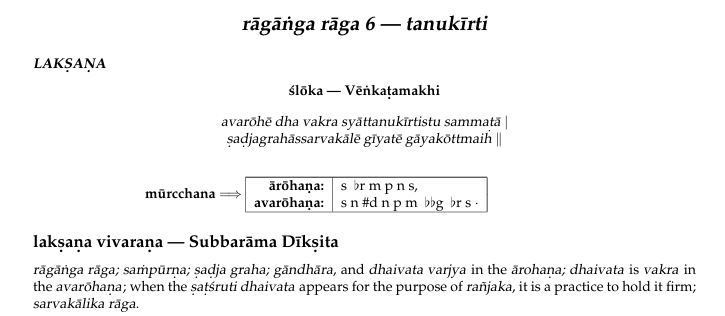
Enclosed below are excerpts for Manōrañjanī from the translation of the Pradarshini.
![Source: Sangita Sampradaya Pradarshini (English Translation)[1]](https://miro.medium.com/v2/resize:fit:720/1*nuwIe2XnpgG_-y7igw5yjQ.png)
Source: Sangita Sampradaya Pradarshini (English Translation)[1]
Manōrañjanī being the fifth raga in the first chakra has one vivaadi svara, namely G1 and the tivra (higher) versions of Dha (D₂) and Ni(N₃).

Exploring Raga Manōrañjanī

- For more context and explanation of the different facets and attributes that are being explored, please read : **72 Rāgāṅga Rāgas — a framework for a deeper dive**
Dr. Sumithra Vasudev whose thesis was on the Musical compositions of Ramasvami Diksita, Balasvami Diksita and Subbarama Diksita shares the following observations and analysis and has also sung the specific musical phrases being highlighted in the mūrchana, traditional gita, and Dīkṣita family compositions.
mūrchana -
“Subbarāma Dīkṣita’s rāga description gives basic details about this rāgāṅga rāga, based on the lakṣaṇa ślōka and the mūrchanā — as noted by Dr N Ramanathan that the ślōka only says gāndhāra is vakra(occurs in a non-linear sequence m r g r s in avarōha(descent)) while Subbarāma Dīkṣita adds that gāndhāra is omitted in ārōha(ascent) (as found in the mūrchanā).”[2]
· (5a) — listen to the mūrchanā:s r m p d n, ṡ — ṡ n d p m m p m r g r s
From Subbarāma Dīkṣita’s rāga description:
Phrases in compositions:
gīta —
“We see many sañcāra-s with ‘p d s’ in the gīta. The ‘p d n, s’ phrase in the mūrchanā is almost absent in the gīta. Instead ‘s n s’ is found, and ‘p d s’, and its variants like ‘d p s’, ‘s n d s’ and are used (5b). There is a depiction of dhaivata as a strong svara which is highlighted in the sañcāra-s like ‘d d s’; ‘p d s’ and so on, and rare or no usage of ‘p d n s’.”[2]
- (5b) — listen to these sañcāra-s
“avarōha has the sañcāra-s ‘s n d’, ‘s n d p m’ in most contexts (5c).”[2]
- (5c) — listen to these sañcāra-s
“In the region of madhya ṣaḍja — madhya pañcama, ‘m r g r s’ is mostly used in avarōha based sañcāra-s; ‘s — r g s’, ‘s g r s’ are only used when the movement begins with madhya ṣaḍja. It is noteworthy that ‘s r g r s’ is not found in the gīta. It seems that ‘r g r s’ was to be used only when there is an avarōha based movement from ‘m’. In the antari section of the gīta there is a sañcāra with two dīrgha(elongated) gāndhāra-s — ‘s, s g, g, r, s’ showcasing the vivādi svara distinctly (5d).”[2]
- (5d) — listen to these sañcāra-s
‘m d p’ is another distinct usage (5e).[2]
- (5e) — listen to these sañcāra-s
**“It is interesting that the sañcāra ‘p d m’ is used in bhānumati(lower ni) while ‘m d p’ is seen in manōrañjanī (higher ni)— it may be said that these two phrases highlight the difference in the niṣāda variety in the two rāga-s though the dhaivata is the same, but without actually spelling out the niṣāda!” — Dr Sumithra Vasudev**
Dīkṣita composition —
“The pallavī of the kīrtana ‘bālāmbikē pāhi’ has the usage ‘s r, — p, d’ (5f). In the tāna we find frequent use of sañcāra-s like ‘p-s’, ‘p-r’ while Dīkṣita uses ‘r-p’, though as part of two different melodic phrases.”[2]
- (5f) — listen to these sañcāra-s
‘m g g r s’ is found in the pallavi section of ‘bālāmbikē’. This usage is not found in the gīta but is found in the tāna given in the SSP (5g).[2]
- (5g) — listen to these sañcāra-s
‘s r g g r s’ is seen in the madhyamakāla sāhitya of the kīrtana and is used only once in the kīrtana. It is not used at all in both gīta and tāna (5h).[2]
- (5h)- *listen to these sañcāra-s*
“The sañcāra ‘s, p, d, p’ found in the anupallavī is a distinct one in that, the other sañcāra having ‘s p’ as ‘s p m p’ where the ‘s p’ descends to ‘m’ is seen to be used more frequently (5i)”[2]
- (5i)- *listen to these sañcāra-s*
‘m d, p’ is found in the anupallavī and interestingly the name of the rāga is embedded in this beautiful sañcāra (5j).[2]
- (5j)- *listen to these sañcāra-s*
‘d, n, s’ is not found in the gīta or tāna but is seen in the madhyamakāla sāhitya and svara section of the kīrtana, and ‘s d s’ is also a different phrase found in the svara section (5k).[2]
- (5k)- *listen to these sañcāra-s*
sañcāri —
“The sañcāri combines sañcāra-s from the gīta and Muddusvāmī’s kīrtana and does not seem to have any other phrases apart from those found in the latter two compositions.
Frequent use of ‘d d s’ is found in the sañcāri though ‘d n s’ is also seen.
‘m g r s’ and ‘s r g r’ are rarely found and ‘m r g r (s)’, ‘s g r’, ‘r g s — r s’ are all frequently used. ‘s g, g r g g r’ highlighting the vivādi svara, ‘s d, d s,’, ‘s m’, ‘s p’, ‘p s’ and ‘m d p’ are the other distinct usages found in the sañcāri also (5l).”[2]
- (5l)- *listen to these sañcāra-s*
RRM section
“The RRM section of manōrañjanī rāga has the usage ‘p d n — n d n s’ in the sāhitya portion, which follows the mūrchanā, and ‘p d d s’ in the svara portion. ‘m r g r s’, ‘ m g r r s’ are both seen; ‘r g s’, ‘r g r — g s r s’ and ‘s, s — r g g r r s,’ are all used in this section; ‘s r m’ is the ārōha-based sañcāra used often and ‘r g, r m,’ is seen once.”[2]
· *listen to manōrañjanī section in RRM*
Muthuswami Dikshithar’s composition in Raga Manōrañjanī
![Source: Sangita Sampradaya Pradarshini (English Translation)[1]](https://miro.medium.com/v2/resize:fit:685/1*6aPzH1hVRD0Ae2pwbw4NOw.png)
Source: Sangita Sampradaya Pradarshini (English Translation)[1]
The composition is balambike pahi in matya tala with the raga mudra appearing in the anupallavi at Sankara nArAyaNa manOranjani dhanini
The song’s framework is P–A/M–S[7]
i.e it consists of the Pallavi and Anupallavi and the Madhyamakala sahitya and Chittasvaram are both featured in the Anupallavi
In her thesis, Raganga Ragas in Sangita Sampradaya Pradarshini ,Dr Hemalatha highlights that amongst the raganga ragas in this first chakram, the vivaadi gandhara is omitted in the aroha(ascent) and in the purvanga (lower section) of avaroha (descent), “only in the rāga Manōrañjani, the pattern of svara-s is vakra ‘ma ri ga ri sa’. ”[4]
Melakartas Equivalent —
· Lecdem on Melakartas — Raga Manavati by Vidushi Suguna Varadachari
· *Raga Manavati — Vidwan S Kalyanaraman*
There is a kriti by Tyagaraja in raga Manoranjani.
In her thesis, Raganga Ragas in Sangita Sampradaya Pradarshini ,Dr Hemalatha explains that “the Rāga Manōrañjani of Kanakāmbari (raganga raga) school seems to be melodically different from the Manōrañjani of Kanakāńgi (melakarta) school especially if we take the present day version of the Tyāgarāja kriti to represent the latter school.”[4]
References
-
guruguha.org — Sangita Sampradaya Pradarshini — English Translation
-
Analysis of musical phrases in this raga by Dr Sumithra Vasudev
-
Thesis — Raganga Ragas in Sangita Sampradaya Pradarshini by Dr R Hemalatha
-
Music Research Library — Ragalakshana Sangraha, Compilation and Translation by Hema Ramanathan
-
Medieval.org — List of Muthuswami Dikshithar compositions
-
MusicResearchLibrary — A Statistical Analysis of Muttusvami Dikshitar Compositions, by P P Narayanaswami
메타데이터
- post_id
- 10f090ef9ee5
- slug
- an-exploration-of-rāgāṅga-rāgas-5-manōrañjanī-10f090ef9ee5
- url
- https://medium.com/kavyavriksha/an-exploration-of-r%C4%81g%C4%81%E1%B9%85ga-r%C4%81gas-5-man%C5%8Dra%C3%B1jan%C4%AB-10f090ef9ee5
- canonical_url
- https://medium.com/kavyavriksha/an-exploration-of-r%C4%81g%C4%81%E1%B9%85ga-r%C4%81gas-5-man%C5%8Dra%C3%B1jan%C4%AB-10f090ef9ee5
- author_url
- https://medium.com/@kavyavriksha
- status
- ok
- fetched_at
- 2026-06-21 07:44:09