Why FMCG Brands Lose Sales Even When Market Demand Is High
Companies in the FMCG industry often blame declining sales on low customer demand, changing market trends or increasing competition. But…
Why FMCG Brands Lose Sales Even When Market Demand Is High
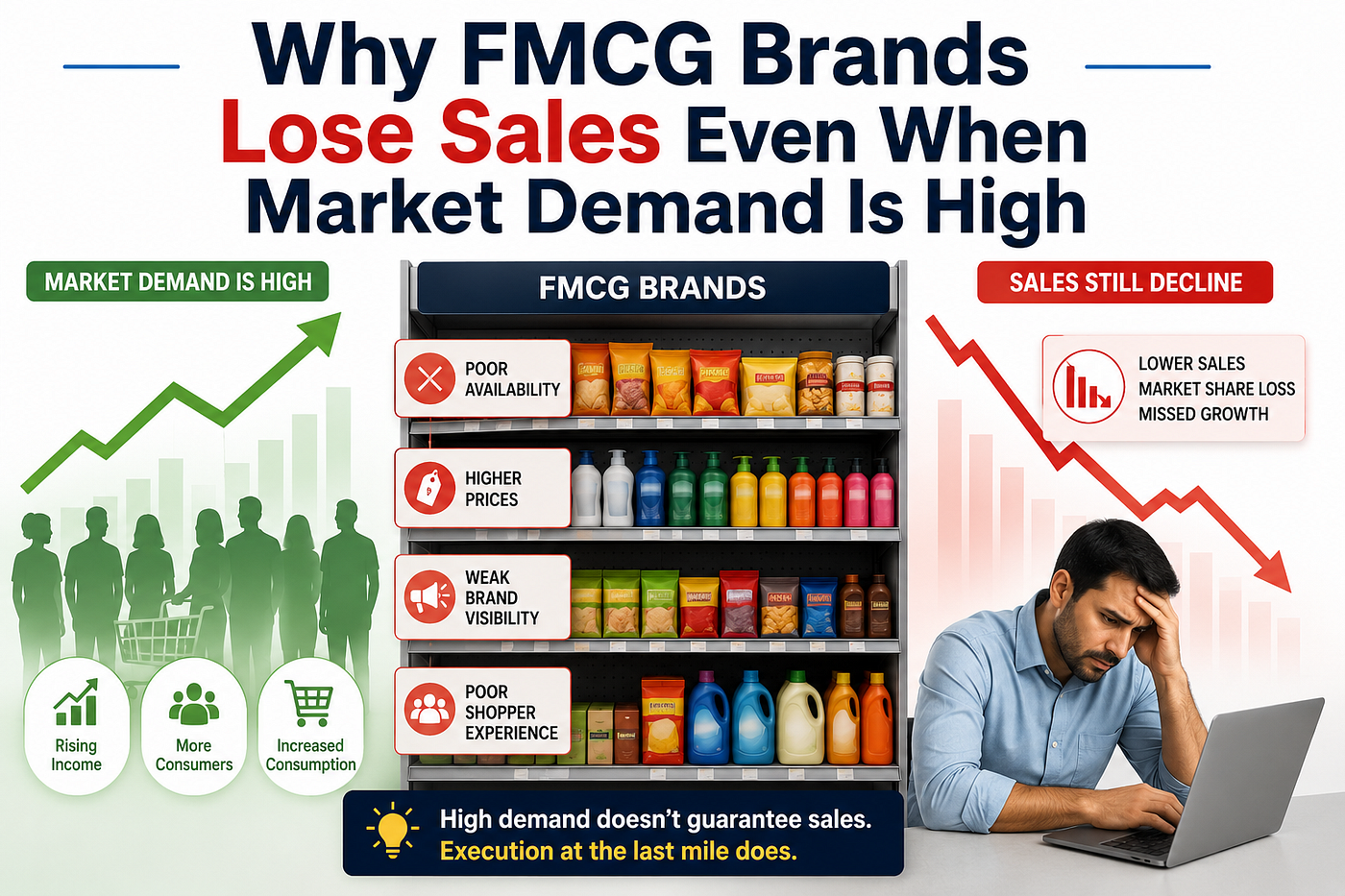
Companies in the FMCG industry often blame declining sales on low customer demand, changing market trends or increasing competition. But the real problem is often much deeper within the daily sales operations. The demand for a product could be high but the sales can be low if the execution on the ground is weak. Sales reps may not often get to retail stores. Orders might be delayed. Products can be sold out and management doesn’t notify for days. As companies continue to assume that all is well, competitor brands may slowly gain better shelf visibility.
Operational gaps tend to develop over time. At first they may appear small and harmless. However, when multiple issues occur simultaneously across hundreds of outlets, they can result in significant revenue leakage. By the time management sees the impact in monthly sales reports, the damage has often already extended to retailer relationships, customer trust and market share.
That’s the reason today’s FMCG companies are placing a lot of emphasis on real time sales visibility and stronger field execution.
The Hidden Problems Inside Traditional FMCG Operations
Many FMCG companies are still reliant on manual processes for the management of field sales teams and distributors. Sales reps often share updates via phone calls, spreadsheets, paper reports or messaging apps. This may work for smaller operations in the short term, but it also creates serious visibility gaps as your business scales.
The main problem with traditional systems is information delay. The managers cannot immediately make sense of what is happening in the market. As a result, vital problems are ignored until the sales performance begins to decline.
Missed Retail Visits
In many companies, sales representatives are expected to visit multiple retail outlets daily. However, without proper tracking systems, some outlets may be skipped regularly.
When retailers do not receive consistent visits:
- Orders become irregular
- Retailers lose engagement with the brand
- Competitors get more opportunities to promote their products
- Shelf visibility starts decreasing
Over time, these missed visits directly impact product availability and retailer loyalty.
Delayed Order Collection
Manual order collection creates delays between retailers, distributors, and warehouses. Sales representatives may collect orders on paper and submit them later, which slows down the entire process.
This often leads to:
- Delayed deliveries
- Incorrect order entries
- Inventory confusion
- Retailer dissatisfaction
Retailers usually prefer suppliers that provide faster and more reliable service. Frequent delays can push them toward competitor brands.
Poor Shelf Visibility
In FMCG, visibility is one of the biggest drivers of sales. Customers often purchase products that are clearly visible and easily available.
When field execution is weak:
- Products may not be displayed properly
- Promotional materials may not be installed
- Competitor products may dominate shelves
- Stockouts may remain unresolved
Even a strong brand can lose sales quickly if its products are not consistently visible in stores.
Why Real Time Visibility Has Become Essential
Modern FMCG businesses need immediate access to field data to maintain control over operations. Real time visibility allows managers to monitor sales activities as they happen instead of waiting for end-of-day or weekly reports.
With digital sales systems, businesses can track:
- Sales representative activity
- Retail outlet coverage
- Route completion
- Order collection
- Product availability
- Distributor performance
- Inventory movement
This helps businesses identify problems early and take corrective action before sales are affected.
How Sales Automation Improves FMCG Operations
**Sales automation platforms** are helping FMCG companies improve operational efficiency and field accountability. Instead of depending on manual updates, businesses can manage sales operations through centralized digital systems.
Better Field Team Accountability
GPS tracking and live activity monitoring help managers understand whether field teams are completing assigned tasks properly.

This improves:
- Outlet coverage consistency
- Route discipline
- Sales productivity
- Team performance measurement
Sales teams also become more organized because their activities are properly monitored and recorded.
Faster Decision Making
One of the biggest advantages of real time reporting is faster decision making.
Management can instantly identify:
- Low-performing territories
- Frequently skipped outlets
- Fast-moving products
- Inventory shortages
- Delivery bottlenecks
This allows businesses to respond quickly instead of reacting after problems become severe.
Improved Retailer Relationships
Retailers value suppliers that provide consistent support and faster service. Digital sales systems help businesses improve communication and order management, leading to stronger retailer relationships.
Retailers benefit from:
- Faster order processing
- Better stock availability
- More regular visits
- Improved issue resolution
Strong retailer relationships often lead to higher repeat orders and better shelf placement.
Technology Is Becoming a Competitive Advantage
The FMCG market is becoming increasingly competitive every year. Businesses that continue using outdated sales processes often struggle with poor visibility, operational inefficiency, and slow execution.
Companies adopting modern sales automation tools gain advantages through:
- Faster reporting
- Better operational control
- Improved distribution management
- Stronger retail execution
- Higher field productivity
Technology is no longer optional for growing FMCG businesses. It has become an important part of long term market expansion and sales growth.
How Delta Sales App Supports FMCG Businesses
Many FMCG brands, wholesalers, and distributors are using **Delta Sales App** to digitize field sales operations and improve market execution.
The platform helps businesses manage:
- Field sales tracking
- Order management
- Route planning
- Distributor coordination
- Attendance monitoring
- Inventory visibility
- Retail execution tracking
- Real time analytics
By improving operational visibility, businesses can reduce revenue leakage, improve team accountability, and strengthen overall sales performance.
Final Thoughts
FMCG sales decline is not always caused by weak demand. In many cases, the bigger issue is poor execution inside daily sales operations.
Missed retailer visits, delayed orders, weak shelf visibility, and lack of field monitoring slowly reduce market performance over time. Businesses that fail to identify these operational gaps early often lose valuable growth opportunities.
Companies that invest in real time sales visibility and smarter field sales management systems are better prepared to compete in today’s fast-moving FMCG environment. As the industry continues evolving, businesses that combine strong products with strong execution will achieve the greatest long term success. To experience it **book a free demo**
메타데이터
- post_id
- 11052250a4ec
- slug
- why-fmcg-brands-lose-sales-even-when-market-demand-is-high-11052250a4ec
- url
- https://medium.com/@deltasalesapp1/why-fmcg-brands-lose-sales-even-when-market-demand-is-high-11052250a4ec
- canonical_url
- https://medium.com/@deltasalesapp1/why-fmcg-brands-lose-sales-even-when-market-demand-is-high-11052250a4ec
- author_url
- https://medium.com/@deltasalesapp1
- status
- ok
- fetched_at
- 2026-06-15 20:49:13