The Saltwater Underground Railroad: Black Seminoles and the Atlantic Path to Freedom
When most Americans think of the Underground Railroad, they picture a northward journey: enslaved people moving through forests and towns…
The Saltwater Underground Railroad: Black Seminoles and the Atlantic Path to Freedom
When most Americans think of the Underground Railroad, they picture a northward journey: enslaved people moving through forests and towns toward free states and Canada. Yet for some, freedom lay across water rather than land. Between the early 1820s and the late 1830s, a little-known maritime route connected South Florida to the Caribbean. Historians now call this the Saltwater Underground Railroad, or simply the Saltwater Railroad — a path where enslaved and self-liberated people escaped bondage by sailing from the United States to the Bahamas.
This route was not large in scale compared to the Northern Railroad, but it was significant. Roughly 200 Black Seminoles are documented as traveling from Florida to Andros Island in the Bahamas between 1821 and 1837. While modest in numbers, these journeys illustrate that freedom-seekers used diverse, regionally specific strategies, and that escape could occur even under the shadow of slavery’s geographic reach.
The Saltwater Railroad’s geography shaped its possibilities. Florida, a U.S. territory after 1821, remained sparsely settled, with extensive marshes, barrier islands, and rivers. The southern peninsula — including areas around Key Biscayne and Biscayne Bay — provided relative concealment for groups moving southward from Georgia and the Carolinas. Prior to U.S. annexation, Spanish Florida had been known as a haven for runaways, and even after 1821, its remoteness and difficult terrain made full enforcement of U.S. slave laws challenging.
From the perspective of freedom-seekers, Florida was a transit zone rather than a final destination. It offered both concealment and access to the Atlantic coast, where small boats and knowledge of currents enabled a passage to the Bahamas. Red Bays on Andros Island became a refuge because chattel slavery had been outlawed there, providing legal freedom and, in some cases, opportunities for settlement.
The Saltwater Railroad was distinctive not just for its maritime nature, but for the people who traveled it. Many participants were Black Seminoles, a community of African-descended people who had allied with Seminole tribes in Florida. These alliances were complex: Black Seminoles shared villages, defended each other militarily, and cultivated small-scale agriculture together. Their familiarity with swamps, rivers, and coastal routes gave them an advantage that other enslaved people often lacked.

The Black Seminoles are a small offshoot of the Gullah who escaped from the rice plantations in South Carolina and Georgia. (Source: Abby Aldrich Rockefeller Folk Art Museum)
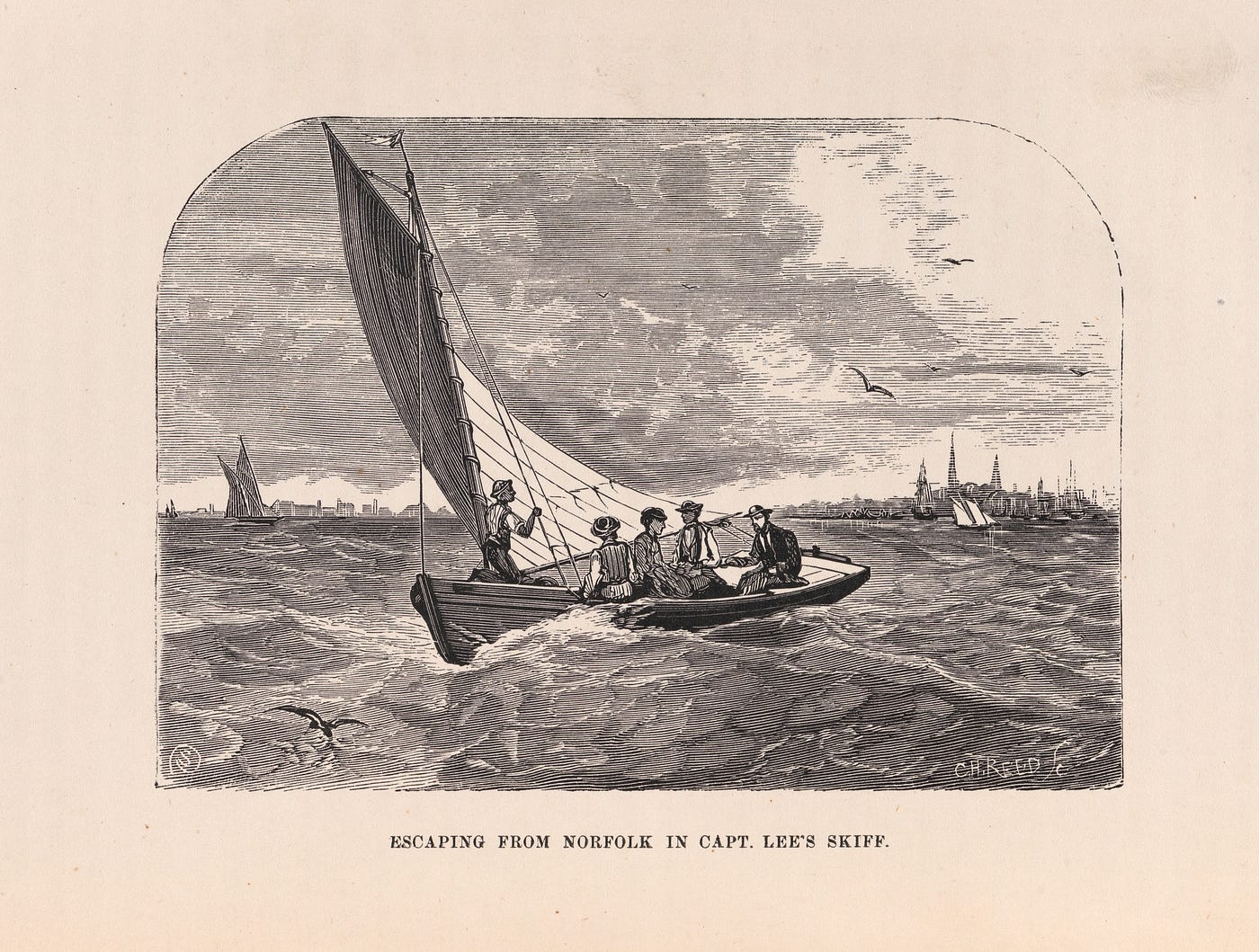
The Black Seminoles’ mobility was critical. They were accustomed to moving stealthily across both inland and coastal terrain, often navigating swamps, hammocks, and tidal flats. Their expertise extended to maritime travel: small, shallow-draft boats could carry them across the channel from Key Biscayne to Andros Island, a journey of approximately 50–60 miles over open water. These crossings were risky and required skill, but when successful, they provided a direct route from slavery to legally recognized freedom.
Historical accounts suggest a typical journey began in the Carolinas or Georgia, where enslaved people fled to Florida, often guided by local knowledge or sympathetic Black or Native allies. They traveled south to the Key Biscayne area, which served as a coastal staging ground. From there, small boats carried groups across the Atlantic to Red Bays in the Bahamas. This route required careful timing, coordination, and endurance. Travel by land through Florida could take weeks, depending on terrain, patrols, and supply access. The Atlantic crossing itself was hazardous: sudden storms, strong currents, and the absence of navigational instruments could prove deadly. Survival likely depended on a combination of skill, community planning, and local knowledge, though detailed records of every journey do not survive.
Available evidence suggests that Black Seminoles occasionally traded goods with nearby free Black residents, enslaved people, or sympathetic whites, obtaining food, tools, or boats. These interactions were carefully managed, because detection could mean capture or death. While the scale and frequency of such trade remain uncertain, archaeological and documentary sources indicate that some exchanges occurred.
Upon arrival, Black Seminoles settled on Andros Island, sometimes for decades. Life there was challenging but legally free. They farmed, fished, and maintained cultural practices, preserving aspects of Seminole and African heritage. In at least some cases, children were born and raised in the Bahamas, having never experienced enslavement in the conventional plantation sense. These settlements also had broader implications. They demonstrate that freedom was attainable even under the shadow of slavery, challenging the perception that the Atlantic coast and Caribbean were merely peripheries of bondage. The Black Seminoles’ migration reinforced the idea that enslaved people used innovative, context-specific pathways to autonomy.
The Saltwater Railroad remains underrepresented in textbooks and public memory. Unlike the Northern Underground Railroad, which was relatively well-documented, this route relied on maritime knowledge, cross-cultural alliances, and small-scale organization. Its historical footprint is fragmentary: records are limited, oral histories survive unevenly, and material evidence is scarce. Yet the consistency of accounts — from U.S. government reports, Seminole correspondence, and Bahamian records — confirms that the Saltwater Railroad was real, operational, and effective for those who used it.
The story of the Saltwater Railroad expands our understanding of escape. It underscores that geography, skill, and community knowledge were as crucial as moral courage. And it highlights a group often absent from broader narratives: Black Seminoles, whose combined land and maritime expertise made these journeys possible. For roughly two decades, they navigated waterways, swamps, and Atlantic channels to claim freedom, showing that enslaved people devised innovative, localized strategies under extreme constraints. The route demonstrates that freedom could be maritime, cross-cultural, and generational, and that enslaved people themselves were the architects of pathways to liberty.
Red Bays in the Bahamas, far from the plantations of the Carolinas and Georgia, became a space where freedom was tangible. Yet this freedom was hard-won, contingent, and precarious — dependent on knowledge, courage, and cooperation. The Saltwater Railroad reminds us that escape routes were diverse, often unexpected, and intimately connected to the skills and networks of those seeking liberation.
메타데이터
- post_id
- 11192ee1112e
- slug
- the-saltwater-underground-railroad-black-seminoles-and-the-atlantic-path-to-freedom-11192ee1112e
- url
- https://medium.com/@lankiewicz/the-saltwater-underground-railroad-black-seminoles-and-the-atlantic-path-to-freedom-11192ee1112e
- canonical_url
- https://medium.com/@lankiewicz/the-saltwater-underground-railroad-black-seminoles-and-the-atlantic-path-to-freedom-11192ee1112e
- author_url
- https://medium.com/@lankiewicz
- status
- ok
- fetched_at
- 2026-07-19 08:32:53