Rome Didn’t Fall — It Just Changed Servers: Why We Can’t Stop Thinking About the Roman Empire
Everybody admitted it at the same time. The whole internet looked up from its phone and confessed that yes, actually, it thinks about the…
Rome Didn’t Fall — It Just Changed Servers: Why We Can’t Stop Thinking About the Roman Empire
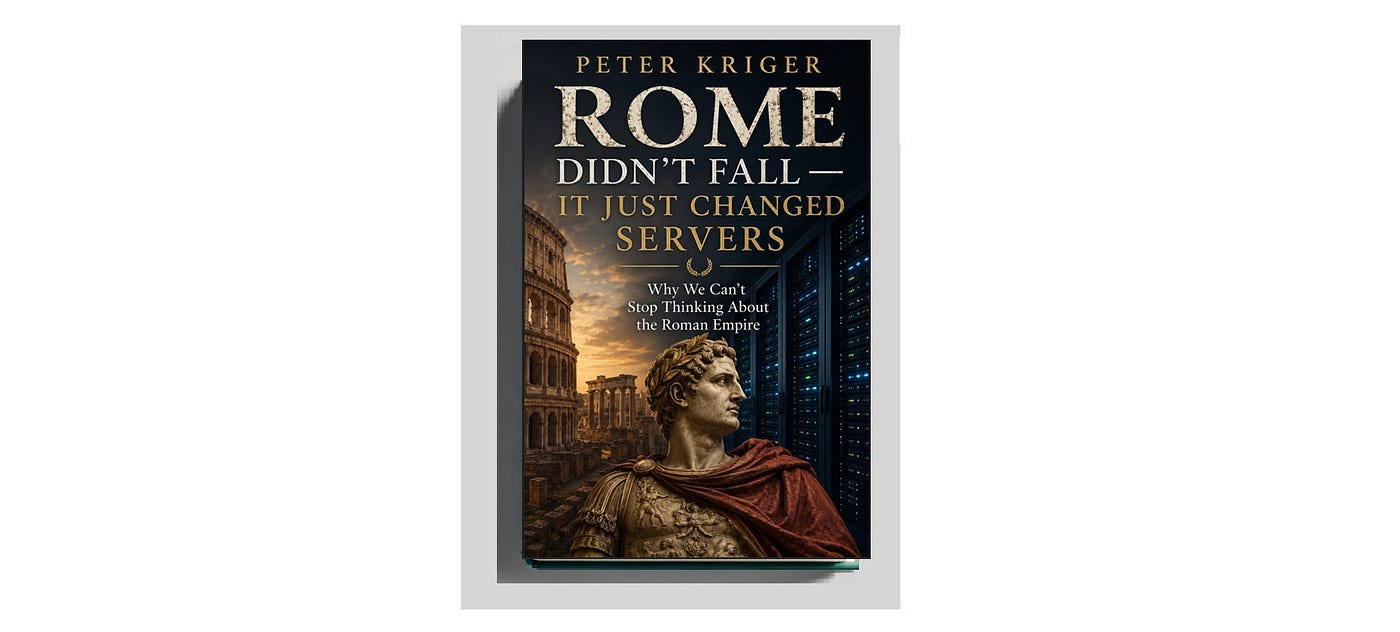
Everybody admitted it at the same time. The whole internet looked up from its phone and confessed that yes, actually, it thinks about the Roman Empire constantly. We turned it into a joke because that is what we do with things that scare us a little. But the joke had a secret inside it, and the secret is this: we cannot stop thinking about Rome because we never actually left it.
This book takes the meme seriously without taking itself seriously at all. It argues something genuinely strange and genuinely true — that Rome didn’t collapse so much as migrate. Its laws, its calendar, its alphabet, its whole idea of what an empire even is got copied forward, server to server, century to century, until it landed on the machine you are reading this on right now. The Colosseum was the first battle royale. Caesar was the first influencer. The aqueducts were somebody’s Minecraft world that happened to be real. And the anxious feeling that our own world might be ending? Rome felt that too, on a loop, for four hundred years.
Because here is the part nobody mentions. If Rome is still running inside us, then we are somebody’s Rome too. Two thousand years from now, when they’re posting about whatever replaces us, what will be our marble? Pull up a chair. The next server is already loading.
Keywords: Roman Empire, history, popular philosophy, Gen Z, internet culture, video games, the future
[embed]
Contents
Chapter One — Rent-Free: The Empire That Won’t Leave Your Head 15
Chapter Two — You’re Already Running Rome (Check Your Calendar) 23
Chapter Three — The Mirror Made of Marble. 31
Chapter Four — The Server Migration (How an Empire Survives Its Own Death) 39
Chapter Five — The Colosseum Was the First Battle Royale. 46
Chapter Six — Every Roman Was Secretly Playing Minecraft 53
Chapter Seven — Caesar Was the First Influencer 60
Chapter Eight — How to Delete a Republic and Keep the Likes. 67
Chapter Nine — The Statues Were Never White. 74
Chapter Ten — The Women Who Actually Ran the Place. 81
Chapter Eleven — Rome Had a Comment Section. 89
Chapter Twelve — Purple Was the Original Flex. 96
Chapter Thirteen — Boss Fights and the Business of Monsters. 104
Chapter Fourteen — Who Carried the Marble. 111
Chapter Fifteen — All Roads Lead to the Platform.. 118
Chapter Sixteen — Who Counts as Us?. 125
Chapter Seventeen — When the Price of Bread Decides Everything. 132
Chapter Eighteen — Marcus Aurelius Is in Your Gym.. 139
Chapter Nineteen — The Group Chat of the Gods. 146
Chapter Twenty — The Day a New Idea Went Viral 153
Chapter Twenty-One — Et Tu? Friendship as a Contact Sport 161
Chapter Twenty-Two — Handed the World at Eighteen. 169
Chapter Twenty-Three — Doomscrolling the Fall 176
Chapter Twenty-Four — The Barbarians Were Us. 183
Chapter Twenty-Five — Nobody Noticed It Was Ending. 190
Chapter Twenty-Six — The Save File That Ran a Thousand More Years. 196
Chapter Twenty-Seven — Everybody Wanted the Skin. 202
Chapter Twenty-Eight — America Showed Up in a Toga. 209
Chapter Twenty-Nine — The Tech-Caesars. 215
Chapter Thirty — The Machine That Runs the Empire. 222
Chapter Thirty-One — Mars Is Just the Next Province. 229
Chapter Thirty-Two — What Will Be Our Marble?. 235
Chapter Thirty-Three — You Can Take Off the Toga Now (You Won’t) 241
The Bread Dole and the Cost-of-Living Election. 255
The Colosseum and the Battle Royale. 255
Caesar’s Commentaries and the Personal Brand. 256
Augustus’s Restored Republic and the Preserved Forms. 257
The Painted Statues and the White-Marble Myth. 257
The Roman Roads and the Platform Chokepoint 258
The Edict of Citizenship and the Question of Belonging. 259
The Aqueduct and the Infrastructure Nobody Sees. 259
The Grain Fleet Delay and the Supply Shock. 260
Marcus Aurelius’s Notebook and the Gym Quote. 261
The Beast Hunts and the Manufactured Monster 261
The Wall Graffiti and the Comment Section. 262
Tyrian Purple and the Status Signal 263
The Empress Behind the Throne and Soft Power 263
The Eastern Empire and the Edited Ending. 264
The Entangled Barbarians and the Invented Threat 265
The Young Emperor and the Inherited World. 265
The Spread of a New Faith and Going Viral 266
The Capitol Building and the Conscious Cosplay. 267
The Calendar Fix and the Accidental Legacy. 267
Histories of Rome and Its Fall 291
The Eastern Empire and the Long Continuation. 292
Rome’s Legacy, Reception, and Image. 292
Stoicism, Ancient and Modern. 293
The Modern Parallels: Attention, Status, Networks, and Decline. 293
Preface
There is a question that went around a couple of years ago, and you have almost certainly been asked it, or asked it of somebody else, probably while pretending you didn’t care about the answer. The question is: how often do you think about the Roman Empire? And the reason it spread like a brushfire is that the answer kept coming back wrong. Not wrong as in incorrect. Wrong as in too much. People expected the answer to be never, or maybe once, that one time in school. Instead the answer was Tuesday. The answer was this morning. The answer was an embarrassing number of times per week, every week, for no reason anybody could explain, about an empire that has been dead for fifteen hundred years and owes us nothing.
That is a strange thing to discover about yourself. You can go your whole life not thinking about, say, the Kingdom of Aksum, which was also enormous and also impressive and also gone. Nobody made a trend out of the Aksumite Empire. Nobody confessed, eyes darting, that they think about Aksum while doing the dishes. It was specifically Rome that crawled inside our skulls and set up residence, paying no rent, leaving the lights on, and the goal of this book is to figure out why. Not in the bored way a textbook would, where the answer is a list of dates and you forget it before lunch. In the real way. The way where you finish and you cannot look at your own world the same again.
Here is the short version of the answer, and the rest of the book is just me proving it to you. We cannot stop thinking about Rome because we are still thinking inside Rome. The empire did not fall in the way a tower falls, all at once, with a satisfying crash and then nothing. It did something much sneakier. It changed servers. Everything that made Rome Rome — the laws, the language, the calendar on your phone, the alphabet these very sentences are wearing, the whole concept that a single sprawling system could swallow the known world and call it order — all of that got copied forward. Backed up. Migrated. From Rome to the Church, from the Church to Europe, from Europe to America, from America to the internet, and from the internet into the device that is glowing in your hand at this exact moment. The hardware keeps changing. The software is two thousand years old. That is why Rome feels familiar even though you never lived there. You are running it.
I want to be honest about who is talking to you, because it changes how you should read this. I am eighteen. I have never excavated anything. I have never read a sentence of Latin that wasn’t on a coin or a tattoo. What I have done is the thing my entire generation has done, which is to absorb Rome through the back door, through the stuff we actually touch all day. I did not meet the Colosseum in a classroom. I met it in the shape of every last-one-standing game I have ever played, the kind where a hundred people drop in and one walks out and a crowd watches the whole thing for fun. I did not meet Roman engineering in a lecture. I met it the first time I built something in a game that was bigger than I needed it to be, just so that it would still be standing after I logged off. We did not study Rome. We respawned in it without noticing.
And that, weirdly, makes my generation better at understanding Rome than almost anybody, even though we know fewer of the dates. Because Rome was not really about dates. Rome was about a feeling, and we are fluent in the feeling. The feeling of refreshing something to see if the world ended while you slept. The feeling of watching a person become a brand. The feeling of an arena. The feeling of building something just to leave proof you existed. The feeling of being absolutely certain your civilization is in its final season while also lining up to buy the merch. A Roman would understand our entire internet in about ten minutes, and we understand their entire empire faster than we’d like to admit. Same software. Newer screen.
So that is the method of this book, and I should warn you about it up front because it is a little unusual for a history book. We are not going to stand behind the glass and look at Rome like it’s a dead butterfly pinned to a board. We are going to try it on. Every chapter is basically a fitting room. You walk in holding your phone, being completely yourself, and for a few pages you put on the toga — you stand in a Roman’s sandals, see what they saw, want what they wanted, fear what they feared — and then you walk back out. But here is the catch, and it’s the whole catch of the book: you never take the toga all the way off. There is always a fold of it left on you when you leave. By the end you are going to realize you have been wearing it this whole time and just never had a word for it.
I should also tell you what this book is not, so nobody feels tricked. It is not a defense of Rome. Rome did monstrous things, and we are not going to airbrush them out to keep the vibe fun, because a fun lie is worse than an uncomfortable truth and you deserve the truth. The marble we picture was carried by people who never got to rest. The clean white statues you imagine were actually painted in loud colors, and the fact that we picture them white tells you something a little embarrassing about how we invent a Rome that flatters us. We are going to look at all of that directly. A history book that only shows you the cool helmets is not a history book, it is a poster, and you can get a poster anywhere.
It is also not just a boys’ club of legions and swords, even though there will be plenty of that and it will be excellent. Rome was sandals and battle lines, sure, but it was also the most dramatic group chat in human history. It was mothers who quietly installed emperors and then quietly uninstalled them. It was friendships that turned into knife fights in the most literal possible way. It was fashion, gossip, status, heartbreak, ambition, betrayal, and people staying up too late worrying about money — and if you think any of that is the boring half, you have never actually paid attention to people. The war stuff and the human stuff are not two different Romes. They are the same Rome, and you need both or you understand neither.
There is one more thread I want you to keep an eye on, because it runs through every single chapter quietly, like a bass line you feel before you hear. It goes: Rome, then us, then whoever comes next. Every time we catch Rome doing something that feels eerily like us, I am going to gently point past us, to the people who will look back at our age the way we look back at theirs. Because if the whole argument of this book is right — if empires do not die but migrate, if the software outlives the screen — then we are not the end of the line. We are a server in the middle of it. Somebody is going to think about us constantly, fifteen hundred years from now, and turn it into whatever their version of a trend is, and ask each other how often they think about the strange ancient people who lived in the early twenty-first century and could not stop refreshing their phones.
That should feel a little dizzying, and I hope it does, because that dizziness is the actual point. We tend to imagine ourselves as the audience of history — the ones in the comfortable seats, watching the past perform. This book is going to quietly move you out of the audience and onto the stage without telling you when it happened. One minute you are reading about a Roman teenager handed an impossible amount of power. The next minute you realize the book is also, somehow, about you. And then it points one row further back, at the people watching you, and you understand that you have always been in somebody’s Colosseum, and so have I, and so was every Roman who ever lived.
I am going to make you a promise about the ride itself. I am not going to be boring, and I am not going to be fake. I am going to talk to you the way I would actually talk, which means there will be jokes, and some of them will be at the expense of emperors who frankly had it coming, and there will be moments where I drop the bit entirely because something is too real to joke about and you will be able to feel the gear shift. I am not going to fake an old wise voice I do not have. But I am also not going to wink at you so hard the whole thing collapses into a joke about itself, because Rome deserves better than that and so do you. The goal is the thing a good friend does when they are obsessed with something and they pull you into it — fast, funny, a little unhinged, but underneath it all, completely sincere, because they actually want you to love the thing they love.
And I do want you to love it. Not in a homework way. In the way where you finish a chapter and immediately go look something up because you cannot stand not knowing. In the way where you start seeing Rome in places you used to think were just modern life — in the layout of a stadium, in the wording of a law, in the way a powerful person posts, in the architecture of the apps that run your day. Once you see it you cannot unsee it, and that is not a bug, that is the entire experience I am trying to give you. I am trying to install a Rome detector in your brain, and I am warning you now that it does not have an off switch, and that the people I have already given it to have never once thanked me for it and never once turned it off either.
So here is where we are. You have a phone in your hand and an empire in your head and absolutely no idea how the second one got there. Over the next thirty-three chapters we are going to figure it out together, trying the toga on and off, laughing where it’s funny and shutting up where it isn’t, following that quiet bass line — Rome, then us, then whoever’s next — all the way to a single question waiting at the end of the book like a boss at the end of a level. The question is: when the next server boots up, and somebody two thousand years from now cannot stop thinking about us, what exactly will they be thinking about? What will be our marble?
I don’t fully know yet. That is sort of the point of writing the whole thing. But I know where we have to start, and we have to start with the simplest and strangest fact of all, the one that kicked this whole thing off — the fact that an empire that has been gone for fifteen centuries is, at this very moment, living rent-free in your head, and has somehow convinced you that this is normal. It is not normal. It is the most interesting thing about you. Let’s go find out why.
Chapter One — Rent-Free: The Empire That Won’t Leave Your Head
Picture the exact moment the whole thing started, because it is funnier than people remember. Somebody, somewhere, turned to a guy they loved and asked, with the casual menace of a person who already suspects the answer, how often do you think about the Roman Empire? And the guy froze. Not because he had no answer. Because he had a number, and the number was humiliating. The number was several times a week. He had never said it out loud, had never even counted, and now here it was, exposed, blinking in the daylight like a creature that lives under a rock. That single private flinch, multiplied by millions of people all flinching at once, is the reason you are holding this book.
Now, the joke landed because it was framed as a guy thing, and we will deal with that framing later and complicate it, because plenty of people who are not guys think about Rome constantly and were quietly insulted at being left off the list. But set the gender bit aside, because it was never the interesting part. The interesting part is the word often. Not do you think Rome was cool — of course it was cool, that’s not a confession, that’s a Tuesday opinion. The question was how often, and the answer kept being unprompted. Regularly. For no reason. While merging onto the highway. That is a completely different category of fact about a person, and almost nobody noticed they had crossed into it.
Here is the distinction that the whole chapter turns on, so let me say it plainly. There is a difference between something you think about and something you cannot stop thinking about. The first is a hobby. You choose it, you schedule it, you can put it down. The second is not a hobby at all. The second is a haunting. And the tell, the thing that separates the two, is exactly that word the trend accidentally landed on — often, unbidden, without deciding to. You do not decide to be haunted. That is the entire definition of the word. A thing that returns to your mind when you did not invite it is not your guest. It is occupying the place.
We even said it, instantly, without thinking, the second the trend appeared. We said Rome lives rent-free in our heads. We reached for the language of an unwanted tenant, somebody in your space who is not paying and will not leave and whom you cannot quite bring yourself to evict, partly because — and this is the embarrassing part — you sort of like having them around. It is a remarkably precise metaphor for a culture to stumble into by accident. We did not say Rome is our favorite subject. We said Rome will not get out. Those are not the same sentence. One is affection. The other is a little bit of a problem.
So if it is a haunting, the next question writes itself, the way it always does in the stories. What is the unfinished business? Ghosts, in every version of the tale we have ever told, are not random. They are specifically the dead who did not get to finish. The murder that went unavenged, the word that went unsaid, the door left open. A ghost is a piece of the past that did not get fully resolved and therefore cannot fully leave, and it keeps returning to the same hallway, rattling the same chain, because some loop never got to close. If Rome is haunting us — and the evidence is that it is, on a national scale, several times a week, while merging onto the highway — then by the logic of every ghost story ever told, something about Rome never finished.
And this is where the deepest joke of the whole book hides, the one that took me a while to even see. The reason Rome never finished is that Rome never actually died. We touched on this in the opening, so I will not belabor the mechanics yet — the migration, the copying-forward, the changing of servers, all of that is coming and it gets stranger the closer you look. But hold the ghost-story version in your head for now, because it is truer than it has any right to be. The classic horror twist, the one that makes the audience gasp, is that the ghost does not know it is dead. It keeps living its routine, opening its shop, walking its rounds, completely unaware that the world moved on without it. That is Rome. Rome does not know it is dead, because in the only sense that matters, it isn’t. It is still walking its rounds. The rounds are just inside us now.
You can feel how this reframes the original question. How often do you think about the Roman Empire is not really a question about your hobbies or your screen time or whether you are the kind of person who owns a book about aqueducts. It is a diagnostic. It is the doctor tapping your knee to see if the reflex fires, and the reflex fires, every time, in almost everyone, which tells the doctor that the nerve is intact and connected to something deep. The thinking-about-Rome reflex is intact in our whole civilization. We did not install it on purpose. We inherited the wiring. The current just runs through it whether we want it to or not.
I want to sit in the strangeness of that for a second instead of rushing past it, because we rush past strange things too fast and it costs us. It is genuinely bizarre that a dead empire has this kind of grip and a dozen other dead empires have none. Nobody is haunted by the Hittites. The Hittites were a superpower, they had iron and chariots and a peace treaty so famous a copy hangs at the United Nations, and yet no one has ever turned to a loved one and confessed they think about the Hittites several times a week. The Hittites finished. They closed their loop, took their bow, and exited the stage cleanly, and so they rest, and so we do not think of them. Rome did not exit. Rome dissolved into the audience. And a thing that dissolves into the audience never leaves the theater, because now it is the theater.
So the haunting is not a flaw in us. It is accurate. We are picking up a real signal. The mind is doing exactly what minds are built to do, which is to keep returning to the thing that is not actually over, the way your tongue keeps returning to the gap where a tooth used to be. You are not being weird when Rome floats up uninvited on a Tuesday. You are being correctly calibrated to your own situation. You are detecting that you live inside an unfinished story, and the unfinished story is so large and so close that you cannot see its edges, the way a fish would have a hard time detecting water. The trend just handed the fish a word for the wet.
And here is the part where I point past us, the way I told you I would in every chapter, at the bass line under the whole book. If we are haunted by Rome because Rome dissolved into us and never closed its loop, then ask the uncomfortable next thing. We are also a story that has not finished. We are also, right now, mid-sentence, with no idea how the paragraph ends. Which means that someday, on some server we cannot picture yet, somebody is going to be haunted by us. Some kid two thousand years from now is going to feel a strange involuntary pull toward the early twenty-first century, the age of the glowing rectangles and the endless scroll, and they will not understand why they keep thinking about it, and somebody will turn to them and ask, with that same casual menace, how often do you think about them? And the kid will freeze. Because the number will be humiliating.
That is the loop this whole book lives inside, and you can already feel its shape from just one chapter. We are haunted because we are unfinished. We are unfinished because the thing we came from never closed. And the thing we are becoming will not close either, which is precisely why someone, someday, will be haunted by the strange ancient people who could not stop refreshing their phones — us — in exactly the way we cannot stop thinking about the strange ancient people who could not stop building roads.
And here is a detail that should make the back of your neck prickle, because it turns the haunting into something far older and stranger than a modern internet joke. The Romans were haunted too. They were not a confident people striding around feeling like the main characters of history. They were a deeply nostalgic civilization, forever convinced that the real Rome, the good Rome, the Rome of stern virtue and simple farmers and honest senators, had existed sometime before they were born and was slipping away on their watch. They wrote endlessly about a golden past they had personally never seen, idealized ancestors they could not stop measuring themselves against, an older and purer Rome that lived rent-free in their heads exactly the way Rome now lives in ours. They looked backward and ached. So the haunting is not a line from them to us. It is a chain, and we are only the most recent link in it, and every single link has felt exactly as haunted as we do.
That recursion is the part people miss, and it is the part that makes the whole thing feel less like a quirk and more like a law. The thing about a story that never closes is that it does not just haunt the people who come after. It haunted the people who were living it, too, because they could not see their own ending either, and not seeing the ending is the precise condition that produces the ache. The Romans did not know they were Rome in the way we picture Rome. They thought they were a slightly disappointing sequel to some better Rome that came before. Which means the grand, marble, eternal Rome that haunts you was, to the people inside it, just another Tuesday spent worrying that the good times were already over. You are haunted by people who were haunted. It is haunting all the way down.
So we are not going to apologize for the obsession, and we are definitely not going to cure it, because it is not a sickness, it is a sense. It is your historical proprioception, your ability to feel where you are standing in a story much bigger than your own life. Most people go their whole lives numb to it. The trend, for one ridiculous viral moment, woke the nerve up in everybody at once, and the entire internet flinched in recognition, and then, because flinching is uncomfortable, we laughed it off and moved on. This book is the part where we do not move on. This book is the part where we walk toward the rattling, open the door, and finally get a good look at the tenant who will not leave. Because if something is going to live rent-free in your head for the rest of your life, you might as well learn its name, find out what it wants, and figure out why, of all the dead empires that ever were, this is the one that walked into your skull, sat down, and made itself at home.
Chapter Two — You’re Already Running Rome (Check Your Calendar)
Do something for me before you read another sentence. Open the calendar on your phone, the one you check forty times a day without thinking, and look at the names of the months. Really look at them, the way you would look at a word you have said so many times it briefly stops meaning anything. Because two of those months are not words. They are people. July is a man. August is a man. You have been writing a dead Roman’s name at the top of your summer your entire life and it never once occurred to you to ask whose name it was.
July belonged to Julius Caesar, who was important enough, and ambitious enough, to have a chunk of the year renamed after himself, which is a flex so enormous it loops back around to being almost charming. And then his heir, not to be outdone, looked at the month right next to it and took that one too, and called it August after his own title, and made sure his month had just as many days as Caesar’s so it would not look smaller, which is the single most relatable act of insecurity in the entire ancient record. Two men muscled their names permanently into the structure of time, and we just kept using it, century after century, paying out the flex forever, completely unaware we were doing it.
It gets better, and by better I mean more absurd, the moment you keep counting. Look at the last four months. September, October, November, December. Those names are Roman numbers hiding in plain sight — seventh, eighth, ninth, tenth. Sept, oct, nov, dec. Except they are not the seventh, eighth, ninth, and tenth months, are they? They are the ninth, tenth, eleventh, and twelfth. The names are off by exactly two. And the reason they are off by exactly two is that two months got shoved into the front of the year ahead of them, pushing everyone back, and the names never got corrected, so the misalignment just froze there, a permanent typo in the calendar that the entire human species has agreed to live with for two thousand years because fixing it would be more annoying than leaving it broken.
That is the thing I need you to feel, because it is the whole chapter. You are not looking at Rome’s influence on the calendar. Influence is too gentle a word, too much like Rome politely suggested something and we considered it. You are looking at the actual Roman calendar, the literal reform Julius Caesar pushed through, still running, barely patched, with the original bugs still in it. We did not get inspired by Rome’s way of counting days. We never replaced it. We are still inside the program. The version number ticked up a couple of times, a leap-year fix got installed here and there, but the codebase is the same codebase, and the names of the seasons of your life are the names a dictator and his heir assigned to themselves before they were murdered and worshiped, in that order.
And once you see it in the calendar you start seeing it everywhere, and you cannot stop, and I am sorry in advance because this is the part where the Rome detector I warned you about clicks on and never clicks off. These very letters. This alphabet, the one assembling itself into the sentence you are reading, is the Roman one, give or take a few additions they would have found unnecessary. When you write etc. you are abbreviating a Latin phrase. When you put i.e. or e.g. in a message you are quietly speaking Roman, deploying little fossils of a dead language to clarify your point about lunch. AM and PM, the bones of your entire day, are Latin. The Senate that argues in your country, whatever country that is, took its name and half its furniture from a room in Rome. The very word capital, the building, the city, the money, comes from the Roman hill.
None of this is decoration. That is the point I am building toward and I want to be precise about it, because it is easy to hear all this as a fun pile of trivia, Rome bingo, look how many squares we can fill. It is the opposite of trivia. Trivia is the stuff that does not matter and you could remove without consequence. This is load-bearing. This is the stuff holding the building up. You cannot remove the alphabet from your day to see what happens, the way you cannot remove the foundation from a house to see if it was really doing anything. The most important systems in any life are the ones so deep and so reliable that they have gone completely invisible, and invisible is not the same as absent. Invisible usually means essential. You do not notice your own spine until something goes wrong with it.
That invisibility is exactly why the Rome question hit people so hard, and here is where this chapter shakes hands with the last one. We are haunted by Rome, yes, but part of why the haunting feels so eerie is that we genuinely could not see the source. The tenant living rent-free in your head was not hiding in some dusty attic of history class. It was downstairs the whole time, running the heat, keeping the lights on, named on the calendar, baked into the alphabet, structuring the literal hours. The ghost was not in the walls. The ghost was the walls. No wonder it would not leave. You cannot evict the foundation.
Let me push on the infrastructure idea because it is one of the most powerful ideas in this whole book and it will come back in a dozen disguises. The deepest kind of power is not the loud kind. It is not the army or the emperor or the statue in the square — those are the parts of power that want to be seen, and the parts that want to be seen are usually the parts that are most afraid of being forgotten. The deepest power is the plumbing. It is the road nobody thinks about, the standard everybody uses, the format so universal it stops feeling like a choice and starts feeling like reality itself. Rome understood this in its bones. Rome built roads the way we build operating systems, knowing that whoever lays the road decides where everyone can go, and that the people walking it a thousand years later will not even know they are walking on somebody’s decision.
This is the unglamorous secret of how anything lasts. Statues fall. Names of kings blur. Empires, in the dramatic sense, with the borders and the flags, absolutely end. But the format survives. The calendar survives. The alphabet survives. The way of measuring, counting, recording, and organizing slips down below the level of things people argue about and becomes simply the water everyone swims in, and water does not fall the way a statue falls. It just keeps being the medium. Rome figured out, possibly without fully meaning to, that if you cannot make your empire eternal, you can make your infrastructure eternal, and then it almost does not matter that the empire is gone, because everyone is still living on its grid.
So when people ask whether Rome fell, the honest answer is that the wrong part of it fell. The visible part fell — the part with the borders and the emperor and the legions, the part that photographs well and makes a dramatic movie. The invisible part, the load-bearing part, never fell at all. It just went quiet and kept working, which is what good infrastructure does. We staged a whole cultural funeral for the parts of Rome that died and completely failed to notice that the important parts were standing right there at the funeral, holding the program, printed on the calendar we used to schedule the service.
And now, as I promised, the turn toward us and toward whoever comes next, because this is the chapter where that bass line gets genuinely unsettling. Stop and ask what we are laying down right now that will outlive us the way the calendar outlived Caesar. Not our monuments — our monuments will fall like all monuments fall. Our infrastructure. Our formats. The protocols underneath the internet, the standards that decide how machines talk to each other, the conventions so deep that nobody debates them because everybody just builds on top of them. Somebody is writing those right now, quietly, with no statue and no month named after them, and those decisions are going to structure the lives of people two thousand years from now who will have no idea whose choices they are living inside.
Consider money for a second, since money is the one piece of infrastructure everybody claims to care about. The Romans put their rulers’ faces on their coins and sent those coins to the farthest edges of the known world, which meant that a person who would never see the emperor, never visit the capital, never read a word of official propaganda, still held the emperor’s portrait in their hand every single day, worn smooth by use. That is a branding strategy so effective we are still running it; check the money in your own pocket or the icon on your own banking app and ask whose face decided to be there and why. The coin was not just a way to buy bread. It was a tiny, portable, relentless reminder of who was in charge, distributed into the palm of every person alive, and it worked precisely because nobody experienced it as a message. They experienced it as money. The most persuasive propaganda is the kind you mistake for a tool.
This is the quiet law underneath the whole chapter, and it is worth stating outright because it explains so much about how power actually moves through time. Whoever sets the standard wins, and they win in a way that outlasts every army, because a standard does not feel like power. It feels like reality. The country that decides how the world measures, counts, dates, and records does not have to keep conquering anybody; it has already won the only battle that compounds. Rome grasped this so deeply that it barely needed to think about it. Its real empire was never the map with the borders that historians love to color in. Its real empire was the set of defaults so convenient and so universal that abandoning them became unthinkable, which is the exact condition under which a thing stops being a choice and starts being the floor you stand on.
That is the real inheritance, and it is almost never the one we plan. Caesar wanted to be remembered as a conqueror, a statesman, a god, and he got all of that for a while, and then it blurred. What actually survived, undefeated, unkillable, is the thing he probably considered a minor administrative tidy-up: he fixed the calendar. The conquests are in books only specialists read. The calendar is on every phone on Earth. The lesson, if you want one, is almost funny in how backwards it runs. The monument you build to be remembered crumbles. The boring fix you barely thought about runs forever. So the next time you are tempted to ask whether Rome fell, just check your phone. It is right there at the top of the screen, telling you the date, in a dead man’s handwriting, on the seventh day of his month, which is really the ninth, because two emperors cut in line and nobody has had the heart to fix it since.
Chapter Three — The Mirror Made of Marble
Walk through any great museum and you will eventually arrive in the room everyone photographs — the one full of Roman statues, white marble glowing under careful lights, calm faces and clean drapery, the very picture of dignity and reason and order. It is one of the most recognizable images in the world. It is also, in a specific and important way, a lie, and the lie is so beautiful and so total that uncovering it tells you almost everything about why we cannot stop looking at Rome. Because those statues were not white. They were painted. Loudly. Gaudily, even, by our taste — bright skin tones, dark eyes, red lips, hair in vivid color, robes in bold dyes. The Rome you picture in serene marble was, in life, closer to a carnival.
The white you are looking at is not the original. It is the paint worn off, fifteen centuries of weather and burial stripping the color away, leaving the bare stone underneath. And here is the part that should make the hair on your arms stand up. When that bare white stone was rediscovered, centuries later, people did not see a faded thing. They saw an ideal. They decided that the whiteness was the point, that the absence of color was the height of taste, that this was Rome at its purest. They were looking at damage and they called it perfection, and then they made their own art to match the damage, deliberately leaving it white to look classical, to look Roman, to look correct. We did not just inherit a Rome with the color missing. We fell in love with the missing color and started reproducing the loss on purpose.
Sit with how strange that is, because it is the key to the whole chapter. An entire aesthetic, centuries of marble and columns and buildings meant to look noble and eternal, is built on a misunderstanding — on mistaking weathered stone for a deliberate choice. And nobody did it out of stupidity. They did it because the white Rome flattered them. A Rome of pure white marble looks rational, restrained, orderly, civilized, like the calm grandfather of everything respectable, and the people doing the looking very badly wanted to be descended from something rational, restrained, orderly, and civilized. So they scrubbed Rome clean in their imagination until it matched the ancestor they wanted, and then they pointed at it and said, look, that is where we come from, that is who we really are underneath.
This is the idea the chapter is built around, and it is maybe the single most important thing to understand about why Rome has this grip on us. We do not actually see Rome when we look at Rome. We see ourselves. Rome is a mirror, and not an ordinary mirror — a mirror made of marble, heavy and ancient and convincing, that shows each era its own face and swears the reflection is two thousand years old. Every generation that has ever looked into it has seen, staring back, a flattering portrait of its own ideals, dressed in a toga so the portrait would seem inevitable instead of invented. The whiteness of the statues is just the cleanest example. The whole of Rome works this way, every part of it, all the time.
You can watch different eras do it and each one is sure it has finally found the real Rome. People who loved order looked at Rome and found, surprise, a magnificent monument to order. People who loved conquest looked at Rome and found a glorious justification for conquest. People who feared decline looked at Rome and found a terrifying warning about decline. People who loved republics found a noble republic; people who loved strongmen found a necessary strongman. Rome is big enough and old enough and varied enough that it can honestly supply evidence for almost anything, which means that whatever you bring to the mirror, the mirror has it in stock. You will always find your Rome in Rome, because you packed it yourself before you arrived.
And this, finally, is a real answer to the question this whole book is chasing — why this empire and not another. Why Rome haunts us when the Hittites do not. It is not only that Rome is in our infrastructure, though it is, as we just saw. It is that Rome is the mirror our civilization happened to install in the front hall, and a mirror is the most hypnotic object a person can own. You cannot walk past a mirror without checking it. You do not decide to look; your eye is simply pulled, because the one face you can never get enough of, never fully figure out, never stop being a little anxious about, is your own. We think about Rome compulsively for the same reason we cannot resist a reflective surface. We are not looking at it. We are looking at ourselves through it, and ourselves is a subject we will never, ever exhaust.
There is a trap in this, and an honest book has to name it instead of just enjoying the cleverness. The trap is forgetting it is a mirror at all, and mistaking the reflection for a real person standing across the room. When you forget you are looking at yourself, you start treating your own preferences as ancient wisdom. You say Rome proves my point, when what is actually happening is that you walked up to a mirror and it agreed with you, which mirrors famously do. Whole arguments, whole ideologies, whole political movements have been built by people pointing at their own reflection in the marble and announcing that the ancestors have spoken. The ancestors did not speak. You did, in a toga, in a funny voice, and then got spooked by the echo.
So let me do the thing this book promised and look at the real Rome behind the mirror, the one that was never white. The real Rome was loud and colorful and contradictory and frequently a mess. It was a place of staggering cruelty running right alongside staggering beauty, neither one cancelling the other, both completely sincere. It held philosophy and it held slavery in the same hand and saw no contradiction, which should disturb you, and is supposed to. The painted statues are a perfect symbol precisely because they are uncomfortable to us — too bright, too vivid, not dignified enough, not how we like our ancestors. The discomfort is the tell. Whenever the real Rome makes you wince and want to scrub it back to clean white marble, that wince is you, in real time, choosing the flattering reflection over the true thing. Catch yourself doing it. It is one of the most useful skills this book can give you, and it works on a lot more than statues.
None of this means the mirror is useless, and I do not want you to walk away cynical, because cynicism is just a different way of refusing to look. A mirror is one of the most valuable tools a person can have, as long as you remember what it is. You can learn enormous things about yourself by paying attention to which Rome you reach for. If you keep finding a Rome of order, that tells you something true — about you, about what you are afraid of, about what you long for. The reflection is real data; it is just data about the viewer, not the viewed. Used that way, with your eyes open, the marble mirror becomes a kind of confession booth. Tell me your Rome and I will tell you who you are. That is not a parlor trick. That is one of the more honest tests of a person that exists.
And now the turn, the bass line, the part where I point past us at whoever comes next, because this chapter’s version of it is the one that should genuinely unsettle you. If every era has remade Rome into a mirror of its own ideals — scrubbing it white, dressing it in whatever virtue was in fashion — then think about what that means for us. We are going to be somebody’s marble. We are going to be the ancient civilization that a future age looks back at, and they are not going to see us as we actually were, loud and colorful and contradictory and frequently a mess. They are going to scrub us into whatever flatters them. They will paint us, or un-paint us, to match the ancestor they wish they had. They will find, in the strange ancient people of the early twenty-first century, a convenient mirror for their own ideals, and they will point at the reflection and say, look, that is where we come from, and the reflection will agree, because reflections always do.
We will not get a say in it, any more than the Romans got a say in being scrubbed white. The dead never control their own portrait; that is one of the few ironclad rules of the whole game. Whatever we were in our full, embarrassing, vivid color, the future will keep the parts that flatter it and weather away the rest, and then mistake the weathering for our true face. Some version of us will end up the calm white statue in their museum, and visitors will photograph it and feel they understand us, and they will understand us about as well as we understand a painted Roman we insist on seeing in marble.
You can watch the mirror work in an even sneakier way if you notice which Roman each era decides is the real one. Some ages fall in love with the stern republicans, the senators who supposedly died rather than bow to a king, and they hold those men up as the true face of Rome, the part worth descending from. Other ages quietly prefer the emperors, the strong hands that ended the chaos and made the trains run, and they decide that this, the order and the grandeur, was Rome at its truest. Same empire, same set of facts, completely opposite hero. Nobody is lying. They are each looking into the marble and pulling out the ancestor that matches the face they wish they had, and then presenting that single figure as the essence of the whole thousand-year story. Tell me which Roman somebody worships and I can usually guess what they are afraid is wrong with their own time. The hero they reach for is a confession dressed as history.
And the reason this matters, the reason it is not just a clever observation to file away, is that the mirror does not only reflect — it instructs. Once an age decides which Rome is the real Rome, it starts trying to become that reflection, building its institutions and its monuments and its self-image to match the ancestor it invented. The reflection reaches back out of the glass and reshapes the person looking. That is the strange power of a mirror made of marble: it shows you a flattering version of yourself, and then, slowly, you rearrange your actual face to fit the flattering version, until the lie in the mirror has quietly rewritten the truth standing in front of it. We do not just see ourselves in Rome. We use the Rome we see to decide who to become next, which means the reflection is never finished doing its work, and never quite as harmless as it looks.
Which leaves exactly one thing in our power, and it is small but it is not nothing. We can be the rare people who know it is a mirror. We can look at Rome and feel the pull of the flattering reflection and, just for a second, refuse it — insist on the real thing, color and cruelty and contradiction and all. And if we can learn to do that for Rome, we might, on a good day, manage a sliver of it for ourselves: to see our own age in its true loud colors instead of the dignified white marble we would prefer to be remembered in. We will still end up somebody’s flattering reflection in the end. Everyone does. But there is a quiet dignity in being a civilization that looked into the marble mirror, recognized its own face staring back, and had the honesty, just once, to admit it.
Chapter Four — The Server Migration (How an Empire Survives Its Own Death)
Most people, if you ask them when Rome fell, will give you a year, say it with confidence, and be making a mistake so deep that it is almost more interesting than the right answer. Because while half the empire did come apart in the west, the other half did not even slow down. It kept going for another thousand years. A full millennium. The people living in that surviving half never once thought of themselves as some leftover scrap of a dead thing. They called themselves Romans, straight-faced, every single day, while the western half was already a memory and a ruin. Their empire outlasted the supposed fall of Rome by longer than the United States has existed many times over, and most people have genuinely never heard of it, which tells you something about how badly we understand what falling even means.
And that is just the most literal case of the thing this whole book is named after. Rome did not fall the way a tree falls, once and finally, leaving a stump. Rome learned the trick that lets a thing cheat death, which is to stop being one object in one place and start being a pattern that can be copied. A tree cannot survive being cut down. But a song can survive the death of every person who ever sang it, as long as somebody learns it before they go. Rome figured out how to turn itself from a tree into a song, and a song does not fall. A song migrates. It jumps from voice to voice, server to server, and the original singer can be fifteen centuries in the grave while the tune plays on, slightly remixed, in mouths that have never heard the first version.
Watch how the migration actually worked, because it is one of the great magic tricks of history and almost nobody is shown the mechanics. When the western political empire dissolved, the Church was standing right there, already shaped like Rome, already organized like Rome, already speaking Rome’s language and running on Rome’s administrative habits, with a capital in the same city and a reach that ignored the borders armies used to defend. The empire did not vanish so much as change which body it was wearing. The structure, the hierarchy, the reach, the dream of one order binding a scattered world together — all of it copied across into a new host that did not need legions to enforce it. The server changed. The program kept running. People who thought they had escaped Rome were taking orders, in Latin, from an institution built on its blueprint.
Then it happened again, and again, because once a thing knows how to migrate it does not stop at one jump. Centuries later a collection of kingdoms in the middle of Europe decided to call themselves an empire and reached straight back across all that time to borrow the old name, crowning rulers as heirs of Rome as though the title were a piece of property you could inherit, which, in a sense they were right about, it was. Far to the east, another power decided that it was the new inheritor, the third Rome, the true continuation, and built an identity on being the place where the song would keep playing after the second Rome went quiet. None of these were Rome in any literal sense. All of them were Rome in the sense that actually matters, which is that they were running the same idea on new hardware and insisting, correctly, that this made them the real thing.
This is the moment to be precise about a strange truth, because it sounds like wordplay until you sit with it and realize it is just how reality works. A copy can be the real thing. We have an instinct that says the original is real and everything after is a knockoff, a lesser imitation, the sequel nobody asked for. But that instinct fails completely for anything that lives by being copied. There is no original song hiding in a vault somewhere, more real than all the times it has been sung. The song is the pattern, and the pattern is equally real every time it runs. Rome is like that. There is no realer Rome sleeping under the ground in Italy than the Rome that copied itself into the Church, into Europe’s dream of empire, into the law codes of nations that never saw a legionary. The pattern is the empire. The marble was just the first device it happened to run on.
And the reason this matters for you, sitting there with a phone in your hand, is that you are simply the latest device. That is not a metaphor I am stretching for effect; it is the plain continuation of the same chain. The pattern jumped from the marble to the Church to the kingdoms to the modern nations and their senates and their capitols and their Latin mottos, and from there it kept jumping, into the institutions and networks and systems that organize your day, until it reached the most powerful copying machine ever built, the one in your pocket, the one designed from the ground up to take a pattern and reproduce it instantly, perfectly, billions of times. An empire whose entire genius was self-replication has arrived in the age of infinite replication. It is like a fish that spent its whole life learning to breathe finally reaching the ocean.
There is something almost eerie about how well Rome’s survival strategy fits our particular moment, and it is worth naming because it cuts to why the obsession spiked now, in our time, rather than a hundred years ago. We live inside the most copy-obsessed culture that has ever existed. Our entire world runs on the instant, frictionless duplication of patterns — images, sounds, ideas, formats, jokes, leaping from mind to mind faster than thought. We are, without quite admitting it, the civilization that finally caught up to Rome’s core trick and turned it into the air we breathe. So of course Rome floats to the surface of our minds. We finally built the technology that makes Rome’s deepest instinct visible, and the empire of copies looked at the age of copies and recognized a descendant.
Now let me close the loop the way every chapter closes it, by pointing past us, because the migration does not stop with our generation any more than it stopped with the western fall. If Rome survived by becoming a pattern that copies forward into each new host, then we are not the final host. We are a relay station. Whatever is essential about us — our formats, our networks, the deep structure of how we organize a connected world — is, at this very moment, being copied forward into whatever comes next, into systems and minds and machines we cannot yet picture, who will run our pattern without knowing it is ours, the way we run Rome’s without knowing it is Rome’s. The server will change again. The program will keep running. Some of it will be us.
If you want the migration in its least romantic and most concrete form, look at the law, because law is where Rome’s pattern copied forward with the least fanfare and the deepest consequences. The Romans were obsessive about writing down how disputes should be settled, who owned what, what a contract bound you to, how guilt was to be weighed. They built an entire science of it, refined over centuries, and when the political empire dissolved, that science did not dissolve with it. It got copied into the legal traditions of nation after nation, studied in universities, argued in courts, until a startling fraction of the rules that govern your property, your agreements, and your basic rights trace their logic back to Roman jurists who have been dead since before your country was a thought. You may never read a line of it. You live inside its conclusions every time you sign anything.
There is a modern experience that captures the strangeness of this perfectly, and you have probably had it without thinking. You take an old game or an old program, something written for a machine that no longer exists, and you run it on a new device that pretends, in software, to be the dead machine, so the old thing can live again on hardware it was never built for. We call it emulation, and it is the most precise possible picture of what Rome did to survive. The original machine is gone, genuinely gone, irrecoverable. But the pattern it ran is preserved and reproduced on a host that imitates the old environment well enough to keep the program alive. We are, in this exact sense, emulating Rome. We are a new machine pretending, in a thousand invisible ways, to be the old one, so that its program can keep running. And the program does not know, and does not care, that the first machine went dark fifteen centuries ago.
Which means the honest answer to when did Rome fall is that it has not, and the better question, the one this book keeps circling, is which parts of a thing survive the death of the rest. Because some parts of Rome absolutely died — the borders, the emperors, the specific people with their specific fears, all gone, unrecoverable, as dead as anything ever is. And other parts did not die at all, will perhaps never die, are humming along inside you while you read this sentence in their alphabet. The art of lasting is not the art of avoiding death. Everything visible dies. The art of lasting is figuring out which part of yourself is the song and getting it into another voice before the music stops, and then trusting that voice to do the same, on and on, down a chain of servers that has been running for two thousand years and shows no particular sign of caring that the first machine went dark a long, long time ago.
Chapter Five — The Colosseum Was the First Battle Royale
A hundred people fall out of the sky onto a shrinking island, and only one of them is going to walk away. You already know exactly what this is, because you have either played it or watched somebody play it for hours: the last-one-standing game, the genre that ate the world, where the circle closes in, the options narrow, the tension ratchets, and a crowd of spectators watches the whole desperate scramble purely for the thrill of seeing who survives. It feels brand new. It feels like something only our technology could have invented. It is, in fact, one of the oldest forms of entertainment our species has ever devised, and Rome ran the deluxe edition two thousand years ago in a building that still stands, half-broken, in the middle of a modern city, drawing tourists who photograph it without quite realizing they are looking at the original server for the thing they played last night.
The arena was the last-one-standing format in its purest, cruelest form, and the genius of it was identical to the genius of the games you know. Take a simple, brutal rule — only one walks out — and let the human nervous system do the rest. There is something in us, something very old and not entirely flattering, that locks onto a survival contest and cannot look away. We are wired to care intensely about who makes it, to feel the spike of fear and relief as the field narrows, to lean forward as the numbers drop. Rome did not invent that wiring. Rome simply discovered, with brilliant and horrifying clarity, that the wiring was there to be played like an instrument, and that a state which learned to play it held a power over its people that no law could match.
Here is the part that should reframe how you see both the arena and your own screen, and it is the central idea of this chapter, so let me lay it out carefully. The thing being sold in the arena was never really the fight. The fight was the bait. The actual product was the crowd’s attention, harvested at enormous scale, and aimed wherever the people running the show wanted it aimed. A packed arena is tens of thousands of human minds, all locked onto the same point at the same moment, all feeling the same surge together. That is one of the most valuable substances that has ever existed, and Rome figured out how to manufacture it on demand, on a schedule, for free, by exploiting a quirk of how we are built. They were not in the entertainment business. They were in the attention business, and the entertainment was just the machinery for extracting it.
If that phrase sounds familiar, it should, because it is the exact business that runs your life now. Every app you open, every feed you scroll, every game built to keep you dropping back in for one more round, is running the Roman play with the violence mostly swapped out for something subtler. The product was never the content. The product is you, or more precisely the attention you produce, harvested at a scale the emperors could only have dreamed of, because their arena could hold tens of thousands and the modern arena holds billions and never closes and follows you into bed. We watched a brutal ancient spectacle and congratulated ourselves on having grown out of it, while carrying in our pockets a device that performs the identical trick on our nervous systems every waking hour, more efficiently than any emperor ever managed, and we pay for the privilege.
The Romans even understood the deepest secret of the attention business, the one our own age took a surprisingly long time to admit, which is that the spectacle is never really about the spectacle. There was a famous phrase about giving the people bread and circuses, and it is usually quoted with a sneer, as if it were only about keeping the mob fat and distracted. But there is something sharper hiding in it. The arena was a release valve and a stage at once. It let a restless population discharge its energy on a contained target instead of on the people in charge, and it let those in charge appear, in the best seats, as the generous givers of the whole experience. The spectacle pointed the crowd’s feeling exactly where the powerful needed it pointed, and away from where they did not. That is not entertainment. That is governance wearing entertainment as a mask.
And the crowd, crucially, was not a passive lump being acted upon. The crowd was part of the show, and it knew it, and it had real power inside that space. The roar of the arena could decide things; the mood of the assembled thousands was a force the powerful had to read and respond to in real time, a kind of live, deafening poll that no one could ignore. The people in the stands got to feel, for a few hours, that their reaction mattered, that their collective voice bent outcomes, that they were participants rather than subjects. Whether that feeling was real or a brilliantly designed illusion is a question worth holding onto, because it is the exact question we should be asking about our own arenas, where the crowd also roars, also feels powerful, also gets to vote with its attention, and also might be more managed than it knows.
There is a darkness here that an honest book cannot skate past, and I am not going to, because the arena is where the gap between Rome’s beauty and Rome’s cruelty stops being abstract and starts being a body on the sand. Real people died for that harvested attention. Most of them had no choice about it; they were the unfree, the condemned, the captured, fed into the machine because the machine needed feeding and they were considered expendable. The thrill the crowd felt, that old survival-wiring lighting up, was purchased with lives that did not consent to be spent. When we admire the engineering of the Colosseum, the elegant way it moved tens of thousands of people in and out, we are admiring a beautifully designed device whose purpose was to make killing into a reliable, repeatable, monetizable show. The beauty and the horror are the same object. They do not cancel. You have to hold both or you are not looking at it honestly.
That refusal to cancel is itself the lesson, and it carries straight into our own arenas, which is where this chapter’s quiet warning lives. We like to believe our spectacles have left the blood behind, that we extract attention now through harmless fun, and mostly that is true and worth being grateful for. But the underlying machine is the same machine, and it still runs on a quirk of human wiring that does not especially care about our comfort, and it still serves, beneath the entertainment, the interests of whoever built the arena. The question is never whether the show is fun. Of course it is fun; it was engineered to be fun, by people who understood your nervous system better than you do. The question is what the fun is for, and who is sitting in the best seats, and where exactly your roaring attention is being pointed while you are busy enjoying yourself.
The fighters themselves complicate the picture in a way that makes it land even closer to home, because the most successful of them were not just victims; they were stars. The crowd knew their names, argued about them, scratched their nicknames onto walls, bet fortunes on them, swooned over them. The best of them became famous in a way that looks unmistakably modern, their faces on objects, their reputations preceding them, a whole economy of fandom and merchandise and obsessive opinion swirling around individual performers who were, underneath the glamour, mostly unfree people fighting for the entertainment of others. If that combination unsettles you — adoration and exploitation braided so tightly you cannot pull them apart — then you are starting to understand something true about every system that turns human performance into spectacle, including the ones that make our own favorite performers famous today, and including the question of who actually profits from all that love.
And the building itself was a machine for managing the crowd, engineered with a precision that should sound eerily familiar to anyone who has thought about how a stadium or a platform is designed. The seating sorted people by rank, so that the social order was visible at a glance the moment you walked in, everyone reminded of exactly where they stood. The passages were laid out so that tens of thousands could pour in and out with startling speed, the human flow studied and solved like the engineering problem it was. The whole structure was a device for assembling an enormous crowd, holding it at maximum intensity, and releasing it safely, on a schedule, again and again. We build our arenas the same way now, physical and digital alike, sorting and channeling and intensifying attention with the same underlying goal, and we are no more aware of being managed by the architecture than the Romans were as they filed cheerfully to their assigned seats.
So when I point past us, the way I always do, the arena gives the through-line a particularly sharp edge. If the attention business is two thousand years old and has only grown more powerful with each new host, then whoever comes after us will inherit it too, refined further, aimed better, harder to see. They will look back at our feeds and our endless scrolling the way we look back at the Colosseum — half-impressed by the engineering, a little horrified by what it did to the people inside it, and quietly certain that they themselves are far too sophisticated to be caught in any such thing. They will be wrong about that, exactly as we are wrong about it, because the wiring does not update between generations. A hundred people fall out of the sky onto a shrinking island, and only one walks away, and a crowd leans forward to watch, and it has been the same crowd, leaning forward, for two thousand years, and it will be leaning forward still when the next server boots up.
Chapter Six — Every Roman Was Secretly Playing Minecraft
There is a particular kind of person, and if you are not one you have certainly watched one in action, who opens a game whose only purpose is to let you build things and immediately starts constructing something absurdly, pointlessly enormous. Not a little shelter to survive the night. A cathedral. A working city. A castle with rooms nobody will ever use, connected by roads to places nobody needs to go, ringed by walls against an enemy that may not exist. They are not doing it because the game requires it. The game would let them hide in a hole. They are doing it because something deep in the human animal looks at an empty world and feels a compulsion to fill it with structures that will outlast the session, and that compulsion, that exact itch, is the most Roman thing about any of us, and almost nobody knows it has a name and a history.
The Romans were, above everything else they were, builders of a kind the world had genuinely never seen. Other peoples built impressive things; the Romans built compulsively, systematically, everywhere, as a way of being. They laid roads across an entire continent, so many and so well that some are still walkable, still holding the line they were given two thousand years ago. They threw water across valleys on stone arches to bring it to cities that could have made do with less, because making do with less was not the point; the point was the doing. They built the same forts, the same baths, the same grid-planned towns from one end of the known world to the other, stamping their pattern onto the landscape with a relentlessness that reads, from a distance, exactly like someone filling an empty map with structures just to prove they were there.
And here is the idea this chapter turns on, the thing I most want you to carry out of it, because it reframes engineering from something boring into something almost spiritual. To build something larger and more permanent than your own life requires is a way of arguing with death. It is the most concrete answer a person or a civilization can give to the fact that they will not last. You cannot stop yourself from ending. But you can leave a road, and the road does not end when you do. You can raise an arch, and the arch keeps standing, holding up nothing but its own stubborn refusal to fall, long after every hand that placed a stone has turned to dust. The building instinct is not really about the building. It is about leaving proof. It is a message dropped into the future that says, in stone, someone was here, and they were not nothing.
That is why the sandbox-game builder and the Roman engineer are the same person wearing different millennia. The kid raising a needless cathedral in a game is rehearsing, in miniature and in play, the oldest serious project there is: the attempt to make something that will still be standing when you log off for good. Games tapped into this on purpose, because their designers understood what Rome understood, that the drive to build and leave a mark is one of the most reliable engines in the human heart. Hand a person an empty world and the tools to shape it, and a startling number of them will not rest until they have filled it with monuments to their own brief existence. We call it a game. Rome called it civilization. The impulse underneath is identical, and it is one of the truest things about our species.
It is worth pausing on what kind of art this actually is, because we are trained not to see engineering as art at all, and that training does Rome a quiet injustice. We are taught to find the soul of a culture in its poems and its paintings, the things that wear their feeling on the surface, and we tend to file roads and aqueducts under mere usefulness, as if a thing that works cannot also be a thing that means. But the Roman genius was precisely an aesthetic of function, a beauty that lived inside doing the job superbly and forever. An aqueduct is a sentence about permanence written in the only language that does not lie, the language of whether the thing is still standing. To build that way is to make a kind of poetry whose subject is always the same and always serious: we will be gone, and this will remain, and that is the closest thing to immortality that hands can make.
There is a humility folded into this that is easy to miss under all the grandeur, and it is one of the more moving things about the whole Roman project. The person who lays a road mostly will not live to see the far end of what it makes possible. The engineer who designs an aqueduct to last centuries is, by definition, building for strangers, for people unborn, for a future that will use the water without sparing a thought for the mind that figured out how to deliver it. That is a strange and generous orientation, to labor at something whose payoff belongs entirely to people you will never meet and who will never thank you. The builders accepted that the whole time. Rome was full of people content to be the unremembered hands behind a remembered thing, which is its own kind of quiet heroism, and a kind we are not especially good at anymore.
Now, the same impulse has a shadow, and an honest builder names it, because the drive to fill the world with your structures is not automatically a gift to the world. The Romans built their roads partly so their armies could march down them faster, into places that had not asked to be reached. They built to connect, yes, but also to control, to bind a conquered map tightly enough that it could not wriggle free. The aqueduct that blessed a city was often a city taken by force, watered for the benefit of the takers. The building instinct, like everything powerful, points wherever the builder aims it, and Rome frequently aimed it at domination dressed up as improvement. Filling an empty world with your monuments is beautiful when the world was truly empty. It is something darker when the world was already someone’s home and you decided, on their behalf, that it needed your roads.
Hold both of those, the generosity and the domination, because they live in the same stone and our own age has not escaped the tension at all. We are builders too, maybe the greatest builders since Rome, though most of what we build is invisible. We do not lay roads across continents; we lay networks, platforms, systems, vast infrastructures of connection that bind the world together exactly the way Roman roads once did, and for exactly the same mix of motives, the generous and the controlling tangled together so tightly that the builders themselves often cannot tell which is which. Every great connecting structure is both a gift and a leash, and pretending otherwise is how the leash gets accepted. Rome knew this in its body. We are still pretending we invented the connection and skipped the leash.
It helps to look at one building that simply refuses to leave, because it turns this whole argument from an idea into a thing you could go stand inside tomorrow. The Romans figured out a recipe for concrete so good that some of their structures have outlasted nearly everything built since, including a vast domed temple whose unsupported ceiling stayed the largest of its kind in the world for over a thousand years and still stands, whole, holding its perfect round opening to the sky, while empires and styles and entire ways of life have risen and crumbled around it. People walk into it today and feel small, exactly as intended, by a design served to them across two thousand years by builders who wanted precisely that feeling and trusted their recipe to deliver it long after they were gone. That is a save file that never corrupted. That is a message that arrived intact across an almost unimaginable distance of time.
There is another, sneakier piece of the building instinct that you have definitely encountered without naming it, and it is the love of the repeatable template. Roman towns across the whole sprawling map tended to follow the same plan, the same grid, the same key buildings in the same arrangement, so that a traveler could arrive in a settlement a thousand miles from home and instantly know where everything was, because it was a copy of the layout in their bones. This is the logic of the franchise, the template, the reusable blueprint stamped out wherever the pattern goes, and we run it constantly — in the identical layouts of the stores and suburbs and chains that make a faraway place feel preloaded and familiar, in the way a sequel reuses the map you already learned. Rome discovered that you do not have to design each place from scratch. You design the pattern once, and then you let it copy itself across the world, which is, once again, the whole trick of the entire book wearing a slightly different outfit.
So when I point past us, as I always do at the close, the builder’s instinct gives the through-line its most literal possible form, because building is the one human act explicitly designed to reach the people who come next. Whatever we are constructing right now, the networks and systems and structures of our connected age, is a message in stone aimed straight at the future, and the future will live inside it the way we live inside Rome’s roads, using it without thanking us, mostly without knowing it was ours. Some unborn person will move through the infrastructure we are laying down and never once wonder whose hands placed the first stone, just as you have walked countless paths that Rome’s logic carved and never paused to feel the dead engineer beneath your feet. That is the deal the builder always takes. You will not be remembered. But the road will hold. And someone you will never meet will get where they are going because, once, you refused to leave the world the empty way you found it.
Chapter Seven — Caesar Was the First Influencer
Every influencer who has ever lived follows the same three rules, whether they could name them or not. Document everything you do so that your life becomes content. Control the story before anyone else can tell it for you. And talk straight past the gatekeepers — the editors, the institutions, the official channels — directly to the crowd, building a bond with the audience that no middleman gets to manage. Those three rules are the entire job. They feel like a product of our moment, a thing the camera and the feed made possible. They are not. A man followed all three with terrifying discipline two thousand years before any of the technology existed, and he rode them from ambitious nobody to the most famous human being in the world, and his name still means power in half the languages on Earth.
Start with the documenting, because it is the most blatant tell. While conquering his way across a vast stretch of Europe, Caesar wrote his own account of the whole campaign and sent it home in installments, and the thing that should stop you cold is that he wrote it about himself in the third person. Not I marched, I decided, I won. Caesar marched. Caesar decided. Caesar, ever merciful, accepted their surrender. Read that with modern eyes and it is instantly familiar; it is a person referring to themselves as a brand, narrating their own life from the outside as though they were already a legend being recorded for posterity. He was not just fighting a war. He was posting it, in polished prose, framing every event so that by the time the news reached home, the story was already told, and it was his version, and he was the hero of it.
That move — getting your version out first — is the whole second rule, and Caesar understood it better than people who do it for a living today. The political world he came from had its gatekeepers, the established powers who expected to control reputations, to decide who was celebrated and who was buried, the way old institutions always do. Caesar simply went around them. By sending his own narrative directly to the public, he made himself impossible to define from above. By the time his rivals tried to spin events, the audience had already received Caesar’s cut, beautifully edited, and believed it. He had seized the one position that matters most in any age of information: he was the source. The story started with him and everyone else was reacting.
The third rule, the direct bond with the crowd, is where his genius turned dangerous, and where the comparison stops being cute and starts being serious. Caesar grasped that real power was not in the approval of the few at the top but in the devotion of the many at the bottom, and that those two things could be set against each other. He courted the ordinary people relentlessly — with spectacles, with generosity, with the sense that he, unlike the distant elite, actually saw them and was on their side. He built a following so large and so loyal that it became its own kind of authority, a base that answered to him personally rather than to any office or institution. He was, in the most precise sense, an influencer: someone whose power came from a direct emotional relationship with a mass audience, unmediated and unmanageable by the establishment that feared him.
And the establishment did fear him, exactly the way gatekeepers always fear the figure who has slipped their control, and this is the part of the story that should make you think hardest about our own world. The thing that terrified the old powers about Caesar was not any single law he passed or war he won. It was that he had something they could not take away from him and could not replicate themselves: the love of the crowd. A person with a direct line to the masses does not need the institution’s permission, and an institution that has lost its monopoly on attention has lost the thing it did not even realize was the source of its power. They could out-vote him in their chamber and it would not matter, because the real chamber, the one that counted, was the street, and the street was his.
It is worth being honest about the hollowness at the center of this kind of power, because the influencer’s strength is also the influencer’s weakness, then and now. Image-power is real — it topples institutions, it wins the room, it makes you the story — but it rests on something thin, on perception, on the mood of a crowd that adores you today and could turn tomorrow. It tempts the person who has it to mistake popularity for legitimacy, to believe that being loved is the same as being right, or safe. Caesar made exactly that error. He read his bond with the people as a kind of armor, and it was not armor. The very thing that made him untouchable from below made him intolerable to those above, and they solved the problem the old-fashioned way, with knives, which is a subject the book will return to when we talk about what friendship costs in a world like that.
There is a deeper point hiding under the whole comparison, and it reframes not just Caesar but the strange thing all of us now do without thinking. Caesar invented, or at least perfected, the move of turning a self into a story and a story into power. He understood that if you can make people experience your life as a narrative they are following, you acquire a hold on them that no title confers. We have taken that move, once available only to a singular genius with an empire’s resources, and handed it to everyone. The whole modern world runs on ordinary people performing curated versions of their own lives, narrating themselves in the third person of the carefully chosen image, each of us a tiny Caesar posting our own commentaries from our own small wars. He was the prototype. We are the mass production.
Consider what happened to his name, because it is the most complete branding victory in the history of the species and we walk past it every day. Caesar was a family name, one man’s surname, and through the sheer gravity of his image it stopped being a name at all and became a word for ruler, a title other men reached for to borrow his shine. Centuries and continents later, rulers who never spoke his language and could not have found his grave still called themselves by versions of his name to claim a piece of what it meant, and those echoes survived into the modern words for emperor in more than one tongue. Think about that. The brand so thoroughly swallowed the man that the man’s own name became the generic label for the thing he was. That is what every brand secretly dreams of and almost none achieve: to stop being a name and become the category itself.
The intimacy he offered the crowd is worth looking at closely, because it is the exact illusion our own age runs on and mostly refuses to examine. When Caesar made ordinary people feel that he, unlike the cold and distant elite, truly saw them and stood with them, that feeling was real to them and largely manufactured by him. It was a performance of closeness, an engineered sense of personal connection between one powerful figure and a faceless multitude who would never actually meet him. This is the precise trick of the modern creator who makes millions of strangers feel personally befriended, the curated authenticity that feels like intimacy and functions as influence. The bond is sincere on one end and strategic on the other, and the genius is arranging things so the audience never feels the difference, never notices that the friend who sees them so clearly has, in fact, never seen them at all.
He also understood tempo, the underrated weapon of anyone who lives by image, and it is the part that translates most directly to the frantic information world you actually inhabit. Caesar grasped that in any contest of narratives, speed is a form of power, that the version which arrives first does most of the work of shaping what people believe, and that whoever sets the pace forces everyone else into the weaker position of reacting. He kept his story moving, kept fresh accounts flowing home, never let a vacuum form that a rival could fill. We live now inside a permanent storm of exactly this, an endless race to define events before they can be defined for us, and we tend to imagine it as a sickness of our particular technology. It is not. It is an old instrument, and a Roman played it like a master before the instrument had a name.
So when I point past us, as the bass line of this book requires, the influencer thread runs straight into a future that should give you pause. If the move from self to story to power has only grown more potent with each new host — from Caesar’s dispatches to the printed page to the broadcast to the feed — then whoever comes after us will inherit a version of it more total than anything we can imagine, tools for turning a self into a story so seamless that the line between living and performing may vanish entirely. They will look back at our age of influencers the way we look back at Caesar, as a quaint early prototype, charmingly primitive, not yet understanding how completely a person could become content. And somewhere in their world, a new nobody will pick up the three old rules, document everything, control the story, talk straight past the gatekeepers to the crowd, and ride them all the way to the top, exactly as a Roman did, before the word influencer existed, before anyone knew the game had already been invented and perfected and was simply waiting for the rest of us to catch up.
Chapter Eight — How to Delete a Republic and Keep the Likes
The greatest trick in the history of power is not seizing control. Plenty of people have seized control; the world is littered with them, and most ended badly and quickly, because nothing unites enemies like a naked grab. The truly masterful trick, the one almost nobody pulls off, is to seize total control while everyone watching swears that nothing has changed — to take the whole thing and leave the wrapping perfectly intact, so that people go on performing the old rituals in the old buildings with the old words, never quite noticing that the substance has been quietly scooped out from the inside. One man did this so well that historians still argue about the exact moment a free state became the property of a single ruler, because there was no moment. There was no crash. There was just a costume, worn so convincingly that the corpse underneath kept its color for centuries.
To understand the trick you have to start with the cautionary tale that taught it, which is the fate of the man from the last chapter. Caesar reached for power too visibly. He let himself look like a king in a culture that had built its entire identity on hating kings, and that visibility is what got him killed; the knives came out precisely because the threat was so legible. His heir watched all of this happen, absorbed the lesson with cold precision, and drew the conclusion that would reshape the world: the problem was never the power. The problem was that the power could be seen. Take everything, the heir decided, but never let it look like taking. Never wear the crown. Let them keep the crown in the cupboard and worship it while you hold the only thing that actually matters, which is the loyalty of the soldiers, and let everyone else play democracy in the foyer.
So that is what he did, and the genius is in the staging. He made a great public show of giving power back, of declining honors, of insisting he was merely the first among equals, a humble servant of the restored old order. The assemblies still met. The elections still happened. The ancient offices still existed, with their ancient names, filled by proud men who felt themselves the heirs of a free tradition. All the lights of the old republic stayed on, every ritual preserved, every form honored. It was a fully functioning theater of self-government, performed in earnest by people who half-believed it, and behind the set, holding the ropes that moved every piece of scenery, stood one man who had quietly arranged that nothing of importance could happen without him, and who never once had to say so out loud.
Here is why it worked, and the reason is a fact about human beings so reliable that it should frighten you a little. People can absorb an astonishing amount of change as long as the surface stays familiar. Leave us our rituals, our titles, our comforting sense that the thing we belong to is still the thing it was, and we will tolerate almost any hollowing-out underneath, because we are not really tracking the substance. We are tracking the surface, the vibe, the feeling that we are still who we were. The likes stayed on. The forms kept getting their applause. And because the applause kept coming, almost nobody did the unbearable arithmetic of noticing that the republic they were cheering for had already, silently, ceased to exist. The costume was doing the believing for them.
And this connects back to something we saw in the mirror, because the deepest part of the trick was not what he did to the people but what he let the people do to themselves. He did not have to force the comforting story on anyone. They wanted it. They reached for it. Faced with a choice between an alarming truth — that their cherished free state was gone and would not return — and a flattering fiction in which it lived on with them as its proud citizens, they chose the fiction, the way the mirror always tempts us to choose the flattering reflection over the real face. He simply built the fiction beautifully and let them walk into it. The most effective control is the kind the controlled prefer, because it asks nothing of them but the thing they already wanted to do, which is to not look too closely.
Now, an honest book has to resist the urge to make this a simple morality tale, because it was not one, and pretending otherwise would be its own kind of flattering fiction. The hollow republic was preceded by something genuinely terrible — years of civil war, of slaughter, of a society tearing itself to pieces, the kind of chaos that makes people long for any order at all. And the man who scooped out the republic also ended the bleeding. He brought peace, stability, a long stretch of calm that millions experienced as an enormous relief and a real gift, and many of them were sincerely grateful and not wrong to be. This is the genuinely hard part, the part that should sit uncomfortably: the trade he offered was not nothing-for-something. It was liberty for order, self-rule for peace, and that is one of the oldest and most seductive bargains there is, precisely because it is not a swindle. It is a real trade, with real benefits, and that is exactly what makes it dangerous.
Because the bargain never announces itself as a bargain. Nobody stands up and says, would you like to trade your freedom for safety. The offer always arrives disguised as continuity, as restoration, as a return to stability with all the cherished forms intact — keep your rituals, keep your titles, keep your sense of who you are, and in exchange simply stop asking who actually holds the ropes. The forms become a kind of anesthetic. As long as they are performed, the patient feels nothing, and the operation proceeds. That is the lasting lesson of how a republic gets deleted: not with a coup that everyone can see and resist, but with a reassurance, repeated until it is believed, that nothing important is being taken, while the only thing that mattered is carried quietly out the back.
Watch the language he chose for himself, because the euphemisms are the whole strategy in miniature. He could have taken the hard, frightening titles, the ones that named raw power for what it was, and that is exactly what he refused to do, because those were the words that had gotten his predecessor killed. Instead he wrapped himself in soft, modest-sounding names — a word suggesting he was merely the leading citizen among equals, another carrying a gentle glow of reverence rather than command. The titles sounded humble, almost self-effacing, the verbal equivalent of declining the best seat. And underneath the modest words sat the immodest reality, total control dressed in the vocabulary of service. This is one of the oldest tools in the kit of power, the deliberate choice of a gentle name for a hard thing, and once you learn to hear it you will catch it everywhere, every time authority reaches for a soothing word to describe something that is not soothing at all.
He managed his image in stone as carefully as in words, and the boast that survives him gives the game away. He liked to say that he had found the city built of brick and left it clothed in marble, and it is a perfect line, because it casts him as a restorer, a beautifier, a humble servant improving what he inherited rather than a man who had seized it. He rebuilt, he renovated, he adorned, and every gleaming new surface carried the same quiet message: things are not being destroyed, things are being made better, the old order is not gone, it is glorious again. The marble was propaganda you could walk through. It made the hollowing-out feel like a golden age, which, in the only way most people experience such things, it sincerely was, and that sincerity was the most effective part of the disguise.
But there is one detail that exposes the whole costume, one fact the forms could not paper over, and it is the simplest test you can apply to any system pretending to be what it is not: watch what happens when the man at the center dies. Power passed to his heir. It was handed down, within the family, like property, like an inheritance, which is the one thing that absolutely cannot happen in a genuine republic, where office is supposed to flow from the choice of the governed and not the bloodline of the powerful. All the preserved rituals, all the modest titles, all the marble humility could not hide the meaning of that single succession. A thing that is inherited is owned, and a thing that is owned is not free, and the moment the empire passed quietly from one man to his chosen heir, the costume slipped, just for an instant, and the monarchy underneath was visible to anyone willing to look, which, as ever, was almost no one.
So when I point past us, as I always do, this is the chapter where the through-line stops being a curiosity and becomes something closer to a civic warning meant to outlive its author. The move is permanent, available in every age, because it exploits a permanent feature of us, our willingness to mistake the surface for the substance, the ritual for the reality, the likes for the thing the likes were supposed to measure. Some future generation, running this same human software on hardware we cannot picture, will face their own version of the offer — keep the comforting forms, surrender the inconvenient substance — and the ones who survive it as free people will be the ones who learned to do the unbearable arithmetic, to look past the preserved surface and ask the rude, essential question that the whole beautiful theater is designed to keep them from asking: never mind the rituals, never mind the applause, who is actually holding the ropes, and what happens to me if I try to find out.
Chapter Nine — The Statues Were Never White
Quick, before you think about it too hard: what color was a Roman? Picture one. Picture the face that comes when someone says the word. For most people raised on the same images, the face that arrives is pale, marble-toned, vaguely like a statue come to life, the kind of face that belongs to the white-stone Rome we already caught ourselves inventing. Now hold that picture up against the actual fact, which is that the Roman world stretched across three continents and contained an almost unimaginable variety of human beings, and that the face you just pictured represents a sliver of the truth wearing the costume of the whole. We have already seen that we scrub Rome’s marble white to flatter ourselves. This chapter is about the deepest and most damaging place that scrubbing reached, which was not the stone. It was the people.
The empire was, by any honest measure, one of the great mixing bowls in human history. It bound together the lands around an entire sea and far beyond, and across that vast space people moved constantly — soldiers posted a thousand miles from their birthplace, merchants carrying goods and languages between continents, the enslaved torn from every corner and scattered to every other, officials and travelers and settlers flowing along those famous roads. A busy Roman port was a riot of tongues and gods and origins, faces from northern Europe beside faces from North Africa beside faces from the eastern provinces, all of them, in their different ways, part of the same sprawling thing. The Rome of one color is not a simplification of this reality. It is an erasure of it.
And the erasure gets more obvious the higher you look, because Rome did not even reserve its summit for a single origin. The men who ruled the empire came from all over it. Some came from the provinces of the far west, some from the deserts and cities of the Middle East, and at least one of its most significant rulers came from North Africa. To be Roman, in the sense that the empire itself cared about, was never about coming from one place or wearing one face. It was a status, a belonging, a participation in a shared project, and it was extended, however unevenly and self-servingly, to peoples the original city had once regarded as foreign. We will dig into the actual machinery of that belonging later, when we ask who gets to count as us, because it is one of the richest questions Rome has to offer. For now the point is simpler and starker: the real Rome would not recognize the monochrome ancestor we have made of it.
Why does this particular act of whitewashing matter more than the others, more than getting the color of the statues wrong? Because this is the version of the mirror with real victims. When we scrub Rome into a single pale ancestor, we are not just flattering ourselves in some harmless way. We are reaching back across two thousand years and deleting millions of people from a story they helped build and were genuinely part of — writing them out of an inheritance that was as much theirs as anyone’s. And the fantasy does not stay harmless, because a monochrome Rome has at times been picked up and wielded as a weapon, used to claim a pure and singular ancestry that simply never existed, to draw lines of belonging that the actual empire would have found baffling. The lie is not idle. People have built ugly arguments on it, and the first step in dismantling those arguments is the plain historical truth that the Rome they imagine never lived.
I have to be equally honest in the other direction, though, because there is a tempting fantasy waiting on this side too, and it would be its own kind of mirror. The diversity of Rome was real, but it was not harmony, and it was certainly not equality. This was a brutally hierarchical society built substantially on the labor of the enslaved, organized around domination, casually cruel to those it ranked low, and the mixing of peoples within it happened largely through conquest, slavery, and the hard machinery of empire, not through some enlightened embrace of difference. To turn Rome into a feel-good poster for diversity would be to flatter ourselves all over again, just with a different brush. The truth is harder and more interesting than either fantasy: Rome was genuinely, deeply mixed and genuinely, deeply unequal, at the same time, with no contradiction felt, and you have to hold both halves or you have swapped one comfortable lie for another.
That double truth is actually the most useful thing this chapter has to offer, because it breaks a habit of thinking we badly need to break. We tend to assume that a diverse society and a just society are the same society, that mixing automatically means progress, so that showing a place was diverse feels like showing it was good. Rome demonstrates, with brutal clarity, that this is not so. You can have an enormous, multicolored, many-tongued human reality and run it on a foundation of staggering injustice without anyone in charge feeling the slightest tension between those facts. Diversity is a description, not a verdict. It tells you who was there. It does not tell you how they were treated. Rome was a melting pot and a meat grinder at once, and the people who insist it must have been only one or the other are both, in their different ways, reaching for the flattering reflection instead of the real face.
We are not guessing about the color, by the way, and it is worth knowing how we know, because the evidence is wonderfully stubborn. Faint traces of the original pigments still cling to the stone, in the sheltered grooves and crevices where weather could not quite scrub them away, and under the right light and the right instruments they reappear, ghosts of the colors that once covered everything. When researchers carefully reconstruct those colors and paint copies to match, the results tend to startle and even offend modern eyes, because they look nothing like the dignified white we expect; they look vivid, sometimes garish, alive in a way that feels almost too much. That recoil you might feel looking at a correctly painted Roman statue is precisely the feeling this whole book keeps circling, the discomfort of the real thing refusing to match the flattering version you did not know you were carrying.
The lived texture of that mixed world shows up most movingly in the small, ordinary traces real people left behind, the kind of evidence that does not lie because no one was trying to make a point with it. On the cold northern frontiers, at the very edge of the empire, the records and markers of the people stationed there reveal an astonishing range of origins, soldiers and their families carried from distant southern and eastern lands to damp outposts at the end of the world, living and dying far from where they began. Grave markers name people whose origins span the whole map, recording in plain stone that this person came from there and ended up here, an entire human migration written one quiet memorial at a time. These were not famous figures making a statement. They were ordinary inhabitants of a genuinely intermixed empire, and they are the truest possible witnesses against the monochrome fantasy, precisely because they were not trying to testify at all.
Even the gods were mixed, which tells you the blending went all the way down, past politics and into the deepest layers of how people made sense of their lives. Rome imported deities the way it imported everything else, absorbing gods from the lands it touched, setting foreign worship beside its own, letting cults from the eastern provinces and beyond take root in the heart of the empire until the religious life of a Roman city was its own crowded marketplace of origins. A person could move through that world encountering forms of devotion drawn from across three continents, layered and mingled and coexisting, the spiritual equivalent of the many-tongued port. A civilization mixes its gods only when the mixing has reached its very core, when difference is not a visitor at the edges but a permanent resident of the center, and Rome had reached exactly that point long before it became the white-stone ancestor we later invented in its place.
So when I point past us, as the book always does, the erasure of Rome’s true human variety becomes a warning about our own portrait that is almost unbearably direct. The future is going to edit us exactly the way we edited Rome. It will keep whichever version of us flatters the story it wants to tell, and it will quietly weather away the rest, and the millions who do not fit the chosen image will be scrubbed out of the picture as thoroughly as the painted faces were scrubbed off the marble. Some future age will look back and decide who the real people of our time were, and that decision will say far more about them and their needs than about the actual, messy, gloriously and brutally mixed reality of who we actually are. We will become someone’s monochrome ancestor. The only question is which of us gets deleted to make the portrait clean, and the uncomfortable truth is that we do not get to vote, any more than the painted Romans got to vote on being remembered in white.
Chapter Ten — The Women Who Actually Ran the Place
History likes to tell you that power in Rome lived in the official positions — the magistracies, the commands, the seats in the chamber where the important decisions were announced. And every single one of those positions was closed, by law and by custom, to half the population. Women could not hold the offices, could not cast the votes, could not command the legions, could not stand in the chamber and speak. If power were truly only where the titles were, then the story of Roman power would be a story with the women left out, a cast of men doing all the deciding while everyone else watched. That version gets told constantly. It is also lazy, and it misses some of the most formidable players ever to sit at the table, precisely because they were never given a chair with a name on it.
We have already seen, more than once, that the official surface of power and the real location of power are not the same place. The deepest authority hides in the infrastructure nobody notices; the man holding all the ropes wore the modest title of first citizen. The same truth, turned slightly, explains how women operated in a world that barred them from every formal lever. If the official channel is closed to you, you do not stop wanting power, and you do not stop being capable of it. You master the unofficial channel instead — and the unofficial channel, as this whole book keeps insisting, is very often where the real decisions were being made anyway.
So the ambitious women of Rome became masters of the levers that had no names. Family alliance. Marriage, arranged and rearranged like a strategic board. Wealth, quietly controlled and pointedly deployed. The vast networks of obligation and favor that actually moved the Roman world, in which a well-placed word, a timely loan, a cultivated friendship could redirect events more surely than any vote. And above all, proximity — the simple, enormous power of being the person closest to the man whose name was on the decree, the wife who shaped him in private, the mother who raised the heir and never stopped guiding the ruler he became.
Look at what those roles could actually do and the word lesser stops making sense. The mother of an emperor held no constitutional authority whatsoever and could, in practice, decide the fate of the empire — could secure the throne for her son, could steer his choices, could outlast a string of rulers and remain the one fixed point while the men at the top rose and fell and died around her. Some of these women governed in everything but title, the stable intelligence behind an unstable throne, and the empire ran on their judgment while the records politely credited someone else. The position had no official power. It had all the actual power, which is a distinction this book has now made so many times that you should be starting to hear it as the central joke of how authority really works.
There is a cruel catch built into this, though, and an honest chapter has to sit in it, because it distorts almost everything we think we know about these women. A man who maneuvered his way to influence through alliances and favors and shrewd positioning was called a statesman, a strategist, a master of the game. A woman who did the identical thing, with the identical skill, was called a schemer, a manipulator, a poisoner, a danger. The same maneuver earned admiration from one and slander for the other, and since almost all the surviving accounts were written by men who found powerful women frightening, the portraits we inherited are warped by that fear. When the sources tell you a Roman woman was monstrous, the honest reader learns to ask a second question: monstrous, or merely effective in a way the writer could not forgive.
This means that recovering these women is partly an act of reading against the grain, of catching the bias in the very source that is supposed to inform us. The hostile writer, sneering that some empress controlled everything from the shadows, meant it as an accusation, but accidentally left us the truth he was trying to weaponize: she controlled everything. The slander is also the evidence. Buried inside the insult that a woman was dangerously powerful is the confirmation that she was, in fact, powerful, and you can lift that fact back out from under the contempt if you know to look. Some of the most capable rulers Rome ever had reach us only in the form of complaints about how much influence they had, which is a backhanded monument, but a monument all the same.
And the reason this matters far beyond Rome is that the basic situation has never gone away. We still tell the story of power as the story of the people with the titles, the names on the doors, the figures at the podium. And influence still flows, constantly and decisively, through channels that no organizational chart shows — through relationships, through networks, through the quiet people whose names never appear in the announcement but without whom the announcement would never have happened. We still systematically miscredit power, handing the recognition to whoever held the visible position and overlooking whoever actually shaped the outcome from a place with no formal authority. The Roman women just show the pattern in its starkest form, because they were barred from the visible positions entirely, which means everything they accomplished, they accomplished off the chart.
It is worth saying plainly that none of this was liberation, and romanticizing it would be its own distortion. These women operated brilliantly inside a brutally restrictive system, and the brilliance does not redeem the restriction. They found power in the cracks of a structure designed to deny it to them, and the fact that the most determined could claw their way to enormous influence through proximity and alliance does not mean the structure was anything but a cage. We can admire the skill and still name the injustice; in fact we have to, because pretending the cage was a kind of freedom because a few exceptional prisoners learned to run the prison is exactly the sort of flattering story this book keeps warning you against.
It helps to put faces on this, because the pattern is easier to believe when you watch specific women run it. There was the long-lived wife of the first emperor, who survived at the center of power for decades, trusted as a counselor, shaping the succession itself, the steady hand behind a throne that changed occupants while she remained. There was the determined mother a few generations later who maneuvered her son into power and then wielded influence so openly that it scandalized the men around her, appearing in places and roles no woman was supposed to occupy. There was the brilliant empress from the eastern provinces who gathered thinkers and writers around her, steered policy, and held the family’s fortunes together through crisis. Different women, different methods, the same essential truth: the formal record hands the era to the men whose names it carries, and the era does not make sense until you put these women back into it.
Rome did carve out exactly one official public role for women, and it is worth looking at because of what it reveals. A small order of priestesses held a sacred public function, and with it came real privileges the ordinary woman could only dream of — a measure of legal independence, the right to control property, a public dignity that commanded genuine respect, even influence over serious matters at the highest level. The very existence of this single carved-out exception proves the rule around it. Rome could grant women formal standing; it understood perfectly well how to do so; it simply chose, almost everywhere else, not to. The priestesses were the exception that showed the exclusion elsewhere was a decision, not a law of nature, which is exactly the sort of thing the excluded are rarely allowed to notice.
Money was its own quiet lever, and plenty of women worked it expertly. Roman women could own property, inherit wealth, and control fortunes, and a wealthy woman was a powerful one regardless of her exclusion from office, because wealth in that world bought the thing that actually moved events: the ability to fund, to lend, to sponsor, to make others dependent on your generosity. Women financed public buildings and games, backed careers, ran estates and businesses, and stood at the center of webs of obligation spun entirely from their own resources. The man who needed her loan, the candidate who needed her sponsorship, the community that enjoyed the temple she paid for — all of them were, in a real sense, in her power, and none of it required a title or a vote.
This is the mechanism worth understanding, because it is how all soft power actually works, then and now. The Roman world ran on a vast informal economy of favors, obligations, and patronage — you did things for people, and they owed you, and the owing could be called in. A person rich in obligations was rich in power, able to direct outcomes through the simple leverage of who needed what from whom. Women, locked out of the formal stage, became extraordinarily skilled at this real and underlying game, accumulating networks of obligation that let them shape events from behind the curtain as decisively as any office-holder did from in front of it. It looks like influence, which we are trained to rank below authority. It was authority, simply wearing a form the record did not know how to write down.
So when I point past us, as I always do, this thread runs straight into a question about our own records and who they quietly erase. If power flows through unofficial channels, and if our histories keep crediting only the official ones, then we are right now writing accounts of our own age that will systematically lose the people whose influence had no title. Some future reader will inherit our version, in which the named office-holders did everything, and they will have to read against the grain of our biases the way we read against the grain of Rome’s, hunting for the figures we overlooked, lifting real power back out from under our blind spots and our slanders. The women who actually ran the place are a warning written across two thousand years: do not mistake the names on the doors for the hands on the ropes, because the people who keep the records almost always do, and the truth has to be rescued from them later, one buried insult at a time.
Chapter Eleven — Rome Had a Comment Section
Walk down a street in a Roman town and the walls would be talking to you. Not metaphorically — literally covered in writing, scratched and painted and carved by ordinary hands at eye level, layer upon layer of it, on the sides of shops and houses and tombs and public buildings, anywhere a surface met a person with something to say. It was not official writing, not the grand inscriptions that emperors commissioned to be admired. It was the unfiltered output of regular people broadcasting to whoever passed by, and if you could read it all at once it would look unmistakably like something you scroll through every day. The Romans had a comment section. It was the wall, and the wall never stopped posting.
The astonishing thing, the thing that collapses two thousand years in an instant, is how familiar the content is. People scratched their names to announce simply that they had been there, the oldest post there is, the pure I exist broadcast into the void. They wrote crude insults about specific other people, naming names, the way a thread turns nasty. They praised and mocked the famous performers of the day, the celebrity fighters with their fandoms, rating them, arguing over them. They left love notes and heartbreak. They complained about service. They told dirty jokes. They wrote the ancient equivalent of advertisements and endorsements. Strip away the language and the surface, and it is the same churn of declaration, opinion, affection, and cruelty that fills any feed, produced by the same impulse, aimed at the same imagined audience of everyone.
This is the idea the chapter rests on, and it is a humbling one. The comment section is not a product of the internet. The internet did not create the urge to publicly broadcast your name, rate a stranger, mock an enemy, or share your unsolicited two cents with the world. That urge was sitting in us the whole time, fully formed, waiting only for a surface and an audience. Give a human being any writable public space and the knowledge that others will see it, and they will immediately begin doing the exact things we now blame on our technology. The Romans had no screens, no networks, no feeds. They had walls and something sharp, and that was enough. The behavior is not technological. It is human, and it is old.
Notice especially what the wall did to people’s restraint, because it is the same thing the screen does to ours. A surface you can write on without standing there to defend it grants a kind of distance, a gap between the writer and the consequences, and into that gap floods everything people will not say to a face. The crude insult, the cruel nickname, the opinion too sharp to own out loud — the wall received them all, just as the anonymous handle receives ours. The disinhibition we treat as a modern disease, the way people become bolder and meaner when they are not quite present for what they say, is simply what happens when you separate a person’s voice from their body, and a scratched wall separates them almost as cleanly as a screen does.
There is something precious in all this graffiti, beyond the comedy of recognition, and it is worth pausing to honor. Almost everything else that survives from Rome is the voice of the powerful and the literate elite — the official histories, the grand monuments, the writings of men with the leisure to write. The graffiti is one of the only places where we hear the others directly: the ordinary, the poor, the enslaved, the people who left no books and got no statues, speaking in their own unguarded words about what they loved and hated and found funny. It is the closest thing we have to the actual feed of common Roman life, unedited by anyone trying to look dignified for posterity. The marble lies to flatter. The scratched wall, careless and crude, tells a truth the marble was built to hide.
And like every comment section, this one held the full range of what people are, the tender pressed right up against the vile with no separation. On the same kind of wall you might find a sweet declaration of love and a disgusting slur, a clever joke and a vicious threat, a fan’s devotion and a bully’s cruelty, all jostling together exactly as they do in any modern stream of public talk. The wall was not a sewer and it was not a paradise. It was a mirror with the filters off, reflecting back whatever the people already were, amplifying both their warmth and their ugliness because it asked nothing of them and forgave everything. We should recognize this perfectly, because our own comment sections do precisely the same thing, and we keep being shocked by it as though the surface were the cause rather than the revealer.
So the honest verdict on the comment section, ancient or modern, is that it did not make people worse, and it did not make them better. It made them visible. The disinhibited wall, the anonymous scratch, the public broadcast to strangers, takes whatever is already inside a population and brings it to the surface where it can be seen, the good and the bad alike, undignified and unsorted. When we recoil at the cruelty online and imagine it is something the technology summoned into being, we are making the same error as someone who blames the wall for the insult scratched on it. The wall did not write the insult. A person did, and the person was always capable of it; the wall just gave them somewhere to put it and an audience to put it in front of.
Some of the most revealing scratches were political, and they should sound eerily current. When elections came around, the walls filled up with painted endorsements, ordinary supporters and organized groups daubing their candidates’ names across the town, urging passersby to vote this way or that, sometimes with a reason, sometimes with just a name and a push. Whole trades and neighborhoods weighed in publicly, the bakers backing one man, the street of some craft backing another, the city’s surfaces turning into a sprawling, chaotic, partisan feed in the weeks before a vote. It was grassroots political broadcasting in its rawest form, the campaign poster and the partisan repost two thousand years early, and it carried exactly the same mix of sincere conviction and tribal noise that floods our own channels every time there is something to decide.
There was a reviewing culture too, which is somehow the most charming part. People recorded their verdicts on the places they ate and drank and slept, praising a good inn or trashing a bad one, noting that the wine here was watered or the welcome there was warm, leaving for the next traveler the same service that a rating and a review leave for the next customer now. They bragged about conquests and winnings, kept count of things, announced their triumphs to no one in particular. The impulse to score the world publicly, to turn private experience into a public verdict that strangers can use, is not a feature some company invented to keep us engaged. It was already there on the walls of a Roman tavern, scratched by someone who wanted the world to know what they thought.
All of this quietly demolishes an assumption we tend to make about the ancient world, which is that ordinary people back then could not really read or write. The sheer volume and variety of the graffiti tells a different story. To participate in the wall — to write your insult or your endorsement or your joke and to read everyone else’s — required a working everyday literacy, and clearly a great many ordinary Romans had exactly that. The comment section, then as now, had a startlingly broad userbase. It was not the preserve of the educated elite scratching philosophy at one another; it was the common medium of common people, which is precisely why it preserves a voice the official record almost entirely loses, and precisely why it feels so much like ours.
There is one genuinely new wrinkle when you compare their wall to ours, and it is worth sitting with, because it cuts against the easy equivalence. Their scratches survived by pure accident — a wall happened to be buried, happened to be sheltered, happened to escape the erasing weather, and so a careless joke outlived empires entirely by luck. Ours survive by design. Everything we scratch into our digital walls is captured, stored, copied, and made searchable, potentially forever, recoverable in an instant by anyone who cares to look. The Roman who insulted a neighbor on a wall could assume the words would fade. We enjoy no such mercy. We are building a comment section that does not forget, and the difference between a scratch that weathers away and a scratch that lasts forever is one the Romans never had to think about, and one we have barely begun to.
So when I point past us, as the book always does, the comment section turns into a strange and almost touching thought about what will actually survive of us. We build our monuments, our official records, our careful marble versions of ourselves, and we assume those are what the future will read. But it was the careless scratches that gave us the truest picture of ordinary Rome, the unguarded broadcasts of people who were not trying to be remembered. So perhaps the truest record of us will not be the polished things we made on purpose. Perhaps it will be the vast, sprawling, unfiltered comment section we are scratching into the walls of our own age every single day, the billions of small public declarations of I was here and this is what I loved and this is what I could not stand. The future will read our walls, the way we read theirs, and in the crude and tender mess of it they will find us more honestly than in anything we built to be admired.
Chapter Twelve — Purple Was the Original Flex
There was a time when a single color could announce, across a crowded room and without a word being spoken, exactly how much a person was worth. Not their character — their price. Wear a certain deep, rich shade and everyone who saw you instantly understood that you commanded resources most of them would never touch, that you stood near the top of the world, that you were, in the most literal financial sense, not to be messed with. The color was purple, and for a long stretch of Roman history it was less a fashion choice than a walking bank statement, a flex so pure and so legible that the empire eventually had to pass laws about who was allowed to perform it.
The reason purple carried this weight is the whole secret of the chapter, and it comes down to one brutal fact: it was outrageously, almost insanely expensive to produce. The dye was extracted from sea creatures in tiny quantities through a laborious, foul-smelling process that consumed staggering numbers of them to color even a small amount of cloth. The result was a price that put true purple far beyond ordinary reach, which meant that wearing it was not really about liking the color. It was about display. A purple garment broadcast, with total reliability, that its wearer could afford the unaffordable, and everyone looking knew it, because everyone knew what it cost.
That reliability is the key to understanding every flex that has ever existed, and it is worth stating as a principle because it explains so much human behavior that otherwise looks merely silly. A status signal only works if it is hard to fake. The instant something becomes cheap and easy to copy, it stops signaling anything, because anyone could have it, so having it tells you nothing. Purple worked precisely because it could not be faked on the cheap; the expense was not a bug to be engineered around but the entire point, the thing that made the signal trustworthy. The cost was the message. Strip the cost away and the purple would have meant nothing at all, just a color, which is exactly what it is to us now, who can dye anything any shade for pennies and feel no awe whatsoever.
Rome understood the logic so well that it turned the flex into law. Rules restricted who could wear how much purple, with the deepest, most concentrated shades reserved for the highest ranks and ultimately for the supreme power alone. To wear the forbidden purple was not a fashion misstep; it was a kind of treason, a claim to status you had no right to perform, and it could be genuinely dangerous to your health. This is the moment the flex stops being mere vanity and becomes an instrument of order. When the state controls the status signal — decides who may display what — the signal becomes a tool for fixing everyone in their place, a way of making the hierarchy not just real but visible, wearable, enforced by sumptuary rule and the threat behind it.
What makes purple more than a historical curiosity is that the exact same game runs, full speed, all around you right now, and most of it is invisible to us only because we are inside it. We still broadcast status through costly, hard-to-fake signals; we have simply swapped the sea-snail dye for other scarce things whose main value is how difficult they are to obtain. The logic is identical. The worth of the signal lives not in the object itself but in the inaccessibility of the object, in the fact that not everyone can have it. We tell ourselves we desire the thing for its quality or its beauty, and sometimes we even believe it, but the deeper engine is almost always the old purple engine: this is hard to get, and my having it says something about me that I want said.
And because the whole system depends on scarcity, it generates a permanent, restless arms race, which is the most fascinating part of the pattern. The moment a signal becomes too accessible — once the once-exclusive marker can be obtained or faked by too many — it loses its power, and those at the top must move on to a new signal that re-establishes the distance. Purple itself rode this cycle; as access spread, the truly elite shades had to be pushed higher and guarded harder. You can watch the same restless migration everywhere status is performed: the marker that meant everything yesterday becomes common, deflates, and the game moves on to something newer, rarer, harder to copy. The signals change constantly. The hunger they serve never does.
There is even a final, sophisticated move in this game that Rome’s purple helps illuminate, the move of not displaying at all. The most secure status, the kind that no longer needs to convince anyone, can afford to stop shouting — can dress down, hide the labels, perform a studied plainness that itself becomes the ultimate flex precisely because only the truly secure can risk being mistaken for ordinary. The loudest purple belongs to those still climbing, still proving; the quietest belongs to those so established they have nothing left to prove. This is worth holding onto, because it reveals that the deepest signal of power is sometimes its apparent absence, a paradox we will meet again, since the same logic governs the powerful who, as we have seen, learn to wrap their dominance in modest titles and unthreatening words.
An honest chapter should admit that all of this can look unbearably shallow, and often is, but should also resist the easy sneer, because the status game is doing real work whether we approve or not. Signaling is a language. It lets people locate one another in a social landscape quickly, communicate belonging and rank and aspiration without a word, coordinate who is who in a crowd of strangers. We love to mock the flex as empty vanity, and then we all, every one of us, speak the language fluently, reading and sending these signals constantly, usually without noticing. The purple robe and the carefully chosen modern marker are not aberrations of a frivolous culture. They are expressions of a permanent human need to be placed, and to place ourselves, in the order of things.
Purple was only the most vivid entry in a whole grammar of status that the Romans wore on their bodies, and once you learn to read it the entire society becomes a kind of legible chart. The garments themselves carried rank — a particular stripe of color on the clothing marked you as belonging to a certain order, wider or narrower, brighter or plainer, announcing your place to anyone who knew the code, which was everyone. Rings, the cut and quality of cloth, the materials you could afford, all of it was signal. A Roman walking through a crowd was, in effect, broadcasting a continuous readout of exactly where they sat in the hierarchy, and everyone around them was reading it continuously, the way we scan one another’s signals now without ever admitting that is what we are doing.
The single best Roman flex, though, was not worn at all — it was the crowd at your door. Each morning, important men received a throng of dependents and supporters who came to pay respects, ask favors, and simply be seen attending, and the size of that morning crowd was a direct, public, unfakeable measure of the man’s importance. A powerful figure trailed a visible entourage through the streets, a living display of how many people needed him, and the bigger the following the greater the implied status. If that sounds familiar it should, because it is follower count made flesh, the number of people visibly attached to you serving as the metric of your worth. The Romans were tallying followers and displaying their reach two thousand years before anyone thought to put the number on a screen.
And because every status signal invites imitation, Rome had its counterfeits and its anxious policing of them, the arms race made concrete. There were cheaper imitation dyes that approximated the look of true purple without the ruinous cost, attempts to perform a status one had not paid for, and there were rules and sneers aimed at catching exactly that kind of fakery. The whole drama of the knockoff — the cheaper version that lets the climber borrow a signal they have not earned, and the established who resent the dilution of a marker they paid full price for — was already in full swing. The signal and the counterfeit have always traveled together, because the moment a marker means something, someone will try to fake it, and someone else will try to stop them, and that tension never resolves; it just changes materials.
Feasting was its own arena of display, the flex you served on a plate. A lavish banquet, groaning with rare and expensive foods, exotic ingredients carried from impossible distances, dishes whose whole purpose was to demonstrate that the host could command what others could not — this was status performed as hospitality, generosity that was also a flex, the table as a stage for proving your reach. The point was rarely the food itself; it was what the food announced about the man providing it. We do the identical thing whenever a meal or an experience is staged less for its own pleasure than for what sharing it will say about us, the dinner as broadcast, the table as a quieter cousin of the purple robe, declaring through abundance exactly what the dye declared through color.
So when I point past us, as always, the purple thread leaves us with a thought that should puncture a little of our own self-importance. Every age is certain that its own status markers are meaningful, that the scarce things it craves genuinely matter, and every age is baffled by the flexes of the past — we look at a fortune spent to dye a robe with snail extract and find it absurd, a ridiculous amount of effort and treasure poured into a color. The future will look at our flexes with precisely the same bafflement, unable to fathom why we paid what we paid and wanted what we wanted, certain that their own scarce markers are the ones that truly mean something. They will be as wrong as we are, and as right, because the purple was never really about the purple. It was about the oldest game there is, the endless human work of showing one another exactly where we stand, and that game will still be running, in some new and equally absurd color, long after every shade we currently covet has become as cheap and as meaningless as the color purple is today.
Chapter Thirteen — Boss Fights and the Business of Monsters
You know the exact moment, even if you have never put it into words. The regular music cuts out and something heavier takes its place. A bar appears across the top or bottom of the screen, full and waiting. The doors behind you seal. The space ahead opens into an arena, and into that arena walks, or stomps, or slithers, a single enormous enemy that is clearly not like the others. This is the boss fight, the genre’s oldest ceremony, and every player feels the same tightening when it begins. It feels like a thing games invented to give their levels a climax. It is in fact one of the most ancient rituals our species has, and Rome ran a version so elaborate and so expensive that it required building a supply chain across three continents just to keep the monsters coming.
The Roman arena did not only stage fights between people. It staged the hero against the beast, the human figure pitted against a great and dangerous animal, in a sealed space, before a roaring crowd, in a confrontation whose entire appeal was the raw drama of man versus monster. Sometimes the human was a trained specialist who fought beasts for a living; sometimes the human was a condemned person with no chance at all. Either way the structure was the boss fight in its purest physical form: the lone figure, the looming creature, the arena, the crowd holding its breath to see which one walks out. The health bar is new. Everything else about the ceremony is thousands of years old.
What makes this more than a curiosity is the staggering business required to produce it, because monsters, it turns out, do not deliver themselves. Rome built an entire logistical machine to capture exotic and frightening animals at the distant edges of its world, beasts the urban crowd had never seen and could scarcely imagine, and to transport them alive across enormous distances by land and sea to the heart of the empire. This was wildly difficult and wildly expensive — capturing a dangerous animal without killing it, keeping it alive on a long journey, feeding and caging and moving it, all so that it could be released into an arena and destroyed for an afternoon’s entertainment. An immense effort of money and organization existed for no other purpose than to manufacture, on demand, the experience of danger.
And the scale of it should genuinely disturb you, because it was not a rare event. In the great celebrations, animals were slaughtered in the arena by the hundreds and the thousands, killed in a single span of days, a carnage so vast that it left real marks on the natural world. Certain creatures were hunted so relentlessly to feed the arena’s appetite that they grew scarce or vanished from whole regions where they had once been common. The business of monsters was, among other things, an engine of destruction that reached far beyond the city walls, emptying distant landscapes of their most impressive animals to satisfy a crowd’s craving for spectacle. The monster economy had an ecological footprint, and it was brutal.
Which forces the real question this chapter is built to ask: why? Why would a civilization pour such absurd resources into the manufactured experience of facing a monster? The answer is not that Romans were uniquely bloodthirsty, because the appetite they were feeding is one we all carry. The answer is that the monster does something for the watcher that almost nothing else can, something deep enough to justify, in the watcher’s mind, the enormous trouble of supplying it. The boss fight meets a genuine psychological need, and understanding that need explains not just the Roman arena but a great deal of what we ourselves still pay to watch.
Here is what the monster does. The real dangers of a human life are mostly formless — illness, chance, time, the slow indifferent forces that wear us down and that we can neither see nor fight nor defeat. They have no body to strike, no face to hate, no health bar to drain. The monster takes all of that diffuse, unbeatable dread and gathers it into a single shape, a thing with a body, standing in an arena, capable of being fought and, crucially, capable of being beaten. To watch a hero face a monster is to watch the formless terror of existence given a form at last, and then defeated, which offers a relief that the actual terrors of life never grant. The boss fight is a fantasy of a danger you can finally win against.
And the monster does a second thing, just as important: it makes the hero. There is no hero without something to overcome, and the bigger the monster, the bigger the figure who defeats it. We manufacture monsters partly because we are hungry for heroes, and a hero requires a worthy threat the way a flame requires fuel. The size of the beast is the measure of the man who stands against it. This is why the threat in any great story keeps escalating, why the boss must be more terrible than everything before it — because the glory available to the one who wins is exactly proportional to the horror of the thing they beat. To produce a hero, you must first produce, at great expense, a monster worthy of being his measure.
This is the structure underneath an astonishing share of everything we have ever found thrilling, and once you see it you cannot unsee it. The story needs its big bad. The crowd needs its beast. We organize chaos into a shape we can root against, give the formless a target, and then savor the catharsis of watching that target fall. It is one of the most reliable engines in the human heart, and Rome, ever the brilliant and ruthless reader of human appetite, built an empire-spanning industry to feed it, because a population supplied with monsters to watch defeated is a population given a deep and recurring satisfaction that costs the powerful nothing except the price of the beasts.
But there is a darker turn in the business of monsters, and an honest chapter cannot skip it, because Rome did not only import animal monsters. It manufactured human ones. The condemned, the captured, the enemies of the state were cast into the arena in the role of the beast, defined as the thing to be destroyed, so that the crowd could enjoy the familiar catharsis of watching evil — evil as the powerful chose to define it — defeated before their eyes. The same machinery that turned an exotic animal into a spectacle could turn a human being into a monster, simply by assigning them the part, and the crowd, primed by the ceremony, would cheer the destruction of a person exactly as it cheered the destruction of a beast.
This is the genuinely dangerous thing, and it reaches far past Rome: when a society needs monsters and runs short of them, it learns to make monsters out of people. The appetite for a clean fight against a clear evil is so strong, and so easily fed, that it becomes tempting to cast real and complicated human beings as the simple beast the crowd wants to see beaten. The boss fight is a need, and needs that strong do not politely go unmet; they get fed by whatever is available, and what is available is often a human being who can be flattened into a monster by the people who control the story. The machinery that gives chaos a face will, if you let it, give a human face to chaos.
We have not outgrown any of this, which is the uncomfortable thing to admit. We still manufacture our monsters, still crave the big bad, still convert tangled human conflicts into simple stories of a hero and a beast because that shape is so much more satisfying than the truth. Our entertainment runs on it openly, and so, in uglier moments, does our politics, whenever a complicated group of real people gets cast as the monster the crowd is invited to want defeated. The arena is not gone. It has only spread out, become less literal, hidden its mechanics better. The appetite it served is exactly as alive in us as it was in the Romans cheering in the stands, and we are exactly as slow to notice when the monster on the sand is actually a person.
So when I point past us, as the book always does, the business of monsters leaves us with two questions aimed straight at our own age and the next one. The first: who are we currently casting as the beast, to feed our undimmed appetite for a clean fight against a clear evil — and what does it cost the real people assigned that part? The second, quieter and harder: will any age ever manage to stop needing a monster at all, to face the formless real dangers of existence without manufacturing a defeatable shape to take their place? Rome never did. We have not. And somewhere ahead, a future crowd will lean forward as the music changes and the great enemy walks into the arena, feeling the same ancient tightening we feel, supplied with monsters by means we cannot picture, and just as certain as we are that the thing they are watching defeated truly deserved to be.
Chapter Fourteen — Who Carried the Marble
Stand in front of one of the great surviving Roman structures and let the awe do what it is designed to do. Feel the scale of it, the precision, the sheer audacity of building something this permanent by hand. Now notice where your awe travels. It goes, almost without your choosing, toward whoever ordered the thing built — the emperor, the magistrate, the name carved into the inscription, the powerful figure we credit with the achievement. It almost never travels to the people who actually quarried the stone, hauled it, lifted it, and set it in place. This chapter is about those people, the ones the building was specifically designed to make you forget, and it is going to ask you not to forget them.
Begin with the plain and heavy fact, the one a great deal of Roman grandeur is built on top of: an enormous share of the labor that ran the Roman world was done by the enslaved. This was not a marginal cruelty at the edges of an otherwise admirable society. It was central, structural, woven through the entire economy and the texture of daily life. The civilization we admire so freely for its roads and its baths and its gleaming public buildings ran, to a degree that is hard to fully absorb, on the forced labor of human beings who had no say in any of it. You cannot understand Rome’s achievements honestly without understanding whose backs they were built on.
The reach of that labor was total. Enslaved people did very nearly everything. They quarried the marble and the stone, they built and repaired the roads, they rowed the ships and worked the docks, they labored in the fields that fed the cities and in the mines that funded the empire. They also ran the households of the wealthy, raised and taught their children, managed their accounts, cooked their feasts, and performed the countless intimate daily tasks that made elite Roman life possible. The hands behind almost every comfort and almost every wonder were, very often, the hands of people who were themselves owned, bought and sold as property, counted among a household’s possessions rather than its members.
The mines deserve a particular and sober mention, because they were among the worst places the ancient world contained. To be sent to labor in them was frequently a sentence of slow death, the conditions so brutal, the work so punishing and dangerous, that survival was not the expectation. And yet the silver and the gold that made Rome glitter, the very wealth that funded the marble and the monuments, came in significant part out of those mines, extracted under conditions almost too grim to set down on a page. The shine at the top of Roman society was inseparable from the horror at the bottom of those shafts. The brightness and the darkness were connected by a direct and unbroken chain.
So the marble of the beautiful building — the surface that makes us gasp — was quarried by people whose names are entirely lost, hauled across distances by muscle and rope, lifted and fitted by laborers whose suffering left no trace on the finished gleam. The building remembers the patron and forgets the builder, by design. The inscription names the powerful man who paid; it does not name the hundreds or thousands of anonymous workers whose bodies actually raised the thing, and whose erasure is so complete that we have to make a deliberate effort even to remember that they existed at all. The monument is, among other things, a machine for forgetting the people who made it.
This is a nearly universal pattern, and naming it is the real work of the chapter, because it operates far beyond Rome and far beyond the ancient world. Every monument carries two stories. There is the story of who commissioned it, which is celebrated, inscribed, remembered, attached to a famous name. And there is the story of who built it, which is almost always erased, anonymous, uncredited, allowed to vanish. Our attention is trained, by the very design of grand things, to follow the first story and skip the second, to admire the achievement and overlook the achievers, to let the glory of the result eclipse the cost and the labor of the making. We do this automatically, which is precisely why it takes deliberate effort to stop.
Why is the erasure so automatic? Because beauty hides labor; that is part of what beauty does. The finished thing is built to direct your eye toward its splendor and away from its cost, and the more magnificent and seamless the surface, the more completely it conceals the hands and the pain that produced it. A rough, unfinished thing shows its making; a polished masterpiece hides it. The gleaming perfection of a great Roman building is not just beautiful, it is concealing — its smoothness is, in part, the smoothness of a story with the workers sanded out of it. We are moved by exactly the quality that hides from us the human price of what moves us.
And here is the hard truth the chapter refuses to soften, because softening it would be a betrayal: the beauty and the cruelty are not two separate things that happen to sit near each other. They are, very often, the same object. The same stones that take our breath away are the stones that broke the bodies that moved them. The glory of the civilization and the brutality of the civilization are not in different rooms; they are fused in the marble itself, inseparable, each one the condition of the other. To admire the achievement without reckoning with the cost is to see only half of what is actually in front of you, and to mistake that half for the whole.
There are two easy escapes from this discomfort, and both are evasions we should refuse. The first is to look away — to simply enjoy the beauty and decline to think about the cost, to keep the awe and discard the grief. The second is the opposite: to let the cost cancel the beauty entirely, to see only the horror and deny that anything of genuine value was made. Both are ways of making the discomfort go away, and the discomfort is the point. The honest stance is harder and asks more of you: to hold the awe and the grief at the same time, to let the achievement be real and the suffering be real, and to refuse to let either one erase the other. That doubled vision is what it means to look at Rome, or at anything great and terrible, with open eyes.
It helps to remember that the people who carried the marble were not a category but a multitude of individuals, because the very word we use for them, slaves, is itself a kind of erasure, flattening millions of specific human beings into a single faceless mass. Each of them had an inner life, a face, a history, people they loved, skills they had mastered, a name they knew even though we never will. The abstraction hides the persons. And while we cannot recover their names, we can at least recover the awareness that they had names, that each anonymous laborer in the quarry was a someone and not a something, and holding that awareness is a small act of justice we can still perform two thousand years too late.
A note of context is owed, but it must be context and not excuse, because the two are easy to confuse and the confusion is corrosive. Nearly every society of the ancient world practiced slavery; it was the water they swam in, so pervasive that very few even thought to question it, and the rare voices that did made little headway against an institution that the whole world took for granted. This explains how Rome could be both genuinely sophisticated and morally catastrophic at once. It does not make the catastrophe smaller. The honest reader holds both the historical context, which helps us understand, and the moral judgment, which we are not required to suspend, and refuses to let the first dissolve the second into a comfortable shrug.
So when I point past us, as the book always does, this is the chapter where the through-line lands closest to the bone, because we are not standing outside this pattern looking back at it. We are inside it. Our own comforts rest, right now, on labor we are carefully arranged not to see — distant, hidden, performed in conditions kept out of our view so that the finished product can arrive in our hands gleaming and apparently costless, the hands that made it invisible by design. We have our own quarries and our own mines, our own people carrying our own marble in places we are encouraged not to look. And the future will admire whatever we built and, unless they make the effort we so rarely make, will read the names on our inscriptions and forget the hands entirely. The least we owe both the Roman dead and the living who carry our marble now is to keep asking the question this chapter is named after, and to refuse, always, the easy awe that skips it.
Chapter Fifteen — All Roads Lead to the Platform
There is an old saying that all roads lead to Rome, and we tend to hear it as a figure of speech, a poetic way of saying that everything connects to the center of things. But it was very nearly a literal description of a physical fact. The empire was laced with a vast network of roads, and that network was genuinely centered on the city, arranged so that the great routes radiated outward from the capital like spokes from a hub. There was even, in the heart of Rome, a marker from which the distances along those roads were reckoned, a single point that functioned as the zero of the whole system. The roads really did lead to Rome, because Rome had arranged the map so that they would.
As feats of connection, those roads were a genuine marvel, and it would be ungenerous not to say so. They bound an enormous and varied empire into something that could function as a unit. They let people travel, goods flow, messages run, and armies march across distances that had previously been barriers, at speeds that previously would have seemed impossible. A letter, a shipment, a legion could move from one end of the known world toward the other along engineered surfaces that held their line for centuries. The roads shrank the empire, made the far near, and in doing so made the whole sprawling thing governable in a way it never could have been otherwise. That much is real, and impressive, and worth admiring.
But a road is never only a connection, and this is the idea the whole chapter turns on. A road is also a shape — a topology, a particular arrangement of who connects to whom and through where — and that shape is itself a form of power. When all roads lead to one center, then everything that moves must, sooner or later, pass through that center, and whoever holds the center holds a grip on everyone who needs to move. The network does not just enable travel. It channels travel, decides its paths, and concentrates it at chosen points, and the party that controls those points controls far more than they appear to. The map of the roads is also a map of power, drawn in the language of who must pass through whom.
From this follows the deepest lesson of the chapter, and it is one of the most important ideas in the entire book: the highest form of power is not owning places. It is owning the connections between places. You do not need to occupy every house if you control every road that reaches it. You do not need to govern every life directly if every life depends on a network that you own. The road, the channel, the route that everyone must use — that is the real seat of power, because dependence on a connection is a leash, and the hand that holds the connection holds the leash. Rome grasped this in its bones and built its dominance not only on its armies but on the simple, profound fact that it owned the roads everyone needed.
Consider what owning the road actually lets you do, because it is more than it first appears. You can tax the traffic — set up the tolls, take your cut of everything that passes, grow rich simply by owning the path others must travel. You can watch the traffic — see who moves where, monitor the flow, know things about everyone who uses your road that they may not realize they are revealing. And, most powerfully of all, you can cut the traffic — decide who is allowed on the road and who is not, and exile from the network anyone you choose. Tax, surveillance, and exclusion: these three powers come automatically to whoever owns the connection, and together they are very nearly the whole toolkit of control.
Rome therefore understood something that sounds almost too simple to be profound: you do not have to be everywhere if you own the routes to everywhere. Control the network and you effectively control the places it connects, without the cost and difficulty of occupying them directly. The center that all roads lead to does not need to sit in every town, because every town is tied to it by the very paths that make its life possible. This is power exercised at a distance, through structure rather than presence, and it is far more efficient and far more durable than the brute force of occupation. The road does the governing, quietly, just by being the thing everyone has to use.
Now turn this lens on your own world, because the moment you do, the chapter stops being history and becomes a description of your daily life. A platform is a road. The great digital infrastructures that everyone must route through in order to reach one another — to buy and sell, to speak and be heard, to find and be found — are roads in the exact sense that matters, networks of connection that everything must pass through. And they obey the identical logic, down to the smallest detail. All roads, in our age, lead to the platform. We have rebuilt the Roman network in a new medium and centered it, once again, on a small number of points that everything flows through.
We pay tolls on these roads, too, even when it does not feel like paying. The toll is not always collected in coin; it is collected in attention, in data, in a cut taken from every transaction, in the terms dictated by whoever owns the route. To use the road, you accept the owner’s tax, whatever form it takes, exactly as a Roman trader accepted the tolls along the imperial highways. And the platform watches the traffic with a thoroughness Rome could only have dreamed of — every movement along the digital road visible to its owner, recorded, analyzed, a surveillance built into the very surface of the path, so that simply by traveling you reveal yourself to the one who owns the way.
And the platform can do the most fearsome thing of all, the thing that reveals the true scale of the power: it can cut the traffic. It can decide who is permitted on the road and who is cast off it, and in a world where the road is how one reaches everyone else, to be exiled from it is to be cut off from the world. The power to exclude someone from the network everybody uses is a power of staggering magnitude, held by whoever owns the route, and it is the modern face of the oldest leverage there is — the same power Rome held over anyone who needed its roads, now exercised over anyone who needs the connections that structure modern life.
Honesty requires holding both sides of this at once, and the duality is the whole truth of it. The road is a genuine gift. It really does connect, really does enrich, really does open the world to people who would otherwise be isolated, and people flock to it for excellent reasons, because the connection it offers is precious and real. And the very same road is a chokepoint that concentrates enormous power in whoever owns it. The gift and the leverage are not separable; they arrive together, in the same structure, which is precisely why we accept the leverage so readily — because we want the gift, and the gift is real, and the price of the gift is dependence on the one who owns the way. We are not fooled into using the roads. We use them because they are wonderful, and the wonder is exactly what gives the owner their grip.
The practical wisdom the chapter offers is simple to state and hard to keep in view: watch where the roads converge. Whoever owns the convergence owns the age. In Rome, the convergence was a city, and that city ruled a world. In our time, the convergence is a handful of platforms, and the shape is precisely the same — a network centered on a few points that nearly everything must pass through, with the owners of those points holding the tax, the surveillance, and the exclusion that come automatically with the position. The technology is unrecognizable. The topology is identical. The power has not moved; it has only changed addresses, from the milestone in the forum to the servers we now route our entire lives through.
So when I point past us, as the book always does, the roads carry the through-line into a future being built at this very moment. The roads of the next age are being laid right now, in forms we can only partly see, and whoever comes to own the points where they converge will hold that age the way Rome held its own, through the simple, immense power of being the thing everyone has to pass through. And the people traveling those roads will mostly not notice, just as the Romans mostly did not, that the glorious freedom to reach anywhere is also the quiet necessity of passing through someone’s toll booth, of being watched along someone’s road, of depending for their connection to the whole world on a route they do not own and can be cast off at another’s word. All roads will lead somewhere. They always have. The only question that has ever truly mattered is who owns the place they lead to.
Chapter Sixteen — Who Counts as Us?
Underneath every political question ever asked sits an older and simpler one that most arguments never bother to make explicit. Before you can ask how a society should be governed, or who should hold power, or what the rules ought to be, you have to answer a prior question: who is the we? Who counts as one of us, with a claim on the whole arrangement, and who is merely present, on the outside of the circle looking in? Every society has to draw that line somewhere, and where it draws it quietly decides almost everything else. Rome’s answer to that question was unusual, and it may have been the truest source of its staggering endurance.
Most peoples, then and now, have tended to treat belonging as a fact of birth — you are one of us because you were born one of us, of the right blood, in the right place, and no one else can really become what you are. Rome did something different and, for the ancient world, genuinely radical. It treated citizenship as a status rather than a bloodline, a membership that could be granted, earned, and extended to people who had not been born into it. Being Roman, at its most expansive, was less like having a particular ancestry and more like holding a particular standing, one the empire could confer on whomever it chose.
This unlocked a power that most conquerors never possessed: the ability to absorb rather than merely subjugate. A people Rome had defeated did not have to remain forever a resentful subject population held down by force. Over time, they could become Roman — acquire the citizenship, the rights, the belonging, and pass into the circle of us. Rome could turn outsiders into insiders, converting the conquered into participants, and this is a far deeper and more durable form of power than holding people down at the point of a sword, because a person who has become one of you no longer needs to be guarded against. They are invested. The empire became, in part, their empire too.
Compare this with empires that kept their conquered peoples as permanent foreigners, eternally subject and never belonging, and you can see why those tended to be brittle. An empire that can only subjugate must hold a vast resentful population in check forever, spending endless force on people who will never be loyal. An empire that can absorb has a pressure valve and a recruiting engine built into its very structure — discontent can be channeled into the hope of inclusion, and the conquered can become the next generation’s soldiers, officials, and citizens. The expandable us was not softness. It was strength, of a sort most empires were too rigid to imagine.
This logic reached its culmination in a sweeping edict that extended citizenship to nearly all the free inhabitants of the empire, making Roman, almost overnight, a status shared by an enormous and varied multitude across three continents, the great majority of whom had never seen the city and never would. In a single stroke, the circle of us expanded to include almost everyone within the empire’s reach. It was one of the most dramatic redefinitions of belonging in human history, an entire world of people becoming, by decree, members of the same vast we.
At its best, this was a kind of genius — belonging deployed as the ultimate tool of integration. Roads bound the empire together physically; shared citizenship bound it together in identity, giving wildly different peoples a common standing they could actually claim, a we large enough to contain them all. It is one thing to rule diverse populations; it is another to offer them a membership in something they might come to feel is theirs, and Rome, at its most expansive, did exactly that, holding a sprawling and various world together partly through the simple, powerful idea that all of these different people could be, in this one crucial sense, the same.
But honesty requires admitting that the expansion was never purely noble, and never simple. It was frequently pragmatic, even self-interested: citizens could be taxed in particular ways, bound more tightly into the obligations of the system, drawn into its armies and its structures. The extension of belonging was uneven, slow, and contested, granted for mixed motives and experienced unequally. And it generated real anxiety among those who felt that making everyone Roman risked making Roman mean nothing at all — that a status shared by all might be a status valued by none. The widening of the circle was not universally celebrated; it was argued over, exactly as such widenings always are.
This is the eternal tension, and it deserves a genuinely fair hearing on both sides, because it has never been resolved and is intensely alive in our own time. On one side stands the case for the expansive us: that a belonging anyone can join is stronger and more just than one sealed by birth, that a society renews itself by absorbing newcomers, that an identity open enough to grow is an identity with a future. On the other side stands the case for the bounded us: that an identity must mean something specific in order to hold, that a circle drawn to include everyone may end up binding no one, that the shared things which make a we cohere can be strained or lost when the circle expands too far or too fast.
Both of these positions have been held by serious and decent people throughout history, and both point at something real, which is exactly why the tension is permanent. Belonging genuinely does need to be open enough to grow, or it calcifies and dies; and belonging genuinely does need to be bounded enough to mean something, or it dissolves into nothing. The Romans themselves argued it from both directions, some celebrating the widening us as the empire’s glory, others mourning it as the dilution of something precious. No society has ever perfectly balanced the two impulses, because they pull in opposite directions and both are right, and the honest reader should resist the temptation to flatten this into a story of good guys and villains.
There is a darker edge that has to be named, though, because the same flexibility cuts both ways. The power to define us is also the power to define them, and a status that can be granted can also be denied or stripped away. The very flexibility that let Rome include could be turned to exclude — to cast people out of belonging, to decide that some no longer counted, to contract the circle as easily as it had been expanded. A belonging that is a decision rather than a birthright is a belonging that can be revoked, and that is its peril as well as its promise. The hand that draws the circle wide can also redraw it narrow.
And this is finally the deepest thing Roman citizenship reveals: that us is a decision, not a fact of nature. There is no natural, God-given, fixed boundary to the we, no line written into the world that simply tells us who belongs. Every circle of belonging that has ever existed was drawn by people, for reasons, and could have been drawn elsewhere, and can be drawn elsewhere again. This is unsettling, because we prefer to imagine our us as something solid and given rather than chosen and contingent. It is also freeing, because it means the boundary is not a destiny we are stuck with but a choice we keep making, and remaking, in every generation.
So Rome’s expansive citizenship was neither a multicultural paradise to be celebrated without reservation nor a cynical trick to be dismissed, but something more honest and more familiar than either: a powerful, messy, pragmatic, endlessly contested ongoing negotiation over who belonged. It was the same negotiation every society is always having, conducted in togas instead of in our own vocabulary, and we recognize it instantly, beneath the costume, because we have never stopped having it ourselves. The argument over the circle is not a Roman argument or a modern argument. It is a permanent human argument, and Rome simply ran one long and consequential chapter of it.
So when I point past us, as the book always does, the question of who counts hands itself straight to the future, unanswered, because it cannot be answered once and for all. Every age inherits the question and must draw its own circle, and the circles keep moving — contracting in frightened times, widening in confident ones, never settling, never final. We are drawing our circles right now, in our own arguments over who belongs, and we draw them no less anxiously and no more permanently than the Romans drew theirs. The lines feel natural and eternal to the people inside them, exactly as Rome’s felt to the Romans, and they are exactly as temporary.
And the generations after us will draw circles we cannot imagine, including and excluding along lines that would baffle us as ours would have baffled the Romans, and they will look back at where we drew our us and find it by turns admirably broad and bafflingly narrow, judging us by boundaries of their own that they will mistake, as every age does, for simple common sense. They will be, themselves, just one more generation answering the oldest political question there is — who counts as us — which Rome answered more expansively than most of its rivals and never finally settled, because no one ever can. The circle is never closed. It is only ever drawn, and questioned, and drawn again.
Chapter Seventeen — When the Price of Bread Decides Everything
The grain ships are late. That is all it takes. Somewhere out on the sea the fleet that feeds the capital is delayed — bad weather, a poor harvest at the source, simple bad luck — and within days the price of bread begins to climb in the markets of the city, and a nervous ripple runs through the population that no emperor’s speech and no legion’s strength can fully calm. Beneath all the grandeur of Roman power, beneath the marble and the law and the armies, sat a question as humble and as absolute as any question can be: can the people eat? And when the answer wobbled, everything above it wobbled too.
We are in the habit of telling history as a story of ideas and leaders and battles, of ideologies clashing and great figures deciding the fate of nations. Running underneath all of that, quieter and in the end more decisive, is a humbler current: material conditions, the plain facts of whether people have enough, and most basic of all, food. The loftiest political drama floats on top of the question of dinner, and when dinner becomes uncertain, the loftiest drama is suddenly revealed to have been resting on it the whole time. The base asserts itself, and the grand superstructure discovers it was never as independent as it imagined.
Rome understood this with total, unsentimental clarity. The rulers of the city knew that a hungry capital was a dangerous capital, and they built an elaborate machine to guarantee its food — fleets dedicated to hauling grain across the sea, vast granaries to store it, a whole administrative apparatus devoted to keeping bread available and affordable for the urban masses. This was not a minor logistical footnote to Roman governance. It was central statecraft, among the most important things the state did, because those in charge grasped that their hold on power was, in a direct and physical sense, only ever as secure as the food supply beneath it.
The famous old phrase pairs bread with circuses, and an earlier chapter dealt with the circuses — the spectacle, the harvested attention, the management of the crowd through entertainment. But the bread is the more fundamental half of the pair, and it is worth separating out. The spectacle distracts; the bread sustains. In a true crisis, the games can be canceled and the people will grumble and survive, but the bread cannot be skipped, because the bread is not a distraction from the basic problem of living, it is the basic problem of living. Circuses are how you manage a fed population. Bread is what makes them a population you can manage at all.
The reason bread, specifically, decides everything is that hunger is the one grievance no ideology can paper over. People will tolerate an astonishing amount — injustice, indignity, even tyranny — as long as they can still feed their families, because the daily fact of survival quietly outranks almost every abstract complaint. But threaten the food, let the price of bread climb beyond reach, and the calculation changes utterly. A population that would suffer many wrongs in silence will not suffer hunger quietly, and the most placid people on earth become combustible the moment their children are going without. Hunger is the grievance that cannot be argued with, because it is felt in the body before it is ever formed into a thought.
This is why Rome distributed grain to its people, subsidizing and at times simply giving away the basic stuff of life to a large portion of the urban population. We can debate the motives, but the underlying logic was unmistakable: political stability rested on full bellies, and keeping the people fed was not really charity, it was insurance — the cheapest and most reliable insurance against unrest that any ruler could buy. A populace that can eat is a populace that can be governed; a populace that cannot is a fire waiting for a spark. The grain dole was, in this cold light, simply the price of peace, paid out in bread.
And the flip side proved the rule every time it happened. When the supply faltered, when the ships were late or the harvest failed or the price spiked beyond what ordinary people could bear, that was precisely when regimes trembled and the streets turned dangerous. Shortages bred riots; hunger bred rage; the mood of the city turned on the contents of its markets. The price of bread was the truest barometer of political weather there was, rising and falling ahead of every storm, and the wise in power watched it more anxiously than they watched their rivals, because they knew it measured the one pressure that could bring the whole structure down.
Here is the deep idea the chapter is built to deliver: the loftiest politics rests on the most basic material fact. All the grand architecture of power — the institutions, the ideologies, the ceremonies, the claims to glory and destiny — sits on top of a simple and unglamorous question: can ordinary people afford to live? And when the answer turns toward no, the grand architecture shakes, no matter how magnificent it looks. The price of bread is the most honest poll ever taken, more truthful than any speech, any vote, any official measure of the public mood, because it is registered not in opinions but in the daily reality of whether people can survive.
This is why control of the grain was, in effect, control of the city, and why whoever could reliably feed the people held a power that rivaled armies. Feeding the population was one of the central tasks of holding power in Rome, and failing at it was one of the fastest ways to lose that power, faster often than losing a battle. The ruler who kept the bread cheap and flowing bought himself enormous tolerance for his other failings; the ruler who let the people go hungry found that no amount of glory elsewhere could save him. The full belly was the foundation, and everything else was built on top of it.
It would be too cynical to read all this as nothing but manipulation, and too naive to read it as pure benevolence; the truth, as usual, is the entanglement of the two. When a ruler fed the people, his self-interest and their survival aligned — the bread was at once genuine sustenance keeping real families alive and a political tool keeping a real regime safe, and it was almost always both at the same time, inseparably. We do not have to decide whether the grain dole was kindness or control. It was the place where kindness and control became the same act, which is one of the more honest things that can be said about how power and human need actually meet.
Now translate all of this into the present, and the chapter stops being about Rome and becomes about the news. It is still the price of bread; we simply call it by other names — the cost of living, inflation, wages that do or do not keep up, the rent, the price at the pump and the checkout line. The deepest driver of political fortune in any age remains whether ordinary people feel they can afford their own lives, and regimes still rise and fall on it, whatever loftier things they prefer to talk about. The grain ships are now supply chains and energy prices and grocery bills, but the ancient logic is untouched: let the basics climb out of reach, and the ground begins to move.
We dress our politics, as Rome did, in ideology and grand narrative, in talk of values and destiny and great causes, and underneath it all the same humble current keeps running. When people cannot afford to live, the public mood curdles and the structures shake, regardless of what flag flies overhead or what story the powerful are telling. The material base keeps asserting itself through every ideological surface, reminding each confident age that its grand concerns are floating on top of the oldest concern of all. We imagine ourselves to be arguing about ideas, and we are, but the temperature of those arguments is set, more than we like to admit, by the price of bread.
So when I point past us, as the book always does, this most basic of forces carries cleanly into the future, because it is the one thing that does not change. It was the price of bread for Rome, the cost of living for us, and it will be some equally fundamental material fact for whoever comes next — because grand human structures have always sat, and will always sit, on top of the simple question of whether ordinary people can meet their needs. The technology of feeding people will transform beyond recognition; the dependence of power on a fed and provided-for population will not.
And the future, however advanced, however far beyond grain ships and granaries, will still rest on its own version of the same foundation, and its rulers will still rise and fall on whether ordinary people can afford to live. They will likely imagine themselves beyond such primitive concerns, exactly as we imagine ourselves beyond them, right up until their own price of bread begins to climb, and the oldest political force of all asserts itself once again, as it has in every age that ever mistook its grand superstructure for something that could float free of the humble ground that holds it up. It never can. It never has. The bread decides, in the end, as it always did.
Chapter Eighteen — Marcus Aurelius Is in Your Gym
The footage is some montage of effort — weights moving, a run at dawn, the grind documented and set to driving music — and across it, in stark letters, runs a line of ancient wisdom about mastering yourself, enduring hardship, refusing to be ruled by your softer impulses. And a startling number of those lines, it turns out, were written by a Roman emperor, privately, to himself, almost two thousand years ago. Marcus Aurelius has somehow become a fixture of the modern gym, his words tattooed on arms and stamped across workout reels and self-improvement feeds, an unlikely patron saint of discipline for a generation he could never have imagined.
It is a genuine revival, and a curious one. A generation, young men especially, reached back across two millennia and pulled the Stoic philosophers into the present, and Marcus above all the others. His private notebook, never meant for any eyes but his own, has become a staple text of the discipline-and-resilience corner of modern culture, quoted and cropped and shared until his face is nearly as familiar to certain feeds as any living influencer’s. Of all the figures the present might have summoned out of Rome, it summoned a thoughtful, weary emperor talking quietly to himself about how to be good, and there is something worth understanding in that choice.
Start with who Marcus actually was, because the irony is beautiful and important. He was, by most measures, the most powerful man in the world, and the writing that made him a modern icon consists of private notes to himself — reminders to be patient, to stay humble, to act justly, to master his own temper, to accept the things he could not control. They were never written for publication, never meant to instruct or impress anyone; they are a powerful man talking only to himself, trying to stay decent under the weight of his position. In an age drowning in performance, that may be exactly why they ring true: they are the least performed words imaginable, the opposite of content, a man with the largest possible audience writing for an audience of one.
It is worth stating plainly what Stoicism actually teaches, stripped of the montage. At its core sits a single discipline: distinguish what is within your control from what is not, govern the first with all your care, and release the second. Locate your wellbeing in your own character and choices rather than in circumstances you cannot command — in how you act, not in what happens to you. And hold steadily before you the fact that you will die, not as a morbid obsession but as a clarifying one, a way of stripping the trivial away and seeing what actually matters. That is the heart of it: master yourself, release the rest, remember you are mortal, and let all of it make you better.
It is not hard to see why this landed now. An anxious, chaotic, relentlessly performative age, in which so much feels unstable and beyond anyone’s control, found in Stoicism a promise of stability from within — a way to feel solid when everything outside feels like sand, a discipline of the self for a world that seems ungovernable. That hunger is real, and it is not foolish, and the Stoics genuinely speak to it. They offer something an unstable time desperately wants: the idea that no matter what the world does to you, there is a core of you that remains yours to govern, and that this is where peace actually lives.
And the gym version of all this gets real things right, which an honest chapter should say clearly rather than sneer at from a distance. The emphasis on discipline, on taking responsibility for your own life instead of blaming circumstance, on building resilience, on not being jerked around by every passing impulse and emotion — all of that is genuinely Stoic and genuinely valuable, and the young people reaching for it are reaching, often, for something good and steadying in their lives. To mock that hunger would be both unkind and wrong. There is real wisdom in the fragments on the posters, and real benefit in taking it seriously.
But the popular version also distorts, and gently correcting the distortion is worth the trouble, because the distortion runs precisely opposite to the spirit of the thing. The gym-bro Stoic is often imagined as hard, cold, and unfeeling — a lone wolf who has suppressed all emotion, who despises softness, who has made of himself a fortress sealed against the world and everyone in it. Strength as armor, feeling as weakness, the self as a citadel to be defended. That image is striking, and it is almost the reverse of what the Stoics actually taught, and the gap between the two is worth closing.
The real Stoicism was far gentler and far more communal than the lone-wolf version suggests. It was profoundly concerned with justice, with kindness, with the duties we owe one another, with the conviction that all people share a common humanity and therefore a claim on each other’s care. Marcus’s notes return, again and again, not to dominance or conquest but to patience with difficult people, to forgiveness, to the duty to do good even when others do wrong, to the smallness of his own grievances against the largeness of his obligations. The philosophy that has been cropped into a creed of hardness was, at its source, a creed of service.
Even the famous idea of controlling what you can is widely misread. It gets taken as a kind of hardness, a permission to dismiss feeling and wall yourself off — but the Stoics never said do not feel. They said do not be enslaved by what you cannot change, which is a path toward peace, not toward coldness. The aim was to free you from the gnawing anxiety of fighting the unchangeable, so that your energy and your love could go where they might actually do some good. It was meant to open you to life on life’s terms, not to seal you against it. Read rightly, it is a teaching about serenity, and serenity is not the same thing as armor.
The reminder of death is misunderstood in the same direction. Remember that you will die is taken, in the montage, as a grim flex, a hardening, a spur to grind ever harder against the ticking clock. But for the Stoic it was almost the opposite: a way of making life precious, of clearing away the trivial and the petty, of holding the shortness of your days as a reason for kindness, for presence, for not wasting the brief time you have on resentment and vanity. Mortality, rightly held, is not a whip. It is a lens that brings the truly important into focus, and what comes into focus is rarely the grind and almost always the people, the moments, the chance to be good while there is still time.
So the figure on the gym poster is real, but cropped — a true piece of Marcus, framed to show only part of him. The actual emperor would recognize the discipline on the screen and gently question the hardness wrapped around it; he would approve the call to responsibility and ask, quietly, where the kindness had gone; he would honor the pursuit of strength and remind the reader that strength, for a Stoic, finds its meaning in the service of justice and the common good, not in the fortification of the self alone. He is being quoted accurately and understood partially, which is a particular kind of fate, and a revealing one.
This is, of course, the mirror at work once more, the same marble mirror we met early in the book. We reached into Rome and pulled out the Stoicism our moment needed, cropped to fit — keeping the discipline, trimming the tenderness, foregrounding the resilience and quietly dropping the justice and the kindness — and then we called the crop the whole. The Stoic in the gym is partly Marcus and partly us, our own ideals wearing his face, our own needs dressed in his authority. As ever, we did not find our reflection in Rome by accident; we packed it, and Marcus, generous even now, holds up whatever we most want to see.
So when I point past us, as the book always does, the Stoic revival reveals something almost hopeful about how the past survives. Every age reaches back to Rome for the wisdom it needs and reshapes that wisdom in its own image — and this is not only distortion, it is also how wisdom stays alive at all. A philosophy preserved perfectly in a museum case is dead; a philosophy picked up, used, and inevitably bent by each new hand is living, even if every hand bends it differently. The Stoics, who counseled accepting what you cannot control, would perhaps make their peace with being useful again on terms they could not dictate, even cropped, even half-understood, so long as they were genuinely helping someone hold their life together.
And the future will reach back too — to Rome, and perhaps to us — and pull out whatever wisdom it requires, cropping us as we cropped Marcus, keeping the parts that fit its moment and trimming the rest, and calling the result its own. Marcus Aurelius is in your gym because the dead keep being useful to the living, in whatever shape the living happen to need. And someday, in some form none of us can picture, in someone’s future version of a gym, a fragment of our own age may be doing the same quiet work — steadying people who have no idea where it came from, half-understood, generously holding up whatever they most need to see, exactly as a long-dead emperor, talking only to himself, somehow ended up steadying us.
Chapter Nineteen — The Group Chat of the Gods
The most chaotic group chat you have ever been in has nothing on the one the Romans believed was running the universe. Picture that chat at its worst — full of simmering grudges and old romances and shifting alliances, where someone is always offended, someone is always scheming, someone is always taking sides in a fight that started years ago over something nobody can quite remember. Now make the participants immortal, give them control over storms and harvests and love and war, and let their pettiest moods reshape the lives of everyone below. That, more or less, was the Roman picture of the divine. The gods were not remote, perfect, unknowable beings. They were a family, a loud and dysfunctional one, and the universe ran on their drama.
The Romans inherited much of this cast from the Greeks and, in a move we have seen them make with everything, remixed it — merging foreign gods with their own, renaming them, matching up personalities and stories across cultures until the pantheon was itself a kind of grand collaboration, a shared chat that absorbed new members as the empire absorbed new peoples. The gods of conquered and neighboring lands got folded in, identified with existing figures, given seats at the table. The divine group chat kept adding participants, the way the empire kept adding citizens, and the result was a sprawling, crowded, endlessly intermarried cast of characters whose relationships were as tangled as any real family’s.
And what a cast it was, because these gods behaved badly in gloriously recognizable ways. They were jealous and vain. They held grudges for generations and acted on them with spectacular pettiness. They fell in love and out of it, betrayed one another, played favorites, meddled in human affairs out of spite or affection or sheer boredom, took sides in mortal wars because of personal grievances that had nothing to do with the mortals at all. The myths are full of divine tantrums with cosmic consequences, gods wrecking lives to settle scores with each other, the affairs of the universe forever getting tangled up in the soap opera of who slighted whom.
The crucial thing to notice is that the Romans, like the Greeks before them, made their gods in their own image — not as an accident or a failure of imagination, but as a choice that reveals something deep. They could have imagined the divine as cold and perfect and utterly beyond human understanding. Instead they imagined it as intensely, messily human, ruled by the same passions and pettinesses and loves that ruled the people telling the stories. The gods squabbled because people squabble. They loved and betrayed because people love and betray. The sky was populated with characters who behaved exactly like the humans gazing up at it, and that was the point.
Why make your gods so human? Because gods who behave like us make the universe feel like a story with characters rather than a cold machine grinding on without meaning. If the storm is the anger of a being who can be understood, bargained with, even sympathized with, then the storm is not just brute indifferent force — it is part of a narrative, with motives and personalities behind it, a world that makes the kind of sense a story makes. To populate the heavens with relatable characters is to insist that the universe is, at bottom, the sort of place where things happen for reasons a human heart can grasp, and that is an enormously comforting thing to believe.
This humanizing of the divine was doing real work, and it would be a mistake to treat it as mere entertainment, a collection of fun stories with no weight. The myths carried meaning, explained the world, bound communities together in shared ritual and reference, gave people ways to think about love and death and fate and justice. The gods were worshipped, feared, and turned to in genuine need; the drama was also devotion. The group chat framing should not obscure that this was a living religion that organized lives and gave them shape. But the dramatic, personality-driven texture of it tells us something true about what humans want from their stories of the powerful, then and now.
Because here is the part that should feel uncomfortably familiar: we still do this, we have just changed the cast. The appetite for following the dramatic lives of larger-than-life figures, for tracking their feuds and romances and alliances and downfalls, for treating the affairs of a glamorous few as a kind of ongoing story we are all watching — that appetite did not disappear when the old gods faded. It found new objects. We populate our own skies with celebrities, with the famous and the powerful, and we follow their dramas with precisely the hunger the ancients brought to the doings of their gods, tracking who is feuding with whom, who has fallen, who has risen, with the same devotion and the same delight.
Our celebrities are, in a real sense, our pantheon — figures raised above ordinary life, larger than human scale, whose personal dramas we treat as collective entertainment and whose lives we follow with an intensity out of all proportion to any actual connection. The parasocial bond we form with a distant famous person, the sense that we know them, care about their conflicts, take sides in their disputes, is the same bond ancient people formed with their gods, who were also distant, also followed obsessively, also the subject of endless partisan storytelling. We did not outgrow the group chat of the gods. We just swapped immortals for celebrities and kept scrolling.
And the dynamics are eerily preserved, down to the details. The feuds we follow, the alliances we track, the rises and falls we narrate, the way a famous figure’s personal grievance becomes public drama that whole populations take sides in — all of it mirrors the old divine soap opera with uncanny precision. The fandoms that form around figures, defending and attacking, treating their chosen idols’ enemies as their own, are doing exactly what worshippers of rival gods once did. The appetite is identical; only the objects have changed, from beings who controlled the harvest to beings who control nothing but our attention, which, in an age of attention, may amount to a similar kind of power.
It is worth asking, with some honesty, what we lose and keep in the swap. The old pantheon, for all its drama, was tied to meaning — the gods explained the world, anchored morality, bound communities. Our celebrity pantheon offers the drama without much of the meaning, the feuds and romances and downfalls as pure spectacle, a story we follow that explains nothing and binds us to nothing larger than the next development. We have kept the appetite for divine-scale human drama and largely stripped away the function it once served, which may be why the following can feel so endless and so hollow at once, a hunger that the old gods fed and our new ones mostly just stimulate.
None of this means the impulse is foolish, and the warmth of the book wants to defend it a little. The desire to look up and find characters rather than emptiness, to feel that the world has personalities and stories in it and not just blind forces, is one of the most human things there is, and it is the same desire that produced the myths, the religions, the great stories that have consoled and oriented people for all of history. We are storytelling creatures who cannot bear a universe without characters, and populating the heavens with dramatic beings — gods once, celebrities now — is simply that need expressing itself. It is not a flaw. It is part of how we make a cold cosmos feel like home.
There is even a sense in which the Romans were wiser about this than we are, because they knew their gods were a story they were telling, a frame they were placing over the world, and they used that frame deliberately to make meaning. We are often less honest with ourselves, treating our parasocial dramas as mere idle entertainment while they quietly occupy the same place in our inner lives that the gods once held, shaping our sense of what matters and who to admire without our ever acknowledging the religious shape of the appetite. The Romans built temples to their pantheon. We build something similar around ours and pretend we are just passing the time.
So when I point past us, as the book always does, the group chat of the gods carries the through-line into a future that will surely populate its own sky in its own way. Every age fills the heavens with characters who behave like itself — gods who squabble like a Roman family, celebrities who feud like a modern feed — and whoever comes next will do the same, raising up their own larger-than-life figures and following their dramas with the same ancient hunger, in forms we cannot imagine. The cast will change again. The appetite will not. There will always be a group chat in the sky, full of beings who act suspiciously like the people watching it.
And perhaps, in some distant version of that sky, we will be the characters — the strange ancient people of the early twenty-first century, our own dramas and feuds and downfalls remembered and retold and taken sides over by people who never knew us, raised into a kind of pantheon ourselves, made larger and stranger and more story-shaped than we ever were in life. The gods became myths; the myths became entertainment; the entertainment became us. And we, in turn, will become someone’s myth, populating a future heaven with our recognizable, all-too-human drama, immortal at last in the only way anyone ever is — as a story that other people cannot stop telling.
Chapter Twenty — The Day a New Idea Went Viral
Something tiny appears at the far edge of a vast system — a small idea, a minor movement, a message born in an obscure corner that almost no one notices. By every reasonable measure it should stay obscure and die where it was born, as countless such things do. Instead it catches. It spreads from person to person, town to town, riding the connections of the system outward and inward, growing as it goes, until one day the thing that began at the margins is sitting at the center, and the world that ignored it has been remade in its image. We have a word for this now. We call it going viral, and we think of it as a feature of our networked age. Rome witnessed it happen on the grandest possible scale, and the network it traveled was Rome’s own.
To understand how an idea conquers an empire, you first have to see that ideas spread like contagions, and that contagions need a network. A disease cannot spread through an empty desert; it needs bodies in contact, paths between them, a population dense and connected enough to pass the thing along. Ideas are the same. A thought, however powerful, that has no way to travel from mind to mind simply dies with the person who had it. For an idea to spread, it needs the infrastructure of connection — the roads, the routes, the cities, the shared language, the constant movement of people carrying notions along with their goods. It needs, in other words, exactly the kind of network that Rome had spent centuries building.
And Rome had built the most magnificent idea-spreading network the ancient world had ever seen, though it built it for other purposes entirely. Its roads connected everywhere to everywhere. Its common tongues let people across vast distances understand one another. Its cities concentrated populations, its trade routes kept people and messages in constant motion, its relative peace and order let travelers move with unprecedented freedom. Rome had assembled, without meaning to, a perfect machine for transmitting thoughts across an entire civilization — and a machine that can spread anything will, eventually, spread something its makers never intended.
The great case study is the spread of a new religion that began as a marginal movement in a remote province, about as far from the centers of power as it was possible to be. By every worldly measure it started with nothing — no armies, no wealth, no institutions, no claim on the attention of the mighty. And yet it spread, steadily and then explosively, traveling the Roman roads, moving through the Roman cities, passing along the very networks of connection the empire had built, carried by ordinary people from place to place until communities of believers existed across the whole Roman world. The margin flowed toward the center along the empire’s own arteries.
What makes the story more than a historical curiosity is the conditions that let it happen, because those conditions are general — they explain not just this idea but the spread of ideas as such. An idea goes viral when three things align: a connected network for it to travel along, a population receptive to its message, and a message that meets some real and widely felt need. Rome supplied the network. A vast population, many of them poor, displaced, or unsatisfied by the existing order, supplied the receptivity. And the new movement supplied a message that spoke directly to needs the old order left unmet — dignity for the lowly, meaning for the suffering, belonging for the excluded, hope beyond the brutal facts of ordinary life. Network, receptivity, resonant message: when those three meet, a small thing becomes a flood.
There is a deep irony in what followed, and it is the heart of the chapter. The empire’s connective genius — its roads, its common language, its mobility, the whole apparatus of unity it had built to hold itself together — became the vector for an idea that would ultimately overturn its old order from within. Rome built the network to bind its empire, and an idea used that network to capture the empire. The very infrastructure of Roman power became the highway along which something traveled that would transform what Rome was. The system spread the thing that remade the system, which is one of the oldest patterns in history and one of the least anticipated by the people in charge.
This is the thing that ought to make any builder of networks nervous, in any age: a network does not get to choose what travels along it. Rome built its roads for soldiers and trade and administration, and the roads carried those things faithfully — and they also carried, with equal faithfulness, an idea that the builders would never have chosen to spread. The network is neutral about its cargo. It transmits what it is given, friend and contagion alike, the message the powerful approve and the message that will undo them, with no ability to tell the difference. To build a network is to build a thing that can carry your own undoing as efficiently as it carries your commands.
Turn this lens on our own age and the resonance is almost too direct to need stating. We have built the most powerful idea-spreading network in the history of the species, a system that can carry a thought from one obscure mind to the entire planet in hours, and it obeys the identical logic. Ideas, movements, and memes spread through it as contagions spread through a body, riding our connections, leaping from person to person, and a fringe notion in the right conditions can capture the center with a speed that would have stunned the Romans. We watch small things become floods constantly, ideas born at the margins suddenly sitting at the heart of everything, and we are no more able than Rome was to control what our network chooses to carry.
And like Rome’s roads, our network is neutral about its cargo, which is the sober truth beneath the excitement about connection. The same dynamics that spread a liberating idea spread a poisonous one; the same virality that carries hope carries lies; the message that meets a real need and the message that exploits a real fear travel by the identical mechanism, and the network cannot tell them apart. Virality is not good or bad in itself; it is a force, and it amplifies whatever is fed into it, the noble and the toxic alike. We tend to celebrate the spread of the ideas we like and lament the spread of the ones we hate, without noticing that both are riding the same road, and that a network open enough to carry the one is open enough to carry the other.
It is worth sitting with how little control anyone really has over this, because it punctures a fantasy both Rome and our own age have indulged. The powerful imagine they can manage what spreads — promote the ideas that serve them, suppress the ones that threaten them, keep the network carrying only approved cargo. And they can shape the flow at the margins, certainly. But the deep lesson of the idea that conquered Rome is that a sufficiently resonant message, meeting a sufficiently real need, in a sufficiently connected system, becomes very nearly unstoppable, flowing around obstacles, finding new paths, spreading underground when the surface is blocked. The network the powerful built to control their world becomes the thing through which their control slips away.
None of this should be read as a simple warning against connection, because the same openness that makes a network dangerous makes it precious. A world where ideas could not spread would be a world where nothing new could ever take hold, where the obscure good idea would die in obscurity along with the obscure bad one, where the margins could never reach the center and the center could never be challenged or renewed. The viral spread of ideas is how the world changes, how the excluded find each other, how a better notion can overturn a worse established one. The openness is the danger and the openness is the hope, and they are, once again, the same openness, inseparable, which is the recurring shape of nearly everything this book has touched.
The Romans, for their part, did not see it coming, and that blindness is instructive. To the powerful of the early empire, the marginal movement spreading along their roads was beneath notice, a thing of the poor and the obscure, no threat to the grandeur of the established order. By the time it was undeniable, it was unstoppable, woven through the population, traveling too many roads to block. The center almost never sees the viral idea coming, because it is watching the other centers, the rival powers it considers worthy of attention, while the thing that will actually remake the world spreads quietly at the margins it has learned to ignore. The future arrives along the roads no one is watching.
So when I point past us, as the book always does, the day a new idea went viral becomes a permanent feature of every connected age, ours and the next. Ideas have always spread along whatever network exists, at whatever speed the network allows, and ours spread faster than Rome’s by an almost unimaginable margin, and the future’s will spread faster still, through networks denser and more total than anything we have built. Somewhere right now, at a margin no center is watching, a small idea is catching, beginning the quiet journey along our roads toward a center that does not yet know it is coming. It always is. That is what the roads are for, whether their builders intended it or not.
And we ourselves may be the obscure province this time, the early and marginal thing whose ideas spread forward along the networks of the future to remake a world we will never see. The notions born in our age, beneath the notice of whatever powers come next, may travel their roads as the new religion traveled Rome’s, flowing from our margins to their center, conquering quietly from below. We tend to assume we are the established order that the future will inherit and perhaps overturn. But we might instead be the small thing at the far edge, catching, spreading, going viral across the centuries, until an age that barely remembers us finds itself, to its own surprise, remade in the image of an idea we let loose and never lived to see arrive.
Chapter Twenty-One — Et Tu? Friendship as a Contact Sport
There is a phrase that has come down through two thousand years as the very sound of betrayal — the stunned question a dying man is said to have asked when he saw, among the faces of his attackers, one he had loved and trusted. Et tu? You too? It is the cry of a person discovering, in his final moment, that the knife had come from the inner circle, from a friend, from someone close enough to be let past every guard precisely because he was not supposed to be a threat. That single question holds the whole brutal truth of this chapter: in a world of high stakes and personal power, the people close enough to help you are exactly the people close enough to destroy you.
Roman political life, especially at its heights, was a contact sport played with friendship as the ball, and the rules were savage. The same men who were your allies were your rivals; the same families you married into were the families maneuvering against you; the coalition that raised you to power contained, almost by definition, the people best positioned to bring you down. Loyalty and ambition were braided together so tightly that no one could ever be entirely sure which was operating at any moment, and the closer someone stood to you, the more this uncertainty mattered, because closeness was the one thing that made real betrayal possible.
To understand why friendship became so dangerous, you have to see that in this world closeness was leverage. The people you let near you — your confidants, your allies, your trusted lieutenants — were the people who knew your plans, your weaknesses, your secrets, who had access to you and your trust and your unguarded moments. That access was precisely what made them valuable as friends and lethal as enemies. A stranger could not betray you in any way that mattered; they did not know enough, could not get close enough, were not trusted enough to do real damage. Only a friend could truly betray you, because betrayal requires trust to break, and the more trust you had given, the more devastating the break could be.
This produces a cruel paradox that anyone who has ever held anything worth taking will recognize. To accomplish anything in such a world, you needed allies — you could not act alone, could not rise alone, could not hold power alone. But every ally you took on was a person you had to expose yourself to, had to trust, had to bring inside your guard. The price of having friends was vulnerability to friends. You could not gain the support you needed without simultaneously creating the precise conditions under which you could be destroyed, and there was no way around this, no way to have the help without the exposure. To build a circle of power was to build a circle of potential assassins, and to know it.
The shifting nature of these alliances made everything worse, because the friend of today was genuinely capable of becoming the enemy of tomorrow, and back again. Coalitions formed and dissolved as interests changed; the man who fought beside you in one season schemed against you in the next; marriages of alliance bound families together until the alliance no longer served, at which point the bonds became battle lines. Nothing was permanent, which meant no trust was ever fully safe, which meant a wise player could never entirely relax even among friends — because the configuration that made someone your ally was a configuration that could change, and when it changed, the person who knew you best became the person most dangerous to you.
It would be easy to take from all this a purely bleak lesson, a counsel of universal suspicion, and that is exactly the lesson the book wants to resist, because there is a warmer and truer thing hidden inside the brutality. In a world where betrayal is so easy and so tempting, real loyalty becomes the rarest and most precious thing there is. The friend who could betray you and does not, the ally who holds faith when faithlessness would profit them, the person who stays true when the configuration shifts and truth has become costly — that person is worth more than any amount of power, precisely because the world makes them so rare. Betrayal being common is exactly what makes loyalty priceless.
This is the part that redeems the chapter from cynicism, and it is worth dwelling on. The same conditions that make friendship dangerous make genuine friendship sacred. When trust is cheap and safe, keeping faith costs nothing and means little. When trust is dangerous, when staying loyal might cost you everything, then loyalty becomes a profound and beautiful thing, a gift of enormous value freely given. The Romans, living in a world of constant betrayal, understood the worth of a true friend more keenly than people in safer times ever could, because they knew exactly what such a friend was risking and forgoing to remain true. The danger did not destroy the value of friendship. It revealed it.
There is a reason the betrayal by a trusted friend wounds so much more deeply than the opposition of an honest enemy, and it goes to the heart of what friendship is. An enemy who strikes you has done only what enemies do; there is no breach of faith, no violation of something sacred, just the expected hostility of someone who was never on your side. But a friend who strikes you has broken something — the trust that made them a friend, the faith you had extended, the intimacy you had allowed. The wound of betrayal is not only the physical or political damage; it is the desecration of the trust itself, the discovery that something you believed was safe was a door left open to your destruction. That is why the dying man’s question is not anger but anguish. You too means I trusted you, and the trust is what is bleeding.
The dynamic is not confined to ancient Rome, of course; it is a permanent feature of any world where the stakes are high enough, and we see it operating all around us, wherever power and ambition concentrate. In the upper reaches of politics, of business, of any arena where great things can be won and lost, the same pattern reappears: the inner circle is both the source of all support and the source of all real danger, the people close enough to help being the people close enough to harm. The trusted lieutenant who turns, the partner who betrays, the ally who defects at the decisive moment — these are not Roman antiquities. They are recurring features of every high-stakes human endeavor, because the underlying logic, that closeness is leverage, never changes.
And the logic reaches, in a gentler form, into every life, not just the lives of the powerful, which is what makes the chapter universal rather than merely historical. The people who can hurt us most are always the ones we have let close — the friends, the family, the loves to whom we have given access to our unguarded selves. To open yourself to anyone is to hand them the power to wound you, because the wound of betrayal is only available to those we have trusted. This is the quiet price of all intimacy, paid not only by emperors but by everyone who has ever loved or trusted another person: closeness is the precondition of being hurt, and there is no way to be truly close while being truly safe.
Which means the choice the Romans faced in their brutal arena is, in softer form, the choice everyone faces. You can protect yourself by letting no one close, trusting no one, keeping every potential betrayer at a safe distance — and in doing so you guarantee that you will never be betrayed, and also never be truly known, never truly helped, never truly loved, because all of those things require the very closeness that betrayal needs. Or you can accept the risk, open yourself, trust people who could destroy you, and take your chances on their loyalty. The Romans, for all their suspicion, kept choosing the second path, kept making friends in a world that made friendship lethal, because the alternative was a safety not worth having.
That choice, made in full knowledge of the danger, is its own kind of courage, and it is worth honoring. To trust in a world where trust can kill you, to keep extending faith to other people despite knowing how often faith is broken, to keep building circles of intimacy even after you have seen the knife come from inside one — that is not naivety, it is a brave and deeply human refusal to let the existence of betrayal close you off from the goods that only openness can bring. The Romans who kept making friends after watching friends betrayed were braver, in a way, than the ones who simply trusted no one, because they chose connection with their eyes open to its cost.
So when I point past us, as the book always does, friendship as a contact sport reaches into every future that will ever contain high stakes and human hearts, which is to say every future at all. As long as there is power to be won and lost, the inner circle will be both shield and threat, and betrayal will come, as it always has, from the trusted and the close. And as long as there are human beings who love and trust one another, the deeper, gentler version will persist too: that to let anyone close is to risk being wounded by them, and that real loyalty, freely given where betrayal would be easy, will remain the most precious thing a person can offer another.
And so the dying man’s question echoes forward, not only as a warning about the knives of the powerful but as something almost tender about the human condition itself. You too carries, beneath its anguish, the whole bittersweet truth of intimacy — that we are only ever betrayed by those we let close, and that we keep letting people close anyway, generation after generation, in Rome and now and in every age to come, choosing trust over safety, connection over armor, the risk of the knife over the certainty of solitude. It is the bravest and most ordinary thing people do, and the future will do it exactly as we do, exactly as the Romans did, asking the same wounded question when it goes wrong and reaching out, undeterred, to trust again.
Chapter Twenty-Two — Handed the World at Eighteen
A teenager is handed an empire. Not a training role, not a junior seat with adults hovering to take over, but the actual supreme power over the known world, the authority to command armies and decide the fates of millions, placed in the hands of someone barely an adult who days earlier had no more standing than any other young person. It sounds like the setup for a story, and it was — many stories, told many times across Roman history, because Rome did this more than once, and the results add up to one of history’s great natural experiments in what happens when you give the entire world to someone who is not yet ready to receive it.
Rome repeatedly placed the very young at the summit of power. Through accident of birth, the death of a predecessor, or the careful maneuvering of relatives positioning their sons — and we have already seen how skillfully the mothers of Rome could do exactly that — teenagers and young men found themselves suddenly supreme. Some were scarcely older than the students who now encounter them in history books, handed a responsibility so vast that grown and seasoned leaders might have buckled under it, and expected to bear it from the first day.
The results scattered across the entire spectrum of human possibility. Some of these young rulers were catastrophes, and spectacularly so. Given absolute power before they had developed any formed character to wield it with, they curdled — became cruel, erratic, lost in their own unchecked appetites, a parade of cautionary tales about what unlimited power does to a person who has not yet figured out who they are. With no one able to refuse them anything, they became the worst versions of whatever they might have been, their flaws magnified to the scale of an empire.
But others rose to it, and that is the part the cautionary tales leave out. Some young rulers grew into the role, governed with an unexpected steadiness and even wisdom, proved that youth was not destiny and that a person handed enormous responsibility while still young could genuinely meet it. The sheer variation is the fascinating thing. Youth handed power is not automatically a disaster, and not automatically fine either. It is a gamble, with the whole range of outcomes on the table, which means the age of the ruler was never the thing that decided it.
It is worth pausing on what it actually does to a person to be handed the world before they are formed, because it is a strange and brutal fate however it turns out. To hold ultimate responsibility over matters of life and death for millions before you have figured out your own self; to be making history before you have finished growing up; to be denied the ordinary human privilege of being unremarkable for a while, of failing in small safe ways, of becoming yourself in private before the world demands a finished person — that is a weight few of us could imagine bearing, and it would test anyone, at any age, let alone someone barely begun.
The disasters very often grew from exactly this soil. A young person given unlimited power and no limits, surrounded by people who flattered rather than guided, never told no, never allowed to develop the ordinary internal checks that form a character through friction and consequence — such a person could be deformed by the very power that was supposed to be their glory. Power that arrives before character is formed can prevent the character from ever forming at all, freezing a person at their most unfinished and then magnifying that unfinished self across an empire. The throne did not reveal them so much as arrest them.
And yet, beneath the specific drama of the young emperors, there is something universal that reaches far past palaces and crowns, because in a real sense everyone is handed a world they did not make and are not ready for. Every generation inherits a world already in motion, full of problems it did not create and systems it does not understand, and is required to run that world, make decisions within it, and take responsibility for it, long before it has had the time to comprehend what it has been given. The inheritance always arrives too early. No one is ever ready.
The young emperor handed the empire is simply the concentrated, dramatic version of this universal experience of inheritance. We are all, always, taking the controls of something already moving, something we did not design and barely understand, and being expected to steer it competently from the moment it is ours. No generation gets to wait in the wings until it feels prepared; readiness is never actually on offer. The world is handed over mid-flight, to people still in the middle of becoming themselves, and somehow it has to be flown anyway. The teenage emperor is just this truth made vivid and absolute.
This ought to change how we think about young people and responsibility, and the book wants to say so plainly and warmly. We have a habit of telling the young that they are not ready, not formed, not yet to be trusted with anything that truly matters — and then handing them, anyway, the consequences of a world they had no part in shaping. The condescension and the burden arrive together, an insistence that they are too callow to be trusted paired with the demand that they live with and clean up what older hands have made. It is not a coherent position. It is just the one the young are usually handed.
The young rulers who succeeded suggest something genuinely hopeful against all this. They imply that youth handed real responsibility can sometimes rise to it precisely because it is handed something real — that being trusted with weight can be what forms a person rather than what breaks them, that a young person given a genuine task and genuine support may become more than anyone expected. The ones who grew into greatness often did so because they were given not just power but guidance, not just the throne but people willing to help them stay human upon it. Trust, paired with help, made them.
The ones who failed point to the matching warning, and it is not the one we usually draw. Their failure was not really proof that the young cannot handle power. It was proof that anyone, of any age, handed unlimited power with no limits, no guidance, and no honest voices, will be deformed by it. The young emperors who became monsters were undone less by their youth than by the corrupting completeness of what they held and the absence of anyone brave enough to tell them the truth. An older person in the same airless position would have curdled too. The poison was the unchecked power, not the age of the hand that held it.
So the lesson is double, and humane in both halves. Take the young seriously enough to hand them real things, real trust, real responsibility, because that is often what forms them. And surround anyone who holds power, young or old, with the limits and the honest voices that keep power from deforming the person who wields it. The young emperor who rose and the young emperor who fell differed less in their age than in whether anyone stood beside them willing to help them remain a human being. Neither romanticize youth nor condescend to it; just give it the real thing, and the honest company everyone needs.
So when I point past us, as the book always does, the world keeps being handed, mid-motion, to people not ready for it, generation after generation. The young have always inherited the controls in flight, and they always will, and the generation coming up now is being handed a world of enormous inherited problems, told in the same breath that it is not ready, and made responsible all the same. There is nothing new in this except the particular problems. The structure is as old as Rome and older: the unready inherit, because there is no one else, because readiness was never available, because that is simply how the world is passed along.
And the generation after them will be handed the world by us, equally unprepared, equally required to steer something they did not build and cannot yet understand. We will be the ones passing the controls to people who days before had no authority, hoping they rise to it, knowing some will and some will not, exactly as Rome hoped and feared over each of its young emperors. The world is always being handed, in mid-air, to someone not ready to fly it. That is not a flaw in the arrangement. That is the arrangement. It is the only way the world has ever been run, and the only inheritance any of us, at any age, has ever actually received.
Chapter Twenty-Three — Doomscrolling the Fall
The thumb moves and the feed scrolls and it is all collapse — crisis, decline, the slow-motion end of things, headline after headline confirming that we are living through the unraveling, consumed in an anxious loop we somehow cannot put down even as it makes us feel worse. We have a name for this now, this compulsive consumption of our own doom, and we treat it as a fresh affliction of the anxious networked age, a sickness our particular technology invented. Rome was doing it for centuries, without the phone, and understanding how reframes the entire experience of feeling that you live at the end of the world.
Romans were, to a striking degree, obsessed with their own decline. Their moralists and writers and elders were forever convinced that Rome had gone soft, that it had lost the stern virtue of the ancestors, that it had abandoned the sturdy simple ways of the founders and was sliding inexorably toward ruin. We have already met this tendency in its quieter form — the Romans who ached for an idealized lost past they had never actually seen — and here it appears in full voice, as a relentless certainty that the best days were behind and the worst were coming.
This lament was not a brief reaction to some single crisis. It was a permanent genre, sustained across centuries, a continuous chorus of we are in decline, the good days are gone, the end is near — running on and on while the empire, with magnificent indifference to the prophecy, simply kept going, often for centuries more after each fresh announcement of its imminent and certain doom. The criers of ruin were tireless and unfalsifiable, and the empire’s stubborn persistence never seemed to quiet them, because the next generation of moralists would simply take up the same cry about their own degenerate age.
Here is the idea that should rearrange how you see your own dread: the decline narrative is itself a permanent feature of civilizations, a kind of doomscrolling that long predates any technology. Nearly every generation becomes convinced that it is living in the fall, the late and degenerate age, the final act of a story that was better before — and this conviction recurs so reliably, in so many ages and places, that it tells us far more about a permanent human tendency than about any actual measurement of how things are going. The belief that you live at the end is not a finding. It is a reflex.
Why is this belief so persistent, so seductive, that it sounds in good times and bad alike? Partly because believing you live at the end is strangely comforting. It makes your anxieties meaningful — your unease is not merely personal or petty but historic, the appropriate and even noble response to living in the climactic age. It casts you in a dramatic role, as a witness to the end of things, one of the final generation, which is a far more compelling part to play than living somewhere in the unremarkable middle of a story that will simply continue without you.
The decline narrative also quietly absolves. If we are simply in the fall, declining from a better past through vast forces beyond our control, then our problems are not entirely our fault and our failures are merely the symptoms of a doomed age rather than things we might have done differently. The story of inevitable decline is, among its other comforts, a way of laying down responsibility. The golden age is always conveniently behind us, safely in the past where we cannot be blamed for having lost it, and our own shortcomings dissolve into the larger, exculpating tragedy of living after the good times ended.
And there is a darker thrill in it too, the way living-through-the-collapse feels significant, even exciting, in a way that ordinary continuity never does. We are drawn to the fall the way we are drawn to any great spectacle — and we have seen how deep that appetite runs. The fall is the ultimate drama, the grandest possible story, the boss fight at the scale of a whole civilization, and to imagine yourself inside it is to make your own brief life a part of something epic. The doom we scroll is partly dreaded and partly savored, because it promises that our time, at least, is not boring.
But here is the trap, and it is a genuinely hard one that no amount of cleverness fully escapes: sometimes things actually are declining. The doomscroll is not always wrong. Real falls do happen, civilizations really do decline, and the alarm is sometimes entirely correct. And because the cry of decline is constant, sounding in flourishing ages and failing ones alike, you cannot easily tell the true warning from the perpetual false one — the real fall, when it comes, arrives wrapped in exactly the same language that has been crying ruin, wrongly, for centuries. The signal is buried in its own endless noise.
This is the epistemological knot at the center of the chapter, and it does not come untied. If every generation believes it is falling, then the belief carries no information about whether you actually are, because it would be there either way. A conviction that shows up regardless of the facts cannot tell you what the facts are. The permanent doomscroll is therefore useless precisely as a guide to whether doom is real — it never switches off, and an alarm that never switches off is not an alarm, it is a background hum that has lost all power to indicate when something is genuinely wrong.
The Romans demonstrate the knot with painful clarity. For century after century the lament of decline was simply wrong — the empire endured, the prophesied doom did not arrive, the moralists crying ruin were premature again and again and again. And then, eventually, in some sense, a fall did come, though later chapters will complicate what that even means. The criers of decline were mistaken for centuries and then, at last, in a way, right — but their constant crying had given no one any means to tell when the long-false prophecy had finally started to come true. They could not announce the real fall, because they had never stopped announcing the false one.
Turn to our own moment and we are plainly drowning in the genre. We consume decline constantly — collapse content, crisis feeds, the steady relentless drumbeat of we are living through the end. We ask, endlessly and everywhere, whether we are Rome, whether this is our late phase, whether the fall is upon us, and we find the question monetized, performed, and served back to us in an infinite scroll. The appetite for our own decline is enormous, and it is very nearly indistinguishable, in its shape and its function and its comforts, from the Roman appetite for theirs. We doomscroll as they lamented, for the same reasons, to the same effect.
And here is the irony that should make you smile even as it stings: obsessing over whether you are Rome, anxiously scanning for the signs of your own decline, is itself one of the most Roman things a person can possibly do. The Romans doomscrolled their fall for centuries. So when we lie awake wondering whether we are the late empire, that wondering is not evidence that we are uniquely doomed — it is evidence that we are running the same ancient program they ran, the perennial human conviction of living at the end, the timeless certainty that the golden age is over and the dark is closing in. Our dread is not proof of our fall. It is proof of our humanity.
So when I point past us, as the book always does, every age doomscrolls its own fall, consumes its own decline, and casts itself as the final generation — and the future will do the same, equally certain in its turn that it lives at the end, scanning its own feeds for the signs, asking whether it is the new Rome, and as unable as we are to distinguish the real fall from the constant cry. The doomscroll is eternal. Only the screen changes, from the moralist’s scroll to the glowing rectangle to whatever comes next, each generation sure that this time the dread is justified, most of them wrong, a few of them right, and none of them able to tell which from the inside.
The honest counsel, then, is neither to dismiss all decline, which risks missing the real one, nor to wallow in it, which falls straight into the comfort trap, but to hold your age’s certainty of its own ending with a wary and humble skepticism. Know that you cannot fully trust the conviction that you live in the fall, because every age has had that conviction and most were wrong. We are probably not living in the collapse. We might be. The maddening truth, which the Romans never escaped and we will not either, is that from inside it you simply cannot be sure — and the confident certainty that you can is the oldest false alarm there is, sounding now in our feeds exactly as it sounded, for centuries, in theirs.
Chapter Twenty-Four — The Barbarians Were Us
Consider the word barbarian, because it has a secret in it that unravels the whole story we tell about how Rome ended. It did not originally mean savage, or monster, or destroyer. It came from the way foreign speech sounded to ears that could not understand it — an unintelligible bar-bar-bar, the babble of people who did not speak your tongue. The barbarian, at the root of the word, was simply the one whose speech you could not follow, the outsider marked by nothing more than your own failure to understand him. The word never described a quality of the other. It described a relationship — your distance from him, your incomprehension, your line.
We picture the fall of Rome as an invasion of alien hordes: fierce, foreign, monstrous outsiders storming the gates of civilization and tearing it down, a clean and satisfying story of us inside the walls and them beyond, the barbarians at last breaking through. It is a vivid picture, and a dramatic one, and it has launched a thousand grim paintings of smoke and ruin. It is also substantially false, and the falseness matters, because the comfortable story hides a truth about how civilizations actually change that we badly need to see.
The peoples who supposedly destroyed Rome were not alien monsters who materialized from nowhere. They were deeply entangled with the Roman world, often for generations — peoples who lived along and within its borders, who traded with it, who knew it intimately, who had been shaped by long contact with it. The line between Roman and barbarian was nowhere near as sharp as the word implies; it was blurry, porous, and in many places had effectively dissolved long before the supposed moment of the fall. The us and the them had been bleeding into each other for a very long time.
Many of the so-called barbarians had served in Rome’s own armies, sometimes for entire careers, defending the empire, rising through its ranks, absorbing its discipline and its ways. As the centuries wore on, the military that protected Rome was increasingly composed of the very peoples who would later be cast as its destroyers. The fearsome threat imagined at the gates had, in countless individual cases, already spent years inside those gates, in Roman uniform, fighting for Rome. The defender and the invader were frequently the same kind of man, sometimes literally the same man at different points in his life.
Many admired and adopted Roman ways with enthusiasm. They wanted Roman goods, Roman status, Roman titles, the comforts and prestige that being part of the Roman world conferred. Far from being repelled by the empire, they were drawn to it; far from wishing to destroy it, large numbers of them wanted to belong to it, to share in what it offered, to become Roman themselves. The pull of Rome on the peoples around it was overwhelmingly a pull toward inclusion, toward joining, toward acquiring what Rome had — not a hunger to burn it down, but a hunger to be let in.
And many were, in fact, let in — settled within the borders by Rome itself, brought into the empire as soldiers, settlers, and allies, incorporated more or less deliberately into the Roman world. The great invasion was, in significant part, a migration that Rome had encouraged, managed, and come to depend upon, right up until the management broke down. The peoples who flowed across the frontier were often flowing across a frontier that Rome had opened to them, into roles Rome had offered them, until the arrangement that had worked for generations finally failed under pressures no one fully controlled.
So the fall, seen up close, was less a clean invasion by outsiders than a transformation involving people who were already, in countless ways, part of the Roman world. It was a blurring, a merging, a slow change in what Rome was, driven substantially by people who were neither fully outside nor fully inside, neither purely Roman nor purely other. The walls did not hold back an alien flood that suddenly broke through; the inside and the outside had been mixing for centuries, and what we call the fall was, in large part, the late stage of that mixing, the point at which Rome became something new through people it had long pretended were separate from itself.
This delivers the deep idea of the chapter: barbarian is a mirror-word. It tells you far more about the person drawing the line than about whoever stands on the other side of it. To call someone a barbarian is to define them entirely by their exclusion from your us, to flatten an entire people into the single fact of not being you. The word reveals the boundaries and anxieties of the one wielding it, not the nature of the one it is wielded against. It is a label that points backward, at the labeler, exposing where they have decided the edge of their world lies and what they are afraid of beyond it.
And the threat from outside is, very often, a story we tell ourselves to avoid seeing the transformation from within. It is easier and far more flattering to believe that change comes from alien forces breaching our walls than to admit that we ourselves are changing, that the boundary between us and them was always porous, that the thing we dread as an external enemy is substantially our own creation — our own neighbors, our own soldiers, our own slow transformation given a frightening foreign face. The barbarian at the gate is sometimes a way of not looking at the change happening in the mirror.
This turns the question of who counts as us, which we explored earlier, the other way around. There we watched the circle of belonging expand and contract, granted and revoked. Here we examine the figure of the excluded — the them, the barbarian — and discover that the them was never as separate as the word insisted. The barbarian and the citizen were not two different species facing each other across a clear divide; they were points on a blurry continuum that the word barbarian pretended was a hard, bright line. The line was always a fiction. The continuum was always the reality.
Honesty requires holding the real complexity here, because this is genuinely contested ground and the easy version in either direction misleads. There were real conflicts, real violence, real movements of peoples that genuinely disrupted and reshaped the Roman world; it was not a gentle, frictionless merger, and pretending it was would be its own comforting myth, just pointed the opposite way. The point is not that nothing happened, or that no one ever fought, but that what happened was not the clean tale of innocent civilization versus alien monster. It was a tangled, mutual, centuries-long entanglement in which the categories themselves kept dissolving even as people clung to them.
We still invent barbarians, which is what lifts this out of ancient history and sets it down in the present. Every age conjures its own version of the threatening outsider, the alien them at the gates, the foreign force that conveniently explains our anxieties and absolves us of our own transformations. And every age’s barbarians turn out, on closer inspection, to be far more entangled with us than the fear admits — more us than them, more drawn to us than set against us, more a story about our own shifting boundaries than a fact about anyone on the other side of them. The word keeps getting reused, and it keeps revealing the same thing: the one who is afraid, and where they have drawn their line.
So when I point past us, as the book always does, every age draws its line between us and the barbarians, and every age’s line is blurrier than it believes, and the future will draw its own — casting some they as the alien threat at its gates while failing to see, exactly as we fail to see, how entangled that they always was. The barbarian is a permanent invention, redrawn in each era to hold the anxieties of the moment, and it will always reveal more about the frightened ones inside the walls than about whoever has been assigned, this time, to play the monster outside them.
And perhaps the final irony is the one the chapter’s title has been pointing at all along: the barbarians were us. The peoples who transformed Rome were, in so many ways, Rome’s own — its soldiers, its neighbors, its admirers, its invited guests, its own transformation wearing a foreign mask. The story of an outside force destroying a civilization is almost always, underneath, the story of a civilization becoming something new through people it had pretended were separate from itself. We will be transformed too, not by monsters at the gates but by the blurring we refuse to look at, by the them who were always partly us — and someday the people we now strain to keep outside our us may simply be what we have become, the next thing the old word barbarian failed, as it has always failed, to keep beyond the walls.
Chapter Twenty-Five — Nobody Noticed It Was Ending
Somewhere in the late empire, an ordinary person had an ordinary day. They went to the market and complained about the prices. They owed someone money and worried about paying it. They noticed the weather, gossiped about a neighbor, thought about dinner. And they had not the faintest sense that later books would mark their lifetime as the end of an age, that historians would draw a line through their unremarkable years and call it the fall of a civilization. They just had a Tuesday. The fall of Rome, to the people actually falling, was mostly just a long series of Tuesdays.
We imagine the fall as a moment — a single day the gates broke and the city burned and the empire ended, a clear dramatic event with a date you could circle on a calendar. There was no such day. There was no morning when anyone woke up and knew the empire had ended, no instant of collapse that the people living through it experienced as collapse. The fall was not an event at all. It was a process, stretched across generations, so gradual that almost no one inside it ever felt themselves to be living through an ending.
The end of Rome is a label, applied long afterward, by historians assembling a clean event out of a long and messy dissolve — choosing a date, drawing a line, naming a moment, none of which the people who lived through those years would have recognized. To them there was no line. There was only life, continuing and changing slowly, the way life always continues and changes, with no announcement that an age had closed and another had begun. The tidy ending exists in the history book. It never existed in anyone’s actual experience.
People kept being Roman. They kept paying their taxes, or trying to. They kept going to the market, raising their children, arguing with their neighbors, living ordinary lives that did not feel like the end of anything in particular. Even as the great structures of empire frayed and shifted and rearranged themselves around them, the daily texture of life mostly persisted, changing by slow degrees, never delivering the sharp dramatic rupture that a word like fall so strongly implies. The world did not stop. It just slowly became a different world, one ordinary day at a time.
This is the idea the chapter turns on: endings are usually invisible to the people inside them. Transformation happens too slowly to perceive from one day to the next. You do not feel the era change; you feel a Tuesday, and then another Tuesday, and the Tuesdays gradually become different in ways too small to notice as they happen, and only someone looking back across the whole long span can see that somewhere in all those ordinary days, one age quietly became another. From inside, a turning point does not feel like a turning point. It feels like continuous, unremarkable living.
This is genuinely how large changes work, and it cuts against our every instinct, because we crave the clean dramatic turning point. We want the day it ended, the moment everything changed, the hinge we can name and circle. But real historical change almost never offers one. It dissolves and accretes, slow enough to stay invisible, and the dramatic moments we later point to are mostly conveniences imposed in hindsight on a process that had no single climax, no one decisive instant, nothing that anyone alive could have identified as the moment it all turned.
There is a sharp and important relationship between this chapter and the ones just before it. We saw that every age is loudly convinced it is in decline, endlessly doomscrolling its own fall. And here is the twist that completes the picture: when the real, deep transformation finally came to Rome, it did not announce itself, did not feel like the dramatic collapse everyone had always been predicting. The people loudly crying decline and the people quietly living through actual change were frequently the very same people, and the actual change slipped past them undramatically while they kept watching for a collapse that never arrived in the shape they expected.
So you get a double irony, and it is worth holding clearly. The cry of we are ending sounds constantly, and is usually wrong. And the real ending, when it comes, comes so quietly that it does not feel like the thing everyone was crying about. The doom that is loudly anticipated is not the transformation that actually happens; the actual transformation is too gradual to register as doom at all. People braced themselves for a dramatic fall and got, instead, a slow dissolve they hardly noticed living through, an ending with no fire and no date, just the patient accumulation of ordinary changed days.
Why does this matter beyond Rome? Because it means we cannot trust our sense of whether we are living through a historic change, in either direction. We cannot trust the loud certainty that we are collapsing, as we saw last chapter — and we equally cannot trust the quiet feeling that everything is normal and continuous, because that comfortable feeling of normality is precisely what people felt while their world was, in fact, slowly turning into something else. A normal-feeling Tuesday is exactly what a real, deep transformation feels like from the inside. The ordinariness is not evidence that nothing is happening.
This should leave us genuinely humble about our own moment. We do not know what age we are living in. We cannot feel the shape of our own time, because no one ever can from the inside — the people of the late empire could not feel that they were in the late empire; that is a name we placed on them long afterward. We are equally unable to feel the name the future will give us, equally embedded in ordinary days that may, entirely unknown to us, be the slow turning of one age into the next. The label is never available to the people who are busy living the thing.
There is something almost comforting in this, and something unsettling, and the chapter wants to hold both at once. Comforting, because it means the dramatic collapse we fear is not how endings usually feel; the world does not typically end in fire on a single Tuesday, it changes slowly enough to keep living through, so that even an ending can be survived one ordinary day at a time. Unsettling, because it means we could be living through a profound transformation right now and simply not feel it, mistaking the slow dissolve of one age into another for the plain ordinary continuity of normal life.
The people of the late empire were not foolish for failing to notice. There was nothing to notice, in the sense of a single perceptible event. They were doing exactly what we do — living their actual lives in their actual present, which always feels continuous and normal and un-historic, because the present always feels that way, to everyone, in every age, including the ages that later get marked as the great turning points of history. The hinge of history feels, from the inside, exactly like an ordinary day, because from the inside it is one. It only becomes a hinge in the retelling.
So when I point past us, as the book always does, we will not notice our own transition either. Whatever age we are turning into, we are turning into it the way the Romans turned into the post-Roman world — gradually, undramatically, through ordinary days that do not feel like the end of anything. The future will draw a clean line through our messy continuous lives, pick a date, name an ending, mark a tidy hinge — and we will have lived right through that hinge feeling nothing but the ordinary texture of our own unremarkable Tuesdays, exactly as the Romans lived through theirs.
And someday, someone in that future will write that an age ended around our time, will give it a neat date and a dramatic name, will imagine our era closing in some clear identifiable moment — and they will be doing to us precisely what we did to Rome, imposing a clean ending on a process that, to the people inside it, was just life going on. We are, right now, in the middle of an ending we cannot feel, as everyone always is, in every age. The age is always turning. It simply never feels like it, because it always feels like a Tuesday, and it always will, right up until the historians arrive, long after, to tell us which of our ordinary days was the one where everything changed.
Chapter Twenty-Six — The Save File That Ran a Thousand More Years
Everyone learns a date for the fall of Rome, a tidy year to circle as the end of the ancient world. Almost no one learns the stranger and more important fact that sits right beside it: Rome kept going for roughly another thousand years after that date. Not as a memory, not as a fading remnant, but as a living, functioning, sophisticated empire that called itself Roman the entire time — an empire we have quietly cut out of the story and relabeled, because its long survival ruins the tidy tale of rise and fall that we so much prefer to tell.
When the western half of the empire came apart, the eastern half did not. It continued — wealthy, powerful, learned, centered on one of the great cities of the world, governing and trading and creating and defending itself, for another thousand years. And the people of this empire called themselves Romans, without the slightest irony, because that is exactly what they were: the direct, unbroken continuation of the Roman state, the same political entity, simply centered in the east rather than the west. Their Rome had not fallen. Their Rome was where they were standing.
We barely count it. We have given it a different name, one those people would not have recognized or accepted, and we treat it as a separate thing — a footnote, an afterward, a curiosity — rather than as what it actually was, which was Rome, still running. We teach the fall of Rome as a clean ending and then more or less ignore the thousand-year continuation that flatly contradicts the ending we have just taught, as if the contradiction were too inconvenient to mention in the same breath as the dramatic date we want students to remember.
We touched on this earlier, when we said that the wrong half of Rome fell. But the point here is sharper and different. It is not only that Rome migrated and survived in transformed forms, copying itself forward as a pattern. It is that we have made a deliberate editorial choice to cut the most direct, literal continuation of Rome out of our story — to end Rome at the convenient dramatic moment of the western collapse and to disregard the inconvenient millennium that unmistakably followed, under the Roman name, by the Romans’ own account.
Why do we cut it out? Because the continuation does not fit the story we want to tell. We love the shape of rise and fall — the grand arc, the soaring climax, the dramatic collapse, the clean death of a mighty thing. A thousand-year afterlife, thriving under a name we decline to honor, wrecks that beautiful shape. It is untidy. It refuses to let Rome die at the moment the story most wants it to die. So we edit it out, end the tale at the fall, and let the save file go on running off-screen, unwatched, while we cue the credits on the version we prefer.
Here is the deep idea: history’s endings are editorial choices. The fall of Rome is not so much a fact we discovered as a decision we made about where to end the story — and we made it for narrative reasons, because the clean fall is simply a better story than the messy survival. We preferred the dramatic death to the long strange afterlife, so we wrote the death and cut the afterlife, and now a great many people genuinely do not know the afterlife happened at all, because the story they inherited ended before it began.
Sit with what that means. One of the most significant facts about Rome — that it continued, in direct and unbroken form, for a thousand years past its supposed fall — has been very nearly erased from common understanding. Not because anyone conspired to hide it, but because it does not serve the story, and the story is what survives. The record may hold the truth, but the story is what people carry, and the story ended at the fall, so the thousand-year continuation simply dropped out of the version that lives in most minds.
And the continuation was no minor thing. It was a major civilization — preserving vast stores of knowledge that might otherwise have been lost, creating extraordinary art, exerting real power across the world, and lasting, in its eastern form, longer than the western empire had lasted at all. To cut it from the story of Rome is to cut an enormous and vital chapter, arguably the longer chapter, purely because it interrupts a narrative shape we find more satisfying without it. The part we ignored was longer than the part we remember, and we ignored it anyway, for the sake of a cleaner arc.
This exposes something uncomfortable about how we know the past at all. The history that reaches most people is not a neutral record; it is a collection of stories — shaped, edited, ended where endings feel right, with the inconvenient continuations trimmed away for the sake of narrative tidiness. What survives in common memory is often not what was most important but what made the best story, and the best story is usually the one with the cleanest shape: the clear rise, the dramatic fall, the satisfying close, with the messy real continuation left quietly on the cutting-room floor.
And we do this constantly, far beyond Rome. We are always editing the past into stories with the shapes we prefer, ending our tales where they resolve most pleasingly, cutting the parts that complicate the arc, and then mistaking the edited story for the actual record of what happened. The thousand-year save file is simply the most spectacular instance of a thing we do all the time — deciding where history ends based on where the story wants to end, and then forgetting entirely that we were the ones who decided it.
There is a real poignancy in the fate of the eastern Romans, who called themselves Roman for a thousand years and have been denied the name by history’s later editors. They were Rome, by their own lived understanding and by direct unbroken continuity, and we have informed them, retroactively, that they were actually something else, that the real Rome had ended long before them, that their thousand years somehow do not count as part of the very story they believed they were living. The editors, sitting centuries later, overruled the people who were actually there, and the people who were actually there do not get a vote.
Connect this to the present, to the act of editing itself, because we are all editors now, each of us constantly choosing where our own stories end. We decide what continuations to honor and what to cut, which afterlives count and which get relabeled into irrelevance. The lesson of the save file is to grow suspicious of clean endings — to ask, whenever a story resolves a little too neatly, what had to be cut to make it resolve, what continuation is running off-screen and unwatched, under some name we have quietly decided not to honor. The tidy ending is almost always an edit, and the edit almost always hides a survival.
So when I point past us, as the book always does, our own continuation may be cut from the future’s story too. Whatever survives of us — and something will, copied forward as Rome was copied forward — may run for a thousand years under a name the future does not connect to us, a continuation they relabel and sideline because it spoils the shape of the story they prefer to tell about our age. We may fall, in their telling, at some dramatic and convenient moment, while our actual save file runs quietly on, off-screen, unrecognized, transformed but unbroken, for a very long time after the ending they have assigned us.
And someday someone may discover, with genuine surprise, that the age they had been taught ended long ago actually continued — transformed, renamed, doing the very things they believed had stopped — exactly as a curious person today can discover, with that same surprise, that Rome did not fall when the story says it fell, but ran on for another thousand years while nearly everyone looked away. The save file is almost always still running. We just stop watching, decide the story is over, cue the credits, and miss the long, strange, unbroken continuation that was, all along, one of the truest things about the thing we thought we had finished.
Chapter Twenty-Seven — Everybody Wanted the Skin
There is a thing every player understands without being taught: the desire for the skin. The cosmetic you equip to look a certain way, the prestigious appearance everyone wants, the look that signals you belong, you have taste, you are current and not behind. People will go to remarkable lengths to acquire the desirable skin, because a skin is identity you can simply put on, a way of becoming, at least in appearance, the kind of person you wish to be seen as. Across the entire Roman world, everybody wanted the skin, and the skin they wanted was being Roman.
We tend to imagine Rome spreading purely by conquest — the legions arrive, the land is taken, the people are forced into submission. And that happened, often brutally. But a great deal of how Rome actually spread was not force at all. It was desire. Conquered and neighboring peoples wanted to be Roman, wanted to look Roman and live Roman, wanted to equip the Roman identity, because the Roman skin conferred status and belonging and prestige, the powerful sense of being part of the dominant, advanced, current thing rather than outside it looking in.
So they put it on. All across the empire, peoples adopted Roman dress, Roman names, the Roman language, Roman customs, Roman ways of building and bathing and dining and living. Local elites in particular equipped the Roman skin eagerly, because looking Roman was the surest path to status within the new order — you advertised your sophistication, your belonging, your place in the winning civilization, by wearing its identity on your body and in your speech and across the front of your house. The skin was the ticket, and everyone who wanted up reached for it.
They built Roman-style towns far from the city itself, laid out in the familiar Roman pattern, fitted with the familiar Roman buildings. They took Roman names. They learned the Roman tongue and used it to mark themselves as cultured and current. They adopted Roman gods, set beside or in place of their own. They equipped the whole package, the complete skin, because to wear it was to be modern, to be included, to be unmistakably on the right side of the great cultural line between Roman and not-yet-Roman, civilized and still-waiting.
The deep idea underneath all this is that identity is, to a startling degree, something you put on and can change. We tend to think of who we are as an essence, something fixed and deep and given. But the spread of Rome reveals identity as substantially a skin — adoptable, equippable, a costume of language and dress and custom and name that people can choose to wear, and did, in enormous numbers, transforming themselves from one kind of person into another simply by equipping the more prestigious identity and letting the old one slip off.
This means that being Roman was less an essence than a costume that anyone could, in principle, wear. There was, in the end, no deep essential Roman-ness lurking in the blood — there was a skin, a set of adoptable markers, that vast numbers of people from utterly different origins put on and thereby genuinely became Roman, in the only sense that practically mattered. The identity spread precisely because it was wearable, and it was wearable because it was, at bottom, a skin and not a soul, a thing to be equipped rather than a thing one had to be born possessing.
And the skin spread by desire far more than by force, which is the crucial point we so often miss. People were not, for the most part, compelled to become culturally Roman; they wanted to, because the skin was desirable, because it carried real advantages and real status, because everyone who was anyone increasingly seemed to be wearing it. The pull of an aspirational identity — freely equipped because people want what it signals about them — is one of the most powerful forces in all of history, and Rome rode that pull as hard and as far as it ever rode its legions, conquering by allure what it had not already conquered by arms.
But honesty requires naming the cost, because the spread of the desirable skin was also the quiet fading of countless others. As peoples equipped the Roman identity, they let go of their own — their languages dwindled and fell silent, their gods were abandoned, their names and customs and particular ways of living faded as the prestigious skin replaced the local one. Cultural adoption is also cultural erasure. Every person who equipped the Roman skin was, very often, a person setting down something older and more particular, and a great deal of what was set down in those centuries was lost, permanently, never to be worn again.
This is the bittersweet truth at the center of the chapter, and it refuses to resolve into either celebration or lament. The spread of a dominant, desirable identity is experienced, by the people adopting it, largely as a gain — as access, status, modernity, belonging, an opening of doors that had been closed. And it is, at exactly the same time, a vast loss, the slow extinction of countless local ways of being as everyone gradually converges on the single prestigious skin. The gain is real and the loss is real, and they are not two separate things but one process, the equipping of the dominant identity that is also, inseparably, the discarding of the particular one.
We recognize this immediately, because we are living through an enormous version of it right now. A handful of globally dominant cultures spread in our age as aspirational skins, equipped all over the planet — the dress, the language, the brands, the music, the ways of living of the dominant cultures adopted by people who want what the skin signals: modernity, status, belonging to the global winning thing. And as those skins spread, local ones fade; languages die at a steady rate; particular ways of being dissolve into the dominant global identity, exactly as the local identities of the ancient world once dissolved into Roman.
The dynamics are identical, right down to the mix of desire and loss. People are not, by and large, forced to equip the dominant global skin; they want it, for the very reasons the ancient peoples wanted the Roman one — status, access, the feeling of being current and included rather than provincial and behind. And the cost is the same as it ever was: a homogenization, a fading of the particular, a world slowly converging on fewer and fewer skins as the dominant ones spread and the local ones fall silent. We are watching the Roman process run again, at planetary scale, with a different identity stretched over the top of it.
There is one more turn, and it is the one that should give any dominant skin a dose of humility. Every dominant skin eventually becomes someone’s faded local one. The Roman identity that everyone equipped, that erased so many local ways of being, was itself eventually overtaken, transformed, partially abandoned as new dominant skins arose in later ages. The winning identity of one era becomes the old, particular, half-forgotten costume of the next, equipped less and less until it too goes quiet, replaced in its turn by whatever new prestigious skin the next age decides that everyone must now wear to belong.
So when I point past us, as the book always does, every age has its aspirational skin that everyone equips, and the equipping always spreads the dominant identity while fading the local ones, and the dominant identity always eventually becomes a local one itself when the next dominant skin arrives. Our globally dominant skins are spreading and erasing at this very moment, exactly as Rome’s once did; and the future will have its own dominant skin, spreading and erasing in its turn, and ours — the one that feels so inevitable now — will become the old faded particular thing that the next prestigious identity quietly replaces.
And perhaps the strangest thought is that the skin everyone is equipping today — the dominant global identity that feels so current, so inevitable, so much like simply the modern way to be a person — is, in the long view, just this era’s version of the Roman skin: prestigious now, erasing the particular now, and destined to become, someday, the old half-forgotten costume that a future people fold away as they equip whatever comes next. Everybody wanted the skin. Everybody always wants the skin. And every skin, however total its dominance, is finally just a costume the next age folds away, having worn it, briefly, as if it were who they truly and permanently were.
Chapter Twenty-Eight — America Showed Up in a Toga
Stand in front of the building where a modern government does its business and there is a fair chance you are looking at a Roman temple. The columns, the pediment, the broad steps, the whole solemn vocabulary of marble dignity — it is borrowed, deliberately and self-consciously, from Rome. Capital cities across the modern world, and one in particular, are full of structures that are essentially Roman buildings wearing a new flag, and this is not an accident or a coincidence of taste. It is a costume, chosen on purpose. When the modern republics were built, they showed up, quite consciously, dressed in a toga.
This is different from the kind of Roman inheritance we met early in the book — the calendar, the alphabet, the infrastructure absorbed without anyone noticing. That was unconscious, the deep plumbing of Rome running invisibly beneath modern life. This is the opposite: conscious, deliberate, theatrical modeling. The founders of the modern republics knew exactly what they were doing when they reached back to Rome, and they reached on purpose, because they wanted to be understood as the heirs of something specific, something with the authority of antiquity behind it.
The people who built these republics were, in many cases, steeped in Rome. They read the Roman authors, studied the Roman Republic, argued about Roman history, took Roman figures as their models and their warnings. When they designed their new governments, they reached for Roman forms and Roman words — a senate, with the Roman name; an eagle, the Roman bird; Latin mottoes stamped onto their seals and their coins; republican ideals drawn straight from the Roman well. They were not vaguely influenced by Rome. They were doing a deliberate, learned, ambitious cosplay of it.
In the language of an earlier chapter, they equipped the Roman skin — consciously, eagerly, as a statement about who they were and meant to be. They wanted the prestige and the authority and the legitimacy that the Roman costume conferred, the sense of standing in a long noble tradition of free citizens governing themselves. Putting on the Roman forms was a way of claiming the Roman story, of saying: we are the new chapter of that great experiment in liberty, the inheritors of the republic, wearing its dignity as our own.
But here is the thing about equipping the Roman skin, the thing the founders understood far better than we usually remember: you cannot put on the toga without also putting on the fear of how the story ended. The founders were not naive admirers of Rome who saw only its glory. They were, if anything, obsessed with its fall — specifically with the way the Roman Republic, the thing they were trying to imitate, had decayed into the Roman Empire, the thing they were desperate to avoid becoming. They studied the death of the republic as carefully as its birth.
So they built with both the dream and the nightmare in mind. The same people who reached for Roman grandeur also filled their writings with anxious warnings drawn from Rome’s example — fears about how republics rot, how liberty slides into tyranny, how the concentration of power and the corruption of virtue and the seductions of a strongman had turned the Roman Republic into something its founders would have mourned. They tried to build in safeguards precisely because they knew the Roman story did not end well, because they had read the ending and were terrified of living it.
This is the deep idea of the chapter: modeling yourself on Rome means inheriting both the dream and the nightmare. You cannot claim the glory of the Roman Republic without also inheriting the dread of the Roman fall, because they are the same story, and the story includes its own ending. To put on the toga is to take on not just the noble ideal of free self-government but the haunting knowledge of how fragile that ideal proved to be, how it curdled, how the republic the founders admired became the empire they feared. The costume comes with its own ghost stitched into the lining.
And that ghost has never stopped whispering. The republics built in Roman costume have carried, throughout their existence, a persistent anxiety about following Rome’s path — a recurring fear that they too might slide from republic toward something more concentrated, more imperial, more like the ending the founders dreaded. The question are we becoming Rome, in the bad sense, the empire-that-ate-the-republic sense, is not a modern invention; it was built into these republics from the start, a worry their founders deliberately planted because they had read where the road could lead.
There is something almost poignant in this, and the book wants to name it without taking sides in any particular argument. A civilization that consciously models itself on Rome is a civilization that has chosen to live with Rome’s anxieties as well as its aspirations, that has agreed to spend its whole existence measuring itself against an ancestor whose story ended in exactly the way it most fears. The toga is a beautiful and noble garment to put on. It is also a constant reminder, to anyone who knows the history, that the last people to wear it watched their republic become something else.
It is worth being clear and evenhanded about what this does and does not mean, because the comparison gets wielded carelessly in every direction. That a modern republic was built in Roman costume does not mean it is fated to repeat Rome’s specific ending; history does not run on rails, and the differences between any modern society and ancient Rome are vast and real. The Roman parallel is a lens, not a prophecy. It can illuminate genuine dangers, and it can also be abused to dress up any partisan fear in borrowed gravity. The honest use of it is to take the founders’ anxiety seriously without treating it as destiny.
What the comparison does offer, used honestly, is a particular kind of self-awareness. A society that knows it is wearing the Roman costume can look at the Roman story not as its inevitable fate but as a deliberately preserved warning — a record, left by people who loved the republic, of exactly how such a thing can be lost. The founders cosplayed Rome partly so that they would never forget how Rome’s republic died, building the cautionary tale into the very architecture, so that every marble column would quietly carry the question of whether the descendants would do better than the ancestors.
Whether any given society is heeding that warning is precisely the kind of contested question this book leaves to its readers, because reasonable people will look at the same evidence and reach opposite conclusions, and dressing one’s own conclusion in a toga does not make it more true. What the book can say is structural and fair: the anxiety is real, it was deliberately built in, and it is a permanent feature of any civilization that chose to descend, in costume, from Rome. The worry about becoming the empire is not a sign that you are becoming the empire. It is a sign that you are wearing the toga, and the toga always worries.
So when I point past us, as the book always does, the conscious cosplay of Rome raises a question about the costume we are leaving behind. If we modeled ourselves so deliberately on Rome, equipping its forms and inheriting its anxieties, then we are also, right now, creating the costume that some future age may consciously put on — the forms, the words, the architecture, the ideals and the cautionary tales that a later civilization may deliberately model itself upon, claiming descent from us as we claimed descent from Rome.
And whatever costume we leave them will come, as the Roman one did, with its own ghost stitched into the lining — its own record of how our experiment fared, its own warning about how our version of the dream could be lost. Some future republic may show up dressed in whatever our toga turns out to be, claiming our glory and inheriting our dread, measuring itself anxiously against the way our story ended, asking are we becoming them in exactly the worried voice we use about Rome. The costume always carries the ending. We put on Rome’s. Someone, someday, will put on ours.
Chapter Twenty-Nine — The Tech-Caesars
A single individual commands a personal fortune larger than the wealth of nations, a direct line to a following of hundreds of millions, and control over infrastructure that much of the world cannot function without — and answers, in any meaningful day-to-day sense, to no traditional institution at all. This is not a description of an emperor. It is a description of a type of figure our own age has produced in abundance, the founder-owner of a great technological power, and the resemblance to a particular Roman moment is close enough to be worth examining carefully, and fairly, without pretending it is either flattering or damning.
To see the parallel clearly you have to recall the late Roman Republic, the period before the republic became the empire. It was an age in which the old institutions — the senate, the offices, the shared structures of collective self-government — were increasingly outmatched by individuals who had accumulated personal power that the institutions could no longer contain. Men with their own armies, their own fortunes, their own direct bonds to the masses, rose above the structures that were supposed to check them, until the structures became, in effect, a stage on which these outsized individuals performed.
The figure who concentrates such personal power outside the institutions is a recurring type, and it tends to appear under recurring conditions — specifically, when the traditional institutions weaken or fail to keep pace with new sources of power. We met one version of this figure already, the influencer who builds a direct bond with a mass following and thereby slips the control of the established gatekeepers. The tech-Caesar is that figure scaled up to the level of empire: personal power, mass devotion, and control of essential infrastructure, all concentrated in an individual who stands, increasingly, above the old institutional checks.
The control of infrastructure is central, and it connects directly to what we said about roads and platforms. The late-Republican strongmen often rose by controlling something the system could not do without; the modern version rises by owning the platforms, the networks, the essential connective infrastructure that everyone now depends on to communicate, to transact, to participate in the life of the age. To own the road everyone must travel is to hold a kind of power that does not require any official title, and the figures who own the digital roads of our time hold exactly that, in a measure that would have impressed a Roman.
And like the late-Republican figures, the modern tech-Caesar often possesses a direct bond with a mass following that bypasses traditional institutions entirely. The personal megaphone, the millions who attend to an individual’s words directly, the ability to speak straight to a vast audience over the heads of any establishment — this is the influencer’s power and the Caesar’s power fused and amplified, a direct line to the multitude that makes the individual a force unto themselves, independent of and often greater than the institutions that nominally govern the society they operate in.
It is essential to be evenhanded here, because the lazy version of this comparison is just an insult, and an insult is not an analysis. The point is not that these figures are villains; the parallel is structural, not a verdict on anyone’s character. The late-Republican strongmen were not simply monsters either — many were genuinely capable, genuinely admired, genuine benefactors who gave real gifts to the people and built real things of value, exactly as the great modern founders have built genuinely valuable technologies that billions use and appreciate. The pattern is about a type of concentrated power, not a moral judgment on the individuals who happen to hold it.
Indeed, the genuine benefits are part of what makes the pattern work, then and now. The Roman crowd loved its strongmen partly because those men delivered — spectacles, grain, victories, real and tangible goods. The modern public embraces its tech-Caesars partly because they too deliver — tools of astonishing power and convenience, genuine improvements to daily life, things people sincerely value and would not want to give up. The bond is not based on deception. It is based, substantially, on real benefit, which is exactly why the concentration of power that comes bundled with the benefit is so easily accepted and so hard to resist.
What the Roman parallel offers is not a condemnation but a warning about a structural situation, and the warning is this: the late Republic showed what can happen when individuals accumulate power beyond the ability of a society’s institutions to check it. The danger is not located in the character of any particular powerful person, good or bad; it is located in the imbalance itself, in the gap that opens when individual power outgrows institutional control. That gap is dangerous regardless of who stands in it, because it means the society’s fate increasingly depends on the personal choices of individuals rather than on durable shared structures.
The Roman story suggests that such imbalances tend not to resolve themselves gently. When individual power decisively outgrows institutional power, the usual outcome is not a return to the old balance but a transformation of the whole system around the new reality — the institutions reshaping themselves to accommodate the outsized individuals, the forms persisting while the substance shifts, in the manner we examined when we watched a republic get hollowed out while keeping its rituals. The concentration of power outside the institutions is often the prelude to a reorganization of everything around that power.
None of this tells us what will happen in our own time, and the book will not pretend that it does, because the differences between our world and Rome’s are enormous and the future is genuinely open. Modern societies have institutions, laws, and countervailing powers the late Republic lacked; the analogy illuminates a risk, it does not dictate an outcome. It is entirely possible that our institutions prove more resilient than Rome’s, that the imbalance is checked, that the tech-Caesars are absorbed into a stable order rather than transforming it. The Roman parallel is a question posed to us, not an answer handed down.
What the parallel asks, fairly and without partisanship, is the oldest question a free society faces: how does it handle individuals who grow more powerful than its institutions? This is not a question about whether such individuals are good or bad people; it is a question about structure, about whether a society can maintain meaningful collective control over the sources of power within it, or whether it allows those sources to concentrate in individual hands beyond any check. Rome, in the end, could not maintain that control. Whether we can is one of the genuinely open questions of our age, and reasonable people disagree about where we stand.
It is a question worth holding without rushing to a comfortable answer in either direction — neither the complacent assurance that our institutions are obviously fine, nor the cynical certainty that we are obviously doomed to Rome’s path. Both of those are ways of avoiding the actual difficulty, which is that the concentration of power outside institutions is genuinely happening, genuinely consequential, and genuinely unresolved, and that history offers us a sobering precedent without telling us how our own version of the story ends. The honest stance is to take the precedent seriously and the uncertainty seriously, at the same time.
So when I point past us, as the book always does, the tech-Caesar reveals a pattern that will outlast our particular version of it. Every age that allows power to concentrate outside its institutions throws up its Caesars — individuals who rise above the structures by owning the connection to the people and the infrastructure of their time. The forms change completely; the structural situation recurs. Whatever institutions the future builds, it will face its own version of the figure who grows too powerful for them, and it will have to answer, in its own terms, the same question Rome and we have struggled with.
And perhaps the future will look back at our tech-Caesars the way we look back at Rome’s strongmen — as a recognizable type, neither simply heroes nor simply villains, individuals who concentrated the power of their age in their own hands at a moment when the institutions could not keep pace. They will see, more clearly than we can from inside it, whether our story bent toward the republic’s survival or the empire’s rise. We cannot see our own ending. But we can see Rome’s, and we can let it sharpen the question rather than settle it, which is the most honest thing a parallel two thousand years old can do for us.
Chapter Thirty — The Machine That Runs the Empire
An empire is not really run by an emperor. It is run by paperwork. Behind the figure on the throne, behind the dramatic decrees and the grand pronouncements, there is a vast, unglamorous, largely invisible machine of clerks and records and procedures and routines, grinding away day after day, processing the countless small decisions that actually govern people’s lives. The emperor is the face. The machine is the government. And the machine, not the emperor, is where the real continuity and the real power of any empire actually live.
Rome understood this, and much of its genius was administrative rather than military or charismatic. It built an apparatus for running things — collecting taxes, keeping records, administering justice, managing supplies, governing provinces — that could function across enormous distances and absorb the countless routine decisions that holding a vast territory requires. This machine was not glamorous and it produced no thrilling stories, but it was the thing that made the empire an empire rather than just a collection of conquests, and it was, in the most practical sense, what governed.
The crucial feature of this machine is that it outlasted the individuals who nominally sat atop it. Emperors rose and fell, were murdered and replaced, were brilliant or incompetent or insane — and the administrative machine ground on regardless, processing its records, collecting its taxes, running the empire’s daily life with a continuity that the chaos at the top never quite interrupted. The person on the throne might change violently overnight; the clerk at his desk came in the next morning and did the same job he had done the day before. The machine was the real constant.
This points to one of the more counterintuitive truths about power: the real power is often the impersonal machine, not the visible ruler. We focus our attention on the dramatic individuals, the emperors and the strongmen, because they are visible and make good stories. But the thing that actually governs the texture of ordinary life — what you owe, what you are permitted, how you are recorded and sorted and processed — is the machine, the bureaucracy, the impersonal apparatus that runs according to its own procedures largely regardless of who is nominally in charge. The machine governs more of your actual life than any emperor ever did.
There is a strange comfort and a strange horror in this, both worth feeling. The comfort: the machine provides stability, continuity, a predictable order that survives the madness of individual rulers, so that life can go on even when the top is in chaos. The horror: the machine is impersonal, indifferent, following its procedures without regard for the individual human beings it processes, a vast apparatus with no face to appeal to and no heart to move. To be caught in the gears of an indifferent bureaucracy, processed by procedures that do not see you as a person, is one of the distinctive miseries of life under any large administrative system, ancient or modern.
Now our own administrative machine is undergoing the most significant transformation in its history: it is becoming automated. The countless small decisions that govern lives — who qualifies, who is flagged, who is approved or denied, who is sorted into which category — are increasingly made not by human clerks but by algorithms, by systems, by automated procedures that process us at a scale and speed no human bureaucracy could match. The administrative machine is becoming, more and more, a literal machine, and the bureaucracy that runs the empire is turning into software.
This is, in one sense, simply the old Roman story continuing — the administrative apparatus growing more capable, more far-reaching, more efficient at processing the population. But the automation introduces something genuinely new and genuinely consequential. The human bureaucrat, however bound by procedure, was still a human being, capable in principle of judgment, of mercy, of seeing the person in front of them and bending the rule. The algorithm has no such capacity unless it is deliberately built in. The machine becoming a literal machine means the impersonality of bureaucracy becoming total, the procedures executing without even the possibility of a human pause.
And the automated machine is even harder to appeal to than the human one, which was already hard enough. When a procedure goes wrong in a human bureaucracy, there is at least, somewhere, a person — frustrating, perhaps, and bound by rules, but a person who could in principle understand and act. When an automated system processes you wrongly, there may be no person anywhere in the loop, no one who decided, no one who can simply see the error and fix it, just a machine executing its logic and a human population with no door to knock on. The faceless bureaucracy acquires, in automation, a perfect and total facelessness.
The deep idea here is that the real government of our lives is shifting further toward the impersonal machine, and as it does, it becomes less accountable, less visible, and less human. We still focus our attention on the visible rulers, the dramatic individuals at the top, exactly as the Romans focused on their emperors. But the thing that increasingly governs the actual texture of our days is the automated administrative machine, the algorithms and systems that sort and flag and approve and deny, running according to their own logic, largely invisible, often beyond appeal. The face of power distracts us from the machine of power, now more than ever.
It would be unfair and inaccurate to paint this as simply sinister, because the administrative machine, automated or not, is genuinely necessary, and that is the honest complication. You cannot run anything large without it — no vast society can function on personal judgment alone; it requires procedures, records, systems, the impersonal apparatus that handles scale. The Roman machine was what made a humane and ordered life possible across an enormous territory, and our automated systems likewise deliver real efficiency, real fairness in some respects, real capacity to manage a complex world. The machine is not the enemy. The machine is the price and the means of scale.
But the necessity is exactly what makes the danger hard to escape, because we cannot simply refuse the machine; we can only try to govern it. And governing the machine is far harder than governing an emperor, because the machine has no ambition to check, no mortality to wait out, no face to confront — it just runs, according to whatever logic it was given, processing the population with an indifference that is not cruelty exactly but is something perhaps colder than cruelty, the pure execution of procedure without the friction of a human conscience anywhere in the works. The question of who governs the machine, and how, becomes one of the central questions of any age that runs on one.
This was always the quiet question underneath Roman administration, and it is the loud question underneath ours: the machine runs the empire, but who runs the machine? In Rome, the answer was at least human, however imperfect — the apparatus was staffed by people, embedded in a human chain of command, checkable in principle by other humans. As our machine automates, that human chain thins, and the answer to who runs the machine becomes harder to give, until we risk arriving at a situation the Romans never faced: a machine that runs the empire and is, in important respects, run by no one, executing a logic that no living person fully controls or even fully understands.
So when I point past us, as the book always does, the machine that runs the empire grows more capable and more impersonal with every age, and the future’s machine will run more of life than ours does, more automatically, with fewer humans anywhere in its loops. The Roman clerk became the modern bureaucrat became the algorithm, and the algorithm will become something further still, an administrative apparatus of a power and reach and autonomy we can barely imagine, governing the texture of lives in ways its subjects will scarcely see, exactly as the Roman machine governed lives that focused their attention on the emperor instead.
And the deepest inheritance we may be leaving the future is not any emperor or any monument but the machine itself — the impersonal apparatus of administration, ever more automated, ever more total, handed forward and built upon as Rome’s was, until it runs more of human life than any ruler ever dreamed of running. The face of power will still be there, still distracting, still making the stories. But the machine will be doing the governing, as it always has, only more so, and the question the Romans never quite had to ask in its full modern form will press harder on every age that follows: when the machine runs the empire, and no one quite runs the machine, who is actually in charge?
Chapter Thirty-One — Mars Is Just the Next Province
A rocket lifts off, and somewhere in the imagination of everyone watching is a picture of a new world being reached, a flag planted on red soil, the first settlement rising under an alien sky. We tend to think of going to space as something utterly new, a clean break from all of human history, our species finally stepping beyond its past into a genuinely unprecedented future. But the impulse carrying us upward is one of the oldest there is, and Rome would recognize it in an instant. Mars is not a new beginning. Mars is just the next province.
Rome was driven, through much of its history, to expand — to push the frontier outward, to incorporate new territory, to extend the known and ordered world to the next edge of the map and then the edge beyond that. The expansionary drive was woven into what Rome was; the empire was almost by definition a thing that grew, that reached, that kept folding the next region into itself. To be Rome was to be always pressing against the boundary of the known, always incorporating the next province beyond the last frontier.
The frontier was a powerful idea for Rome — the living edge of the ordered world, beyond which lay the unincorporated, the wild, the not-yet-Roman. It was where the empire ended and the unknown began, a line that the whole expansionary energy of Rome was forever trying to push further out. The drive to bring the next region inside that line, to extend the order and the reach a little further into the dark, shaped Roman ambition for centuries and defined the empire’s restless sense of itself as something that ought always to be growing.
And the frontier carried a particular romance braided inseparably with a particular brutality. It was a place of opportunity — where fortunes could be made, where the ambitious went to rise, where new land and new possibility beckoned to anyone bold enough to reach for them. And it was, at the very same time, a place of conquest and exploitation — where incorporating new territory meant subjugating whoever already lived there, extracting new wealth by force, and dressing the violence of expansion in the noble language of spreading civilization to the benighted edges of the world.
Now listen to how we talk about space, and the pattern is unmistakable. The new frontier. The next horizon. The opportunity, the romance, the ambition reaching outward to plant a flag on a new world. Mars and the worlds beyond it occupy, in the structure of our imagination, exactly the place the next province occupied in Rome’s — the next edge of the map waiting to be incorporated, the new territory into which the old expansionary drive naturally flows. We have not invented a new dream. We have pointed the oldest dream in a new direction.
The deep idea is that the drive to expand into new territory — to push the frontier, plant the flag, extend the known world — is the same ancient imperial impulse, now aimed upward instead of outward. We have not transcended the Roman pattern by going to space; we have given it a new vector. The rocket is the legion crossing the next river. The colony is the next province. The expansionary logic is precisely the logic that carried Rome to the edges of its world, running again, on new hardware, toward a frontier that happens to be vertical.
We imagine space as a clean new beginning, and this is the seductive and dangerous part of the dream. We tell ourselves that out there, on a fresh world, we can escape the old patterns, start over, build something free of the inequalities and conflicts and brutalities that weigh down the world we came from. The frontier always promises exactly this — a blank slate, a fresh start, an escape from the burdens of history. It is one of the most powerful promises ever made, and one of the most misleading, and Rome’s frontier made it too.
Because the frontier is never actually a blank slate. We do not leave our patterns behind when we cross into new territory; we carry them with us, packed in the hold. Rome did not become a different thing in its provinces; it brought its empire-logic, its hierarchies, its inequalities, its conflicts, and stamped them onto the new land as surely as it built its roads there. The frontier was not an escape from Rome. It was Rome, extended. And our frontier will not be an escape from us. It will be us, extended, carrying everything we are out into the dark.
So whatever we are, we will bring with us, and this is the sobering heart of the chapter. The people who go to the new frontier will not become new people by arriving there; they will be the same people in a new place, running the same patterns on new ground. The dream of the frontier as a fresh start, scrubbed clean of the old world’s sins, is exactly the dream Rome’s frontier sold, and it was never true for Rome, and there is no reason to believe it will be true for us. We do not get a new self by changing planets. We get the same self, somewhere harder to breathe.
This does not mean the reach into space is wrong, and the book wants to be evenhanded and even a little awed here, because the impulse is also genuinely magnificent. The drive to push outward, to extend the human presence, to reach the next edge and the next, is among the most extraordinary things our species does — full of real wonder, real courage, real possibility. The frontier is genuine hope as much as it is old danger; the reaching is beautiful even as the patterns we carry into it are perilous. Both things are true, and neither cancels the other.
Both were true for Rome, too. Its expansion brought real opportunity, real achievement, a real enlargement of what was possible for human beings — and real exploitation, real conquest, real reproduction of old injustices on new ground. We will not get the wonder without the danger, because they travel together, the magnificent reach and the carried patterns stitched into the same vessel. To extend yourself to the next province is to extend the best and the worst of yourself at once, and pretending you can take only the best is the oldest lie the frontier tells.
The honest question, then, is not whether to reach outward — the reaching seems to be in us as it was in Rome — but whether we can do it more consciously than Rome did, aware of the patterns we carry, trying to leave the worst of them behind rather than blindly stamping them onto new worlds. Rome expanded mostly without that awareness, carrying its brutalities outward as though they simply were civilization. Whether we can do better is genuinely open, but the first step is knowing the frontier is never blank, that we bring ourselves with us, that the next world will be made of whatever we are when we arrive.
So when I point past us, as the book always does, the empire keeps expanding its territory, and space is simply the next server’s ground, the new territory into which the ancient expansionary drive flows. The patterns we carry into it, for good and for ill, will shape what the future inherits out there, exactly as the patterns Rome carried into its provinces shaped what later ages inherited across its old map. We are extending ourselves into new territory, and the extension will carry all of us, the magnificent and the brutal together, out into the dark.
And someday, perhaps, people on a world that is not Earth will look back at us the way we look back at Rome — the ancient civilization that first reached their world, planted the first flag, brought the old patterns to new ground. They will live inside what we extend, build on what we plant, inherit the consequences of how consciously or how blindly we carried ourselves outward. Mars is just the next province. And the next province, like every province before it, will not be an escape from the empire. It will be the empire, reaching, carrying everything it is into the dark, and leaving for some future people a new world stamped, for better and for worse, with the patterns we could not help but bring.
Chapter Thirty-Two — What Will Be Our Marble?
Return, now, to the question that has been waiting since the very first pages, the one this whole book has been walking toward. Two thousand years from now, some kid cannot stop thinking about us. They freeze when a friend asks how often, because the number is humiliating, and they cannot explain the strange involuntary pull they feel toward the ancient people of the early twenty-first century. What, exactly, will they be thinking about? Of everything we are, everything we build and value and fear, what will survive to haunt them? What will be our marble?
Rome’s marble survived, and we have seen across this whole book that the truest survival was never the monuments, which fell, but the software — the law, the calendar, the alphabet, the forms, the deep patterns copied silently forward into us. So the question of what survives of us is really the question of what our software is: which part of us will be copied forward into the people who come next, will slip below the level of things they notice, and will become simply the water they swim in without ever knowing whose water it was.
Let me state the key distinction one final time, because it is the whole hinge of the matter: monuments fall, software lasts. Whatever we build to be remembered — our great visible works, our deliberate monuments to ourselves — will crumble as all monuments crumble. What survives will be the deep stuff, the patterns and systems and ways of doing things that sink beneath notice and become the unquestioned ground the future stands on. That, and not our proud visible achievements, is our marble, and the whole question is what it will turn out to be.
So what is our deep software? Here we can only speculate, seriously and a little playfully. Perhaps our marble is the internet itself — the protocols, the underlying standards, the deep architecture of the connected world, the formats so universal that the future will run on them without thinking, exactly as we run on Rome’s calendar without thinking. The boring technical standards being written right now, the invisible conventions beneath everything, may prove to be the thing that outlives every achievement we are actually proud of.
Or perhaps our marble is a way of thinking — some pattern of understanding the world, some framework or assumption so deep that we cannot even see it as a choice, which will be copied forward into minds two thousand years from now who will think in our grooves without ever knowing the grooves are ours. The deepest inheritances are mental, the very shapes of thought passed invisibly from age to age, and we cannot easily identify our own, because we are thinking inside them right now, and the water is hardest to see for the fish swimming in it.
Or perhaps our marble is something we cannot see at all, precisely because we are inside it — just as the Romans could never have told you which part of themselves would survive to haunt us. If you had asked a Roman what their marble would be, they would have pointed proudly to their conquests, their monuments, their glory, and they would have been wrong. The thing that actually survived — the calendar fix, the legal forms, the deep ordinary patterns — was largely invisible to them, too unremarkable to notice. Our marble is almost certainly just as invisible to us.
This points to the humbling truth at the center of the chapter: you cannot choose your own marble. The dead do not pick what survives them. We saw it with the painted statues — the dead do not control their own portrait — and it holds for the deepest inheritance as fully as for the surface. We do not get to decide which part of us the future keeps. The future keeps the part that is useful to it, not the part we are proud of, and across all of history those two have rarely turned out to be the same part.
Caesar wanted to be remembered as a conqueror and a god; what survived undefeated was his adjustment to the calendar. Rome wanted to be remembered for its glory; what survived was its plumbing, its law, its forms. The pattern is relentless and a little merciless: the monument you build to be remembered crumbles, and the boring thing you barely thought about runs forever. We are almost certainly making the identical error this very moment, pointing proudly at the things we expect to be our legacy while our actual marble sits in plain sight, unregarded, in something we never thought to notice.
So our real marble is probably hiding in the ordinary, the unremarkable, the things we do not even register doing — exactly where Rome’s was hiding all along. Not our grand projects but our defaults. Not our monuments but our habits. Some small ordinary feature of how we live, beneath our notice, far too boring to celebrate, may be the very thing that gets copied forward, the groove the future runs in, the marble that outlasts everything we are straining to be remembered for. The legacy is in the footnotes, as it always was.
And this means we are laying down our marble right now, blindly, in the ordinary unremarkable things, with no way of knowing which part of it will set. Every day, in the defaults we establish and the patterns we normalize and the deep standards we quietly build, we are pouring the software that may run for two thousand years, and we cannot tell which of it will last and which will wash away. The marble is being poured continuously, invisibly, in the stuff too ordinary to notice, and we will never know in our own lifetimes which of it hardened into the thing that haunts the future.
There is something at once freeing and frightening in this, and the chapter wants to hold both. Freeing, because it lifts the pressure off the monuments — you do not have to build something grand to last, since the lasting things were never the grand things anyway. Frightening, because it means we have far less control over our legacy than we imagine; we cannot curate what survives; the future will take what it takes, and it will very likely take something we never thought to be careful about, some ordinary pattern we poured without a second thought.
The most we can do, then, is to be a little more careful about the ordinary — to recognize that our defaults and our deep patterns, the boring standards and the invisible habits, are the real inheritance, and to try to make those good, since those are what will actually be passed on. We cannot choose our marble, but we are pouring it constantly, and we might at least pour it with some awareness that the ordinary things, not the grand ones, are what will set and last and haunt. The legacy is not in the speeches. It is in the defaults, and the defaults are ours to get right.
So when I point past us, as the book always does, here the through-line nearly reaches its full chord: Rome’s marble haunts us, ours will haunt the future, and the chain runs on, each age pouring its invisible software, each age blind to which part will last, each age becoming the next age’s marble without ever choosing how. We stand in the middle of the chain, receiving Rome’s marble and pouring our own, and someday the future will be haunted by us exactly as we are haunted by Rome — by some ordinary part of us we never once thought to notice.
So what will be our marble? The honest answer is that we cannot know, and that the not-knowing is itself the deepest bond between us and Rome, because they could not know either, and the thing that survived them was the thing they would have guessed last. Somewhere in the ordinary texture of our days, the marble is quietly setting. Some future kid will be unable to stop thinking about it, about us, and will not know why, and will freeze when asked how often, and the number will be humiliating. We do not get to choose what they think about. We only get to pour, blindly, the marble we cannot see, and hope that somewhere in the ordinary stuff we are leaving behind, there is something worth being haunted by.
Chapter Thirty-Three — You Can Take Off the Toga Now (You Won’t)
Here we are, in the fitting room, at the end. The whole way through, this book has been exactly that — a fitting room. You walked in holding your phone, being completely yourself, and chapter by chapter you tried the toga on and off, stood in a Roman’s sandals for a few pages, saw what they saw and wanted what they wanted and feared what they feared, and then walked back out. And now, at the very end, here is the moment you have earned the right to reach: you can take the toga off now. The book is ending. You can put Rome down and go back to your life. Except you won’t. And you can’t. And the reason why is the entire point of everything that came before.
You can’t take off the toga because it was never a costume. That was the quiet trick of the fitting room, the thing the book has been demonstrating all along without ever quite saying it outright: you thought you were trying on something foreign, putting on a garment that belonged to someone else, and the whole time the toga was already on you. It was woven into your calendar and your alphabet and your laws. It was stitched into your appetites and your fears. You cannot take it off, because it is not a costume you put on. It is the skin you were born in.
Recall everything this book has laid in front of you. The calendar you check is Roman. The arena you watch, the hundred-drop-in-one-survives spectacle, is Roman. The way power performs humility while seizing everything, the way the crowd roars, the way the flex works and the comment section churns, the way you doomscroll your own decline and reach back for the wisdom you happen to need and dread the barbarians at the gates — all of it Roman, all of it already on you, all the time, long before you ever opened this book. The fitting room was a gentle deception. You never put the toga on. You only, at long last, noticed that it was there.
This completes the thesis the entire book has been building toward from its first page. We cannot stop thinking about Rome because we are Rome — the latest version, running on the newest hardware, wearing a toga we cannot remove because it is woven into us. The haunting from the very first chapter, the tenant who would not leave, the empire living rent-free in your head — it was never an intruder breaking in. It was the house itself. You cannot evict the foundation. You cannot take off your own skin. The thing that would not leave was never going to leave, because it was you all along.
So the toga does not come off, and that was never really the question. The only thing that ever changes — the only thing this book could ever have changed — is whether you know you are wearing it. That is the entire gift on offer here: not to dress you in Rome, because you were already dressed, but to let you see what you have on, to turn the invisible toga visible, to make you aware of the thing that was shaping you all along beneath your notice. Before, you wore it blind. Now, perhaps, you wear it with your eyes open. And that is not a small difference. It may be the only difference available to anyone.
Because seeing it changes how you move in it. Once you know the toga is on you, you can feel it — notice the Roman shape of the spectacle you are watching, the Roman logic of the platform you are routing your life through, the Roman pattern in the power you are observing, the Roman anxiety humming in your own dread about whether your world is ending. You still cannot take it off. But you can know it is there, and knowing it is there lets you wear it consciously, even critically, even wisely, instead of being worn by it, moved by it, governed by it without ever once knowing what was moving you.
And here, at last, the through-line resolves into its full chord, the bass note that has been humming under every single chapter. Now that you can see the toga, you can see the whole chain it belongs to. Rome wore a toga too — the toga of its own idealized past, the lost golden age it could not stop aching for, the better, purer Rome it believed it had descended from and was forever failing to live up to. Rome was haunted, exactly as we are haunted, by an earlier thing it wore without ever quite seeing it, aching for ancestors it had largely invented.
And we wear Rome’s toga, as this whole book has shown, woven into everything we are. And the future — this is the part that should raise the hair on your arms as the book closes — the future will wear ours. Some age two thousand years from now will be running our software on hardware we cannot begin to imagine, wearing the toga we are weaving for them right now, haunted by us, unable to stop thinking about us, freezing when a friend asks how often, the number humiliating. The chain runs from Rome’s imagined past, through Rome, through us, into that future — each link wearing the one before, each haunted by it, each quietly becoming the toga of the next.
This is the vision the whole book has been walking you toward, one chapter at a time. You are not the audience of history. You thought you were — we all begin by assuming we are the ones in the comfortable seats, watching the past perform for our benefit. But the book has been quietly moving you out of the audience and onto the stage the entire time, and now you can finally see where you actually stand. You are a link in the chain. A server in the middle of a very long transmission. Not the end of the story and not its beginning, but a moment in a long continuous passing-forward that started before Rome and will run on long after us.
And there is something to do with that recognition, something this book has been preparing you for without ever stating it plainly. You can take your place in the chain consciously. You can be a link that knows it is a link — that knows it received the toga from Rome and will hand it forward to whoever comes next, that knows it is both haunted and will haunt, that knows it is wearing something it did not choose and weaving something it cannot see. To know your place in the chain is not to escape it; no one escapes it. It is to inhabit it with your eyes open, which is the only freedom ever available to anyone born already wearing the toga.
This is what the book has been for, in the end. Not to teach you facts about Rome, though there were facts. Not even to make you love Rome, though I hope, by now, you do a little. But to turn you from an unconscious link into a conscious one — to let you feel the toga you were always wearing, see the chain you were always part of, and take your place in it knowingly, as someone who understands that they are carrying something forward, that they are somebody’s future and somebody else’s past, that they are wearing Rome even now and weaving, in their ordinary days, the very thing the future will one day wear.
So no, you will not take off the toga, and now you understand why. It is not a costume you can shed at the end of a book; it is the deep pattern of how you live, woven into you before you were born, and the book that promised to let you try it on was really only ever helping you notice that you could never take it off. The fitting room was always a recognition scene in disguise. You did not come here to put Rome on. You came here to discover that you were already wearing it, and to decide, now that you know, what kind of link in the chain you want to be.
The chain, then, is the whole truth of it, the full chord sounding at last: Rome wore its past, we wear Rome, the future will wear us, and the toga passes down the line forever, each link haunted by the one before and becoming the haunting of the one after. You cannot step out of the chain. No one ever has. But you can know that you are in it, and that knowing is the entire difference between being carried by history blindly and carrying it forward with your eyes open. That is the whole journey of this book, compressed into a single garment you will never be able to remove.
So close the book now, if you like. Put it down. Go back to your day. The calendar will still be Roman. The arena will still be Roman. The toga will still be on you, woven into the ordinary texture of everything you do. But now you know. And the next time someone turns to you, with that familiar casual menace, and asks how often you think about the Roman Empire, you can give the honest answer at last, the one this entire book has been building toward: constantly, and from now on, on purpose — because I finally understand that I was never really thinking about Rome at all. I was thinking about us. I always was. You can take off the toga now. You won’t. And now, at last, you know exactly why.
Conclusion
So. How often do you think about the Roman Empire? We started with that question as a joke, the way the whole internet started with it as a joke, a silly little trend that asked people to confess something faintly embarrassing about themselves. And we have spent a whole book refusing to let it stay a joke, because hiding inside that throwaway question was one of the strangest and most revealing facts about the human beings of our particular moment, and it deserved to be taken seriously, and now, at the end, it has been. The joke turned out to be a door, and we walked all the way through it, and this is where it led.
Look back at the distance we covered. We took the obsession seriously as data rather than dismissing it as a meme, and found that it was not a quirk but a clue. We walked through Rome not through the dusty front door of the textbook but through the side entrance this generation actually uses — the last-one-standing games, the building games, the boss fights, the feeds, the flexes, the endless scroll. We tried the toga on and off, chapter after chapter, standing in Roman sandals long enough to feel what they felt and then stepping back to see ourselves in the mirror they held up. And somewhere along the way, the strangeness curdled into recognition.
Here is the answer, stated as plainly as it can be, now that you have earned it. We cannot stop thinking about Rome because we are Rome’s continuation — the latest version, running on the newest hardware, haunted by an ancestor we never quite buried because it never quite died. The obsession is not random and it is not embarrassing. It is recognition. It is the accurate response of a civilization detecting that it lives inside an unfinished story, picking up the signal of a past that is not actually past, feeling the weight of a toga it did not know it was wearing. The haunting was never a malfunction. It was the truest thing about us, finally given a name.
But let me step back, because a clever thesis is not worth a whole book unless it does something for the person who finishes it, and I want to be honest about what I think this one actually offers you. It is not just a neat idea to file away and mention at parties, though it does work well at parties. It matters because seeing the chain changes how you live inside your own moment. Once you can see that you are a link, that the toga is on you, that the patterns running through your world are old and deep and inherited, you move through your own life differently. You see more. You are fooled less. That is the real gift, and it is a practical one.
Think about what the double vision actually does for you. Once you can read your own world as Rome continued, things that were invisible snap into focus. The platform reveals itself as a road, with someone owning the place all the roads lead to. The feed reveals itself as an arena, harvesting your attention exactly as the Colosseum harvested a crowd’s. The flex, the influencer, the way power performs humility while taking everything, the way a complicated enemy gets flattened into a monster for the crowd to cheer against — all of it becomes legible, nameable, visible, where before it was just the water you swam in. You cannot be manipulated quite so easily by a pattern you can see, and this book has spent thirty-three chapters teaching you to see the patterns.
And there is a steadiness in it, too, a kind of perspective that is genuinely calming once you have it. You are not the first generation to feel that it is living at the end of the world; nearly every generation has felt that, Rome loudest of all, doomscrolling its own fall for centuries while the world stubbornly kept going. You are not the first to fear the barbarians at the gates, not the first to be handed a world you did not make and were not ready for, not the first to wonder whether the good times are behind you. Knowing that does not make your problems smaller, but it does make them less lonely, and it inoculates you a little against the oldest false certainty there is — the conviction that your anxieties are unprecedented, when they are, in fact, ancient.
Most of all, it gives you a place to stand. You are not the audience of history, watching the past perform from a comfortable seat. You are in it, on the stage, a link in a chain that began before Rome and will run long after you, somebody’s distant ancestor and somebody else’s distant future. What you do in your ordinary days, the defaults you set and the patterns you pass on, is the marble you are pouring for people you will never meet. That is a strange responsibility and also a strange comfort: your small unremarkable life is part of a transmission far larger than itself, and what you hand forward matters, even though you will never see where it lands.
I want to say a word about Rome itself, now that we are saying goodbye to it, because it would be wrong to use these people purely as a mirror and never see them as people. They were real. They loved and feared and built and failed and hoped exactly as we do. They stayed up worrying about money and about their children and about whether their world was falling apart. They made jokes on walls and followed the dramas of the famous and reached for wisdom when they were frightened and grieved their dead and tried, mostly, to get through their days. To think about Rome, in the end, is to think about being human, because that is all Rome ever was — human beings, doing the human things, at a scale and a distance that let us finally see the shape of what we are.
And we tried, throughout, to see them whole, which meant refusing to airbrush. We looked at the marble and we asked who carried it. We admired the engineering and we named the people broken to build it. We let the statues be the loud painted things they actually were instead of the dignified white we would have preferred, and we let the diversity and the brutality sit in the same hand without pretending either one cancelled the other. That honesty was not a way of spoiling the beauty. It was the only way to actually see it, because a Rome with the cost edited out is not Rome, it is a poster, and you deserved the real thing. And the same honesty we owed the Romans is the honesty we owe our own age, which will also one day be admired by people tempted to skip its cost.
So here is what I hope you carry out of this fitting room and back into your actual life. Not a pile of facts, though I hope a few of them stuck. Not even a love of Rome, though I would not mind. What I hope you carry is the seeing itself — the installed and un-switch-off-able awareness that you are wearing a toga, that you are standing in a chain, that the patterns running through your world are old and legible and yours to notice. Close the book, go back to your day, check your Roman calendar, scroll your Roman arena, and watch the whole thing light up with meaning it did not have before. That is the Rome detector, and I warned you at the start that it does not come with an off switch. I was not kidding.
I will be straight with you, the way I have tried to be straight with you the whole way through. I cannot actually promise you good luck forever for finishing this book, however much I might like to. But I can promise you something a little more real, which is that you will never look at your own world the same way again, and that this is a genuinely good trade for the hours you spent here. You came in able to scroll past your own life without quite seeing it. You leave able to read it. That is not nothing. In fact, for a book that started as a response to a meme, I think it is rather a lot.
Because the meme was right, in the end, more right than the people who made it ever knew. We do think about the Roman Empire constantly. We think about it while merging onto the highway and doing the dishes and lying awake at night, several times a week, for no reason we could ever quite explain. And now you know the reason. It was never really about Rome. It was about us — about catching, in that distant mirror, the unmistakable shape of our own faces, our own power and our own appetites and our own fear that the story might be ending. We think about Rome constantly because thinking about Rome is how we sneak up on thinking about ourselves, and ourselves is the one subject we will never, ever exhaust.
So the next time it happens — and it will happen, probably before the week is out — when Rome floats up uninvited in the middle of some ordinary moment and you feel that familiar little pull, I hope you will not be embarrassed by it anymore. I hope you will recognize it for what it is: not a quirk, not a guilty pleasure, not a thing to confess with a nervous laugh, but a civilization’s deepest instinct, working exactly as it should, reaching back across two thousand years to touch the thing it came from and the thing it still is. Let it happen. Lean into it. You are not malfunctioning. You are remembering who you are.
How often do you think about the Roman Empire? Constantly. From now on, on purpose. And with the whole strange beautiful reason finally clear: because Rome didn’t fall. It just changed servers. And the server it is running on now, the latest one, the one wearing the toga it cannot take off and pouring the marble it cannot see and standing in the chain it can finally name — the server it is running on now is you. Welcome to the empire. You were always already in it. Now, at last, you know.
Case Studies
The Bread Dole and the Cost-of-Living Election
Rome distributed subsidized and free grain to a large share of its urban population, not out of pure charity but because rulers understood that a fed city was a governable city and a hungry one was a powder keg. When the supply held, regimes felt secure; when prices spiked, the streets turned dangerous. This is the clearest possible illustration of the book’s claim that the loftiest politics rests on the most basic material fact. The modern parallel is exact: elections and the fortunes of governments still turn, more than on any ideology, on whether ordinary people feel they can afford their lives. The grain ship has become the supply chain and the grocery bill, but the ancient logic is untouched — let the basics climb out of reach, and the ground begins to move beneath whoever is in charge.
The Colosseum and the Battle Royale
The Roman arena perfected the last-one-standing spectacle two thousand years before the genre conquered our screens: many enter, one survives, and a vast crowd watches purely for the thrill of the narrowing field. The case illustrates the book’s argument that the arena was never really selling the fight — it was harvesting attention at enormous scale, the original attention economy. The modern battle royale, with its hundred players dropping onto a shrinking island, runs the identical play on the identical human wiring, and the streaming platforms that broadcast it harvest attention exactly as the emperors did, only now the arena never closes and follows the spectator home. We congratulated ourselves on outgrowing the Colosseum while carrying a more efficient version of it in our pockets.
Caesar’s Commentaries and the Personal Brand
Caesar wrote his own account of his military campaigns and, tellingly, narrated himself in the third person — not I won but Caesar won — broadcasting polished dispatches that framed every event with himself as the hero before any rival could tell the story differently. This case illustrates the book’s portrait of Caesar as the first influencer: documenting his life as content, controlling the narrative by being its source, and speaking past the established gatekeepers straight to the public. The modern creator who narrates a curated life as an unfolding story, who races to define events before others can, who builds a direct bond with a mass audience that bypasses every traditional institution, is running Caesar’s exact playbook — proof that the move from self to story to power long predates the technology we blame for it.
Augustus’s Restored Republic and the Preserved Forms
After his predecessor was murdered for looking too much like a king, Augustus seized total power while loudly insisting he had restored the old republic. The assemblies still met, the offices kept their ancient names, the rituals continued — and behind the perfectly preserved forms, one man quietly held every rope that mattered. This case illustrates the book’s claim that the greatest political trick is not seizing power but seizing it while everyone swears nothing has changed. The modern echo appears wherever the comforting surface of a system is preserved while its substance is hollowed out, where the familiar rituals keep getting their applause and almost no one performs the unbearable arithmetic of noticing that the thing being celebrated has quietly ceased to exist.
The Painted Statues and the White-Marble Myth
Roman statues were not the serene white marble we picture; they were painted in loud, vivid colors, and the whiteness we admire is simply the paint worn away. When later ages rediscovered the bare stone, they mistook damage for an ideal and built a whole aesthetic of pure white classicism on a misunderstanding. This case illustrates the book’s central image of Rome as a mirror made of marble: each era scrubs Rome clean to match the dignified ancestor it wishes to descend from, mistaking its own reflection for the ancient truth. The lesson reaches far past statues — whenever the real, messy, colorful past makes us wince and want to scrub it back to flattering white, that wince is the reflection winning, and catching ourselves in the act is one of the most useful skills history can teach.
The Roman Roads and the Platform Chokepoint
All roads led to Rome — nearly literally, since the empire’s network radiated from the capital, with distances measured from a single marker at its heart. The roads genuinely connected and enriched, and they also concentrated power, because whoever owns the routes everyone must travel can tax the traffic, watch it, and cut it off. This case illustrates the book’s argument that the deepest power is not owning places but owning the connections between them. The modern platform is a road in exactly this sense: the digital infrastructure everyone must route through to communicate, transact, and be seen, whose owners collect tolls in attention and data, watch every movement along the way, and hold the staggering power to exile anyone from the network the whole world now depends on.
The Edict of Citizenship and the Question of Belonging
With a single sweeping decree, Rome extended citizenship to nearly all the free inhabitants of the empire, making Roman a status shared overnight across three continents by people who had never seen the city. This case illustrates the book’s exploration of who counts as us: Rome’s unusual treatment of belonging as a grantable status rather than a birthright gave it the superpower to absorb rather than merely subjugate. The modern resonance is direct and contested — every society still argues over where to draw the circle of belonging, between the case for an expansive us that renews itself through inclusion and the case for a bounded us that fears dilution. The argument is permanent because both intuitions point at something real, and Rome simply ran one long, consequential chapter of a debate we have never stopped having.
The Aqueduct and the Infrastructure Nobody Sees
Roman aqueducts carried water across valleys on stone arches to cities that could have made do with less, and some of that engineering still stands, holding its line two thousand years later. This case illustrates the book’s claim that the deepest and most durable power is the unglamorous kind — the infrastructure so reliable it becomes invisible, and invisible because it is essential rather than absent. We notice the emperors and forget the aqueducts, exactly as we notice today’s visible power struggles while overlooking the protocols and standards and systems quietly structuring our entire lives. The builder of the road decides where everyone can go; the writer of the standard decides how everyone must operate; and the people living on that infrastructure a thousand years later rarely know they are walking on somebody’s decision.
The Grain Fleet Delay and the Supply Shock
When the fleet that fed the capital was delayed by weather or a failed harvest, the price of bread climbed within days and a dangerous nervousness ran through the city that no speech or army could calm. This case illustrates how a purely material disruption, far below the level of ideology or politics, could shake the whole imperial structure. The modern parallel is the supply shock — the disrupted shipping lane, the energy spike, the sudden jump in basic prices — that destabilizes governments regardless of what loftier matters they prefer to discuss. It demonstrates the book’s point that grand human structures float on top of the simple question of whether ordinary people can meet their needs, and that the question reasserts itself, with the force of the oldest political pressure there is, the moment the basics wobble.
Marcus Aurelius’s Notebook and the Gym Quote
The most powerful man in the world filled a private notebook with reminders to be patient, humble, just, and kind, never intending a single word for publication — and two thousand years later those words appear, cropped, across workout montages and self-improvement feeds. This case illustrates the book’s treatment of the modern Stoic revival as the mirror at work: we reached into Rome and pulled out the discipline we needed while trimming away the tenderness, the justice, and the communal duty that were the philosophy’s living heart. The gym version gets real things right about resilience and responsibility, but the actual Marcus would recognize the discipline and gently question the hardness wrapped around it, asking where the kindness went — a reminder that every age crops the past to fit its needs and then mistakes the crop for the whole.
The Beast Hunts and the Manufactured Monster
Rome built an empire-spanning supply chain to capture exotic animals at the edges of its world and ship them alive to the arena to be slaughtered by the thousands, sometimes driving species from entire regions to feed the spectacle. This case illustrates the book’s analysis of the boss fight: the monster gives formless dread a body and a defeatable shape, and the size of the beast becomes the measure of the hero who faces it. The dangerous turn is that Rome also manufactured human monsters, casting condemned people as the beast for the crowd to cheer against. The modern echo lies in our undimmed appetite for a clear villain — in entertainment openly, and in uglier moments in the way complicated human conflicts get flattened into a simple story of a hero and a monster the crowd is invited to want destroyed.
The Wall Graffiti and the Comment Section
The walls of Roman towns were covered in scratched and painted messages — names announcing I was here, crude insults, praise and mockery of celebrity performers, love notes, tavern reviews, election endorsements, and jokes. This case illustrates the book’s claim that the comment section is not a product of the internet but a permanent feature of human beings given any writable surface and an audience. The disinhibition of the anonymous scratch is the disinhibition of the anonymous handle; the mix of tenderness and cruelty on a Roman wall is the mix in any modern feed. The graffiti even preserves the rare direct voice of ordinary people, the closest thing we have to the actual feed of common Roman life — a reminder that the truest record of an age is often its careless scratches, not its careful monuments.
Tyrian Purple and the Status Signal
True purple dye was extracted from sea creatures through a laborious, foul process so expensive that wearing it amounted to displaying a walking bank statement, and Rome eventually passed laws restricting who could wear how much. This case illustrates the book’s anatomy of the flex: a status signal works only if it is hard to fake, so the cost is not a side effect but the entire message. The modern parallel runs through every scarce luxury marker whose value lies mainly in its inaccessibility, and through the restless arms race in which a signal loses power the moment it becomes too common, forcing the elite to move on to something newer and rarer. Purple’s whole history — exclusive, then imitated, then policed, then surpassed — is the eternal status game in miniature, played now in different but equally absurd materials.
The Empress Behind the Throne and Soft Power
Barred from every formal office, the most capable women of Rome mastered the unofficial channels instead — alliance, wealth, patronage, and above all proximity to power — and some effectively governed the empire while the records politely credited someone else. This case illustrates the book’s argument that the official surface of power and its real location are not the same place, and that influence flowing through channels no organizational chart shows is still power, often the realer kind. The modern parallel is every setting where the named office-holders get the credit while the decisive shaping happens through relationships and networks that leave no formal trace. The Roman women show the pattern in its starkest form, because they were locked out of the visible positions entirely, which means everything they accomplished, they accomplished off the chart, where history is trained not to look.
The Eastern Empire and the Edited Ending
After the western half of Rome came apart, the eastern half continued — wealthy, sophisticated, calling itself Roman without irony — for roughly another thousand years, a continuation most people have never been taught to count. This case illustrates the book’s claim that history’s endings are editorial choices: we end the story of Rome at the dramatic western fall and quietly cut the inconvenient millennium that followed, because a clean rise-and-fall makes a better story than a messy thousand-year afterlife. The lesson is to grow suspicious of tidy endings and to ask what got cut to make a story resolve so neatly. The save file kept running long after we stopped watching, and the surprise of discovering that Rome did not fall when the story says it did is a small lesson in how the past we carry is shaped less by what happened than by what makes the cleanest tale.
The Entangled Barbarians and the Invented Threat
The peoples who supposedly destroyed Rome were not alien monsters at the gates; many had served for years in Rome’s own armies, admired and adopted its ways, wanted its goods and status, and were often invited to settle within its borders. This case illustrates the book’s argument that barbarian is a mirror-word, revealing more about the anxious person drawing the line than about whoever stands beyond it, and that the fall was a blurring and merging rather than a clean invasion by outsiders. The modern parallel is the way every age conjures a threatening external other to explain its anxieties and avoid confronting its own transformation, only to find, on closer inspection, that the supposed outsiders were always more entangled with us than the fear admitted — more us than them, more drawn to us than set against us.
The Young Emperor and the Inherited World
Rome repeatedly placed teenagers and very young men in supreme power, with results that ranged from catastrophe to surprising wisdom, the outcome turning less on age than on whether anyone surrounded them with honest voices and real limits. This case illustrates the book’s reflection on being handed a world before you are ready: the young emperor is the concentrated, dramatic version of a universal experience, since every generation inherits a world it did not make and must run before it understands it. The modern parallel is a generation handed enormous inherited problems, told in the same breath that it is not ready, and made responsible all the same. The double lesson is humane: take the young seriously enough to hand them real things, and surround anyone who holds power, of any age, with the limits and honest company that keep power from deforming the person who wields it.
The Spread of a New Faith and Going Viral
A movement that began as a marginal idea in a remote province spread steadily and then explosively along the Roman roads, through the Roman cities, in the common Roman tongue, until it had captured the empire from within. This case illustrates the book’s analysis of how ideas go viral: they spread like contagions along the infrastructure of connection, and a small idea meeting a real need in a connected system can become unstoppable. The deep irony is that Rome’s own connective genius — built to bind its empire — became the vector for an idea that transformed it, because a network cannot choose what travels along it. The modern parallel is our own vastly more powerful network, along which fringe ideas can capture the center in hours, carrying the liberating and the toxic by the identical mechanism, because virality is a force that amplifies whatever it is fed.
The Capitol Building and the Conscious Cosplay
Modern government buildings are frequently Roman temples in all but name — columns, pediments, broad marble steps — and the republics that built them deliberately reached for Roman forms: a senate with the Roman name, the Roman eagle, Latin mottoes, republican ideals drawn straight from the Roman well. This case illustrates the book’s point that some Roman inheritance is not the unconscious plumbing of the calendar but a deliberate, theatrical equipping of the Roman skin. Crucially, the founders were as obsessed with Rome’s fall as its glory, building cautionary warnings into the very architecture, because they knew the republic they admired had decayed into the empire they feared. To put on the toga is to inherit both the dream and the nightmare, which is why these republics have carried, from the start, a built-in anxiety about following Rome’s path.
The Calendar Fix and the Accidental Legacy
Caesar wanted to be remembered as a conqueror and a god, and for a while he was; what actually survived him, undefeated and running on every phone on Earth, was the boring administrative tidy-up by which he reformed the calendar. This case illustrates the book’s closing meditation on what will be our marble: monuments fall, but the deep ordinary software — the calendar, the forms, the standards nobody thinks about — runs forever. The unsettling lesson is that you cannot choose your own legacy; the dead do not pick what survives them, and the future keeps the part that is useful to it, not the part you were proud of. We are pouring our own marble right now, blindly, in the ordinary unremarkable defaults we never think to notice, exactly as Caesar poured his in a calendar fix he surely considered the least of his achievements.
Glossary
Algorithm. A set of rules a computer follows to make decisions; the book sees it as the new administrative machine running quietly behind modern life.
Amphitheater. A round or oval open-air arena with seats all around, built for public spectacles; the Colosseum is the most famous example.
Annona. The Roman system for supplying and distributing grain to the city’s people to keep bread cheap and the population calm.
Aqueduct. A channel, often carried high on stone arches, that brought fresh water from distant sources into Roman cities.
Aristocracy. The small class of wealthy, high-status families who held most of a society’s power and prestige.
Aspirational identity. An identity people adopt because it signals status and belonging; the book calls equipping it putting on a “skin.”
Assembly. A gathering of Roman citizens that could vote on laws and elect officials during the Republic.
Attention economy. A system in which human attention is the valuable thing being captured and sold; the book argues the Roman arena was an early version.
Augustus. The first Roman emperor, who took total power while claiming he had simply restored the old Republic.
Automation. Having machines or software, rather than people, make decisions and run tasks; the book calls it the bureaucracy becoming a literal machine.
Barbarian. Originally just someone whose language you could not understand; the book calls it a “mirror-word” that reveals the fears of the one using it.
Battle royale. A modern game type in which many players compete until only one is left; the book links it to the Colosseum.
Beast hunt. A Roman arena event in which people fought or slaughtered wild animals brought from across the empire.
Boss fight. In games, a climactic battle against one powerful enemy; the book uses it to explain the human need to give dread a defeatable shape.
Bread and circuses. The famous phrase for keeping people content with food and entertainment; the book treats bread as survival and circuses as spectacle.
Bureaucracy. The system of clerks, records, and procedures that actually runs an empire day to day, outlasting individual rulers.
Byzantium. The eastern Roman Empire, which continued for about a thousand years after the western half fell, still calling itself Roman.
Caesar. Originally Julius Caesar’s family name, which became a word for “ruler” and survives in later titles for emperor; the book calls him the first influencer.
Carthage. Rome’s great rival power, defeated in the long Punic Wars, after which Rome dominated the Mediterranean.
Chain (the). The book’s image of each age inheriting the one before and being inherited by the next: Rome’s past, then Rome, then us, then the future.
Chariot. A light two-wheeled cart pulled by horses, used in Roman racing and warfare.
Chokepoint. A point everything must pass through, giving its owner the power to tax, watch, or block; the book links Roman roads to modern platforms.
Christianity (rise of). A movement that began at the margins and spread along Roman roads until it transformed the empire; the book’s main example of an idea going viral.
Circus. A long Roman racetrack for chariot races; the Circus Maximus was the largest.
Citizenship. Legal membership in the Roman state, carrying rights and belonging; Rome treated it as a status that could be granted, not only inherited.
Client. A lower-status person who depended on and supported a more powerful patron in exchange for protection and favors.
Colosseum. Rome’s great amphitheater, where gladiator fights and beast hunts drew huge crowds; the book calls it the first battle royale.
Commentaries. Caesar’s written accounts of his own wars, narrated in the third person; the book treats them as self-promoting content.
Concrete (Roman). A remarkably durable building material the Romans developed, used in structures that still stand today.
Constantine. The emperor who embraced Christianity and founded a new eastern capital, shaping the empire’s later course.
Constitutio Antoniniana. The edict that extended Roman citizenship to nearly all the free inhabitants of the empire.
Consul. One of the two highest elected officials of the Roman Republic, each holding power for a single year.
Cost of living. The modern price of basic needs; the book treats it as our version of the price of bread that quietly decides politics.
Costly signal. A status marker that works precisely because it is expensive and hard to fake, like Roman purple.
Cult of personality. Intense public devotion built around a single leader’s image; the book traces it to figures like Caesar.
Damnatio memoriae. The official erasing of a disgraced person’s name and image from records and monuments.
Decline narrative. The recurring belief that one’s own age is falling from a better past; the book calls it a kind of ancient doomscrolling.
Dictator. In the Republic, an official granted temporary absolute power in an emergency; the word’s meaning darkened over time.
Diocletian. A later emperor known for sweeping reforms and the reorganization of the empire.
Dome. A rounded roof; Roman engineers built famous large domes, some of which still stand intact.
Doomscrolling. Compulsively consuming bad news and signs of collapse; the book argues Rome did this for centuries without a screen.
Eagle. The standard and symbol of the Roman legions, later adopted by many states modeling themselves on Rome.
Eastern Roman Empire. The surviving eastern half of Rome, also called Byzantium, which lasted about a thousand more years.
Edict. An official order or decree issued by a ruler.
Emperor. The supreme ruler of the Roman state after the Republic gave way to one-man rule.
Empire. A large state ruling many peoples and territories under one central power; also the era of Roman imperial rule.
Equestrian. A member of the Roman business and landowning class, ranking just below the senators.
Feed. The endless stream of posts on a modern platform; the book compares it to Roman wall graffiti.
Flex (the). A display of status or wealth; the book traces it to Roman markers like purple and the morning crowd of clients.
Foederati. Allied outside peoples settled within or along the empire’s borders, often serving in its armies.
Forum. The central public square of a Roman city, used for business, politics, and gatherings.
Frontier. The edge of the ordered Roman world; the book treats space, and Mars, as the next province beyond it.
Gaul. A large region roughly covering modern France, famously conquered by Caesar.
Gladiator. A fighter, often enslaved or condemned, who battled in the arena for public entertainment; the best became celebrities.
Glory. Public fame and honor, which Rome prized highly and which the book contrasts with what actually survives an age.
Going viral. Spreading rapidly from person to person; the book shows ideas did this along Roman roads long before the internet.
Grain dole. The free or subsidized grain Rome gave its people to keep them fed and politically stable.
Hadrian. An emperor known for consolidating the empire and for major building projects, including a famous frontier wall.
Homogenization. The fading of local differences as one dominant culture spreads; the book ties it to Romanization and modern globalization.
Imperial cult. The worship of emperors as divine or near-divine figures.
Influencer. Someone with a direct bond to a mass audience who shapes opinion outside traditional institutions; the book calls Caesar the first.
Infrastructure. The underlying systems, such as roads, water, and standards, that make a society work; the book locates the deepest power here.
Inherited world. The book’s idea that every generation is handed a world it did not make and must run before it fully understands it.
Late antiquity. The long transitional period during which the Roman world gradually changed into the medieval one.
Late Republic. The final period of the Roman Republic, marked by strongmen, civil war, and the slide toward one-man rule.
Latin. The language of Rome, which spread across the empire and survives in countless modern words and in the alphabet itself.
Legion. The main large unit of the Roman army; also used to mean the army’s organized fighting strength.
Limes. The fortified frontier or boundary of the Roman Empire.
Magistrate. An elected Roman official holding public power, such as a consul or a praetor.
Marble (as legacy). In the book, the lasting thing a civilization leaves behind; it asks what will be our marble.
Marcus Aurelius. A Roman emperor and Stoic thinker whose private notebook became a modern self-improvement favorite.
Material conditions. The basic physical facts of life, like food and money, that the book argues drive politics from underneath.
Meme. A piece of culture, such as a joke or image, that spreads quickly online; the book began with the “think about Rome” meme.
Memento mori. A reminder that you will die; for the Stoics a way to focus on what matters, not a grim boast.
Migration Period. The era of large movements of peoples that reshaped the late Roman world.
Milestone. A roadside marker showing distances; Rome measured its roads from a central golden milestone in the capital.
Mines (Roman). Sites of brutal forced labor, often a death sentence, that produced much of the wealth behind Rome’s splendor.
Mirror (marble). The book’s image of Rome as a surface in which each age sees a flattering reflection of itself.
Monument. A built thing meant to be remembered; the book argues monuments fall while deep software lasts.
Mos maiorum. The Roman “way of the ancestors,” the respected body of traditional custom.
Nero. An emperor remembered for tyranny and excess; an example of power handed to an unready ruler.
Org chart. The official map of who holds power; the book stresses that real influence often flows outside it.
Paganism. The traditional polytheistic religion of Rome before the rise of Christianity.
Pantheon. Both the collection of Roman gods and a famous domed temple in Rome that still stands.
Parasocial. Describing a one-sided sense of personal connection to a distant famous figure; the book ties it to both gods and celebrities.
Patrician. A member of Rome’s oldest and most aristocratic families.
Patron. A powerful person who protected and supported lower-status clients in exchange for their loyalty and service.
Pax Romana. The long period of relative peace and stability across the Roman Empire.
Personal brand. A carefully managed public image of oneself; the book traces it to Caesar’s self-presentation.
Platform. A digital service everyone routes through to connect or transact; the book calls it the modern Roman road.
Plebeians. The common people of Rome, as distinct from the patrician elite.
Praetorian Guard. The elite soldiers who protected the emperor and at times made or unmade them.
Principate. The early imperial system begun by Augustus, in which the ruler kept up republican appearances.
Proscription. An official list marking people for death or loss of property during political purges.
Province. A territory outside Italy governed by Rome; the book treats Mars as the next province.
Provincial. A person from the provinces rather than the capital; many became citizens and even emperors.
Punic Wars. The long series of wars between Rome and Carthage that helped make Rome a dominant power.
Purple (Tyrian). An extremely expensive dye whose color signaled the highest status; its use was restricted by law.
Recursive haunting. The book’s idea that the Romans too ached for an idealized past, so the haunting runs back in a chain.
Rent-free. A casual phrase for something that occupies your mind without your consent; the book uses it for Rome’s grip on us.
Republic. The period when Rome was governed by elected officials and citizen assemblies rather than an emperor.
Roads (Roman). The vast engineered network that connected the empire and concentrated power at its center.
Romanization. The spread of Roman language, dress, and customs as conquered peoples adopted Roman identity.
Sack of Rome. An occasion when the city of Rome was captured and plundered; a dramatic symbol of decline.
Save file (the). The book’s image for a civilization’s continuation; it argues Rome’s save file kept running for a thousand years after the supposed fall.
Senate. The council of leading Romans that advised and, in the Republic, largely directed the state.
Server migration. The book’s central image: Rome did not fall but copied itself onto new hardware, age after age.
Sigma / grindset. Modern self-optimization culture focused on discipline and self-reliance; the book links it to a cropped version of Stoicism.
Skin (the). A game’s cosmetic appearance; the book uses it for an adoptable identity, such as being Roman.
Slavery (Roman). The central and brutal institution of forced, unfree labor on which much of Roman life and wealth depended.
Soft power. Influence exercised through relationships and persuasion rather than formal authority; the book ties it to Rome’s powerful women.
Software (vs monument). The book’s term for the deep patterns, such as law and the calendar, that outlast a civilization’s visible monuments.
Spectacle. A large public show staged to capture and direct a crowd’s attention.
SPQR. A Roman motto and emblem meaning “the Senate and People of Rome.”
Status signal. A marker that broadcasts one’s rank or wealth, working only if it is hard to fake.
Stoicism. A Greek and Roman philosophy of self-mastery, accepting what you cannot control, and acting with virtue, justice, and kindness.
Sumptuary laws. Laws restricting who could wear or own certain luxuries, such as purple, in order to mark rank.
Tech-Caesar. The book’s term for a modern figure whose personal power, mass following, and control of infrastructure echo a late-Republican strongman.
Toga. The draped garment of a Roman citizen; the book uses “trying on the toga” for stepping into a Roman’s perspective.
Tribune. An official who represented the common people and could block certain actions through a veto.
Triumph. A grand public parade celebrating a victorious Roman general.
Trying on the toga. The book’s method of briefly inhabiting a Roman’s point of view and then stepping back to see ourselves.
Tyranny. Cruel or absolute rule by a single person; a fear deliberately built into republics modeled on Rome.
Venatio. A staged Roman beast hunt held in the arena.
Vestal Virgins. Priestesses of Rome who held a rare official public role and unusual legal privileges for women.
Veto. The power to block an action, from a Latin word meaning “I forbid,” used by Roman tribunes.
Virtue (virtus). The Roman ideal of courage, character, and excellence, especially as the ancestors were imagined to have possessed it.
Vomitoria. The passages of an amphitheater that let large crowds enter and exit quickly.
Whitewashing. Cleaning up the past to make it more flattering; the book ties it to imagining Rome’s painted statues as pure white.
Timeline
c. 8th century BCE — Traditional founding of the city of Rome, the small beginning of what becomes the empire that still haunts us.
509 BCE — Traditional date for the founding of the Roman Republic, after the last king is expelled; Rome’s lasting hatred of kingship begins here, and with it the ideal of free self-government that later ages will inherit.
c. 300 BCE — Stoicism is founded in the Greek world; its ideas of self-mastery, accepting what one cannot control, and acting with virtue and justice will be absorbed by Rome and revived two thousand years later in modern self-improvement culture.
264–146 BCE — The Punic Wars against Carthage; Rome becomes the dominant Mediterranean power and begins the relentless expansion that defines it, pushing the frontier ever outward.
2nd–1st centuries BCE — The late Republic: rising inequality, ambitious strongmen, and civil strife. Roman moralists already lament that Rome has lost its ancestral virtue and is in decline — the decline narrative, the original doomscroll, begins.
58–50 BCE — Caesar’s campaigns in Gaul, during which he writes his own Commentaries, narrating himself in the third person — the prototype of the personal brand and the self as content.
49–44 BCE — Caesar takes power in civil war and reforms the calendar; in 44 BCE he is assassinated by trusted associates, the archetype of betrayal from the inner circle. His calendar fix will outlive his conquests by two thousand years.
27 BCE — Augustus founds the Principate, seizing total power while carefully preserving the forms of the Republic — the masterclass in deleting a republic while keeping the likes.
1st–2nd centuries CE — The Pax Romana: the empire at its height, building roads, aqueducts, and arenas, and perfecting the management of crowds through bread and circuses — an early attention economy.
80 CE — The Colosseum opens, industrializing the last-one-standing spectacle and the business of manufactured monsters.
c. 1st century CE — A new faith begins spreading from a remote province along the Roman roads — the great example of an idea going viral on the empire’s own infrastructure.
161–180 CE — The reign of Marcus Aurelius, who fills a private notebook with Stoic reminders never meant for publication — the text that, cropped, will later appear on modern gym walls.
212 CE — The Constitutio Antoniniana extends Roman citizenship to nearly all free inhabitants of the empire, the dramatic widening of the circle of who counts as us.
3rd century CE — A long stretch of crisis and instability nearly tears the empire apart; it survives by reorganizing, showing how the administrative machine outlasts the chaos at the top.
284–305 CE — Diocletian’s reforms reorganize and divide the empire’s administration, strengthening the bureaucratic machine that truly runs it.
313 and 380 CE — Christianity is first tolerated and then made the empire’s dominant faith; the once-marginal idea has completed its journey from the margins to the center.
330 CE — Constantine founds a new eastern capital, shifting Rome’s center of gravity eastward and setting up the empire’s long second life.
395 CE — The empire is formally divided into western and eastern halves, with very different fates ahead.
410 CE — The city of Rome is sacked, a shocking event that becomes a lasting symbol of decline and feeds the perennial anxiety about the fall.
476 CE — The conventional date for the fall of the western Roman Empire — though, as the book stresses, no one alive experienced it as a single dramatic ending; it was a slow dissolve of ordinary days.
476–1453 CE — The eastern Roman Empire, which we call Byzantium, continues calling itself Roman for nearly a thousand more years — the save file that kept running long after we stopped watching.
800 CE — A new western empire is crowned, reaching back across the centuries to claim the Roman name; the pattern of later powers wearing Rome’s mantle begins.
1453 CE — The fall of the eastern capital finally ends the Roman state, almost a thousand years after the supposed fall of Rome — the true end of the longest-running continuation.
14th–16th centuries — The Renaissance rediscovers and revives classical Rome, returning Roman texts, forms, and ideals to the center of European culture and reawakening the obsession.
16th century onward — The idea of a Third Rome arises in the east, another power claiming to continue Rome’s mantle — the chain of inheritance made explicit.
1764–1788 — Edward Gibbon publishes The History of the Decline and Fall of the Roman Empire, cementing the modern fascination with Rome’s fall and giving the decline narrative its most influential form.
18th century onward — Modern republics are founded consciously modeling themselves on Rome — senates, eagles, Latin mottoes, neoclassical temples for government — deliberately equipping the Roman skin and inheriting its built-in dread of decay.
18th–19th centuries — Neoclassicism enshrines the white-marble image of antiquity, mistaking the faded, once-painted statues for a pure white ideal and flattering the age with a Rome scrubbed clean.
20th century — Scientific analysis confirms that ancient statues were brightly painted, exposing the serene white marble as a later projection — a vivid lesson in how each age invents the Rome it wants.
20th–21st centuries — Mass media and then the internet build an attention economy and a connective infrastructure that echo Rome’s arenas and roads at planetary scale.
early 21st century — Platforms become the new roads everyone must route through, and a small number of figures concentrate personal power, mass followings, and control of essential infrastructure — the tech-Caesars.
2023 — The trend “How often do you think about the Roman Empire?” sweeps social media, revealing how persistently Rome still haunts the modern mind — the question this book takes seriously.
the present and beyond — Space exploration reframes the frontier as the next province, automation extends the administrative machine toward a literal one, and the chain runs on — as we become, in our turn, the Rome that some future age will not be able to stop thinking about.
Literature
The following works trace the intellectual context of this book — the primary voices of Rome itself, the major histories of its rise and fall, the long story of its survival and reception, the Stoic tradition it carried, and the modern thinking on attention, status, networks, and decline that the book’s parallels draw upon. Ancient works are available in many modern editions and translations.
Primary Ancient Sources
Marcus Aurelius, Meditations (various modern editions).
Julius Caesar, The Gallic War (Commentarii de Bello Gallico) (various modern editions).
Cicero, On Duties (De Officiis) and Selected Letters (various modern editions).
Epictetus, Discourses and the Enchiridion (various modern editions).
Juvenal, The Satires (various modern editions).
Livy, The History of Rome (Ab Urbe Condita) (various modern editions).
Plutarch, Parallel Lives (various modern editions).
Polybius, The Histories (various modern editions).
Procopius, The Wars and The Secret History (various modern editions).
Seneca, Letters from a Stoic (Epistulae Morales) (various modern editions).
Suetonius, The Twelve Caesars (De Vita Caesarum) (various modern editions).
Tacitus, The Annals and The Histories (various modern editions).
Virgil, The Aeneid (various modern editions).
Histories of Rome and Its Fall
Mary Beard, SPQR: A History of Ancient Rome (2015).
Edward Gibbon, The History of the Decline and Fall of the Roman Empire (1776–1788).
Adrian Goldsworthy, Caesar: Life of a Colossus (2006).
Adrian Goldsworthy, How Rome Fell: Death of a Superpower (2009).
Kyle Harper, The Fate of Rome: Climate, Disease, and the End of an Empire (2017).
Peter Heather, The Fall of the Roman Empire: A New History of Rome and the Barbarians (2005).
Tom Holland, Rubicon: The Last Years of the Roman Republic (2003).
Tom Holland, Dynasty: The Rise and Fall of the House of Caesar (2015).
Anthony Everitt, Augustus: The Life of Rome’s First Emperor (2006).
Walter Scheidel, Escape from Rome: The Failure of Empire and the Road to Prosperity (2019).
Bryan Ward-Perkins, The Fall of Rome and the End of Civilization (2005).
Edward J. Watts, Mortal Republic: How Rome Fell into Tyranny (2018).
Greg Woolf, Rome: An Empire’s Story (2012).
The Eastern Empire and the Long Continuation
Judith Herrin, Byzantium: The Surprising Life of a Medieval Empire (2007).
John Julius Norwich, A Short History of Byzantium (1997).
Rome’s Legacy, Reception, and Image
Mary Beard, Twelve Caesars: Images of Power from the Ancient World to the Modern (2021).
Mary Beard and Keith Hopkins, The Colosseum (2005).
Vinzenz Brinkmann and others, Gods in Color: Polychromy in the Ancient World (2007).
Cullen Murphy, Are We Rome? The Fall of an Empire and the Fate of America (2007).
Stoicism, Ancient and Modern
Pierre Hadot, The Inner Citadel: The Meditations of Marcus Aurelius (English translation, 1998).
Ryan Holiday, The Obstacle Is the Way (2014).
Ryan Holiday, The Daily Stoic (2016).
William B. Irvine, A Guide to the Good Life: The Ancient Art of Stoic Joy (2008).
Donald Robertson, How to Think Like a Roman Emperor (2019).
The Modern Parallels: Attention, Status, Networks, and Decline
Benedict Anderson, Imagined Communities: Reflections on the Origin and Spread of Nationalism (1983).
Pierre Bourdieu, Distinction: A Social Critique of the Judgement of Taste (English translation, 1984).
Jared Diamond, Collapse: How Societies Choose to Fail or Succeed (2005).
Niall Ferguson, The Square and the Tower: Networks and Power (2017).
Yuval Noah Harari, Sapiens: A Brief History of Humankind (English edition, 2014).
Marshall McLuhan, Understanding Media: The Extensions of Man (1964).
Neil Postman, Amusing Ourselves to Death (1985).
James C. Scott, Seeing Like a State (1998).
Joseph A. Tainter, The Collapse of Complex Societies (1988).
Thorstein Veblen, The Theory of the Leisure Class (1899).
Tim Wu, The Attention Merchants: The Epic Scramble to Get Inside Our Heads (2016).
Shoshana Zuboff, The Age of Surveillance Capitalism (2019).
메타데이터
- post_id
- 115acbd03200
- slug
- rome-didnt-fall-it-just-changed-servers-why-we-can-t-stop-thinking-about-the-roman-empire-115acbd03200
- url
- https://medium.com/common-sense-world/rome-didnt-fall-it-just-changed-servers-why-we-can-t-stop-thinking-about-the-roman-empire-115acbd03200
- canonical_url
- https://medium.com/common-sense-world/rome-didnt-fall-it-just-changed-servers-why-we-can-t-stop-thinking-about-the-roman-empire-115acbd03200
- author_url
- https://medium.com/@peterkriger
- status
- ok
- fetched_at
- 2026-06-21 07:44:09