If Biblical Borders Are Valid, Every Empire Is Coming Back
Mike Huckabee’s remarks reopened an uncomfortable question: if ancient promises determine modern borders, what prevents every civilization…
If Biblical Borders Are Valid, Every Empire Is Coming Back
Mike Huckabee’s remarks reopened an uncomfortable question: if ancient promises determine modern borders, what prevents every civilization from reviving its imperial past?
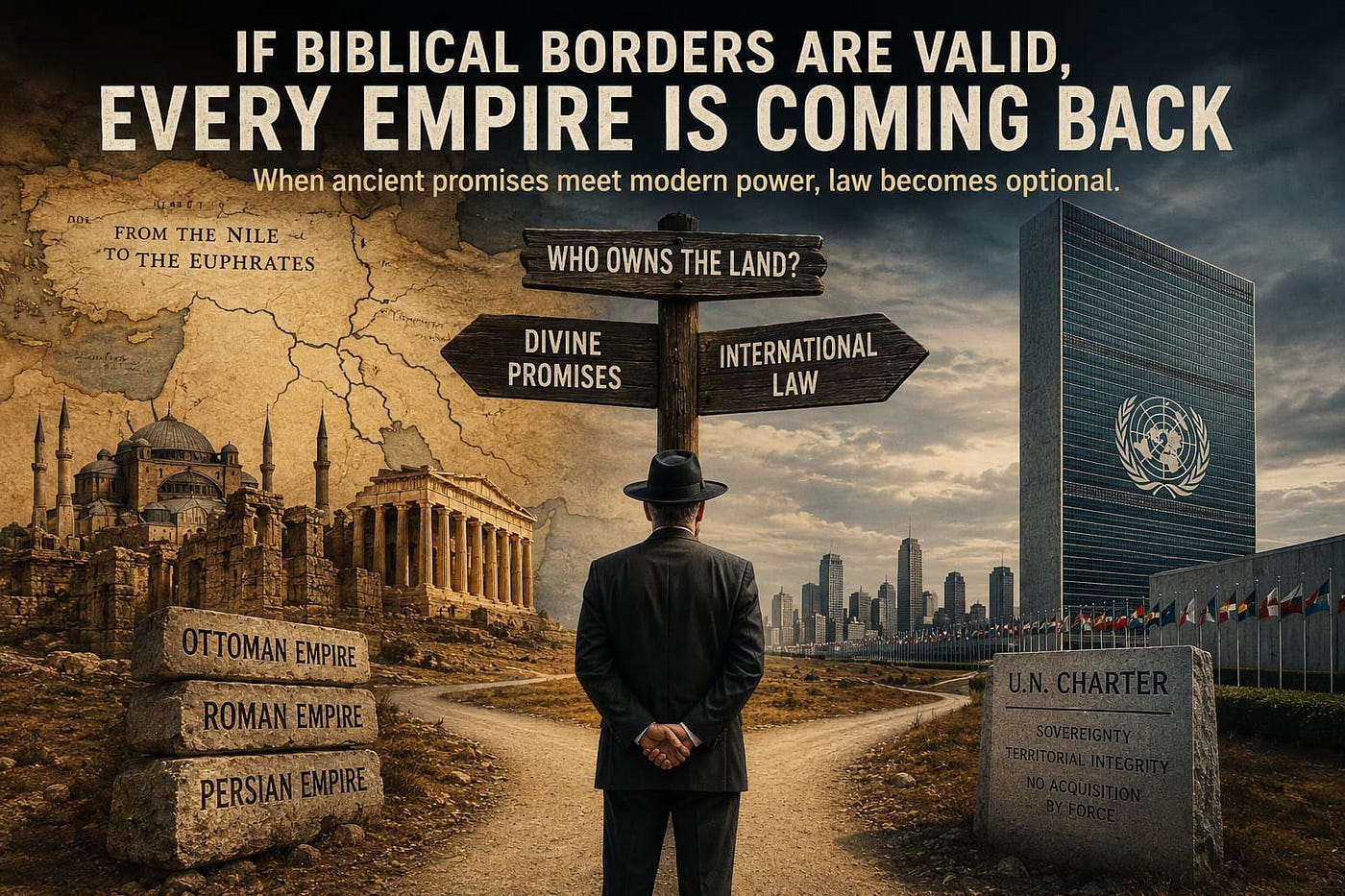
An editorial illustration exploring the tension between biblical territorial claims and the post-1945 international order built on sovereignty and international law.
Mike Huckabee’s remarks stopped me in the middle of my morning routine in Karachi. The American ambassador to Israel had reportedly responded to a question about biblical claims stretching from the Nile to the Euphrates with a simple endorsement. He would be fine if Israel took it all. I read the quote twice because diplomats usually hide their convictions behind carefully polished language.
Comment sections often reveal more than official statements. People started asking whether Italy should reclaim the Roman Empire. Others wanted to know if Turkey could revive the Ottoman Empire or if Iran could restore Persia. One comment compared scripture to a property deed written by the claimant. Another defended biblical claims as historical justice delayed. Nobody agreed on the rules anymore.
I studied political science and international relations in Karachi long before I started writing about geopolitics. One lesson stayed with me. Modern states survive because they accept limits on historical ambition. Borders do not exist because everyone believes they are fair.
Europe spent centuries fighting over dynastic inheritance and disputes rooted in sacred authority. Old empires never disappeared completely from political imagination. Entire populations disappeared into wars fueled by ancient grievances and divine certainty. Exhaustion produced a different idea. International law would replace inherited entitlement as the basis of coexistence.
The United Nations Charter emerged from that wreckage. Sovereignty became the operating principle. Territorial acquisition through force lost legitimacy, at least on paper. Major powers violated those principles often enough, but they rarely abandoned the language of law altogether.
Huckabee’s reported remarks matter because they challenge that language. Biblical interpretation enters the machinery of statecraft and asks the world to accept revelation as strategic doctrine. One ambassador cannot rewrite international law. Senior officials can normalize ways of thinking that weaken it. Critics of Israel sometimes rush toward explanations that flatten history into slogans and villains. Supporters of Israel often dismiss every concern as disguised hostility.
I reject both habits. Israel has security concerns. Palestinians possess national aspirations. Neither reality grants anyone the authority to redraw maps according to ancient texts.
Karachi teaches uncomfortable lessons about identity and power. People here understand what happens when politics absorbs religious certainty and converts it into public policy. Ideological conviction does not reduce conflict. It sharpens it because compromise begins to resemble betrayal.
One fact keeps bothering me. Nuclear weapons exist in the same world as messianic politics. Earlier generations could afford romantic fantasies about restoring lost kingdoms because their armies marched on horseback. Modern states possess technologies capable of ending entire cities before breakfast.
Cautious commentators avoid saying what follows. International law survives partly because most governments fear the alternative more than they resent the constraints. Remove those constraints and every dormant grievance gains fresh oxygen. Historical memory becomes military aspiration.
Readers defending Huckabee’s position asked why biblical claims should face special scrutiny when other societies also draw legitimacy from religion. My answer remains simple. Nobody receives a free pass. Muslim majoritarian projects deserve criticism when they invoke sacred authority to diminish equal citizenship. Hindu nationalism warrants the same scrutiny. Christian nationalism belongs in that conversation as well.
Consistency matters because selective outrage destroys credibility. States cannot invoke law when convenient and revelation when advantageous. Principles that apply only to adversaries are not principles. They are tactics wearing formal clothes.
People living in comfortable capitals often assume the international order possesses natural durability. Karachi encourages different instincts. Pakistan emerged from partition. India and Pakistan still dispute territory. Afghanistan reminds the region that ideological conflicts rarely stay confined within borders.
Huckabee’s remarks may fade from the news cycle. Another crisis will capture attention. Another spokesperson will issue clarifications. Political memory works in strange ways, especially online.
Questions raised by those comments will linger longer than the controversy itself. What grants legitimacy to territorial claims in the twenty first century? Who decides which histories matter and which belong in museums? Powerful people rarely describe their ambitions in imperial language, yet old dreams of restoration still shape political imagination.
I no longer dismiss those questions as academic exercises. Comment sections revealed something raw beneath the outrage. Large numbers of people appear ready to replace international law with ancestry, faith, or civilizational nostalgia.
Maps have changed throughout human history. Future generations will inherit different borders from the ones we know today. I understand that much.
Confidence in shared rules worries me more. Once people conclude that ancient promises outrank contemporary obligations, every frontier becomes provisional. No ambassador can settle that argument. One ambassador can expose how fragile the consensus had already become.
메타데이터
- post_id
- 118ca576d9ae
- slug
- if-biblical-borders-are-valid-every-empire-is-coming-back-118ca576d9ae
- url
- https://medium.com/@munaeem/if-biblical-borders-are-valid-every-empire-is-coming-back-118ca576d9ae
- canonical_url
- https://medium.com/@munaeem/if-biblical-borders-are-valid-every-empire-is-coming-back-118ca576d9ae
- author_url
- https://medium.com/@munaeem
- status
- ok
- fetched_at
- 2026-06-15 20:49:13