The Death of the Individual: Why the 2026 Tax Reforms are Forcing Investors to Weaponize the…
For twenty-five years, the playbook for the everyday Australian wealth-builder was simple, predictable, and remarkably effective: work a…
The Death of the Individual: Why the 2026 Tax Reforms are Forcing Investors to Weaponize the Corporate Structure
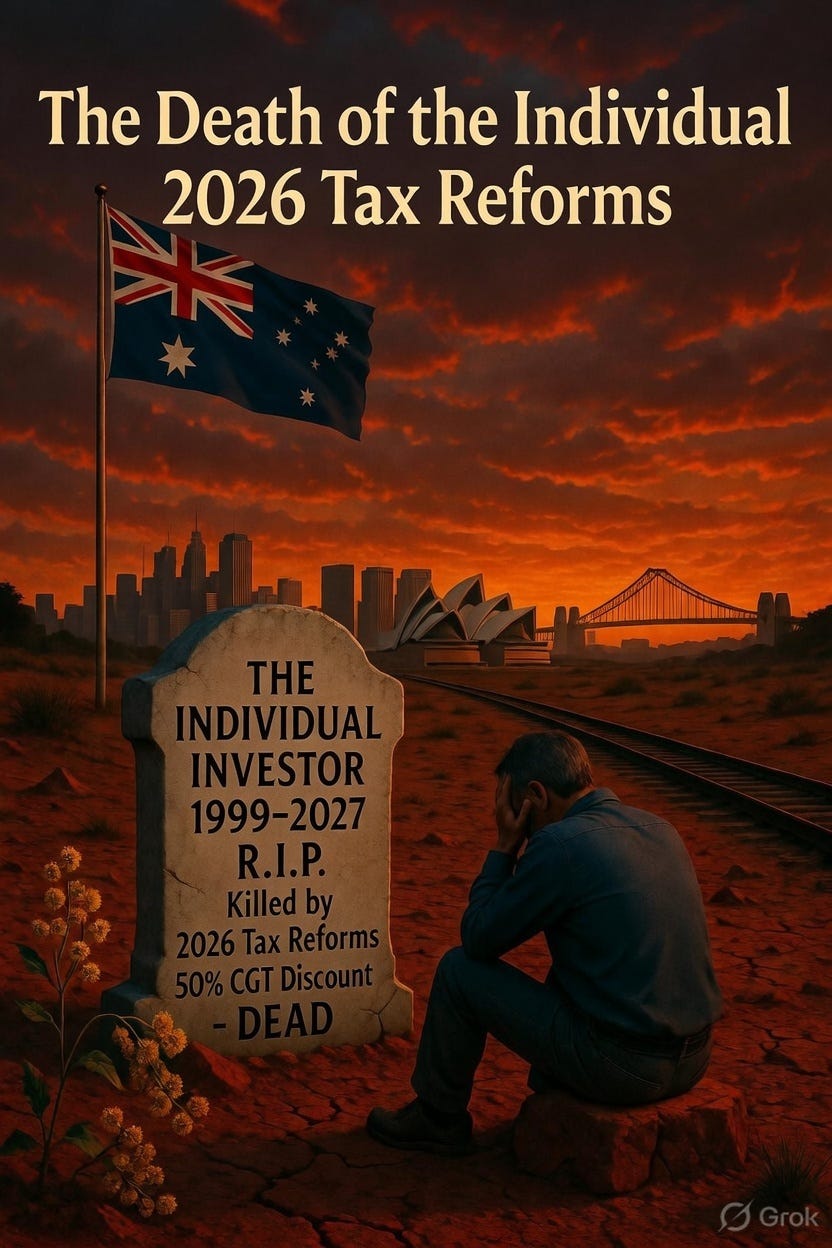
For twenty-five years, the playbook for the everyday Australian wealth-builder was simple, predictable, and remarkably effective: work a job, save some cash, buy high-growth assets in your own name, and hold them for at least 12 months. When it came time to sell, the government would kindly slash your tax bill in half via the 50% Capital Gains Tax (CGT) discount. It was a system designed to reward risk-taking at the individual level. But that era is officially over. The 2026–27 Federal Budget proposals have effectively signed the death warrant for the individual investor model. By scrapping the 50% CGT discount from 1 July 2027 and rolling out an aggressive 30% minimum tax floor, the government has completely flipped the script.
If you continue to invest in your personal name under these rules, you aren’t just playing on hard mode, you are willingly walking into a tax trap. Here is why the modern landscape is forcing a massive migration toward corporate holding structures, and how the new math stacks up.
The New Reality: Out with the Discount, In with the Floor The headline policy shift sounds harmlessly nostalgic on paper: the government is returning to the pre-1999 system of CPI Indexation. The narrative is that you will only be taxed on “real” gains, adjusted for inflation.
But it’s a wolf in sheep’s clothing. The real sting lies in the fine print: a flat 30% minimum tax floor on individual capital gains. Under the old rules, if you were a high-income earner on the 45% marginal tax bracket and made a $100,000 profit on a stock or crypto portfolio, the 50% discount knocked your taxable gain down to $50,000. You paid 45% on that amount, leaving you with an effective tax rate of 22.5% on your total profit.
Under the new regime, if that same asset goes on a high-growth tear over a few short years, inflation adjustments will barely touch the sides. If CPI only offsets $10,000 of your cost base, your taxable “real” gain is $90,000. Because the 50% discount is dead, that entire $90,000 is exposed to your top personal bracket.
Even if you wait until retirement to sell when your personal income is zero, you hit a brick wall. The 30% minimum floor means the absolute least the government will take from your real capital gain is a flat 30%. The message from Canberra is clear: High-growth individual investing will be heavily penalised.
The Strategic Shift: The Corporate Shield Faced with the “death of the individual,” investors are abandoning personal name portfolios in droves and pivoting to proprietary limited (Pty Ltd) holding companies to act as their private investment vaults. While companies have historically been excluded from CGT discounts, the new laws have completely erased the individual’s advantage, turning the corporate tax structure into a safe haven.
-
Capping the Bleeding at 30% (or 25%) A company caps its passive investment and capital gains tax at a flat corporate rate of 30%. For small business operators who run active trading companies (like an architecture or consulting practice billing a consistent annual revenue), that tax shield can drop even further to a flat 25%, provided their passive investment income stays under 80% of the company’s total revenue. Paying 25% or 30% inside a company leaves significantly more capital on the table to reinvest and compound than losing up to 47% in your personal name.
-
The Director’s Loan: Pulling Capital Back Tax-Free The biggest hesitation investors have with companies is getting their money back out without triggering the ATO’s anti-avoidance laws (Division 7A). The modern corporate strategy solves this through a formal Director’s Loan. If you inject $350,000 of your own post-tax cash into your holding company to buy blue-chip shares, ETFs, or gold, the company is legally indebted to you. As those investments generate profits, the company can funnel those gains straight back into your personal bank account as tax-free loan repayments. You get your initial principal back completely clear of personal income tax.
-
Income Smoothing and Time Travel Once the initial loan is paid back, a company gives you total control over the clock. An individual triggers a tax event the moment they sell an asset. A company, however, can absorb the capital gain at the corporate rate, hoard the cash, and choose to “drip-feed” franked dividends to you years down the line, ideally when you’ve taken a sabbatical, transitioned to part-time work, or retired into a much lower personal tax bracket.
The Final Verdict The 2026 tax regulations have fundamentally changed what it means to build wealth in Australia. The era of the casual, high-growth retail investor surviving on the 50% personal discount is drawing to a close. Is a corporate structure perfect? No. It requires setup fees, accounting overhead, and hyper-vigilant compliance to keep active and passive income balanced. If you are holding a slow-moving asset for 30 years, individual CPI indexation might still have some merit.
But for fast-moving, high-growth assets like modern equities portfolios and digital assets, the individual path is broken. If you want to survive the new era, you have to stop thinking like a consumer and start operating like a corporation.
Disclaimer
This article is for general informational and discussion purposes only and does not constitute financial, tax, or legal advice. Tax laws and proposed reforms may change, and outcomes will vary depending on individual circumstances. You should seek advice from a qualified financial adviser or tax professional before making any financial decisions.
메타데이터
- post_id
- 11dd49da8a51
- slug
- the-death-of-the-individual-why-the-2026-tax-reforms-are-forcing-investors-to-weaponize-the-11dd49da8a51
- url
- https://medium.com/@joe_2878/the-death-of-the-individual-why-the-2026-tax-reforms-are-forcing-investors-to-weaponize-the-11dd49da8a51
- canonical_url
- https://medium.com/@joe_2878/the-death-of-the-individual-why-the-2026-tax-reforms-are-forcing-investors-to-weaponize-the-11dd49da8a51
- author_url
- https://medium.com/@joe_2878
- status
- ok
- fetched_at
- 2026-07-10 08:43:10




