*210* Beyond Binary States: Continuity, Observation, and Structural Illusions from Differential…
The Binary Illusion in Linear Differential Equations
210 Beyond Binary States: Continuity, Observation, and Structural Illusions from Differential Dynamics to Living DNA
The Binary Illusion in Linear Differential Equations
A first-order linear differential equation with constant coefficients defines a remarkably simple yet often misunderstood dynamical structure. While standard approaches emphasise procedural resolution methods, a deeper reading reveals that the system is governed by a single continuous organisation, whose coherence is frequently obscured by interpretative shortcuts.
Consider the equation:

This system admits a unique equilibrium point:

Rather than treating this equilibrium as a particular solution among others, it is more precise to recognise it as a reference around which the entire set of solutions is organised.


y(t) = y* + C exp(lambda t)
This expression captures the full dynamics without ambiguity. All solutions are generated by the same exponential law, and the diversity of behaviours arises solely from the continuous variation of the real parameter C. No additional structure is required.

At this level, the essential property of the system becomes clear: it is entirely continuous. The set of solutions forms a one-parameter family without discontinuity, partition, or intrinsic division. Each value of C corresponds to a trajectory, and these trajectories collectively fill the phase space in a continuous manner.


It is important to emphasise that the equilibrium does not introduce any form of boundary within this structure. It corresponds simply to the case where C equals zero. Its invariance makes it a distinguished point, but not a separating one. The fact that trajectories do not cross this point is not due to the presence of a barrier, but follows directly from the uniqueness of solutions for differential equations.

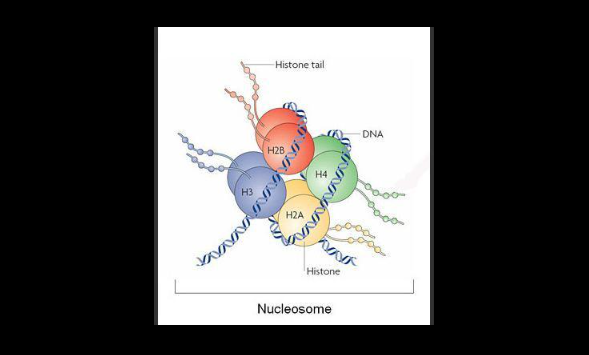
From Discrete States to Continuous Geometry: A Structural Reinterpretation of Nucleosome Variability

Such a formulation implicitly conveys the idea of an ontological discovery, as if new fundamental forms of genetic material had been revealed. A rigorous reading, however, requires a clear distinction between structural discovery and methodological refinement.
The structure of DNA has been firmly established since the work of James Watson and Francis Crick, and the nucleosome has long been recognised as a canonical unit of chromatin organisation. The real stake of the publication therefore lies not in the identification of new objects, but in the enhancement of descriptive resolution applied.

The Illusion of Observing a Living Cell Without Altering It
It is now being claimed that biology may have crossed a historic frontier: observing the complete genetic activity of a living cell without destroying it. The announcement appears spectacular because, for decades, in-depth genetic analysis almost always required stopping or altering the cell being studied.
This new approach therefore creates the impression that science has finally gained access to a continuous and intact reading of living systems.


There is undeniably a real scientific advance behind this development. Keeping a cell biologically alive during advanced genetic observation represents an important technical achievement. It allows researchers to follow the evolution of certain mechanisms over time, compare gradual transformations, and reduce the distortions caused by older destructive methods.
In cancer research especially, this capability could become highly valuable for identifying cellular changes at much earlier stages than conventional approaches allow.

The cell continues functioning, but within an environment that promotes a more stable, less spontaneous condition that is already partially shaped by the observational framework itself.

This leads to a deeper idea. A cell observed over extended periods may gradually adjust its own behavior in order to preserve equilibrium within that controlled environment. Certain fluctuations become weaker, some internal exchanges reorganize, and some biological priorities may temporarily shift.
What is being observed then reflects not only the natural functioning of the cell, but also the way the cell adapts to the conditions of the experiment.


However, despite this real influence, the experiment does not become useless or entirely misleading. A cell cannot artificially fabricate its entire biological structure. Even while adapting to observational conditions, it still reveals authentic aspects of its internal organization.
The major genetic signatures remain present and continue to hold significant scientific value.
And as these techniques become increasingly refined, the central question will become even more subtle: understanding not only what a living cell reveals, but also what its presence inside an observational system silently changes within itself.

In its initial formulation, the publication proposes an enumeration of fourteen states, presented as distinct configurations of the nucleosome:
- Canonical nucleosome
- Slightly unwrapped nucleosome (open DNA ends)
- Moderately unwrapped nucleosome
- Asymmetric nucleosome
- Strongly unwrapped nucleosome
- Hexasome (incomplete nucleosome)
- Sliding nucleosome
- Repositioned nucleosome
- Overwound nucleosome
- Underwound nucleosome
- Nucleosome with histone modifications
- Nucleosome with histone variants
- Nucleosome interacting with proteins
- Polymorphic nucleosome (AI-derived class)
The effect produced by such a list rests on an implicit rhetoric of discretisation: by juxtaposing heterogeneous elements under the common label of “states”, it suggests an intrinsic structural multiplicity. Yet this multiplicity largely arises from a confusion of descriptive levels.
The elements listed do not belong to a single ontological register. Some correspond to geometric configurations of the nucleosome, others to dynamic processes, others still to incomplete structures or context-dependent interactions. This superposition generates an illusion of structural richness that does not withstand rigorous conceptual analysis.


The notions of overwinding and underwinding refer to global topological properties of DNA that extend beyond the scale of the individual nucleosome. Histone modifications and variants introduce a biochemical and functional dimension distinct from purely geometric description. Finally, interactions with external proteins shift the analysis towards multiprotein assemblies, thereby exceeding the definitional scope of an intrinsic nucleosomal state.


Once these distinctions are established, the system can be reformulated within a strictly structural framework, based on criteria of completeness, minimal stability, direct observability, and experimental reproducibility. Within this perspective, a coherent core of states can be identified:
- Canonical nucleosome
- Moderately unwrapped nucleosome
- Compacted nucleosome
- Internal DNA repositioning
- Local DNA distortion
- DNA rotational phase variation
- Histone–DNA contact variation
- Polymorphic nucleosome (structural class)
This conceptual narrowing does not constitute an arbitrary reduction, but rather a reorganisation of the description around degrees of freedom genuinely supported by nucleosomal structure. The retained configurations should not be interpreted as strictly discrete states, but as regions of relative stability within a continuous space of deformations. Artificial intelligence operates here as a segmentation tool within this space, producing classes that facilitate analysis without corresponding to distinct natural entities.

The real scientific contribution of these works thus lies in the ability to map this configurational space with greater precision, identifying variations that were previously difficult to isolate. This refined mapping enhances our understanding of the relationship between structure and DNA accessibility, a central aspect of epigenetic mechanisms. It allows for a more precise characterisation of how subtle geometric variations may modulate the exposure of genetic sequences and influence gene expression.

The apparent distinction between different types of behaviour arises from the sign of C. When C is positive, the solution evolves in one direction; when C is negative, it evolves in the opposite direction. However, this distinction does not correspond to the existence of different dynamical regimes. It reflects a continuous variation within a single and unified structure. No qualitative rupture occurs.
A similar clarification applies to the use of initial conditions, often written in the form y0 = y(0). While mathematically valid, this notation introduces an arbitrary temporal reference that has no structural significance. The dynamics are not anchored to any specific time. The parameter C fully determines the trajectory independently of any chosen origin.

This continuous nature of the system also clarifies its long-term behaviour. For positive lambda, all trajectories diverge exponentially from the equilibrium, except the equilibrium itself. Yet even in this case, there is no splitting of the system into distinct entities. The divergence is governed by a single exponential mechanism, applied uniformly across the entire family of solutions.


The interpretation of such systems as exhibiting fundamentally different “destinies” emerges from a descriptive simplification rather than from the mathematical structure itself. What appears as a duality is in fact the projection of a continuous parameter onto a binary interpretation. This projection introduces an artificial distinction that does not exist within the system.
A more rigorous geometric understanding therefore consists in recognising that the phase space is organised continuously around the equilibrium, with no intrinsic separation. The system does not divide into distinct behaviours; it unfolds along a continuous spectrum determined by a real parameter.


Such clarity is essential, not only for accuracy, but also for preserving the integrity of the mathematical description. When continuity is replaced by binary interpretations, the structure of the system is no longer faithfully represented.

Recognising the continuous nature of linear differential equations restores their simplicity. It reveals that all solutions are variations of a single underlying dynamic, centred on an equilibrium and parameterised without discontinuity.


Certain quantum experiments are often presented as spectacular breakthroughs capable of transferring something from one place to another almost instantly. However, when we examine what is truly happening, a completely different interpretation begins to emerge. Nothing physically travels through space.
No object actually moves from one location to another. What appears at a distance is closer to an extremely precise reconstruction than to any real displacement.
A simple photograph provides a much clearer comparison. When a person takes a picture, the original scene does not physically travel into the camera. Instead, the camera captures visible information and reconstructs an image from it. The final photograph may appear almost identical to the original scene, yet everyone understands that the image itself is not the original reality. It is only a reproduced structure.

Scientists generally explain this fragility through heat, vibrations, electromagnetic disturbances, or environmental noise. But this explanation may only describe the surface of the problem rather than its deeper cause.
The instability could originate directly from the fact that reconstruction reproduces form without fully reproducing continuity.
In other words, the visible or informational structure may be copied correctly while something deeper remains absent.

The reconstructed state may not degrade simply because external disturbances attack it, but because the reconstruction itself was never fully anchored from the beginning. The copied structure would therefore remain fragile by nature, much like a perfectly reproduced image lacking the deeper continuity of the original reality from which it emerged.
This interpretation can also be extended directly to ordinary photography. A normal photograph may reproduce shapes, colors, shadows, and visible depth with remarkable accuracy, while still failing to capture the full structural imprint of the original scene. The image would therefore remain visually correct while lacking part of the deeper continuity naturally present in the real environment itself.
This missing continuity could explain why two images that appear visually identical might still produce a very different impression of depth or presence. One image would merely reproduce visible information, while the other could preserve a stronger continuity with the original environment from which it emerged.
In this concept, the orange light would not simply illuminate the scene. Instead, it would diffuse structural saturation uniformly throughout the entire environment during the reconstruction process. The goal would not be brightness, but environmental coherence.

However, such visible saturation would naturally modify the colors of the final image and could become visually intrusive.
The result would be extremely subtle externally yet fundamentally different structurally. A standard photograph would preserve only visible information.
An impregnated photograph, however, could preserve part of the deeper continuity of the original environment itself. The image would therefore remain visually natural while carrying a more stable structural imprint.

Within this framework, visible orange saturation and infrared impregnation would not produce identical results. The visible orange approach could generate a denser and stronger aura imprint, while infrared impregnation would create a softer, less intense, but more discreet structural continuity.


A similar principle could also be extended to the observation of nuclear fusion. Today, fusion experiments are generally analyzed through energetic measurements, plasma confinement, temperature control, magnetic fields, and particle behavior. Yet within this framework, another factor could potentially influence the stability of the phenomenon itself: the structural continuity between the fusion process and its surrounding observational environment.
Without coherent environmental saturation, the fusion phenomenon may remain structurally separated from the environment observing it. In this interpretation, the observation itself could introduce a form of discontinuity between the energetic process and the surrounding framework in which it is being maintained and analyzed.
If the entire observational environment were coherently impregnated during the fusion process, this structural rupture could theoretically decrease. The fusion phenomenon, the surrounding environment, and the observational framework would remain more unified throughout the process.

Structural Continuity as a Source of Stability
In this concept, stability would not depend only on energy, pressure, confinement, or technical control. Another factor could also play an important role: the continuity between a phenomenon and the environment surrounding it.

Today, most explanations focus mainly on external disturbances, mechanical limits, or energetic conditions to explain why certain systems become unstable. But another possibility could exist. A system may begin losing stability when it becomes too separated from its surrounding environment.
In this interpretation, stability is not maintained only from inside the system itself. It also depends on how well the phenomenon remains connected to the environment in which it exists and evolves.
This same idea could apply to many different fields. It could concern quantum reconstruction, photography, biological recovery after surgery, and even powerful energetic systems such as nuclear fusion. In every case, the important point would not only be technical control, but also the preservation of a coherent environmental continuity during the entire process.

The main idea emerging from these examples is simple: true stability may come not only from the internal structure of a system, but also from the continuity and coherence of the environment surrounding it.

메타데이터
- post_id
- 1203da3cd974
- slug
- 210-beyond-binary-states-continuity-observation-and-structural-illusions-from-differential-1203da3cd974
- url
- https://medium.com/@gouvielos/210-beyond-binary-states-continuity-observation-and-structural-illusions-from-differential-1203da3cd974
- canonical_url
- https://medium.com/@gouvielos/210-beyond-binary-states-continuity-observation-and-structural-illusions-from-differential-1203da3cd974
- author_url
- https://medium.com/@gouvielos
- status
- ok
- fetched_at
- 2026-07-29 04:16:27