The US Millwork Labor Shortage Isn’t a Shop-Floor Problem Anymore
Ask anyone in US millwork what keeps them up at night and you’ll hear the same word: labor. It’s not a new complaint. What’s new is where…
The US Millwork Labor Shortage Isn’t a Shop-Floor Problem Anymore
Ask anyone in US millwork what keeps them up at night and you’ll hear the same word: labor. It’s not a new complaint. What’s new is where the shortage now bites, and the data on that has gotten hard to ignore.
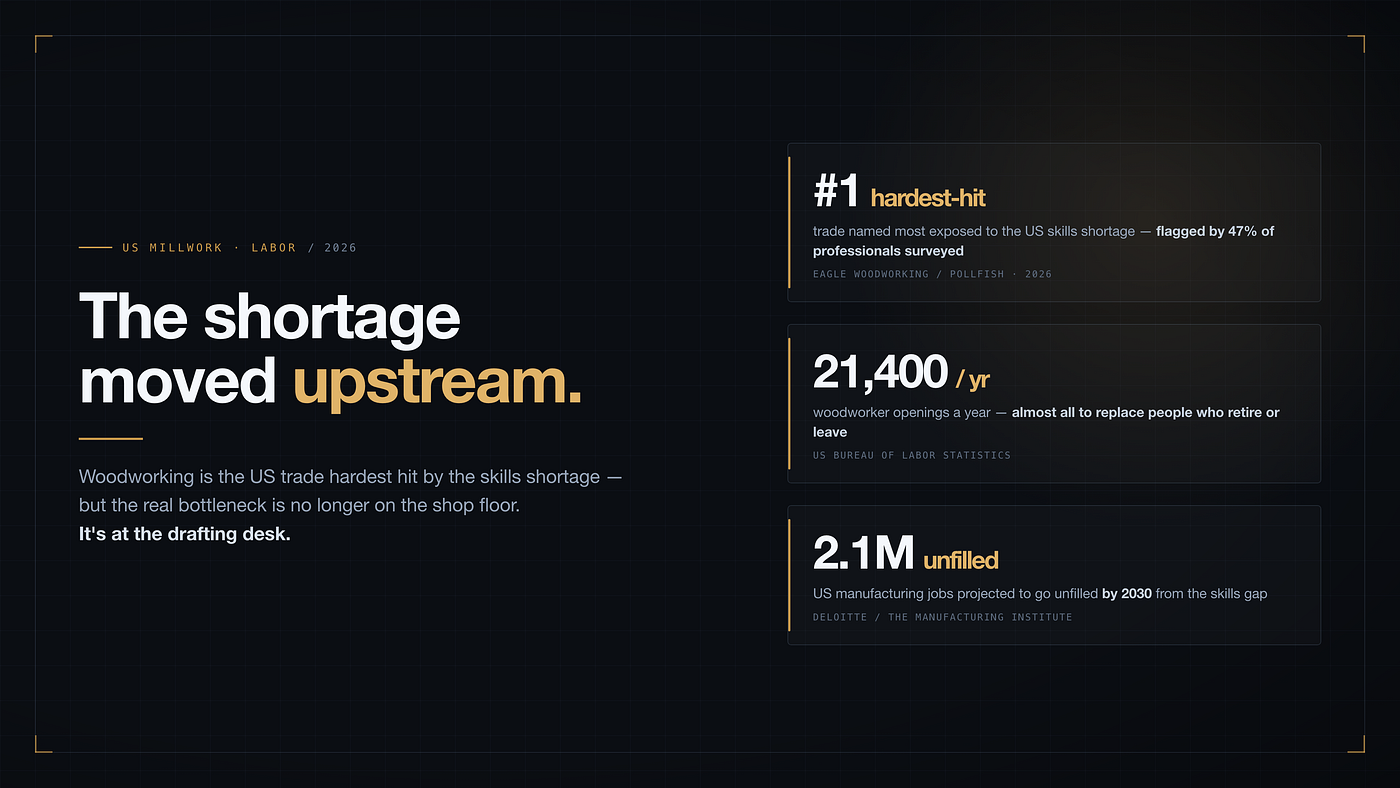
In a June 2026 survey of 500 US construction and trades professionals conducted by Eagle Woodworking through the Pollfish platform, carpenters and woodworkers were named the trade most exposed to the skills shortage — flagged by 47% of respondents, and picked as the single hardest-hit trade by 19.6%, more than any other. (**Eagle Woodworking**)
That tracks with the federal numbers. The US Bureau of Labor Statistics counted about 214,600 woodworker jobs in 2024, projects that total to decline 2% through 2034, and still expects roughly 21,400 openings a year — almost all of them to replace people who retire or leave the field, not to grow the workforce. (**BLS Occupational Outlook Handbook**)
Read those two facts together and the picture sharpens. This isn’t a hiring wave. It’s a slow-motion replacement problem in a shrinking pool, in the trade the rest of construction expects to hurt the most.
But the headline number hides the part that actually matters for anyone running a millwork shop in 2026. The shortage isn’t distributed evenly across the work. It’s concentrating — and it’s moving upstream.
The bottleneck moved off the floor
For most of the last two decades, “millwork labor shortage” meant benches. Not enough hands to build, sand, assemble, install. That version is real and it hasn’t gone away.
What’s changed is that automation solved part of the floor problem and created a new one somewhere else.
As one industry analysis put it, automation doesn’t reduce headcount so much as change who you need to hire: fewer manual cutters, but more CNC operators, programmers, QA specialists, and data-oriented supervisors — plus rising demand for advanced drafters, engineers, and installers who genuinely understand construction tolerances. (**Powerline Machinery**)
Put a CNC router on the floor and you’ve moved the constraint. The machine will cut anything you feed it — but only as well as the file it’s fed. Suddenly the scarce person isn’t the one holding the sander. It’s the one who can turn an architect’s intent into a clean, manufacturable, CNC-ready drawing that the machine can execute without a shop-floor guess.
That person is harder to find than a bench hand, takes far longer to train, and when they retire they take something with them that doesn’t show up in any BLS table.
Some firms report losing 20–30 years of tribal knowledge in a single retirement.
That line, from the same body of reporting on the skills shortage, is the whole problem in one sentence. A retiring master drafter isn’t a headcount you backfill. They’re a walking library of why the drawing is the way it is — which details fail in the field, which tolerances the shop can actually hold, which callouts the CNC will choke on. You can hire a replacement. You cannot hire the twenty-five years.
Why this is a demographic problem, not a cyclical one
It would be comforting to file this under “tight labor market, it’ll loosen.” The demographics say otherwise.
The BLS projection is explicit that the openings are replacement-driven — retirements and exits, not expansion. And the pessimism about the shortage rises straight up the age curve. In the Eagle Woodworking survey, 39.2% of the youngest respondents (18–34) thought the shortage was getting worse — a share that climbed through every age band to 60.7% of those 55 and older. (**Eagle Woodworking**)
The people closest to retirement — the ones who can see exactly what walks out the door when they leave — are the most worried. That’s not a sentiment problem. That’s the market pricing in known information.
Zoom out to manufacturing as a whole and the frame holds. A widely cited Deloitte and Manufacturing Institute study projected the US skills gap could leave 2.1 million manufacturing jobs unfilled by 2030 — at a potential cost of $1 trillion in that year alone. (**The Manufacturing Institute**) Millwork is a small, specialized slice of that — but it’s a slice where the skills are harder to transfer and the training runway is longer than average.
You don’t automate your way out of a demographic cliff. You automate into it, and the automation just relocates the shortage to whoever feeds the machines.
What this means for a US millwork shop in 2026
Strip away the macro and here’s the operational reality for a mid-sized shop this year:
Your machine capacity is no longer your constraint. Your drafting capacity is. A shop can buy a second CNC in a quarter. It can’t produce a senior drafter in a quarter. When the drawings are the bottleneck, more machine time doesn’t help — it just means the router sits waiting on files.
A single drafter departure is now a schedule risk, not an HR line item. When the person who knows how your shop details a curved reception desk retires, the projects that depend on that knowledge slow down until someone rebuilds it. In a market where woodworking is the hardest-hit trade for talent, rebuilding it is neither fast nor cheap.
“Just hire more” competes against everyone. You’re recruiting from the same shrinking pool as every other shop, plus the general contractors and cabinet manufacturers who also need people who understand tolerances. The BLS openings are real, but so is the competition for them.
The knowledge risk is invisible until it isn’t. Machine downtime shows up on a dashboard. The slow erosion of drafting depth doesn’t — until a submittal comes back in red, a panel gets cut wrong, or a job misses its install date. By the time it’s measurable, it’s already cost you.
None of this is an argument that the shop floor doesn’t matter. It’s an argument that the scarcest resource in US millwork has quietly moved from the bench to the drafting desk — and most shops are still managing the shortage as if it hadn’t.
Four ways shops are actually responding
There’s no single fix. The shops navigating this well tend to combine several of the following:
- Capturing tribal knowledge before it retires. Turning a senior drafter’s judgment into standards — detail libraries, drawing checklists, documented tolerances — so the knowledge outlives the person. This is unglamorous and almost always under-resourced, and it’s the highest-leverage thing a shop can do.
- Investing in tools that make junior drafters productive faster. Parametric and library-driven drafting environments (Microvellum, Cabinet Vision, and the like) let a less-experienced drafter lean on encoded expertise instead of relearning it from scratch. The software is a way to store the knowledge the demographics are draining.
- Splitting the work by skill level. Not every drawing needs your most senior person. Shops that route routine casework to junior or external capacity and reserve senior judgment for the genuinely hard details get more out of scarce expertise.
- Adding external drafting capacity. A growing number of US and Canadian shops offload some or all of their shop-drawing production to dedicated drafting partners — converting a fixed hiring problem into flexible capacity, and buying access to a bench of drafters trained to AWI and AWMAC standards without carrying that overhead in-house.
That last one is, transparently, the business we’re in — so weigh it accordingly. But the broader point stands regardless of who does the drafting: the constraint has moved, and the shops that recognize it early will out-execute the ones still solving last decade’s version of the problem.
The uncomfortable summary
The US millwork labor shortage is real, it’s structural, and it’s demographic — not a cycle that loosens next year. Woodworking has been named the trade hardest hit by the skills shortage, employment is projected to shrink even as openings pile up, and the people who understand the work best are the ones nearest the exit.
But the shortage everyone talks about — hands on the floor — is now only half the story. Automation moved the bottleneck upstream to the people who turn design into manufacturable drawings, and that talent is scarcer, slower to build, and more expensive to lose.
The shops that treat drafting capacity as a first-class constraint — and protect the knowledge behind it — are the ones that will still be hitting their install dates in 2030. The rest will keep buying machines to solve a problem that stopped living on the floor years ago.
A note on the numbers
Every figure in this article is linked to its source. Two caveats worth stating plainly, because they matter for anyone acting on this:
- Market-size estimates for US millwork vary widely between research firms — from single-digit to multi-tens of billions of dollars — depending on how each defines the category (NAICS scope, whether stock vs. custom, residential vs. commercial). We deliberately built this piece on labor and employment data, which is more consistent across sources and comes largely from the BLS, rather than on any single market-size headline.
- The Eagle Woodworking survey (n=500, Pollfish, June 2026) is a professional-sentiment survey, not a census. It’s a strong signal of how the trade sees the problem, cited here as such.
When a number matters to a decision, go to the primary source. We’ve linked them so you can.
About the author
A2Z Millwork Design LLC produces millwork shop drawings, CAD drafting, CNC programming, and 3D modeling for architectural millwork manufacturers and contractors across the United States and Canada. The firm works to AWI and AWMAC standards, with a team of 100+ drafters supporting 400+ shops, and a three-stage quality review on every drawing set.
We write about the technical and business side of millwork drafting — standards, shop-drawing quality, and the economics of getting a design cleanly from concept to CNC.
More on our blog: a2zmillwork.com/blog · Reach us at info@a2zmillwork.com
메타데이터
- post_id
- 1215153bc5ea
- slug
- the-us-millwork-labor-shortage-isnt-a-shop-floor-problem-anymore-1215153bc5ea
- url
- https://medium.com/@amanpartapmillworkconsultant/the-us-millwork-labor-shortage-isnt-a-shop-floor-problem-anymore-1215153bc5ea
- canonical_url
- https://medium.com/@amanpartapmillworkconsultant/the-us-millwork-labor-shortage-isnt-a-shop-floor-problem-anymore-1215153bc5ea
- author_url
- https://medium.com/@amanpartapmillworkconsultant
- status
- ok
- fetched_at
- 2026-08-16 05:59:04