Beyond the Chatbot: A Deep Technical Review of Snowflake’s New Agentic Core
It is easy to tune out enterprise tech keynotes when the announcements are dominated by superficial AI features and UI gimmicks. But…
Beyond the Chatbot: A Deep Technical Review of Snowflake’s New Agentic Core
It is easy to tune out enterprise tech keynotes when the announcements are dominated by superficial AI features and UI gimmicks. But beneath the marketing buzzwords at the Snowflake Summit 2026, a serious re-engineering effort has taken place. Snowflake has quietly introduced a tightly integrated framework designed for the Agentic Enterprise — an architecture that moves away from disconnected data lakes and builds low-latency stream processing, hypervisor-isolated sandbox environments, and automated semantic telemetry directly into the hardware-compute plane.
Building an isolated AI stack forces engineering teams to repeat historical data-silo mistakes, fracturing corporate governance and driving up processing complexity. A unified platform architecture unlocks a powerful flywheel: corporate data makes the AI models smarter, which in turn optimizes data pipelines, query planning, and runtime economics.
1. Unified Architecture Core Map
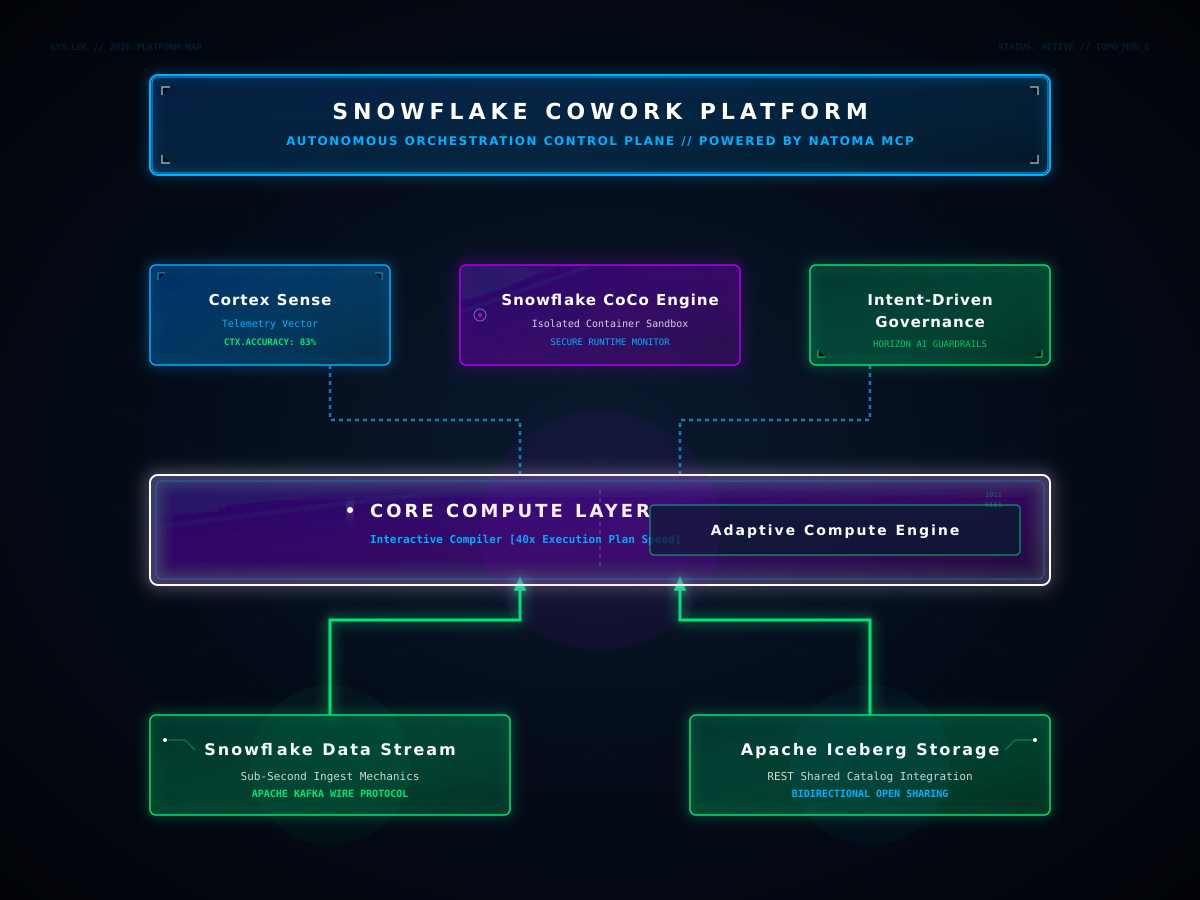
To understand how these architectural layers interact without sifting through hours of keynote footage, look at the system topology below:
2. Compute & Stream Ingestion Engine Advancements
To eliminate latency bottlenecks and the need for external orchestrators, Snowflake has embedded low-latency continuous stream processing and dynamic query planning directly into the platform core.
Snowflake Data Stream
Historically, streaming data into an analytical data warehouse required disconnected systems: Apache Kafka pipelines paired with intermediate ETL tools, staging zones, and eventually Snowpipe micro-batches. Snowflake Data Stream provides a native, fully managed streaming service built directly into Snowflake’s compute tier.
- Kafka Wire Compatibility: Engineering teams can repoint existing upstream Kafka consumer/producer client pipelines directly to Snowflake without modifying application code.
- Zero-Copy Sub-Second Unification: By decoupling compute from storage at the stream-buffer layer, inbound streams are written directly into optimized storage files with sub-second latency. This eliminates intermediary compute tiers and avoids multi-hop write amplification. Topics can be instantly materialized into native structured relational rows or Apache Iceberg tables.
The Interactive Compiler
Traditional data warehouse query compilers prioritize global plan optimization for massive scan operations, processing large joins over multi-terabyte tables. This introduces a heavy compilation latency tax ($T_{comp}$) that renders short-lived transactional statements and programmatic micro-services highly inefficient.
The new Interactive Compiler bypasses exhaustive combinatorial plan evaluations for high-concurrency, point-lookup queries. This lightweight compiler structure yields a 40x reduction in query compilation times, generating an end-to-end workload acceleration of 3x to 4x for data-heavy applications.
3. The AI Control Plane: CoCo, CoWork & Cortex Sense
A fragmented AI framework fractures security and drives up engineering complexity. Snowflake resolved this by unifying its developer and business AI capabilities under two distinct, native control planes backed by automated context engineering.
Snowflake CoCo (Formerly Cortex Code)
Renamed to emphasize operational focus, Snowflake CoCo handles end-to-end data pipeline construction and infrastructure engineering via declarative inputs. To secure autonomous code creation, CoCo implements a Secured Local Sandbox environment. When executing newly generated code blocks, CoCo constructs a temporary, hypervisor-level isolated container space. This guarantees untrusted scripts cannot alter underlying host operating systems or compromise core warehouse state.
Snowflake CoWork & Cortex Sense
Where CoCo is targeted at developers, Snowflake CoWork (formerly Snowflake Intelligence) provides an execution engine for business users. CoWork coordinates groups of automated agents via a built-in Personal Work Engine that logs cross-session user feedback inside persistent User Memory pools.
This orchestration layer is powered directly by Cortex Sense. Rather than forcing software engineering teams to spend months writing custom relational schemas and system mapping configurations, Cortex Sense continuously indexes active workspace telemetry, running queries, metadata properties, and analytical dashboard states. It aggregates this metadata into a live vector space, raising out-of-the-box system request tracking accuracy from a baseline of 24% up to 83%.
4. Intent-Driven Governance & Secure Agent Guardrails
As autonomous software components begin updating analytical structures and generating transactional operations, legacy access governance models become insufficient. Snowflake introduced a security framework to isolate and police agent actions.
Agent Identity and Context Verification
Snowflake added a native security validation function, IS_AGENT_CONTEXT(). This allows administrators to construct programmatic access control vectors that evaluate agent requests differently than manual human queries. If a script initiates a deep search query across corporate tables, the platform detects the software identity token. Row-level filters can automatically restrict data visibility or mask attributes (e.g., PII fields), preventing data exposure risks from automated parsing scripts.
Data Movement Policies (DMP)
To stop automated scripts or misconfigured prompt flows from extracting records, Data Movement Policies enforce data perimeter boundaries. If an agent tries to copy sensitive or tagged assets into external cloud object buckets or execute local file downloads via the Snowsight interface, Horizon Catalog instantly kills the operation at the storage driver tier.
Multi-Party Approvals
To protect operations against rogue administrative control or compromised system credentials, sensitive administrative procedures (e.g., globally disabling multi-factor authentication or changing root cross-region replication strategies) can no longer be forced through single-party execution. The platform introduces Multi-Party Approvals, which mandate a secondary authenticated administrator signature to confirm the transaction before it is permanently applied to the system state.
5. Open Interoperability & Zero-Copy Ecosystem Storage
Snowflake’s platform updates further validate its commitment to decoupled open standards, breaking down application data walls without requiring extensive ETL movement.
Apache Iceberg V3/V4 Implementation & Open Sharing
Snowflake introduced full native production-grade adherence to the Apache Iceberg V3 specification, incorporating file-level optimization parameters like dynamic deletion vectors and fill-level optimizations alongside broad semi-structured VARIANT parsing properties. Combined with Apache Polaris metadata tracking, this enables Open Sharing.
Data teams can share live analytical records with external, non-Snowflake consumers. External platforms query the underlying cloud data catalog endpoints natively via standard Iceberg REST specifications, bypassing data duplication entirely.
6. Core Technology Implementation Index
+-----------------------+----------------------+----------------------------------------+--------------------------------------------------------------+
| Feature Core Module   | Release State        | Primary Engine Protocol                | Target Engineering Benefit                                   |
+-----------------------+----------------------+----------------------------------------+--------------------------------------------------------------+
| Snowflake CoCo        | Private Preview      | Isolated Container Sandbox             | Prevents untrusted agent code execution from breaching walls.|
| Snowflake CoWork      | General Availability | Model Context Protocol (MCP)           | Coordinates complex tasks across 100+ business environments. |
| Cortex Sense          | General Availability | Continuous Log Telemetry Vectorization | Raises autonomous task context accuracy from 24% to 83%.     |
| Snowflake Data Stream | Private Preview      | Kafka Wire Protocol Inversion          | Achieves sub-second event ingest directly into raw formats.  |
| Interactive Compiler  | Private Preview      | High-Concurrency Light Query Planner   | Delivers up to a 40x speedup in query compilation latency.   |
| Open Sharing          | Public Preview       | Iceberg REST Catalog (Polaris)         | Allows external engines to query live data zero-copy.        |
| Multi-Party Approvals | Private Preview      | Dual-Signature Consensus Validation     | Blocks single-party administrative infrastructure exploits.  |
+-----------------------+----------------------+----------------------------------------+--------------------------------------------------------------+
메타데이터
- post_id
- 1237365d703e
- slug
- beyond-the-chatbot-a-deep-technical-review-of-snowflakes-new-agentic-core-1237365d703e
- url
- https://medium.com/@gupta.sahil.201191/beyond-the-chatbot-a-deep-technical-review-of-snowflakes-new-agentic-core-1237365d703e
- canonical_url
- https://medium.com/@gupta.sahil.201191/beyond-the-chatbot-a-deep-technical-review-of-snowflakes-new-agentic-core-1237365d703e
- author_url
- https://medium.com/@gupta.sahil.201191
- status
- ok
- fetched_at
- 2026-06-16 19:09:56



