Girls in Gaming: Infiltrating the Boys’ Club
Lack of diversity in gaming spheres from production to gameplay cultivate an unwelcoming space for women in gaming.

Samantha Jones playing Overwatch for Cal Poly San Luis Obispo during esports tournament at San Diego State University on April 18, 2026.
Girls in Gaming: Infiltrating the Boys’ Club
Lack of diversity in gaming spheres from production to gameplay cultivate an unwelcoming space for women in gaming.
Video games have been reflecting the modern age for the past 50 years, rising parallel alongside technological advancements. Gaming has commonly been perceived as a boys’ activity, with many denying the narrative that girls want to play, let alone could be skilled at video games as well.
However, this narrative is not reflected in society. According to Statista, a data tracking company, women over the age of 18 in the United States have made up almost half of all gamers for the past two decades. Yet, when asked to imagine a gamer, most will imagine a group of teenage boys engaged in virtual combat.
[embed]
“They just think that girls aren’t supposed to be there, like, they’re supposed to be doing something else,” said Emmery Pot, the treasurer of Aztec Gaming, a student-run organization at San Diego State University.
The world of science fiction exploded in pop culture media in the ’80s, shaping society’s most primitive understandings and approaches to gaming. Popular films such as “Wargames,” “Tron” and “Jumanji” portray boys engaging in combative and immersive gaming, leaving viewers to think this is what gamers look like exclusively.
While combative games are very popular, the most popular games also include sandbox, simulation and puzzle games. According to a survey conducted by Quantic Foundry in 2017, women make up the majority of match-3 and farm/simulation games. So where does this narrative against girls in gaming come from?
“We’re quiet, but we’re there,” said Sara Roldan, a psychology professor at SDSU, who specializes in therapeutic practices with video games and geek culture. “It’s just you have to find us.”
Roldan addressed the sexualization of female characters in video games, and argued that in our patriarchal capitalist society, sex sells.
“We provide a lot of the ‘goods,’ if you will,” she said. “Because of that, a lot of the things that we do is through the male gaze.”
For example, Marvel Rivals is a very popular shooter-game based in the Marvel Cinematic Universe. The skins for the female characters are typical to comic book style drawings of women, including provocative, skin-tight bodysuits with unnecessary cut outs.
When it came to her favorite game, Andrea Montiel, director of Aztec Gaming at SDSU, said that “guys use that skin more while they’re playing (Marvel Rivals). It makes them play a character more.”
While there are only a limited number of studies, existing data indicates that women are less likely to play these combative games due to the portrayal of highly sexualized female characters with unrealistic body types.

Screenshot of player POV as Catwoman in Batman: Arkam City, courtesy of Gamespot.
“Video games were catered to men, not to women, that’s why you see a lot of the sexualization of female characters,” Roldan said.
Both Montiel and Pot noted that Aztec Gaming is predominantly full of men. The Esports Engagement Center on SDSU campus hosts many esports events for Aztec Gaming, which Montiel mentioned only two or three out of around 70 students are girls.
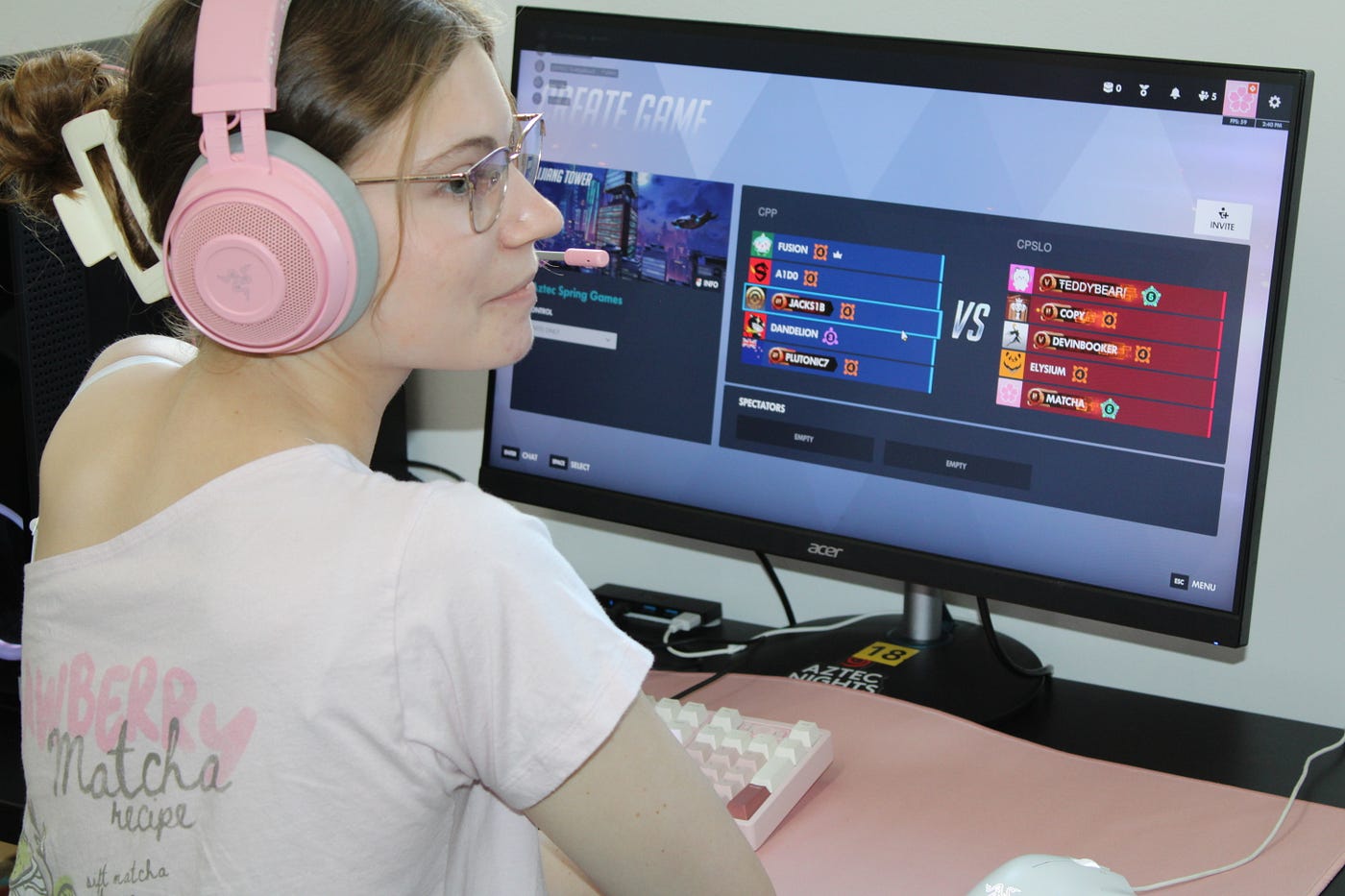
Samantha Jones playing for Cal Poly SLO in esports tournament at SDSU on April 18, 2026.
“I feel like it kind of makes (women) more intimidated because the only people who really show up is men,” Montiel said. “It’s kind of scary.”
Beyond just the hypersexualization of female characters, many girls like Montiel and Pot have also experienced misogyny from their peers while playing. Just over 60% of women reported being harassed while playing online games.
“They just think that girls aren’t supposed to be there, like, they’re supposed to be doing something else,” Pot said.
Montiel talked about being on the receiving end of many sexist remarks and disrespectful jokes in certain discord servers that were predominantly male. Pot also recalled many sexist remarks, such as, “go back to the kitchen” and “make me a sandwich” whilst playing online.
These statements are not just exaggerated cliches, but true depictions of rampant misogyny in the gaming industry. While it may not be as common to hear day-to-day, the protection of anonymity allows men to verbally abuse their female peers without any repercussions. There is some predisposed notion acted on by these men that women inherently do not belong in any gaming atmosphere.
“(Men) don’t expect women to perform better than men,” Montiel said.
This phenomenon does not only affect gameplay and society. The roots of gaming culture can be traced back to game development itself.
Ashleigh Amrine, a former gameplay programmer at Amazon Games, recounts a widely common practice at gaming conventions, to which she referred to as “booth babes.”
“These women don’t work for the studio,” Amrine said. “They’re hired to be hot and for people to take pictures with them.”
Amrine recalled multiple instances of attending different video game conferences, where game development companies would showcase their new and upcoming products. Often, these booths featured women wearing bikinis just to attract attention from men. These marketing tactics only worked to a certain extent, as these girls could not talk to developers about anything related to the game they were promoting.
“This wasn’t just an outlier,” Amrine said. “This was basically the standard for booths at these conferences for years.”
Gaming has long been considered a boys’ club, ostracizing any women who dare enter the field. Successful companies like Activision and Ubisoft have faced multiple sexual harassment/misconduct lawsuits, citing a “frat boy” culture that perpetuates unequal working conditions and pay for their female employees.

According to Women in Games, a nonprofit activist organization, only 23% of gaming developers are women. This same report also surveyed that confidence in DEI efforts are decreasing amongst employees, with higher ups reporting shortcomings rather than successes in their DEI policies.
This was reported in 2024, a year before the Trump Administration removed a multitude of Diversity, Equity and Inclusion programs across the nation. While many companies moved forward with removing DEI programs to save on costs, CEO of Activision Blizzard confirms their values for DEI initiatives, stating that their Inclusive Growth team is “important to (their) games, (their) culture and who (they) are as a company.”
“Without bringing in new blood, (the gaming industry) won’t change,” Amrine said. “I just hope that a lot more voices will be making games, and I hope that they are brave enough to make something from their heart.”
This project was produced by Myckenzie Smith as a published learning experience in JMS 550 Multimedia News Lab, part of the Journalism and Media Studies Program at San Diego State University.
메타데이터
- post_id
- 123fa57629ba
- slug
- girls-in-gaming-infiltrating-the-boys-club-123fa57629ba
- url
- https://medium.com/@myckenzie/girls-in-gaming-infiltrating-the-boys-club-123fa57629ba
- canonical_url
- https://medium.com/@myckenzie/girls-in-gaming-infiltrating-the-boys-club-123fa57629ba
- author_url
- https://medium.com/@myckenzie
- status
- ok
- fetched_at
- 2026-06-22 05:41:33