C++26 Placeholder Variables: No More Unused Variable Warnings
How the new _ syntax simplifies your code and satisfies the compiler.
C++26 Placeholder Variables: No More Unused Variable Warnings
How the new _ syntax simplifies your code and satisfies the compiler.
As someone who splits their time between C++ and Rust, I’ve grown used to a certain kind of context-switching whiplash. I’ll be happily writing Rust, drop a casual **let _ = something(); to discard a value, and think nothing of it. Then I switch back to a C++ project, try the same trick, and get greeted by a wall of `-Wunused-variable** warnings and the dreaded[[maybe_unused]]` dance.
For years, this tiny ergonomic gap has been a small but persistent papercut. Every time I destructured a **std::map entry and only needed the value, or wanted to chain a couple of RAII guards without inventing names like `guard1**,guard2`, **guard3**, I'd quietly miss Rust's humble underscore.
And with C++26 already here, it’s been genuinely fun exploring the little quality-of-life upgrades starting to land.
Well, fellow polyglots: C++26 is closing the gap. C++26 introduces placeholder identifiers that make ignored bindings far more ergonomic, with underscore-style syntax inspired by patterns developers may recognize from Rust and other languages. If you’re coming from Rust, the feel will be familiar — though, as we’ll see, the semantics aren’t identical.
Let’s dig in and explore what this looks like in real code.
The Everyday Annoyance C++26 Finally Fixes
Consider this classic scenario:
#include <map>
#include <string>

std::map<std::string, int> scores = {{"Alice", 95}, {"Bob", 88}};

for (const auto& [name, score] : scores) {
    std::cout << score << '\n';   // 'name' is never used
}
In Rust, you’d just write **for (_, score) in &scores** and be done. But in C++, until now, we had to resort to workarounds:
- Prefixing with
**[[maybe_unused]]** - Using cryptic names like
**unused1, `dummy**, orignored` - Suppressing warnings globally (please don’t)
None of these are elegant. All of them add noise.
Enter _ — The Placeholder Identifier Of C++26
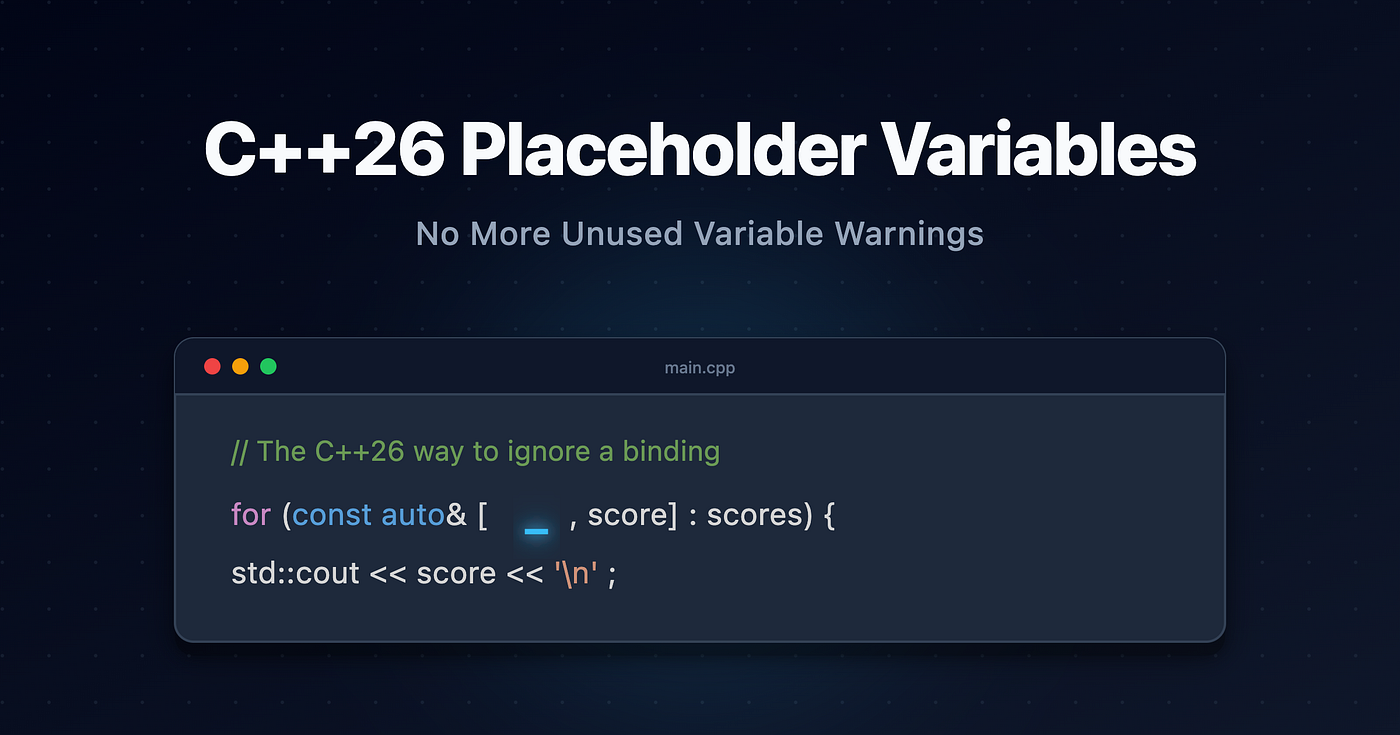
In C++26, **_ gains special treatment as a placeholder identifier — a name that signals "**I'm intentionally ignoring this":
for (const auto& [_, score] : scores) {
    std::cout << score << '\n';
}
No warning. No noise. Just pure intent: “I’m ignoring this part.”
It’s conceptually similar to Rust’s **_, but keep in mind the two languages arrived at this through different routes — C++ had to preserve decades of existing code where `** is already a valid identifier (e.g., the**("...")`** gettext macro). The design is therefore carefully scoped to avoid breaking existing programs.
Reducing Naming Friction for Ignored Values
One of the nicer aspects of the feature is that it takes aim at a long-standing irritation: needing to invent unique names for things you don’t actually care about. Normally, declaring two variables with the same name in the same scope is a hard error:
int x = 1;
int x = 2;  // ERROR: redeclaration
C++26’s placeholder identifier rules are designed to reduce this friction, including in scenarios where repeated ignored declarations may be supported — so patterns like RAII guards can become much cleaner:
auto _ = std::scoped_lock(mutex_a);
auto _ = std::scoped_lock(mutex_b);
A note on exact semantics: The precise rules for when multiple
**_** declarations are permitted, and in which contexts, follow the adopted proposal wording. Behavior may also differ subtly between early compiler implementations. Always check your compiler's release notes and cppreference for the final standardized rules before relying on edge cases.
If you’ve written Rust code like this:
let _guard_a = File::open("a.txt")?;
let _guard_b = File::open("b.txt")?;
…you already know the ergonomic win. The C++ version aims to deliver the same feel without forcing you to manufacture unique names.
A subtle difference from Rust: In Rust,
**let _ = expr;** drops the value immediately. The C++ placeholder, when used as a normal variable declaration, follows standard C++ object lifetime rules — which is usually what you want for RAII, but worth remembering when switching languages.
Where Placeholder Variables Actually Shine?
Placeholder identifiers shine in contexts where ignored names are common:
1. Structured Bindings (the headline use case)
auto [_, value] = *map.begin();    // ignore the key
std::cout << value;
This is the example most developers will reach for, and it’s the cleanest, most uncontroversial use of the feature.
2. Regular Variable Declarations (RAII chains)
auto _ = std::scoped_lock(mutex1);
auto _ = std::scoped_lock(mutex2);
Great for when you only care about a destructor running at end of scope.
3. Other Contexts — Check Your Compiler
Beyond the cases above, you may see placeholder-style usage discussed for:
- Lambda init-captures
- Function parameters
- Other declaration contexts
Here’s a quick look at the currently safest uses vs. the more experimental territory:

Some compilers may also experiment with placeholder-style parameters or captures, though support and exact syntax may vary. When in doubt, consult **cppreference** and your compiler’s release notes rather than trusting a blog post (including this one!).
The One Rule to Remember
You can declare **_ freely in the contexts the standard permits, but reading from `** only works when there's a** single, unambiguous****`** in scope:
auto _ = 42;
std::cout << _;  // OK — only one '_' exists

auto _ = 99;    // now there are multiple
std::cout << _;  // ERROR — ambiguous
The mental model: once you’ve declared more than one
**_**, treat it as write-only. Declare and forget.
Why This Tiny Feature Matters?
This feature is small, but it reflects a bigger trend in modern C++: learning from its younger siblings and cleaning up the little papercuts that have accumulated over decades. For those of us who work in both languages, these ergonomic alignments are genuinely refreshing — fewer mental gear-shifts, less friction, more focus on the actual problem.
The benefits:
- Cleaner structured bindings
- Elegant RAII chaining
- No more
[[maybe_unused]]spam on unused bindings - Better communication of intent
- One less reason to context-switch your brain between C++ and Rust
Here is a Quick Cheat Sheet:

Note:
**auto _ = fn();is not equivalent to `(void)fn();`**. The former keeps the returned object alive until end of scope (useful for RAII); the latter discards it immediately. Choose based on whether you need the object to stick around.
Closing Thoughts
Placeholder **_** in C++26 is the kind of feature you won't appreciate until you start using it — and then you'll wonder how useful this tiny feature is. If you're like me and bounce between C++ and Rust projects, this small change makes that context-switch a little smoother every day.
It’s ergonomic, it’s expressive, and it costs you nothing to adopt. Try it out the next time your compiler is ready, verify the exact semantics against current documentation, and enjoy a little less noise in your codebase.
Happy coding — in both languages! 🚀🦀
Compiler support: Check the latest GCC, Clang, and MSVC release notes for **-std=c++26 flag availability and for which placeholder contexts are currently implemented. As of early 2026, support is actively landing across major toolchains — but specifics evolve quickly, so always cross-reference with [cppreference](https://en.cppreference.com/)** for authoritative wording.
Further reading: P2169R4 — A nice placeholder with no name
If you’re serious about passing technical interviews, try PracHub. It helped me structure my preparation with advanced mock sessions. [**Check it out here**] and start practicing. (Disclosure: This is an affiliate link).
Found this article helpful ? Clap 👏 and follow me for more C++ and system programming content.
메타데이터
- post_id
- 12414c9032c1
- slug
- cpp26-placeholder-variables-unused-warnings-12414c9032c1
- url
- https://towardsdev.com/cpp26-placeholder-variables-unused-warnings-12414c9032c1
- canonical_url
- https://towardsdev.com/cpp26-placeholder-variables-unused-warnings-12414c9032c1
- author_url
- https://medium.com/@sagarmadala
- status
- ok
- fetched_at
- 2026-06-23 03:48:11