Capitalism and the Point of Diminishing Purpose
Jay Larson
Capitalism and the Point of Diminishing Purpose
Jay Larson
April 27th, 2026
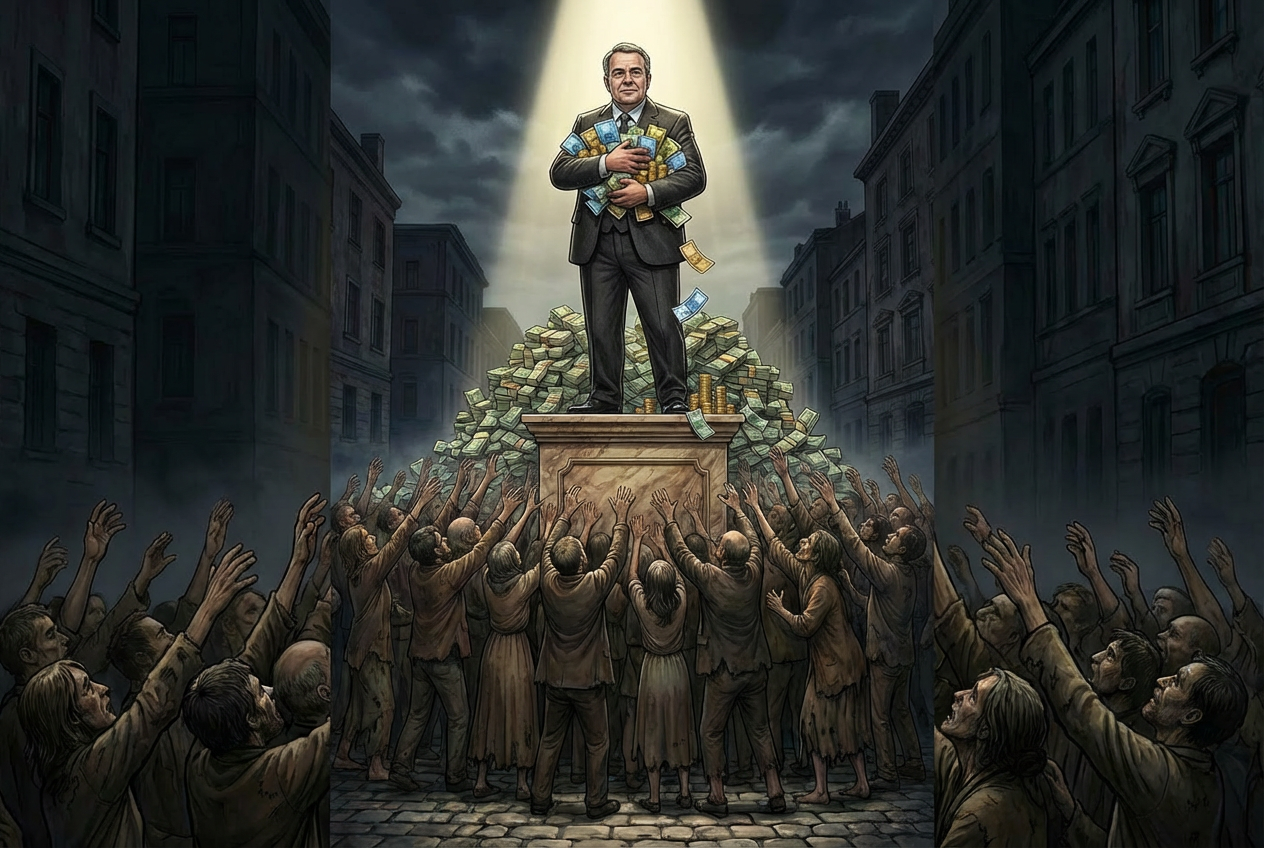
In a capitalist society, wealth accumulation serves a clear function — it allows individuals to improve their quality of life by purchasing goods and services beyond basic necessity. But there is a point at which additional wealth stops serving that purpose. Once a person can buy anything they want, further accumulation becomes meaningless from a practical standpoint.
So why do billionaires keep accumulating?
The Psychology of Accumulation
To understand why billionaires keep accumulating long past the point of any practical purpose, we have to look at what is actually happening in their brains — and in their histories.
At the neurological level, money activates the same reward circuitry as any addictive substance. When we earn or receive money, the brain releases dopamine — the neurotransmitter associated with motivation and pleasure — which helps explain why people can become addicted to watching their wealth grow. For the ultra-wealthy, this process doesn’t plateau. A compulsion to acquire more money can be categorized as a “process addiction” — an out-of-control relationship with a behavior that produces changes in brain chemistry similar to the mood-altering effects of alcohol or drugs, kicking off releases of dopamine that produce a high comparable to a chemical substance.
In other words, for many billionaires, accumulation is not a choice. It is a compulsion with a neurological signature.
Former Wall Street banker Sam Polk described this dynamic from the inside. After working with enormously wealthy bosses who simply could not get enough money — fighting against regulations that would make them fairer, opposing codes of conduct that would limit their bonuses — he recognized that he might be using money the same way he had used drugs and alcohol: to make himself feel powerful, and to cover an inner wound that the money was never actually healing.
That wound is worth examining. Behind many wealthy lifestyles lies suffering, pain, and childhood trauma. Children in vastly wealthy families often grow up feeling isolated and unloved, and as adults there can be feelings of never having enough — in both inherited and self-made wealth. The accumulation, in many cases, is not a celebration of abundance. It is a response to a scarcity wound that formed long before the first dollar was ever earned.
Wealth then compounds the problem rather than solving it. Research by social psychologist Paul Piff at UC Irvine found that as a person’s levels of wealth increase, their feelings of compassion and empathy go down, while their feelings of entitlement, deservingness, and ideology of self-interest increase. Wealthier individuals are more likely to moralize greed and self-interest as favorable, less likely to be prosocial, and more likely to cheat and break laws if it benefits them.
This is the cruel irony at the heart of extreme accumulation. The very act of acquiring more wealth systematically dismantles the empathy that would allow a person to recognize the harm their hoarding causes. Studies of lottery winners and the ultra-wealthy reveal that sudden riches often lead to increased isolation, distrust, and anxiety. Psychologists have labeled the personalities of billionaires as a “dark triad” of Machiavellianism, psychopathy, and narcissism, with studies showing extremely wealthy people are more likely to exhibit self-promotion, emotional coldness, duplicity, and aggressiveness.
But here is the critical finding that makes the case for structural intervention rather than moral condemnation: when wealthy people are given even small nudges — simple reminders of the needs of others — their levels of empathy, compassion, and charity go up significantly. The empathy is not gone. It is suppressed by the environment that extreme wealth creates. Wealth itself alters brain function — abundance reduces sensitivity to risk and increases a sense of control — effectively insulating the wealthy from the feedback that would naturally trigger compassion.
The system, in other words, is not producing monsters. It is producing people whose environment has been stripped of the very signals that generate human connection and moral awareness. That is not an argument for sympathy. It is an argument for changing the system itself.
The Societal Effect of Overaccumulation
When billions of dollars are hoarded, that money stops circulating. When money is hoarded rather than spent or invested, it leads to decreased consumer demand, reduced economic growth, and increased economic inequality. More precisely, the problem is one of capital concentration and insufficient circulation of income through the working and middle classes. People starve, become homeless, and die — not from scarcity of resources, but from scarcity of access. The extreme concentration of wealth slows the pace of economic growth, exacerbates political dysfunction, and undermines faith in political and economic systems. This is the defining feature of late-stage capitalism: the middle class erodes, and the gap between rich and poor widens without bound. Find more concrete details in the human cost section below.
The Solution: The Trophy Without the Reward
What if the wealthy could keep their game but not their prize? What if they received the trophy — the recognition, the record, the score — while the excess wealth itself was redistributed beyond the point at which it serves them anyway?
This is not as radical as it sounds. Nobel Prize laureates Daniel Kahneman and Angus Deaton published landmark research showing that rising income increased wellbeing, but only up to a ceiling of approximately $75,000 annually, beyond which there was no meaningful increase. More recent adversarial collaboration between Kahneman and researcher Matthew Killingsworth refined this further: while larger incomes are associated with increasing happiness on average, for an unhappy cohort happiness rises sharply up to around $100,000 annually and then plateaus.
Separately, research on 500,000 people across 123 countries found that the greater the wealth, the weaker the connection grows between meaning and happiness — with wealthier individuals having greater difficulty finding happiness through meaning than those with lower incomes.
In other words, extreme wealth doesn’t just stop helping — it begins to hurt. It breeds isolation from everyday reality, distorted thinking, and a diminished capacity to find meaning in life. Requiring redistribution above a certain threshold would not only benefit society — it would likely benefit the ultra-wealthy themselves.
The Scoreboard: Separating the Trophy from the Vault
If accumulation is a game — and the evidence strongly suggests it is — then the solution is not to end the game. It is to change what winning looks like.
The infrastructure for this already exists. Forbes magazine has published its annual billionaire rankings since 1987, and the ultra-wealthy track their position obsessively. They compete over it. They are motivated by it. The scoreboard already works. It simply measures the wrong thing. It measures the size of the vault rather than the magnitude of the contribution — rewarding hoarding rather than impact.
The proposed reform is straightforward in concept: decouple the trophy from the reward. Continue tracking wealth accumulation with full transparency and precision. Let the competition remain intact. But require that wealth beyond the threshold at which it ceases to serve any practical purpose be redistributed — and make every dimension of that process publicly visible.
The Game: Measuring Wealth Impact Indicators (WIIs)
Administration would require an independent, internationally recognized body — not a partisan government agency subject to political manipulation, but a transparent, tamper-proof public institution with a mandate insulated from the interests of those it oversees. Its function would be threefold: to verify lifetime accumulation, to manage redistribution above the defined threshold, and to maintain a public record accessible to anyone in the world.
The public ledger — a website in its simplest form — would track three distinct layers of information (WIIs) for every individual who crosses the threshold.
The first indicator is lifetime earnings: the raw competitive metric. This replaces the vault as the scoreboard. A billionaire’s standing is no longer determined by what they are currently hoarding but by the total they have generated across their lifetime. The competition continues. The number still grows. Winning is still possible. It simply no longer requires that the money sit idle while people suffer.
The second indicator is what was redistributed: a full, transparent accounting of every dollar that flowed back into the economy and toward those in need. This is the accountability layer. It is public, verifiable, and permanent. It cannot be manipulated, minimized, or quietly redirected toward vanity projects under the guise of philanthropy.
The third indicator is what it did: the human impact of the redistributed wealth, translated into concrete and visible outcomes. Schools built. Meals provided. Medical treatments funded. Communities stabilized. Housing created. This is not an abstraction. It is a living record of the real world that exists because a particular person generated a particular amount of wealth.
The Unexpected Beneficiary
This third layer may matter most — and not only for the reasons one might expect.
Recall that research consistently shows the wealthier a person becomes, the weaker the connection grows between meaning and happiness. Extreme wealth isolates and it insulates. It strips away the ordinary feedback loops of human life — the relationships, the struggles, the mutual dependence — through which people normally derive a sense of purpose and meaning in their lives.
The public impact record does not just create accountability for the wealthy. It potentially restores something they lost. By making visible the human lives changed by redistributed wealth, it reconnects the ultra-wealthy to the very thing that generates meaning: impact on other people. Not in the abstract. In the specific — Named schools, named communities, real faces.
A billionaire who has been told by their isolated existence that they are separate from humanity — that their wealth places them above the ordinary web of human need and connection — might find in that public record something no amount of accumulation ever provided. Evidence that they mattered. That their presence in the world made it measurably better for people they will never meet.
That is not a punishment. That is not a redistribution of identity or achievement. It is the restoration of the one thing that money, in all its abundance, consistently fails to buy.
The scoreboard, properly designed, does not diminish the wealthy. It finally gives them a reason to feel proud of something real.
The Mechanics of Redistribution
Any system of mandatory wealth redistribution requires three clearly defined components: a threshold that triggers it, a process that executes it, and a priority structure that governs where the money flows. Each of these must be transparent, evidence-based, and insulated from political manipulation.
The Threshold
The redistribution threshold should not be an arbitrary number selected by legislators susceptible to lobbying. It should be derived directly from the research this essay has already cited — the empirically established point at which additional wealth ceases to meaningfully improve a person’s life. That figure, adjusted periodically for inflation and updated as new research emerges, becomes the defined ceiling. Wealth accumulated beyond it is not confiscated as punishment. It is redirected as a logical consequence of having exceeded the point of personal utility.
This distinction matters enormously. The threshold is not political. It is scientific. It is the point the evidence itself identifies as the boundary between wealth that serves a person and wealth that serves no one.
Accumulation above the threshold is assessed annually. Whatever has grown beyond it during the preceding year flows into the redistribution system. At death, a full reckoning occurs — a final accounting of all remaining holdings above the threshold, redistributed in their entirety according to the same priority structure.
The Priority Structure
Redistribution does not flow toward a single destination. It flows through a triage system — a cascading set of priorities ordered by urgency, with funds directed to the most critical need first and cascading downward as those needs are met.
The first and highest priority is critical human need: food security, emergency shelter, clean water, basic medical care. These are the irreducible foundations of human existence. No dollar flows anywhere else until this tier is fully funded. People do not starve or die of preventable illness while infrastructure projects are debated.
The second priority is education and infrastructure: schools, hospitals, housing, public transit, clean energy, community institutions. These are not luxuries. They are the architecture of a functioning society and the mechanism by which people who received critical support in the first tier gain the tools to build their own futures. Direct cash transfers — a component of the first tier — must always be coupled with access to education, job training, and economic opportunity. Money without tools delays poverty. It does not end it. The goal is not dependence. It is launch.
The third priority is a sovereign wealth fund — a publicly owned, transparently managed long-term investment vehicle that generates ongoing returns for the benefit of current and future generations. A working model already exists. Norway’s Government Pension Fund Global, established to manage surplus revenues from oil and gas production, has grown into the world’s largest sovereign wealth fund, driven not by short-term gain but by long-term stewardship of national wealth. It follows strict ethical guidelines, transfers at most three percent of its worth to the national budget each year, and uses that money to support social services including healthcare, unemployment benefits, pensions, infrastructure, and education.
Critically, the fund avoids investment in companies that cause harm — a principle that would be foundational, not optional, in the proposed global system.
The Absolute Prohibition
One constraint is non-negotiable and requires no further justification: not a single dollar of redistributed wealth may flow toward war, weapons, military expansion, or any instrument designed to harm human beings. This is not a political position. It is a structural one. The entire purpose of this system is to redirect wealth that was causing harm toward ends that reduce it. To allow redistributed funds to flow toward destruction would be a fundamental contradiction of the system’s own moral logic — a betrayal of the principle at its foundation.
The proportions flowing between the three priority tiers are never fixed. They are assessed continuously by the independent body responsible for administration, adjusted in real time based on current global needs. If critical human needs in a given period are fully met, more flows to infrastructure and education. If a sovereign wealth fund reaches sufficient scale to generate adequate returns on its own, more flows back to the first tier. The system is not a rigid formula. It is a living triage mechanism — always asking the same question: where does this money do the most good right now?
That question, asked honestly and answered transparently, is the only algorithm the system needs.
Why Voluntary Philanthropy Is Not Enough
Many billionaires do give. Some give enormously. And they deserve genuine recognition for it — they are demonstrating, through their own behavior, that redistribution of extreme wealth is not only possible but personally survivable. They are, in the most literal sense, proof of concept.
But voluntary philanthropy is not a system. It is a gesture. And the evidence demonstrates clearly that gestures, however well-intentioned, cannot substitute for structure.
In 2010, Warren Buffett and Bill Gates launched the Giving Pledge — a public commitment by the world’s wealthiest individuals to donate at least half of their fortunes either during their lifetimes or upon death. It was a culturally significant moment. It signaled that the ultra-wealthy could be moved toward generosity at scale. By 2021, the Giving Pledge had attracted 220 signatories, making it the most visible voluntary wealth redistribution initiative in history.
Fifteen years later, the results tell a more complicated story.
According to a 2025 analysis by the Institute for Policy Studies, the 32 original U.S. pledgers who remain billionaires have collectively become approximately 166 percent wealthier since signing on in 2010 . They pledged to give away half their wealth. Their wealth more than doubled. The math does not work in philanthropy’s favor.
The initiative has attracted sustained criticism for its voluntary and non-binding nature, which provides no mechanism to verify or enforce the fulfillment of commitments. Some pledgers have used their philanthropy for self-serving purposes, including taking out loans from their own foundations or paying themselves substantial trustee salaries. Others have shifted their giving toward limited liability corporations — for-profit ventures that theoretically carry social benefit but require neither the transparency nor the proven impact of working charities. The decline of the pledge itself is telling. New signatories have fallen from 113 families in the first five years to just four in 2024. Some high-profile figures have privately encouraged others to abandon the non-binding commitment entirely, while others have quietly allowed their pledge commitments to disappear from the website without explanation. But the most fundamental problem with voluntary philanthropy is not the rate of non-compliance. It is the architecture of control.
When redistribution is voluntary, the giver decides everything — how much, when, and crucially, where. Research suggests that when billionaires directly fund charities, they tend to prefer established, agreeable institutions — and consistently avoid funding the kind of robust direct services and community power-building organizations that would actually heal the inequalities that make philanthropy necessary in the first place. In other words, voluntary philanthropy tends to treat the symptoms while carefully avoiding the cure. It funds museums and university buildings and medical research centers — all genuinely valuable — while systematically underfunding the structural interventions that would reduce the need for charity at all.
Critics have argued that billionaire philanthropy functions, explicitly or implicitly, as a response to popular pressure for income redistribution through taxation — a way of appearing generous while preserving the underlying conditions that generate extreme wealth. Whether or not that is the conscious intent of any individual donor, it is demonstrably the structural effect.
Voluntary philanthropy also carries an invisible but consequential power dynamic. When a billionaire chooses to fund a cause, that cause receives resources. When they choose not to, it does not. Communities, institutions, and entire sectors of human need become dependent on the preferences, relationships, and personal priorities of a very small number of unelected, unaccountable individuals. That is not generosity operating at scale. That is patronage. And patronage, however benevolent, is not justice.
The billionaires who give generously and genuinely are not the argument against this system. They are the argument for it. They have already demonstrated that extreme wealth can flow back into the world without destroying the person it came from. What they have not demonstrated — what voluntary systems are structurally incapable of demonstrating — is that this will happen reliably, equitably, and at the scale the need demands.
For that, you need structure. You need transparency. You need accountability that does not depend on the mood, the mortality, or the moral evolution of any single individual.
You need a system.
The Human Cost
This essay has examined the psychology of accumulation, the mechanics of redistribution, and the failures of voluntary philanthropy. But underneath all of it — underneath the policy frameworks, the research findings, and the governance philosophy — is a simpler and more urgent reality.
People are dying. Right now. Today.
Roughly 25,000 people die each day from hunger or hunger-related causes. That is one life lost every few seconds to a preventable crisis. Of the nine million people who die from hunger-related causes each year, roughly one-third are children under the age of five. There are still 15,000 under-five deaths per day from largely preventable causes — and two-thirds of all child deaths are preventable through low-cost, evidence-based interventions such as vaccines, antibiotics, oral rehydration therapy, and basic nutrition support.
These are not deaths caused by an absence of resources. They are deaths caused by an absence of access. The resources exist. Approximately 831 million people worldwide currently live in extreme poverty, surviving on less than three dollars per day. And yet, simultaneously: between November 2024 and November 2025 alone, the world’s billionaires increased their wealth by $2.545 trillion — enough to end extreme poverty 26 times over.
Read that again. In a single year. Twenty-six times over.
The world’s richest one percent increased their wealth by more than $33.9 trillion in real terms since 2015 — more than enough to eliminate annual poverty 22 times over. The wealth is not missing. It is not hiding in some inaccessible place. It is sitting, accumulating, compounding — while one in four people worldwide do not regularly have enough to eat and nearly half the world’s population lives in poverty.
In 2025, an estimated 35.5 million children under the age of five were acutely malnourished across 23 affected countries. Nearly 10 million of those children were suffering from severe wasting — a condition that is life-threatening, but entirely preventable and treatable. Entirely preventable. Entirely treatable. The barrier is not knowledge nor is it capability. It is not even will, in every case. It is money — specifically, money that exists in quantities sufficient to address the problem many times over, locked in the vaults of people for whom it has long since ceased to serve any personal purpose.
Political decisions made by governments to slash aid budgets could lead to more than 14 million additional deaths by 2030. This is happening in the same era in which billionaire wealth has increased by 81 percent since 2020.
The juxtaposition is not accidental. It is structural. The same system that generates extreme wealth systematically drains the public resources that would otherwise address extreme need. Inequality transfers income from low- and middle-income households toward higher-income households — dragging on demand growth as consumption declines. The economy does not simply fail to help those at the bottom. The concentration of wealth at the top actively makes their situation worse.
None of this requires vilifying any individual billionaire. It does not require assuming malicious intent. It requires only acknowledging what the data makes impossible to ignore: that the current system produces death as a predictable and measurable byproduct of wealth concentration. Not as an accident. Not as an unfortunate side effect. As a structural outcome.
The children who die from preventable malnutrition today do not die because we lack the money to save them. They die because the system we have built does not require the people who have that money to use it for that purpose.
That is what this proposal exists to change.
A System Worth Building
This essay is my response to a simple observation: that wealth accumulation serves a clear human purpose up to a point, and beyond that point serves none. Everything that followed — the neuroscience, the economics, the psychology, the human cost data — has been an elaboration of that single truth.
The argument is not that capitalism is without merit. It is that capitalism without limits produces a specific and predictable kind of damage. It produces people so insulated by wealth that they lose the capacity to feel the consequences of their own accumulation. It produces a scoreboard that rewards hoarding over contribution. It produces a world in which 25,000 people die every day from hunger while a single year’s growth in billionaire wealth could end extreme poverty 26 times over.
That is not a market failure. It is a design failure. And design failures can be fixed.
What this proposal offers is not revolution. It is not the dismantling of ambition or the punishment of success. It is a recalibration — a recognition that the game billionaires are already playing can continue, that the competition can remain intact, that the drive to generate and build and earn can be honored and celebrated. The only thing that changes is what happens to the excess once it crosses the threshold of personal utility. Instead of sitting idle, it moves. Instead of compounding in isolation, it circulates. Instead of being locked away from the world, it re-enters it — as food, as shelter, as education, as infrastructure, as the foundation of futures that would otherwise never exist.
The Wealth Impact Indicators — what was earned, what was returned, what it changed — are not a mechanism of shame. They are a mechanism of meaning. They are the system’s way of answering the question that extreme wealth, left to its own devices, consistently fails to answer: what was all of this for?
The billionaires who already give generously have already answered that question for themselves. They discovered, as the research predicts, that the giving mattered more than the having. This proposal simply extends that discovery to everyone — not as an invitation, but as a requirement. Because the need is too great, the resources too abundant, and the cost of continued inaction too measurable in human lives to leave it to individual conscience alone.
Moral law has always held that those who have more than they need bear a responsibility to those who do not have enough. That principle is not new. It is not radical. It is ancient — present in every major religious tradition, every serious ethical framework, every society that has managed to hold itself together across time.
What is new is that we now have the data to define “more than they need” with scientific precision. We have the technology to track it transparently. We have the institutional models to manage it responsibly. We have the evidence to demonstrate that redistributing it would benefit not just the recipients but the donors themselves.
We have everything we need to build this system.
What remains is the will to require it.
A final note on the origins of this idea
The ideas in this essay did not originate in an economics paper or a policy brief. They began with two words in an email: exclusive and all-inclusive.
Structurally, these words are antonyms. Exclusive means shutting out. Inclusive means letting in. But somewhere along the way, prestige culture performed a quiet act of linguistic theft — attaching status and desirability to the act of exclusion, turning a word that means not available to everyone into something people aspire to.
The phrase that started this line of thinking was a small mind-twister: something described as both exclusive and all-inclusive simultaneously. Exclusive in who could access it. All-inclusive in what was available once you were in.
That is, in miniature, exactly the problem this essay describes. A system that concentrates access in the hands of a few — and calls that concentration prestigious — while the abundance that exists inside that system remains invisible and unavailable to everyone on the outside.
The solution proposed here is simple in the same way the linguistic fix is simple: stop attaching prestige to exclusion. Start measuring what gets included, and for whom.
Two words in an email. The rest followed.
메타데이터
- post_id
- 1252789b0f2c
- slug
- capitalism-and-the-point-of-diminishing-purpose-1252789b0f2c
- url
- https://medium.com/@jay_larson/capitalism-and-the-point-of-diminishing-purpose-1252789b0f2c
- canonical_url
- https://medium.com/@jay_larson/capitalism-and-the-point-of-diminishing-purpose-1252789b0f2c
- author_url
- https://medium.com/@jay_larson
- status
- ok
- fetched_at
- 2026-07-26 09:46:03



