Where the Shadows Lie
Michael Ridpath’s Where the Shadows Lie is that rare contemporary thriller which manages, with admirable sophistication and intellectual…
Where the Shadows Lie
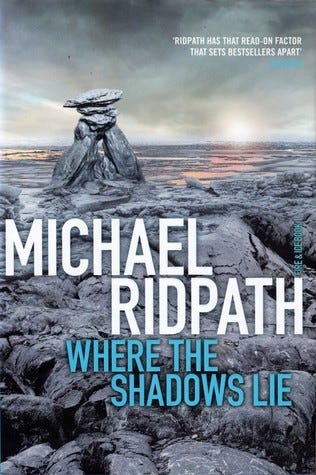
Michael Ridpath’s Where the Shadows Lie is that rare contemporary thriller which manages, with admirable sophistication and intellectual confidence, to transcend the formulaic limitations of conventional crime fiction and evolve into something far richer: a haunting meditation on mythology, memory, cultural inheritance and the dangerous seductions of obsession. Published in 2010, the novel inhabits a fascinating literary crossroads where Nordic noir, Icelandic saga literature, historical mystery and modern detective fiction converge with remarkable elegance. What distinguishes Ridpath’s work is not merely the ingenuity of its murder investigation, but the manner in which it interrogates the enduring power of stories themselves — how ancient myths continue to cast long and unsettling shadows across the modern world.
At its most immediate level, the novel functions as an engrossing police procedural. Yet beneath its investigative framework lies a far more ambitious literary architecture. Ridpath constructs an intricate narrative in which medieval Icelandic legends seep insidiously into contemporary greed, violence and fanaticism. Ancient manuscripts become objects of lethal desire; forgotten sagas acquire the potency of buried curses; literary scholarship itself becomes a battlefield. The result is a thriller that feels simultaneously scholarly and cinematic — intellectually stimulating without ever sacrificing narrative momentum.
At the centre of this richly textured narrative stands Magnus Jonson, one of the novel’s most compelling achievements. Magnus is a man suspended uneasily between identities: Icelandic by birth, American by psychological conditioning. Having emigrated to Boston as a teenager, he has spent much of his life estranged from the country of his origins. Now a homicide detective in Boston, Magnus is abruptly compelled to leave the United States after exposing police corruption connected to a violent drug cartel. With gangsters and corrupt officers eager to silence him before he testifies, he is temporarily seconded to the Reykjavik police force — an exile that is simultaneously professional, emotional and existential.
His return to Iceland after nearly two decades is freighted with unresolved grief and buried resentment. Years earlier, Magnus’s father had been murdered under mysterious circumstances, a trauma from which he never fully recovered. Iceland, for Magnus, is therefore not merely a homeland but a repository of painful memories and unresolved ghosts. Ridpath handles this emotional dislocation with admirable subtlety, transforming Magnus’s homecoming into a poignant exploration of cultural estrangement, fractured identity and the uneasy pull of ancestral belonging.
Soon after his arrival in Reykjavik, Magnus becomes involved in the murder investigation of Professor Agnar Haraldsson, a distinguished scholar of Icelandic literature whose corpse is discovered near Lake Thingvellir — one of Iceland’s most historically and symbolically resonant landscapes. What initially appears to be a relatively straightforward homicide rapidly expands into something far stranger, darker and infinitely more dangerous.
Before his death, Haraldsson had reportedly uncovered evidence relating to Gaukur’s Saga, a lost medieval Icelandic manuscript long believed to have vanished from history. The saga allegedly contains references to a mysterious ring endowed with immense symbolic power and may even have served as an inspiration for J. R. R. Tolkien while writing The Lord of the Rings. This tantalising possibility — that a forgotten Icelandic text might stand at the mythological origins of Tolkien’s literary universe — electrifies scholars, collectors, fanatics and opportunists alike.
Ridpath exploits this literary conceit with considerable intelligence. The novel evolves into a fascinating dialogue between ancient Norse mythology and modern popular culture. Tolkien’s presence looms spectrally over the narrative, yet Ridpath wisely avoids descending into mere homage or fantasy pastiche. Instead, he poses a far more intriguing and psychologically resonant question: what happens when myth itself acquires material value — when stories become sufficiently powerful, profitable or sacred that human beings are willing to kill for them?
As Magnus delves deeper into the investigation, he uncovers an increasingly labyrinthine network of academics, manuscript collectors, wealthy businessmen, obsessive Tolkien enthusiasts and embittered families haunted by old rivalries. Among the more memorable figures are Lawrence Feldman, the enigmatic American collector, and Steve Jubb, a Yorkshire truck driver whose devotion to Tolkien borders upon fanaticism. Equally compelling are Ingileif and Petur, descendants connected to the ancient Gaukur saga lineage, both psychologically scarred and financially devastated by Iceland’s catastrophic 2008 banking collapse. Their motives remain tantalisingly ambiguous throughout much of the narrative. Ingileif, in particular, gradually develops a fragile emotional connection with Magnus, adding a quiet undercurrent of tenderness to the otherwise ominous proceedings.
Then there is Pastor Hakon, an unsettling presence whose past involvement with Ingileif and Petur’s father — who perished after falling from a cliff under suspicious circumstances — introduces yet another layer of moral ambiguity and concealed motive. Around all these characters hovers the legend of the ring itself, which gradually acquires an almost supernatural aura. Yet one of Ridpath’s strengths lies in his refusal to abandon realism entirely. The novel remains grounded even while flirting seductively with mythic possibility.
Running parallel to the Icelandic investigation is the ever-present threat emanating from Boston. The criminal forces Magnus exposed have neither forgotten nor forgiven him. Hitmen linked to the cartel continue hunting him relentlessly and eventually manage to penetrate even Iceland’s seemingly remote isolation. This subplot injects urgency and genuine peril into the novel’s more meditative and atmospheric dimensions. Ridpath balances these dual narrative strands with considerable dexterity, alternating cerebral literary mystery with moments of sharp violence and suspense.
Perhaps the novel’s greatest triumph, however, lies in its extraordinary evocation of Iceland itself. Ridpath transforms the landscape into something far more than mere setting; Iceland becomes an active, almost sentient presence within the narrative. Volcanoes, lava fields, glacial lakes, black sand beaches and isolated villages create an atmosphere of austere beauty infused with latent menace. The country feels ancient in the deepest sense — a place where medieval history and mythological memory remain disturbingly alive beneath the surface of contemporary civilisation.
Equally impressive is the novel’s subtle engagement with Iceland’s post-2008 financial collapse. Beneath the murder mystery lies a society grappling with humiliation, economic devastation and profound existential uncertainty. Ridpath uses this backdrop not simply as historical context but as thematic resonance. Just as Iceland struggles amidst the ruins of financial excess and shattered national confidence, many of the novel’s characters remain imprisoned by inherited guilt, unresolved trauma and dangerous obsessions rooted in the past.
Magnus himself emerges as a deeply engaging, if imperfect, protagonist. Intelligent, stubborn, impulsive and occasionally abrasive, he avoids the emotionally glacial detachment often associated with Scandinavian crime fiction detectives. There is warmth and vulnerability beneath his hard exterior, and his divided identity — simultaneously American detective and Icelandic exile — grants the character considerable psychological depth. His gradual rediscovery of Iceland, both as physical homeland and emotional inheritance, becomes one of the novel’s most affecting emotional arcs.
Stylistically, Ridpath writes with admirable clarity and restraint. His prose remains elegant without becoming ostentatious, accessible without sacrificing intelligence. He introduces readers to Icelandic history, saga literature and Norse mythology with a lightness of touch that never feels pedantic or academically burdensome. The pacing is measured rather than frenetic, allowing the mystery to unfold organically through accumulating revelations rather than relying upon artificial twists or sensational contrivances.
Thematically, Where the Shadows Lie is profoundly concerned with the persistence of the past. Ancient manuscripts, forgotten crimes, inherited sins and cultural memory continue shaping the present in ways both visible and invisible. The title itself becomes deeply symbolic: shadows are not absences but lingering presences — half-seen forces that continue exerting influence long after their origins have faded into obscurity.
Ultimately, Where the Shadows Lie succeeds because it satisfies on multiple levels simultaneously. It is an absorbing murder mystery, an evocative portrait of Iceland, a meditation on mythology and literary inheritance, and a poignant exploration of exile, belonging and return. Few modern thrillers display such confidence in the intelligence and imagination of their readers. Ridpath has produced not merely an entertaining crime novel, but a richly atmospheric and intellectually rewarding work that lingers in the mind long after its final pages have been turned.
메타데이터
- post_id
- 128e9821efb0
- slug
- where-the-shadows-lie-128e9821efb0
- url
- https://medium.com/@vram45/where-the-shadows-lie-128e9821efb0
- canonical_url
- https://medium.com/@vram45/where-the-shadows-lie-128e9821efb0
- author_url
- https://medium.com/@vram45
- status
- ok
- fetched_at
- 2026-06-12 07:40:50