Differentiable Dreams: How Neural Networks Rewrite the Rules of Computation
Machine learning is the art of teaching computers to learn from data, but deep neural networks take this to another level. They’re not just…
Differentiable Dreams: How Neural Networks Rewrite the Rules of Computation
Machine learning is the art of teaching computers to learn from data, but deep neural networks take this to another level. They’re not just algorithms; they’re mathematical artists that sculpt raw data into meaning. Let’s decode their magic.
If you want to understand what is deep learning network and looking for great courses, this post will explain Deep Neural Networks in a smooth way that will help you start your AI journey.
Neural networks represent a profound computational paradigm for learning complex, nonlinear mappings from data. In other words, given specific data, the neural network can detect special things in this data, example how they are related, differences, characteristics, categories…
From Biology to Binary: The Neural Network Analogy
I like to explain concepts in a simple way, so let’s do it🐱. Try first to read this picture.

Imagine when your eyes scan this image. They capture a complex tapestry of information: words, formatting, colors, spacing, and layout. Yet your brain has one primary mission: ‘understand the words.’ This seemingly simple task demonstrates how our brains excel at filtering what’s relevant from a flood of sensory input.
Even if they are not exact replicas of biological brains, Neural networks operate on surprisingly similar principles. When data reaches the network, it initiates a fascinating cascade of computations. Just as your brain transforms visual signals into meaningful patterns, the neural network converts raw input into a numerical landscape it can process.
Within this artificial brain, numerous artificial neurons act as specialized interpreters, connected through weighted pathways, very similar to the synapses in our brains. Some connections carry strong, crucial signals while others transmit weaker, less relevant information. This mimics how your brain might focus intensely on the shapes of letters while paying less attention to the paper’s texture.

As information flows through the network, each layer of neurons performs its own transformation, progressively extracting and abstracting features. Every neuron applies knowledge gained through training, let’s see it as its own version of “experience” using carefully tuned mathematical functions. Think of it like a game of Chinese whispers, where each participant (neuron) doesn’t just pass along the message, but refines it based on their expertise.
The deeper the information travels into the network, the more sophisticated the interpretation becomes. Neurons in early layers might identify basic patterns like lines and curves, while deeper layers recognize complete letters or words. In the end, what started as raw visual data emerges as meaningful understanding. In our case, it was recognizing text, but it can be classifying images, making predictions, or complete the sentence.
This process mirrors how different people might interpret the same poem differently, each bringing their unique perspective to transform simple words into rich meaning. The neural network, through its layered structure, performs a similar feat of transformation, turning simple inputs into increasingly complex and nuanced representations.”
The final output? “You are Special”
Perfect, that was simplified glimpse into the fascinating world of neural networks through familiar metaphors. But to truly understand these powerful systems, we need to dive deeper into their architecture. Don’t worry, we’ll keep building on our brain analogy while introducing the technical concepts, making the complex ideas more digestible and smooth.
Architectural Fundamentals
Talking about neural network, you will always hear about 3 critical architectural elements:
- Neurons: Fundamental computational units that perform nonlinear transformations. Indeed, a neuron is a mathematical function that takes one or more input values/signal, and outputs a single numerical value.
- Connections: Weighted edges representing information flow and learnable parameters
- Layers: Hierarchical computational stages for progressive feature abstraction. Neurons are organized into layers within a neural network. The three main types of layers are:
- Input Layer: This layer receives input information as raw data (pixels, words, sensor data…) and passes it to the next layer.
- Hidden Layers: These layers process the input data through a series of transformations. There can be multiple hidden layers in a neural network. That’s why it’s called Deep Neural Network.
- Output Layer: This layer produces the final output of the network based on the processed information from the hidden layers.

Now, this can be clarified in a simple and enjoyable way. Just as your biological brain has specialized cells called neurons, neural networks have their own digital version. Think of each artificial neuron as a tiny but clever calculator. It’s really just that simple at its core!
Each neuron is like a popular kid at school who gets messages (we call them inputs) from lots of other neurons. But not all messages are treated equally. Each connection has what we call a ‘weight’. Imagine it as the neuron’s way of saying ‘I really trust this friend’s opinion’ or ‘maybe take this one with a grain of salt.’ Some connections are strong (high weight), while others are weak (low weight).
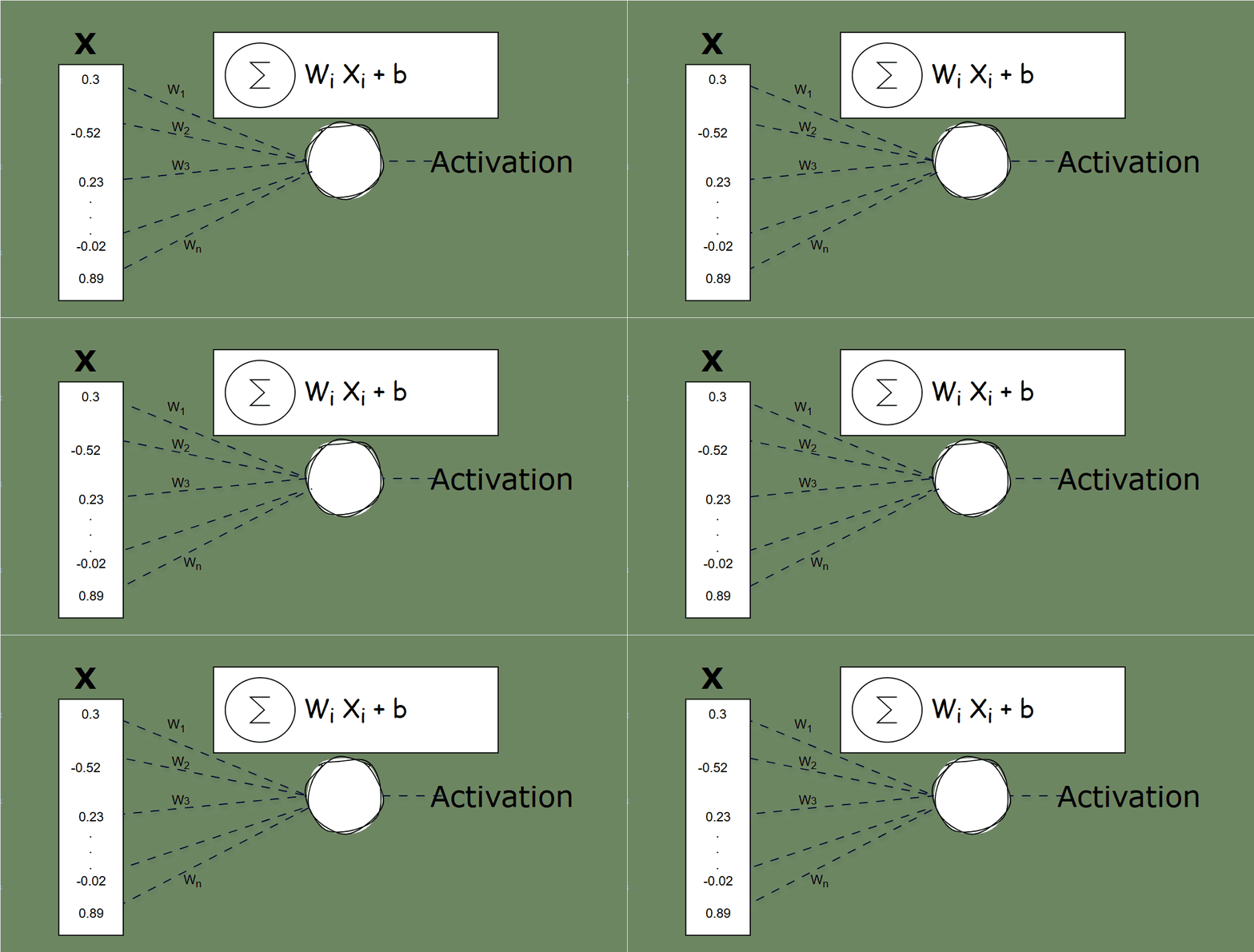
Our digital neuron does something fascinating with all these incoming messages. First, it plays a game of weighted voting; multiplying each input by its importance (weight) and adding them all up. Then, just to make things interesting, it adds its own personal bias to the mix. Think of this bias as the neuron’s default mood. In fact, some neurons are naturally more eager to fire up, while others need more convincing.
I know you are curious and want to know how these weights are selected. In fact, these parameters aren’t just random numbers. They’re more like carefully tuned knobs that the network learns to adjust through experience. The secret will be soon revealed! But let’s not get ahead of ourselves.
Activation Function

Let’s continue! Once the Sum is ready, the neuron then passes it through what we call an ‘activation function.’ If the brain analogy were a person, this would be like their threshold for taking action, should I jump out of bed now, or hit the snooze button? In technical terms, this function helps the neuron decide whether to fire strongly, weakly, or not at all. In other terms, it uses a threshold (ReLU, Tanh, Sigmoid…) to decide how loudly to “speak” to the next layer.

These activation functions serve a crucial purpose beyond just being mathematical functions. They’re what make neural networks capable of understanding our messy, nonlinear world. If you think logically about it, you will find that most things in life aren’t simple straight lines. The relationship between study time and test scores isn’t perfectly linear. The way we perceive brightness isn’t linear. Even the way we make decisions often involves thresholds and complex patterns.
Without these activation functions, our neural network would be like a chain of simple multiplication and addition that always produces straight-line relationships. But by introducing these nonlinear activation functions, we give our network the power to approximate any shape, any pattern, any relationship, no matter how complex and discontinued they are.
The magic behind layers
Arranging neurons in layers is one of the most brilliant ideas in deep learning. The first layer (input layer) receives raw information from the outside world. The middle layers are where the real processing happens, each layer learning to recognize increasingly complex patterns. Finally, the output layer makes the ultimate decision or prediction. In this process, each layer adds its own interpretation, building upon what the previous layers discovered, until we reach a sophisticated understanding of the input.
This layered approach brings several advantages to the deep neural network:
- It breaks down complex problems into manageable steps
- Each layer can specialize in a specific level of abstraction
- The network can learn hierarchical representations automatically
- It’s more efficient than trying to map inputs directly to outputs
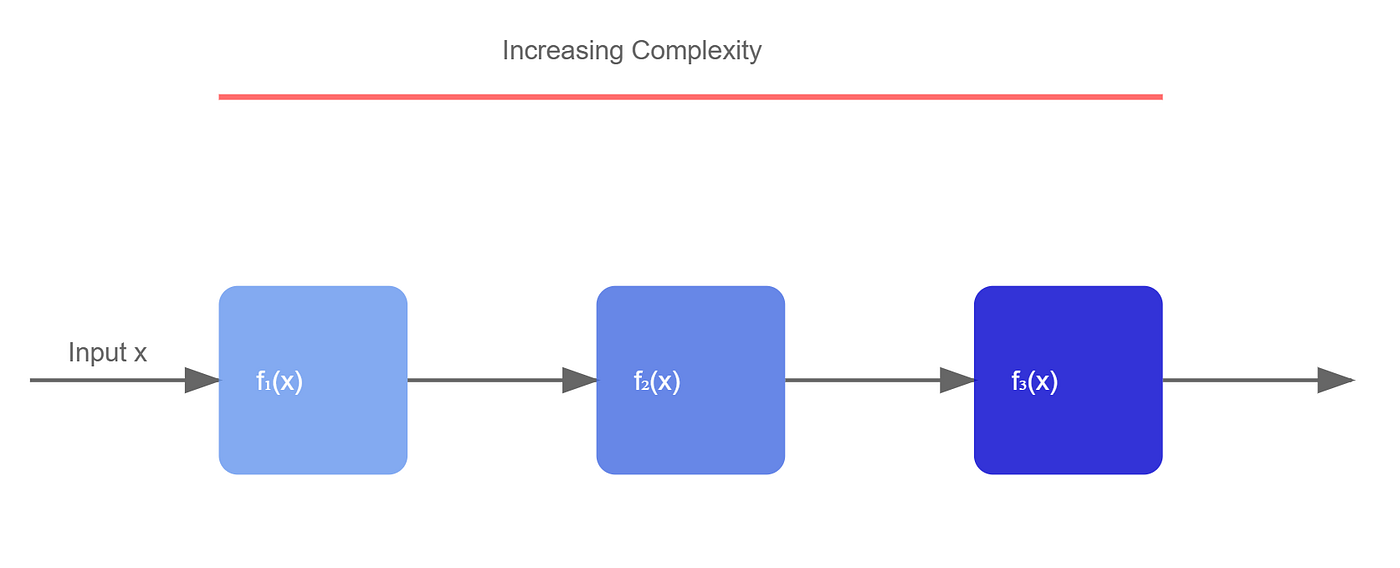
So when we zoom in to the heart of deep learning, we discover at their core, mathematical entities that can represent incredibly complicated patterns by cleverly combining simpler ones to create something far more sophisticated.
f(x) = fₙ(Wₙ ∘ fₙ₋₁(Wₙ₋₁ ∘ … f₁(W₁x)))Where:
- fᵢ represents simple nonlinear activation functions at the ith layer (Tanh, ReLu, Sigmoid..)
- each Wᵢ represents the weight matrix of that layer
- ∘ denotes function composition
The genius of deep learning lies in finding the right composition of these functions, like a maestro combining simple notes, vocals and instruments to create a harmonious and majestic symphony. But that doesn’t come at birth, it need a lot of learning, practice, test and enhancement to reach that level.
The reason why deep learning has been so revolutionary is the fact that using computer and mathematics, it discovers these intricate compositions automatically, learning to represent patterns that would be impossibly complex to program by hand. During training phase, the network automatically and autonomously discovers which combinations of these simple functions best capture the patterns in our complex world. You get it, we reach the part that I promised you before, how to tune all these parameters and create a deep neural network that makes magic.
Neural Network Characteristic
Neural Networks has 2 main characteristics:
- The neural Net architecture that we talked about earlier, which describes the number of layers, number of neurons in each layer and the set of connections-namely, feedforward, recurrent, multi or single-layered. No need to go deeper in this concept now, but the picture below gives few architecture types.

Neural Networks architectures
- The learning which is the training. The most common but not exclusive way to train is with gradient descent and backpropagation.
What is a learning Mechanic in a Neural Network
In each neuron, the equation w·X + b contains parameters that are carefully auto-calibrated. To refine these parameters, the training process leverages massive, diverse datasets that are tailored to the model’s architecture and task,. For instance:
- Visual tasks (e.g., image recognition) rely on pixel data from photos, videos, or medical scans like MRI/MRA (Magnetic Resonance Angiography).
- Linguistic tasks (e.g., language modeling) utilize textual data from books, articles, or social media.
- Multimodal models combine varied inputs (text, images, audio) for complex applications like autonomous systems.
The “auto-calibration” of weights and biases enables neurons to discern patterns and hierarchies in data, ultimately empowering the network to generalize and perform tasks such as classification, prediction, or generation with high accuracy.
To understand how training is done, think about organizing information flow in a family/friends network. You and your sister are like neurons in the hidden layer, collecting stories about an event from various friends (who may collect details from other friends). Each friend’s account carries different weight in your mind, just like neural network connections have weights. You process these stories, filtering and combining them (that’s your activation function at work!) before passing your interpretation to your mother.
In the picture, the information is an image for simplicity in the design😉.

The mother’s role is crucial, she has the ground truth (the actual video) and compares it with the received story. This comparison generates an error signal (in neural networks, we call this the loss function). When the story doesn’t match the video, it triggers a feedback loop (backpropagation) that flows backward through the network (You, your sister, and all the friends). This will let everyone be aware of the error and try to enhance how he describes scene in next time. In your brain, you will know more on whom to rely in each subject (example for football, Eric can describes better football match. For education and movies, Melissa and Ahmad are the best. For details about family events, Amélie and Aynoor are the one to ask…). This happens naturally in our mind. With different experiences and time we get to know our friends and their characteristics.
To summarize the Deep Neural Network training:
- Forward Pass (Story Collection):
- Friends provide information (input features)
- Near friends, You and your sister process this information (hidden layer neurons)
- A final story reaches your mother (network output)
2. Error Calculation (Loss Function):
- Mother compares the story with the video (computing the loss)
- The difference between reality and the story is measured (error metric)
- The goal is actually to minimize a loss function L(f(x), y) over all trainable parameters, where: — f(x) is the network’s prediction — y is the true target (our video)/label — L measures the difference between prediction and ground truth
3. Backward Pass (Backpropagation):
- If the story deviates (high loss), she initiates a feedback loop (backpropagation), tracing errors backward through the chain of participants (you, your sister, friends). This mimics how gradients propagate through network layers.
- You learn which friends are reliable (weight updates)
- Connection strengths are adjusted (gradient descent)
- Each participant adjusts their storytelling strategy for next time.
- Think of training as navigating a complex, mountainous landscape
- The goal is to find the lowest point (minimum loss)
- Gradient descent helps you “roll down” this landscape
- Each step adjusts network weights to reduce error
4. Learning Process (Optimization): Over time; based on the subject, you learn to:
- Trust reliable friends more (increase important weights)
- Discount unreliable sources (decrease irrelevant weights)
- Combine information effectively (optimize activation patterns)
This process repeats thousands of times until the network learns to map inputs to outputs accurately 🤖.
So, the next time you share a story with friends or delegate tasks based on someone’s expertise, remember that you’re not just socializing, you’re training a neural network in the wild. Life, like machine learning, thrives on iteration: every error is a step toward wisdom, every feedback loop sharpens collaboration, and every tiny adjustment (whether in weights or friendships) builds a smarter system.
Unlike algorithms, we get to laugh at our mistakes, celebrate quirks, and grow not just from data, but from shared humanity. Here’s to lifelong learning both in silicon and synapses. 🚀
After all, the best models aren’t just trained… they’re lived.
aisimplified #bestneuralnetworkcourse, #whatisdeepneuralnetwork, #deeplearningneuralnetworkcourses, #bestaicourses, #freedeeplearningtutorial
메타데이터
- post_id
- 129e25c8a44e
- slug
- differentiable-dreams-how-neural-networks-rewrite-the-rules-of-computation-129e25c8a44e
- url
- https://medium.com/@mariem.jabloun/differentiable-dreams-how-neural-networks-rewrite-the-rules-of-computation-129e25c8a44e
- canonical_url
- https://medium.com/@mariem.jabloun/differentiable-dreams-how-neural-networks-rewrite-the-rules-of-computation-129e25c8a44e
- author_url
- https://medium.com/@mariem.jabloun
- status
- ok
- fetched_at
- 2026-07-22 01:17:34




