Top 12 Traffic Shaping Techniques for Burst Resilience
Keep systems stable and responsive during sudden traffic spikes with proven traffic shaping methods.
Top 12 Traffic Shaping Techniques for Burst Resilience
Keep systems stable and responsive during sudden traffic spikes with proven traffic shaping methods.
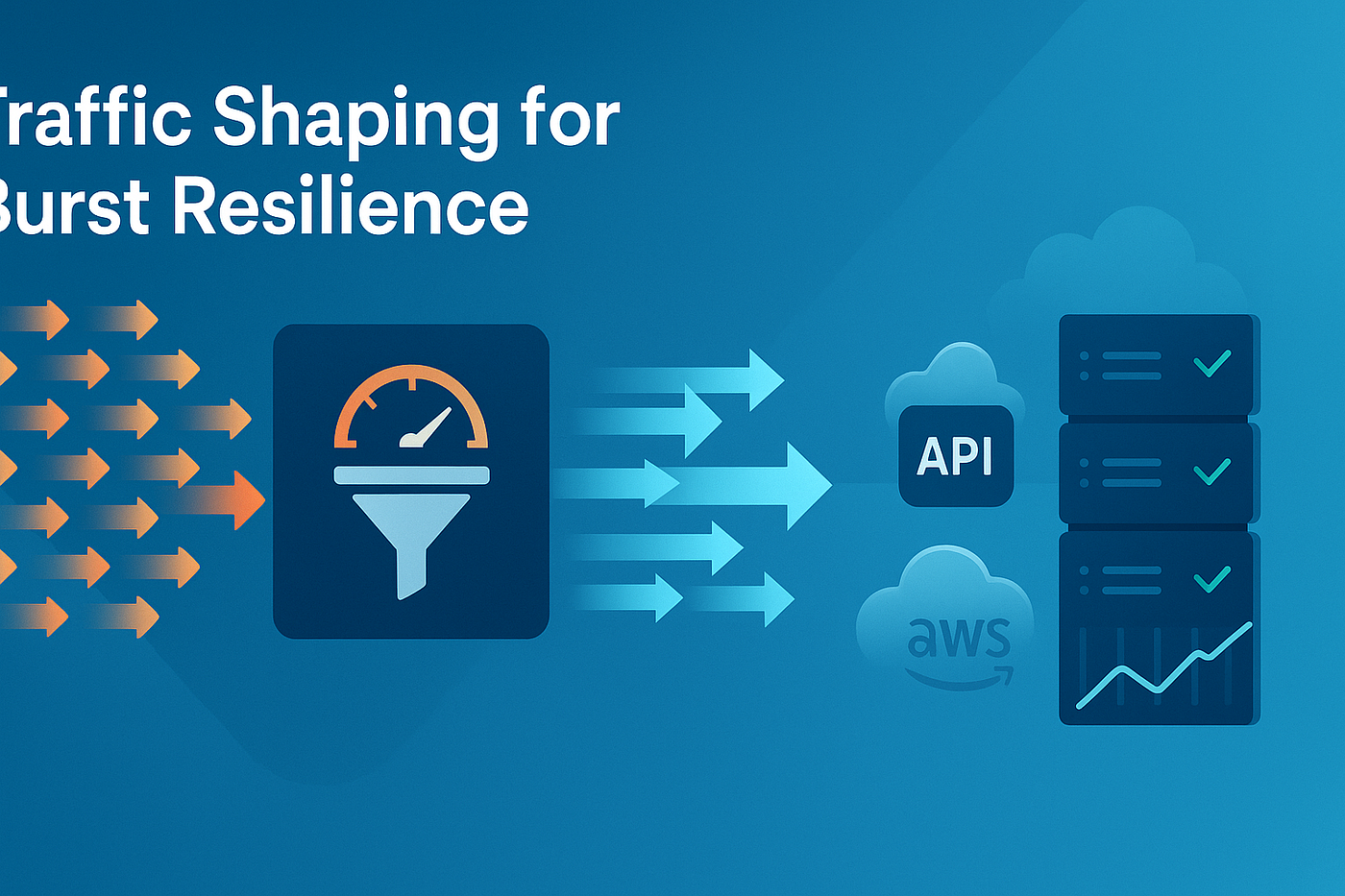
Learn 12 traffic shaping techniques to handle burst traffic without downtime, ensuring stability and performance under load.
When Bursts Break Your System
Traffic spikes are the stress tests you didn’t schedule. One minute, your system is humming along. The next, a flash sale, breaking news, or a viral social post sends requests surging by 10×.
If your backend isn’t prepared, latency climbs, errors spike, and customers leave. The fix? Traffic shaping — controlling how requests enter and flow through your system so bursts don’t overwhelm it.
In this guide, we’ll break down 12 traffic shaping techniques I’ve seen work in real-world production environments, from startups to massive cloud services.
What Is Traffic Shaping?
Traffic shaping is the practice of regulating, prioritizing, or delaying requests to maintain system stability. Think of it as crowd control for APIs — everyone gets in, but at a pace your infrastructure can handle.
It’s not just about surviving the spike. It’s about keeping core user experiences fast and reliable while shedding or delaying non-critical load.
Top 12 Traffic Shaping Techniques for Burst Resilience
1. Rate Limiting
Set a maximum number of requests per second per client, IP, or API key.
Why it works:
- Protects critical services from being flooded.
- Forces fair usage among clients.
Example: GitHub’s API enforces a 5,000-requests-per-hour limit per authenticated user.
2. Token Bucket Algorithm
Allows bursts up to a certain limit, then enforces a steady rate.
Why it’s better than fixed rate limiting:
- Handles small bursts without penalizing normal users.
- Prevents sustained overload.
Real-world: CDN providers often use token buckets for edge request handling.
3. Leaky Bucket Algorithm
Processes requests at a fixed rate, queuing overflow.
Analogy: Like water dripping from a bucket — steady outflow, even if input is erratic.
Best for: Smoothing out traffic patterns before hitting downstream services.
4. Priority Queues
Separate critical from non-critical requests and process accordingly.
Why it matters:
- Login or checkout gets priority over background analytics.
- Non-critical work is deferred under load.
Example: Payment systems prioritizing transaction processing over report generation.
5. Adaptive Concurrency Limits
Dynamically adjust allowed concurrent requests based on system health.
Implementation:
- Monitor CPU, memory, and latency.
- Drop or queue requests when nearing thresholds.
Real-world: Netflix’s Concurrency Limits library adapts request limits in real time.
6. Circuit Breakers
Temporarily block calls to failing or overloaded services.
Why it works:
- Stops cascading failures.
- Gives stressed services time to recover.
Example: Hystrix-style circuit breakers in microservices preventing a slow DB from stalling every request.
7. Request Batching
Combine multiple small requests into a single larger one.
Why it’s useful:
- Reduces request overhead during spikes.
- Improves throughput for downstream systems.
Example: GraphQL batching multiple query resolvers into one DB call.
8. Queue-Based Buffering
Push incoming requests into a durable queue for asynchronous processing.
Benefits:
- Absorbs spikes without overwhelming services.
- Provides retry logic for failures.
Tech: Kafka, RabbitMQ, AWS SQS.
9. Load Shedding
Drop low-value or excessive requests during extreme load.
Why it’s necessary:
- Protects the experience for high-value customers.
- Keeps system alive during overload.
Example: A news site drops image requests for anonymous users during breaking news events to preserve HTML page delivery.
10. Graceful Degradation
Provide a reduced feature set under high load.
Why it works:
- Users still get core functionality.
- Non-critical features disable automatically.
Example: E-commerce sites hiding recommendations and reviews during peak checkout traffic.
11. Geo-Distributed Throttling
Enforce rate limits at regional edges, not just centrally.
Why it’s smart:
- Prevents one region’s spike from starving others.
- Reduces long-haul traffic load.
Example: Global APIs enforcing limits in US, EU, and APAC independently.
12. Pre-Warming Capacity
Spin up extra instances or increase capacity ahead of predictable spikes.
Why it’s powerful:
- Handles expected bursts with zero latency impact.
- Often cheaper than emergency scaling.
Example: Retailers pre-warming search and checkout clusters before Black Friday.
Design Considerations for Burst Resilience
Measure Before You Shape
Traffic shaping without metrics is guesswork. Track:
- Requests per second
- Latency percentiles
- Error rates
- Queue lengths
User Experience First
Always weigh the shaping policy’s effect on end users. Rule of thumb: Protect the experience of 95% of users even under extreme load.
Combine Techniques
In practice, most systems use multiple techniques — e.g., rate limiting + queues + load shedding — to handle different failure modes.
Real-World Case Study: Black Friday Resilience
Background: A large e-commerce platform saw 15× traffic spikes during flash sales.
Solution:
- Implemented token bucket rate limiting at the API gateway.
- Used priority queues to protect checkout APIs.
- Pre-warmed clusters before scheduled sales.
Outcome: 0% downtime and ❤00 ms median checkout latency, even during peak bursts.
Conclusion: Plan for Spikes Before They Happen
Burst traffic isn’t a question of “if” — it’s “when.” By implementing these 12 traffic shaping techniques, you create a safety net that keeps your system stable, your customers happy, and your ops team calm.
Start small. Pick two or three techniques. Measure impact. Layer in more as your traffic patterns evolve.
💬 What’s your go-to traffic shaping method? Share your story in the comments — I’d love to hear your burst survival tactics.
메타데이터
- post_id
- 12bec3ac8a52
- slug
- top-12-traffic-shaping-techniques-for-burst-resilience-12bec3ac8a52
- url
- https://medium.com/@ThinkingLoop/top-12-traffic-shaping-techniques-for-burst-resilience-12bec3ac8a52
- canonical_url
- https://medium.com/@ThinkingLoop/top-12-traffic-shaping-techniques-for-burst-resilience-12bec3ac8a52
- author_url
- https://medium.com/@ThinkingLoop
- status
- ok
- fetched_at
- 2026-08-09 23:34:40