The Widow of the White Mare
Murder, Mining Fraud, and Unexpected Love in the Pampas
The Widow of the White Mare
Murder, Mining Fraud, and Unexpected Love in the Pampas
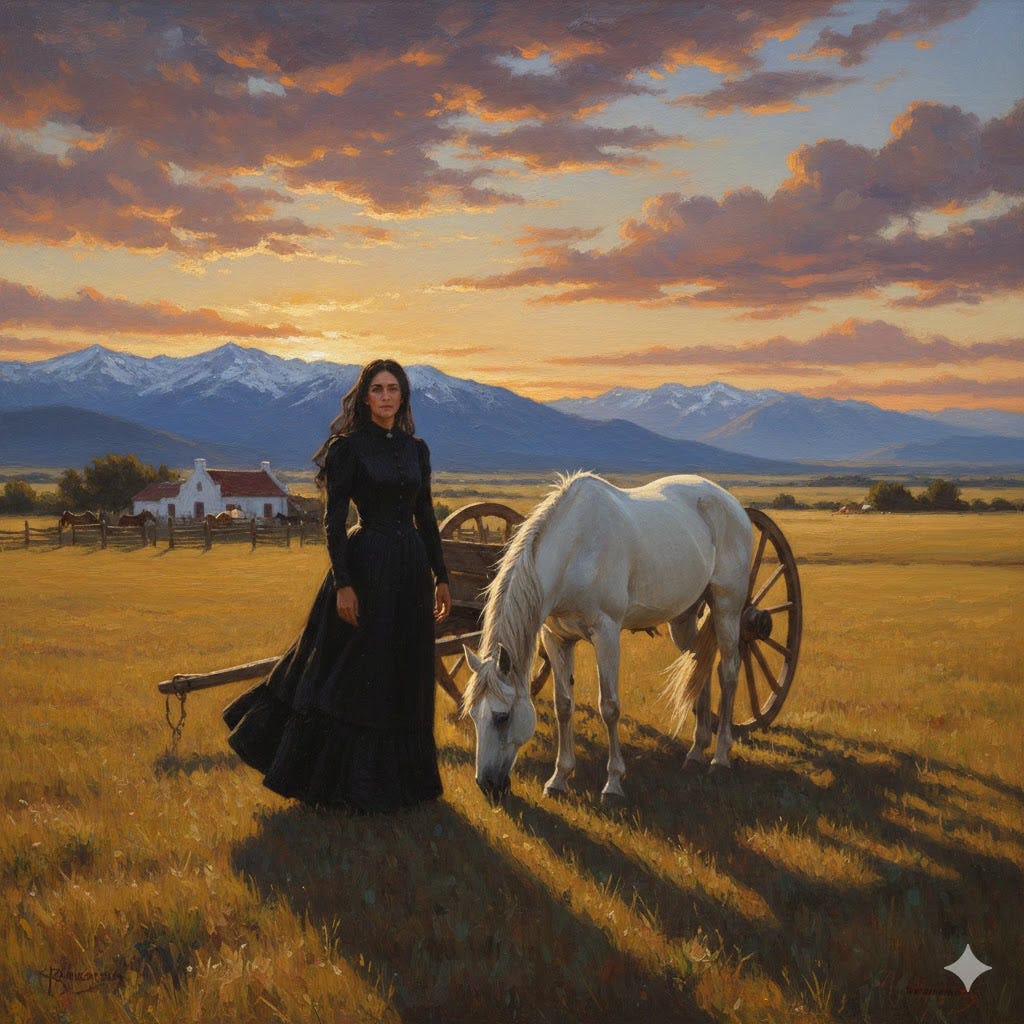
AI Image created by author | jandrewnelson2@gmail.com
The rains had ended four days ago, but the yard of Estancia O’Shannon was still a swamp of thick, clay-heavy barro that clung to boots like a grudge.
Mateo O’Shannon stood beneath the wide gallery of his ranch house, a tin cup of bitter maté warming his hands. He blinked once. Then again.
The cart was gone.
Not vanished — moved.
For nearly a week it had sat sunk to its axles in mud near the corrals. Now it rested twenty paces closer to the barn, square and steady on firm ground. Fresh gravel had been laid beneath the wheels. The ruts were filled cleanly, methodically.
Mateo stared at it.
He heard the wet thud of hooves and turned. His foreman, Tomás, rode in from the southern pasture, horse and rider both streaked in dried mud.
Mateo waited until Tomás dismounted.
“Who pulled the cart out?” he asked.
Tomás removed his hat slowly.
“That,” he said, pointing toward the cart, “was some woman.”
The Woman in Black
She had come riding across the Pampas from the east, not along the road but straight across open grassland. Side-saddle on a tall white mare. Dressed in black from collar to hem, veil and all, like a widow still deep in mourning.
She hadn’t asked for water.
Hadn’t asked for shelter.
She’d simply sat her horse and studied the cart as if it personally offended her.
Then she’d dismounted.
From her saddle she’d untied a small shovel and two sacks of crushed stone. Without a word she began filling the ruts beneath the back wheels.
She told Tomás to harness the two Percherons — “the darker pair,” she’d specified without hesitation.
She took the reins.
Spoke low to the horses.
And the cart came free as if it had been waiting for her permission.
Mateo rode into the nearby mining town of San Aurelio the next day.
He learned her name at the almacén.
Señora Isabel Herrera.
Widow of Engineer Alejandro Herrera, formerly of Mendoza. Alejandro had invested heavily in a silver mine in the Andes foothills — La Estrella del Sur.
He had died three months earlier.
“Fever,” the townspeople said.
Mateo didn’t believe it.
Isabel
She was younger than he’d expected. Early thirties. Dark hair pinned beneath her black bonnet. Eyes pale as winter sky over Patagonia.
When Mateo thanked her for freeing his cart, she dismissed it lightly.
“It was a problem,” she said. “I do not like problems left unattended.”
She was reviewing mine ledgers in town. Asking questions the foreman did not enjoy answering. Comparing assay reports with shipping manifests.
Within days, accidents began.
Her horse was spooked by a rifle crack from a ridge.
A tunnel beam collapsed where she had been standing moments earlier.
The boardinghouse where she stayed burned in the night.
She survived each attempt.
And each time, she grew colder.
The Truth in the Andes
Alejandro’s final letter arrived through a former clerk from Mendoza.
In it, he detailed falsified production reports. Stolen ore diverted through Buenos Aires brokers. Threats made by the mine’s silent partner — Don Ricardo Valdez, a powerful industrialist with influence in Córdoba and the provincial courts.
Alejandro had written:
If anything happens to me, Isabel will not stop until she uncovers it.
He was right.
Isabel gathered testimony from dismissed miners. An assayer willing to admit samples had been switched. Shipping agents who had looked the other way.
When a rifle shot splintered bark beside her head one afternoon near the estancia creek, Mateo made his decision.
“I owe you a favor,” he told her. “And I do not leave debts unpaid.”
She did not ask for his help.
But she did not refuse it.
Córdoba
The case moved to Córdoba under provincial authority. Valdez received them in a polished office overlooking the city.
He smiled with cultured disdain.
“The Pampas are dangerous for a widow alone,” he said.
“I am not alone,” Isabel replied.
The evidence was undeniable. Ledgers. Letters. Testimony. Valdez had orchestrated the theft, threatened Alejandro, and arranged the “fever” that followed.
Though direct proof of murder was elusive, fraud and conspiracy were not.
Valdez was sentenced to fifteen years in a federal prison near Ushuaia.
The mine was dissolved. Profits redistributed.
Justice, though imperfect, had been done.
After the Fire
When it was over, Isabel packed her things.
“There is nothing left for me here,” she said.
Mateo stood in the hotel doorway. “There is,” he replied quietly. “If you wish it.”
She hesitated.
She had come to Argentina’s interior as a widow hunting vengeance.
But somewhere between the mud, the fire, and the courtroom, she had become something else.
Alive again.
The Estancia
She returned to Estancia O’Shannon not in mourning black but in a deep blue riding skirt that brought warmth to her eyes.
Tomás still claimed she frightened him.
She claimed she was simply practical.
One evening, as the sun sank red over the Pampas, she stood beside the old cart in the yard.
“Why haven’t you moved it?” she asked.
Mateo shrugged. “It’s on solid ground now.”
She studied it thoughtfully.
“Still,” she said, lifting the small shovel she’d brought months earlier, “perhaps it could be placed better.”
Mateo smiled.
“Then we’ll move it together.”
And under the wide Argentine sky, beside grazing cattle and wind bending the tall grass, they shifted the cart inch by inch — not because it needed moving, but because some work is better shared.
High on the rise beyond the estancia, her white mare grazed calmly.
Waiting.
For a rider who no longer rode alone.
Jerry Nelson writes character-driven historical fiction set against vast, untamed landscapes where resilience is forged in hardship and justice is carved from stone. With a deep appreciation for frontier cultures — from the American West to the Argentine Pampas — Jerry explores themes of grief, courage, independence, and quiet, hard-earned love.
Drawn to strong, complex heroines and morally grounded heroes, he blends romance, suspense, and historical realism into stories where survival is never guaranteed — but redemption is always possible.
메타데이터
- post_id
- 12c8562d3409
- slug
- the-widow-of-the-white-mare-12c8562d3409
- url
- https://medium.com/readers-club/the-widow-of-the-white-mare-12c8562d3409
- canonical_url
- https://medium.com/readers-club/the-widow-of-the-white-mare-12c8562d3409
- author_url
- https://medium.com/@jandrewnelson2
- status
- ok
- fetched_at
- 2026-06-27 18:20:27