Understanding ACID: The Foundation of Reliable Database Systems
Why your bank account balance doesn’t magically disappear (and how databases ensure data integrity)
Understanding ACID: The Foundation of Reliable Database Systems
Why your bank account balance doesn’t magically disappear (and how databases ensure data integrity)
Have you ever wondered why your online banking works so reliably? When you transfer money from one account to another, how does the system ensure that money doesn’t just vanish into thin air? The answer lies in something very basic called ACID properties — four fundamental principles that make database systems trustworthy and reliable.
Whether you’re a developer working with databases or just curious about how the digital world keeps our data safe, understanding ACID properties will give you insight into one of the most important concepts in computer science.
What Exactly Is a Database Transaction?
Before diving into ACID, let’s understand what a transaction actually is. Think of a transaction as a group of related database operations that must all succeed together, or all fail together. It’s like a recipe — you need all the ingredients and steps to work properly, or you don’t get the desired result.
Consider this real-world scenario: You’re transferring $100 from your checking account to your savings account. This seemingly simple action actually involves multiple database operations:
- SELECT — Check if your checking account has sufficient funds
- UPDATE — Subtract $100 from your checking account
- UPDATE — Add $100 to your savings account
All three operations must succeed for the transaction to be complete. If any one of them fails, the entire transaction should be rolled back to prevent inconsistencies.
The Transaction Lifecycle
Every transaction goes through a predictable lifecycle:
- BEGIN — The transaction starts
- COMMIT — All operations succeeded, make changes permanent
- ROLLBACK — Something went wrong, undo all changes
- Unexpected ending — System crash or error automatically triggers rollback
Transactions aren’t just for changing data either. You might have read-only transactions when generating reports where you want a consistent snapshot of data at a specific point in time.
The A in ACID: Atomicity
Atomicity means that a transaction is “all or nothing.” Every query in a transaction must succeed, or the entire transaction fails and gets rolled back. There’s no middle ground.
Let’s go back to our money transfer example. Imagine this nightmare scenario:
BEGIN TRANSACTION
UPDATE accounts SET balance = balance - 100 WHERE account_id = 1;  -- ✅ Success
-- System crashes here! --
UPDATE accounts SET balance = balance + 100 WHERE account_id = 2;  -- ❌ Never executed
Without atomicity, you’d lose $100 because the first account was debited but the second account was never credited. With atomicity, when the system restarts, it recognizes that the transaction never completed and automatically rolls back the first operation. Your money is safe.
This is why atomicity is crucial for financial systems, e-commerce platforms, and any application where data consistency matters.
The I in ACID: Isolation
Isolation deals with what happens when multiple transactions run simultaneously. The key question is: Can my current transaction see changes made by other ongoing transactions?
This is where things get interesting (and complex). There are several “read phenomena” that can occur:
The Four Read Phenomena
Let me illustrate these with a concrete example using a SALES table:
1. Dirty Reads
SALES Table: Product 1 ($50), Product 2 ($80)Transaction 1 (T1): Transaction 2 (T2):
BEGIN BEGIN
SELECT SUM(price) UPDATE Product 1 SET price = 25
FROM SALES -- T2 crashes and rolls back
-- Reads $105 total ROLLBACK
COMMITTransaction 1 reads a “dirty” value ($25) that was never actually committed. The correct total should be $130, but T1 got $105 because it saw uncommitted changes.
2. Non-Repeatable Reads
SALES Table: Product 1 ($50), Product 2 ($80)Transaction 1 (T1): Transaction 2 (T2):
BEGIN BEGIN
SELECT SUM(price) UPDATE Product 1 SET price = 25
FROM SALES COMMIT
-- Reads $130 total
SELECT SUM(price)
FROM SALES
-- Now reads $105 total
COMMITTransaction 1 reads the same data twice but gets different results ($130, then $105) because T2 modified the data in between. This creates inconsistent results within the same transaction.
3. Phantom Reads
SALES Table: Product 1 ($50), Product 2 ($80)Transaction 1 (T1): Transaction 2 (T2):
BEGIN BEGIN
SELECT SUM(price) INSERT INTO SALES
FROM SALES VALUES ('Product 3', 10)
-- Reads $130 total COMMIT
SELECT SUM(price)
FROM SALES
-- Now reads $140 total
COMMITTransaction 1 sees a new “phantom” row that appeared in the result set. Even though it read committed data, the range of data changed, giving inconsistent results.
4. Lost Updates
SALES Table: Product 1 ($50), Product 2 ($80)Transaction 1 (T1): Transaction 2 (T2):
BEGIN BEGIN
SELECT price FROM SALES SELECT price FROM SALES
WHERE product = 'Product 1' WHERE product = 'Product 1'
-- Reads $50 -- Reads $50
UPDATE SALES SET UPDATE SALES SET
price = 50 + 100 price = 50 + 80
WHERE product = 'Product 1' WHERE product = 'Product 1'
COMMIT COMMITBoth transactions read $50, then T1 tries to set it to $150 and T2 tries to set it to $130. The final result should be $230 (both updates applied), but one update overwrites the other, resulting in data loss.
Isolation Levels: Your Defense Against Read Phenomena
Database systems offer different isolation levels to handle these issues:
- Read Uncommitted — No isolation; you can see uncommitted changes (dangerous!)
- Read Committed — You only see committed changes
- Repeatable Read — Once you read a row, it won’t change during your transaction
- Snapshot — You see a consistent snapshot of data from when your transaction started
- Serializable — Transactions run as if they were executed one after another
Each level offers different trade-offs between performance and consistency. Higher isolation levels are safer but slower.
Which Problems Does Each Isolation Level Solve?
Here’s a helpful table showing which read phenomena can occur at each isolation level:
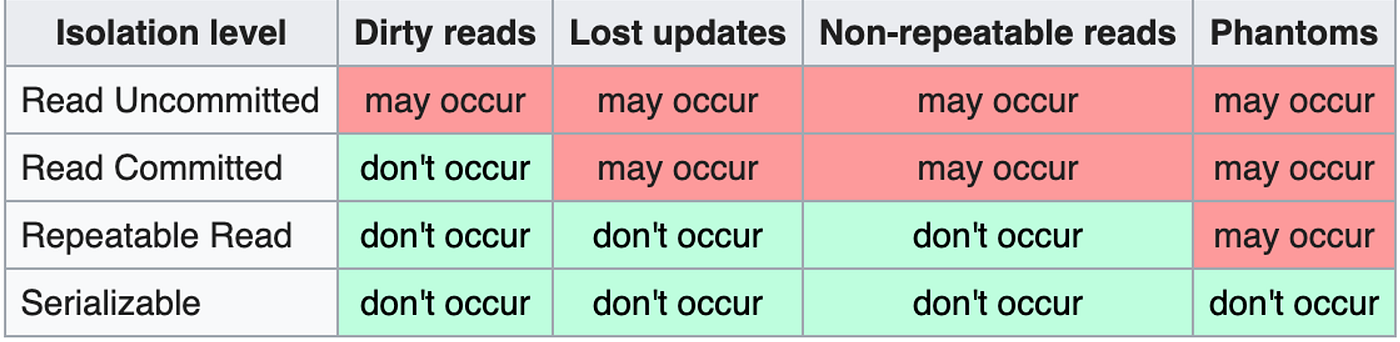
Note: Each database management system (DBMS) implements these isolation levels differently, so behavior may vary between PostgreSQL, MySQL, Oracle, etc.
Implementation: Pessimistic vs. Optimistic
Database systems implement isolation in two main ways:
Pessimistic approach: Use locks (row-level, table-level, page-level) to prevent conflicts. If I’m updating a row, I lock it so no one else can change it until I’m done.
Optimistic approach: Don’t use locks. Instead, track if data has changed and fail the transaction if conflicts are detected.
The choice depends on your use case. High-conflict scenarios might benefit from pessimistic locking, while low-conflict scenarios can use optimistic approaches for better performance.
Database-Specific Implementation Details
Here are some important implementation nuances:
Repeatable Read: Traditionally “locks” the rows it reads, but this can be expensive if you read many rows. PostgreSQL implements Repeatable Read as a snapshot isolation instead, which is why you don’t get phantom reads with PostgreSQL in Repeatable Read mode — it’s actually providing stronger guarantees than the standard requires.
Serializable: Usually implemented with optimistic concurrency control (no locks, detect conflicts at commit time). However, you can implement it pessimistically using SELECT FOR UPDATE to explicitly lock rows before reading them.
Lock Management: Row-level locks are expensive to maintain in memory. If you need to lock 700,000 rows, the database might escalate to a table lock instead, which can cause all other transactions to wait — a common performance problem in high-concurrency systems.
The C in ACID: Consistency
Consistency has two important aspects:
Data Consistency
This is about maintaining the rules and constraints you’ve defined for your data. Think referential integrity — if you have a foreign key relationship, the database ensures that relationship remains valid.
For example, if you have a photos table and a photo_likes table, consistency ensures that every like references a photo that actually exists. If someone tries to like a photo that doesn’t exist, the database will reject the operation.
Read Consistency
This is about whether changes made by one transaction are immediately visible to other transactions. This affects the system as a whole and relates to the famous “CAP theorem” in distributed systems.
In some systems, after you commit a change, other transactions might not immediately see that change due to replication delays or caching. This is called “eventual consistency.”
The D in ACID: Durability
Durability ensures that once a transaction is committed, the changes are permanent and will survive system crashes, power failures, or other disasters.
But here’s the thing — writing every change directly to disk would be incredibly slow. Databases use clever techniques to ensure durability while maintaining performance:
Write-Ahead Logging (WAL)
Instead of immediately writing all changes to the main data files, databases write a compressed version of the changes to a log file first. This log can be used to reconstruct the database state if something goes wrong.
### Durability Techniques

Database systems use several techniques to ensure durability while maintaining performance:

**Write-Ahead Logging (WAL)**
Think of WAL as a "delta log" of changes. When you look at database tables with all their indexes, B-trees, and complex data structures, you realize they're huge. Writing all that data to disk on every commit would be incredibly slow.

Instead, databases write only the changes (deltas) to a write-ahead log first. This log is much smaller and faster to write than updating the entire data structure. The process works like this:

1. Transaction makes changes
2. Changes are immediately written to WAL and flushed to disk
3. Transaction commits (durability guaranteed!)
4. Later, the actual data tables and indexes are updated asynchronously

If the system crashes, the database can read the WAL entries and rebuild the complete state from this persisted log. This gives you both speed and durability—you don't have to wait for the slow main data structures to be updated.

**Asynchronous Snapshots**
Another approach is to keep everything in memory during operation, but periodically snapshot the entire database state to disk in the background. This can be done asynchronously (non-blocking) or synchronously (blocking until complete).

Redis uses this approach effectively—it's lightning fast because everything stays in memory, but it regularly snapshots to disk to ensure durability.

**Append-Only File (AOF)**
Similar to WAL, append-only files keep track of every change that happens and writes these sequentially to disk. Redis also uses this technique alongside snapshots.

The beauty of AOF is that it's a lightweight way to store data changes very quickly. In case of a crash, you can read the entire file and reconstruct the complete state of your database without needing to store complex data structures like indexes, blobs, or foreign key relationships directly.
The OS Cache Challenge
When you write data, it often goes to the operating system’s cache first, not directly to disk. A system crash could cause data loss if the cache hasn’t been flushed to disk. The fsync command forces writes to go directly to disk, but it's expensive and slows down commits.
Database systems carefully balance durability guarantees with performance by configuring when and how often to sync to disk.
Why ACID Matters in the Real World
Understanding ACID properties helps you make better decisions about:
- Database selection: Different databases implement ACID differently
- Performance optimization: Higher isolation levels are safer but slower
- Error handling: Understanding transaction boundaries helps you write more robust applications
- System design: Knowing ACID limitations helps you design better distributed systems
Common Misconceptions
“I don’t need to worry about isolation levels” Most of the time, this is true. But when you have many users reading and writing simultaneously, understanding isolation becomes crucial. I’ve seen systems where transactions locked entire tables (lock escalation), causing all other transactions to wait.
“ACID is only for relational databases” While ACID originated with relational databases, many NoSQL databases now offer ACID properties or similar guarantees.
“Higher isolation levels are always better” Not necessarily. Higher isolation levels can hurt performance and increase the likelihood of deadlocks. Choose based on your specific requirements.
Practical Takeaways
- Design transactions carefully: Keep them short and focused
- Choose appropriate isolation levels: Don’t default to the highest level
- Handle transaction failures gracefully: Always have rollback strategies
- Monitor for lock contention: Watch for situations where transactions are waiting too long
- Test under load: ACID properties become more important as concurrency increases
Conclusion
ACID properties are the foundation of reliable database systems. They ensure that your data remains consistent, your transactions are reliable, and your applications can handle the complexities of concurrent access.
While you might not encounter these edge cases in simple applications, understanding ACID principles will make you a better developer and help you build more robust systems. The next time you see a seamless money transfer or a perfectly synchronized e-commerce transaction, you’ll know the elegant principles working behind the scenes to make it all possible.
Remember: in the world of databases, it’s not just about storing data — it’s about storing it reliably, consistently, and safely. That’s what ACID is all about.
Have you encountered interesting ACID-related challenges in your projects? Share your experiences in the comments below!
메타데이터
- post_id
- 12d09a13cb01
- slug
- understanding-acid-the-foundation-of-reliable-database-systems-12d09a13cb01
- url
- https://medium.com/@basitahmad4/understanding-acid-the-foundation-of-reliable-database-systems-12d09a13cb01
- canonical_url
- https://medium.com/@basitahmad4/understanding-acid-the-foundation-of-reliable-database-systems-12d09a13cb01
- author_url
- https://medium.com/@basitahmad4
- status
- ok
- fetched_at
- 2026-07-30 14:57:08