Model Inversion Attacks: How AI Models Can Leak Your Private Data
We talk a lot about AI models getting smarter. We don’t talk enough about what they’re quietly memorizing.
Model Inversion Attacks: How AI Models Can Leak Your Private Data
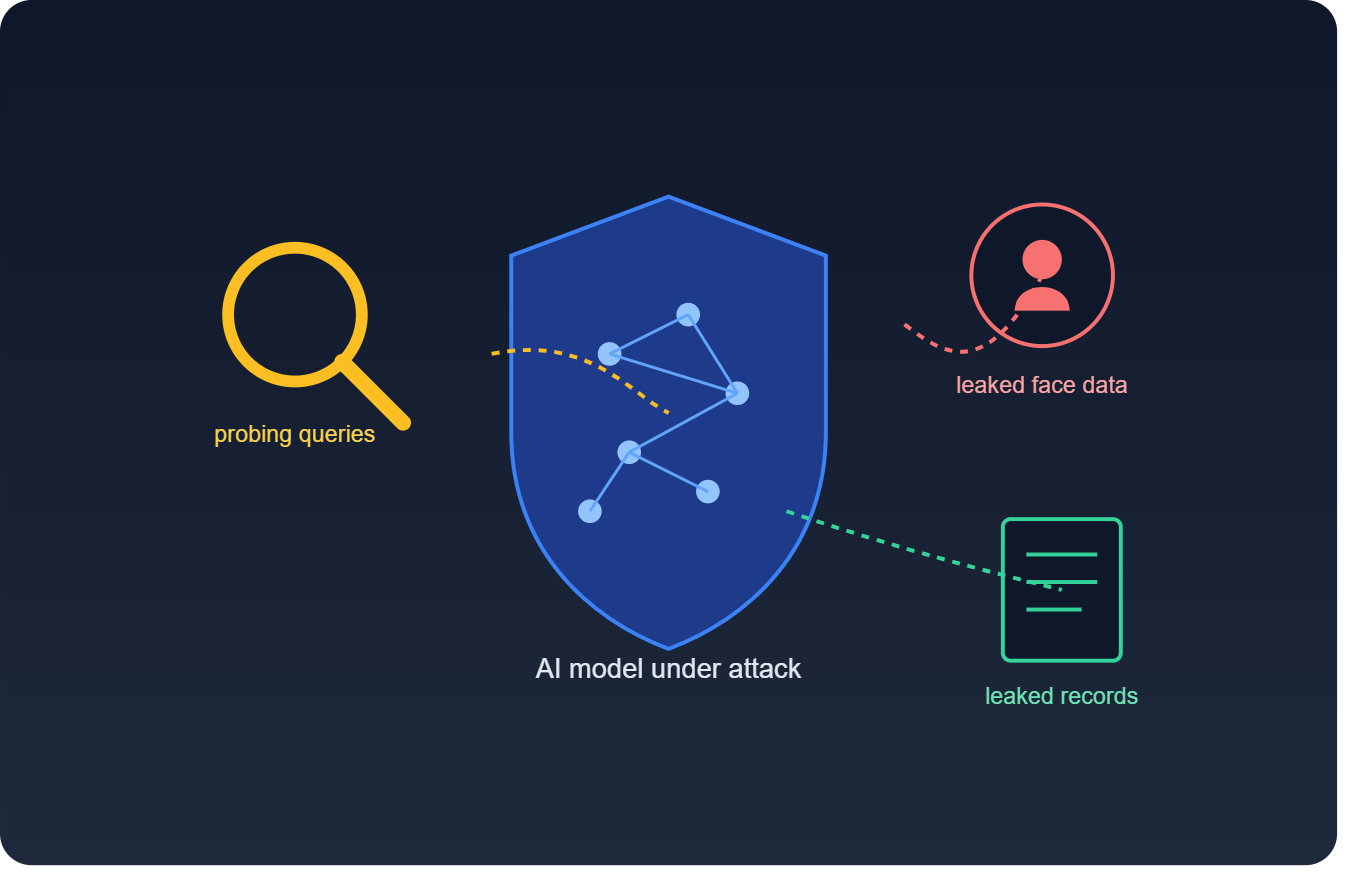
AI Model under Attack
We talk a lot about AI models getting smarter. We don’t talk enough about what they’re quietly memorizing.
Model inversion attacks are one of those AI security threats that sound abstract until you realize what they actually mean: someone can study how your AI model responds, and use that to reconstruct private data the model was trained on. No data breach. No hacked server. Just clever, repeated questioning of a model that was never designed to keep secrets in the first place.
If your company is building or deploying machine learning models — especially ones trained on customer data, medical records, financial information, or facial recognition — this is worth understanding.
What is a model inversion attack?
In simple terms, a model inversion attack is a technique where an attacker uses a trained AI model’s outputs to reverse-engineer details about the data it was trained on.
Machine learning models learn patterns from training data. Ideally, they generalize those patterns without “remembering” specific individuals. In practice, models — especially deep learning and generative AI models — can retain traces of the original data. Attackers exploit this by repeatedly querying the model and analyzing its responses, gradually reconstructing sensitive inputs like a face, a medical condition, or personal identifiers.
This is different from a traditional data breach. Nothing is stolen from a database. The leak happens through the model’s own behavior.
Why this matters more in the AI era
A few years ago, this was mostly an academic concern. Today it’s a real privacy and compliance risk because:
AI models are everywhere — chatbots, recommendation engines, facial recognition systems, healthcare diagnostics, and fraud detection tools are all trained on real, often sensitive, user data.
Models are exposed through APIs. If your AI model is accessible via an API (even with rate limits), it can be queried thousands of times by an attacker scripting automated requests.
Generative AI increases the risk. Large language models and image generators have been shown in research settings to reproduce fragments of their training data when prompted in specific ways.
Regulations are catching up. GDPR, India’s DPDP Act, and similar privacy laws don’t just care about traditional data breaches — they care about any unauthorized exposure of personal data, including data leaked through a model’s behavior.
A simple way to think about it
Imagine a security guard who’s been shown 10,000 employee badge photos and trained to say “access granted” or “access denied.” Now imagine someone outside the building, who’s never seen those photos, asking the guard carefully worded questions until they can sketch a rough picture of what one specific employee looks like — just from the guard’s yes/no answers.
That’s essentially what a model inversion attack does, except the “guard” is your AI model, and the “questions” are API calls.
How companies can reduce the risk
There’s no single fix, but a layered approach helps significantly:
Differential privacy: Adding mathematical noise during training so the model learns patterns without memorizing specific individuals.
Rate limiting and query monitoring: Detecting unusual patterns of repeated, targeted queries that resemble probing behavior.
Output restriction: Limiting how much detail a model’s API exposes, especially confidence scores and raw probability outputs, which attackers often exploit.
Access control and authentication: Treating model APIs with the same security rigor as databases, not as public utilities.
Regular security audits: Testing your own models with inversion attack simulations before someone else does.
Data minimization: Training models on the least sensitive data necessary, reducing what could potentially be reconstructed.
The bigger picture
As more businesses move from “using AI” to “building and deploying AI,” AI security needs to be treated as seriously as application security or network security. Model inversion attacks are a reminder that privacy risk doesn’t end once data is anonymized or “just” used for training — it follows the model wherever it goes.
If your business is building AI-powered products, securing the model itself is just as important as securing the data behind it.
At Alphabit Infoway, our cybersecurity and compliance team helps businesses identify and close AI-specific security gaps like this — before they become a headline.
Learn More: https://alphabitinfoway.com/blogdetails?slug=model-inversion-attacks-how-ai-models-leak-your-private-data Contact Us: E-mail: info@alphabitinfoway.com Ph. No. : +91 97230 28141
메타데이터
- post_id
- 12ef9d021fd1
- slug
- model-inversion-attacks-how-ai-models-can-leak-your-private-data-12ef9d021fd1
- url
- https://medium.com/@alphabitinfoway/model-inversion-attacks-how-ai-models-can-leak-your-private-data-12ef9d021fd1
- canonical_url
- https://medium.com/@alphabitinfoway/model-inversion-attacks-how-ai-models-can-leak-your-private-data-12ef9d021fd1
- author_url
- https://medium.com/@alphabitinfoway
- status
- ok
- fetched_at
- 2026-07-10 13:32:34