Why Ramanujan’s Radical Equation Is So Elegant
Turning Radical Equations into Logic
Why Ramanujan’s Radical Equation Is So Elegant
Turning Radical Equations into Logic
Read it here if you’re not a Medium member. If this helped you see mathematics differently, support my writing ☕ here
When students encounter a square root within an equation, they always seem to anticipate a long, drawn out process involving algebra. The normal approach follows the steps of isolating the square root, squaring both sides, simplifying, repeating, and hoping not to create any extraneous solutions in the process.
But what if all that wasn’t even necessary ?
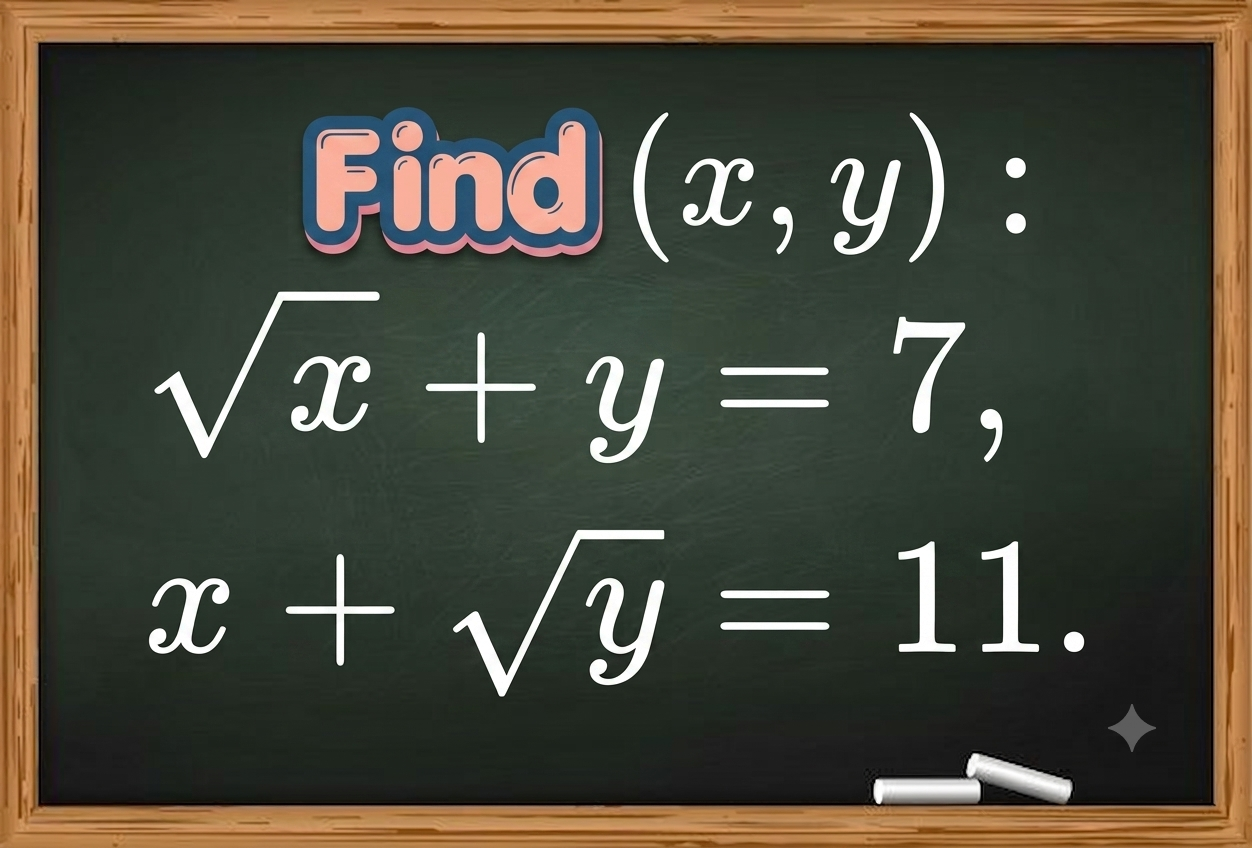
Consider the system


First impressions might lead you to believe that this is a normal algebraic question. In truth, it is not. The only purpose for the square roots is to confuse. This question is really about combinations.
Once this is understood, the answer is quite short.
The crucial piece of information is not actually the square roots. The vital information is the phrase positive integers.
This single piece of information will change the entire question.
Cracking the Problem ➡️

Look carefully at the first equation


Why ?

which is irrational. Adding an integer to an irrational number never produces an integer. The irrational part cannot simply disappear.


Exactly the same reasoning applies to the second equation.


Notice what just happened.

Now they can only be perfect squares.
The search space has already shrunk dramatically before we’ve performed a single calculation.
But we can reduce it even further.


Now ask a much simpler question :
Which perfect squares are less than 7 ?

That’s all the search space.
Rather than infinitely many possibilities, there are only two to choose from now.
It’s right here that the problem subtly shifts from being algebraic to arithmetic.
All we need to do is try out the options.


It wasn’t really the solution that was surprising but the approach.
No equation was ever squared, there were no quadratic equations, nor were there any messy expansions and extra solutions. The problem was approached by asking another, more fundamental question:
Which numbers are even possible here ?

This particular example can be expanded to many other problems involving radicals and integers. Whenever there is something like this in the problem statement, one should first ask :
◈ Should the radical be an integer ? ◈ Does it mean the perfect square (or cube) ? ◈ Are the equations giving enough constraints ? ◈ How many options have we got left ?
Most often the restrictions will provide most of the solution before even starting on the algebra.
The general rule is very simple treat restrictions like “ positive integers ” as a hint, rather than just a condition.

I completed my 100 Days of Mathematics Challenge!
Thank you to everyone who supported and encouraged me throughout this journey.
📖 DAY 10 article ➜
Thank you for reading! 😊
If you enjoyed this puzzle, please consider following me for more mathematics content, subscribing to stay updated with my latest articles, and leaving a few claps it really helps! 👏
Have a question, a different solution, or an interesting insight ? 💬 Share it in the comments below. I’d love to hear from you! 🤗

메타데이터
- post_id
- 12fbff28a229
- slug
- why-radical-equations-become-counting-problems-12fbff28a229
- url
- https://medium.com/think-art/why-radical-equations-become-counting-problems-12fbff28a229
- canonical_url
- https://medium.com/think-art/why-radical-equations-become-counting-problems-12fbff28a229
- author_url
- https://medium.com/@thanushansiva100
- status
- ok
- fetched_at
- 2026-07-08 17:17:42