“Men are Thieves!”
A day in Science Education through an Unlearning Lens
“Men are Thieves!”
A day in Science Education through an Unlearning Lens
“Men are thieves!” exclaimed an angry 12-year-old girl, unable to contain herself. The energy of the whole classroom space was intense. Several pairs of young eyes were looking at me and each other in shock and disbelief. A sense of fiery retaliation filled the collective energy of the learning space.
Some part of my stomach felt uneasy, my chest tightened and my breath struggled to flow easily. “Let’s not make such sweeping generalized statements please. What have I told you about stereotyping?” These and a few other responses popped into my head.
I took a deep breath and turned towards the young girl and met her eyes, which were full of angst and ferocity. I took another deep breath and felt my body relax.
“This isn’t about you. Don’t make this about yourself” I reminded myself.
I nodded at the kid and continued on with my science session. I realized that the whole context we were exploring WAS in fact, a blatant injustice because of gender-based bias and stereotyping.
I had just introduced The Matilda Effect.
The Matilda Effect, for those who are unfamiliar with it, is a systemic bias through history, and across the globe, that under-recognizes or outright denies achievements by women, primarily in the science and STEM fields (Science, Technology, Engineering and Mathematics) and instead attributes them to male figures. Most of their work has been blatantly stolen from women by men, and even sadder still, history shows that this effect is not restricted to just this field.
What does the cure for leprosy, the discovery of pulsars, the knowledge of splitting atoms for nuclear fission and the discovery of dark matter in the universe all share in common? The names of the women who made all these happen are virtually erased from history. And the rabbit hole goes so very deep!
So when a twelve-year-old girl realizes that this is the terrible world that adults have left behind for her as a woman to grow into, irrespective of her dreams and ambitions for herself and the world, that she would have to fight hurdles simply because she was born a female in a biased society, her exclaiming “MEN ARE THIEVES!!!” feels like an under-reaction.
When I first came across The Matilda Effect, I became curious to get a sense of how much I myself may be steeped in this biased conditioning and ignorance all these years. Most folks can only think of Marie Curie when asked to name a female scientist. And I was also one of them for most of my life.
Most of the popular names of scientists that I grew up with, even as a child fascinated by science, were men. And I was already appalled by the time I was in my late teens to know that many of these famous scientists like Edison, Newton and Davy also had stories of bullying, oppression and prejudice associated with their social lives and their work.
I certainly did not want yet another generation of learners to grow up in such ignorance, especially not the ones I’m teaching science to; that would be on me. So I decided to dig into my own research on the Matilda Effect to share the names of some women scientists with them and expand their knowing of science’s history.
When I actively began collecting stories and names of women scientists who had been wronged by society, the list grew exponentially every few weeks. My research also extended to investigating if I could collect more names of Indian women who have contributed significantly in various fields.
It took me weeks of effort to collect names and draft a list. By the time I introduced this concept to the children, I had 52 names compiled of women scientists who have produced revolutionary work from various parts of the world. But in the few weeks since, my list has exponentially grown once again as newer resources come to light, such as Jessica Wade’s work. Dr. Jessica Wade is a physicist who has painstakingly created about two thousand Wikipedia pages for women scientists so that their names and contributions are available in the public domain with more visibility.
Dr. Jessica Wade who works at Imperial College, London, who contributed to numerous wikipedia biographies of female scientists. Courtesy : Jess Wade
Projects like lostwomenofscience.org have also compiled the stories of dozens of women scientists and shared them in podcast format, and several other publications have published books on women’s contributions to science and other fields that have been unearthed after being overwritten by dominant historical narratives.
When Matilda Joslyn Gage first wrote about this phenomenon in her essay “Woman as Inventor” in 1870, she would not have guessed that this would be coined “The Matilda Effect” in her honor after well over a century in 1993 by historian Margaret Rossiter.
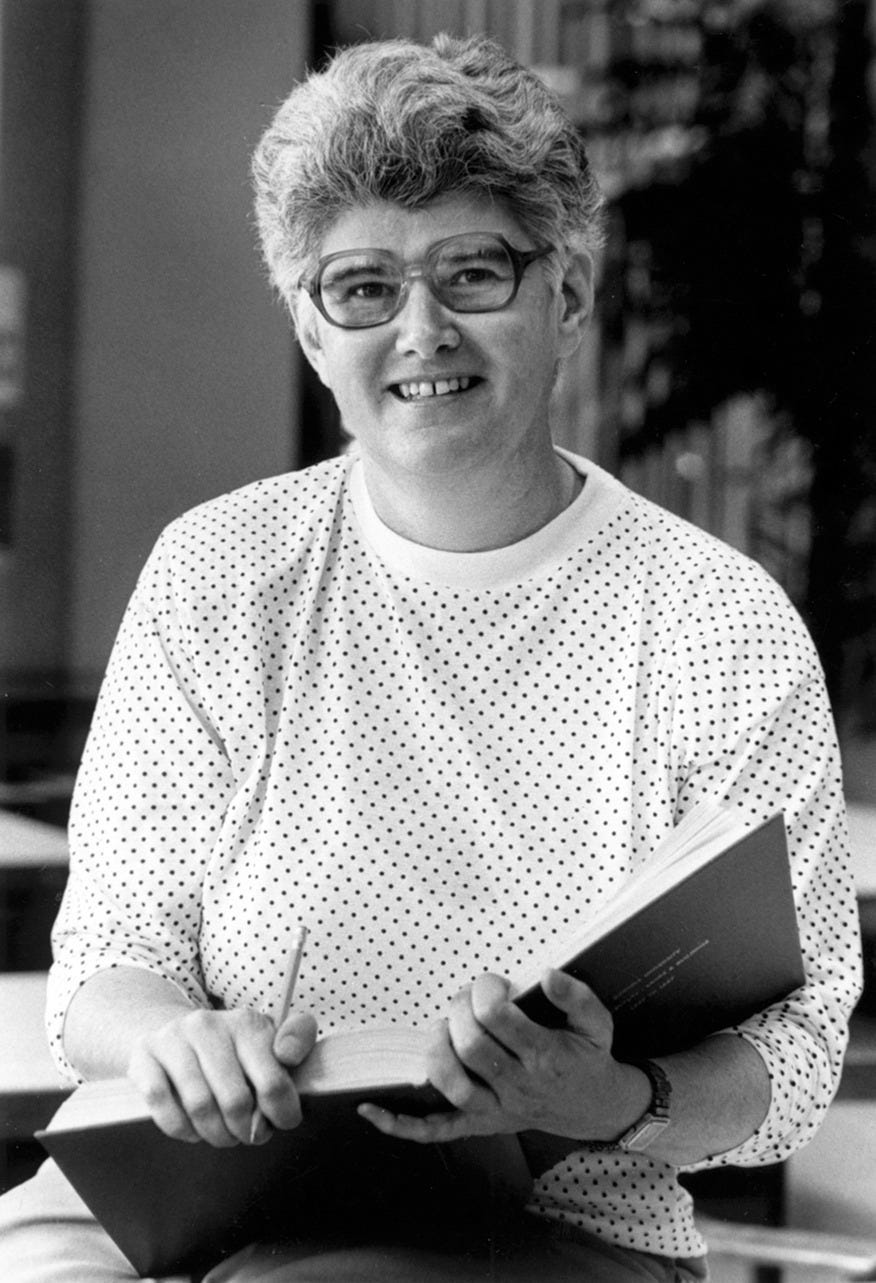
Rossiter, shown in 1989, has devoted her career to uncovering the contributions of women in science who have been written out of history. Credits: Office of Visual Services (UREL), Cornell University and onwisconsin.uwalumni.com
I wish I could say that the Matilda Effect is a thing of the past. It is not. Discrimination based on gender, as well as race, class, caste and several other identities are still rampant in societies around the world today. Despite all the visible developments in technology, educational infrastructure and communication of information, our rudimentary biases still remain standing, which, to me, is a testament to the fact that knowledge and intellect without empathy and humanity is not necessarily a sign of ‘intelligence’.
I will continue to keep exploring The Matilda Effect with children and adults and I hope those of you who have read this would also do your part in making this world a better place. I remember something we discussed towards the tail end of that science session.
“Think about it! If only we didn’t suppress women from contributing! There would be twice the knowledge! Twice the number of research! Twice the number of breakthroughs and cures! Twice the number of cool technologies and inventions! Why on earth wouldn’t anyone want more of a good thing?”
Why? What do you think? :)
Growing up, I often heard of scientists whose discoveries brought destruction and harm (Space Pioneer Verner Von Braun for instance) quoted as making excuses for themselves like, “As a scientist, I can’t be responsible for what is done with my work after I’ve discovered/invented it. I’m a scientist, not a politician.” I personally think it is a crime to teach science as a subject separate from society, given the polycrises we have to address through generations to come. Specialization is only relevant as long as it helps us reach depths of knowledge and skill. It cannot come at the cost of compartmentalizing our human responsibility.
Scientific knowledge is immensely empowering and as most of us know, “with great power comes…”
well, we may recollect the rest of that statement. But I hope, for all of life’s sake, that we also learn to embody it in our actions before it is too late.
Resources to study the Matilda Effect and related themes
- https://www.lostwomenofscience.org
- https://nationalgeographic.de/themen/wissenschaft/2023/02/der-matilda-effekt-wie-frauen-in-der-wissenschaft-unsichtbar-werden/ (Original Article in German)
- https://en.wikipedia.org/wiki/Timeline_of_women_in_science
- https://www.marieclaire.com/culture/g5026/female-discoveries-credited-to-men/
- https://www.unsw.edu.au/science/about-us/equity-diversity-inclusion/science-history-trail
- https://en.wikipedia.org/wiki/Jess_Wade
- https://en.wikipedia.org/wiki/Matthew_effect
Books to explore on the topic
- The Only Woman in the Room by Eileen Pollack
- The Woman Who Split the Atom by Marissa Moss
- Sisters in Science by Diann Jordan
- Headstrong by Rachel Swaby
- The Immortal Life of Henrietta Lacks by Rebecca Skloot
- A Lab of One’s Own by Patricia Fara
- Code Girls by Liza Mundy
- Hidden Figures by Margot Lee Shetterly
- Women in Science by Rachel Ignotofsky
- Feminists and Science (Vol I and II) by Ed. Sumi Krishna and Gita Chadha
메타데이터
- post_id
- 1304319cedaa
- slug
- men-are-thieves-1304319cedaa
- url
- https://medium.com/@kaushiekpranoo/men-are-thieves-1304319cedaa
- canonical_url
- https://medium.com/@kaushiekpranoo/men-are-thieves-1304319cedaa
- author_url
- https://medium.com/@kaushiekpranoo
- status
- ok
- fetched_at
- 2026-06-09 15:37:30




