Famous Courtesans of Antiquity-Lamia
Celebrated courtesan and mistress of Demetrius Poliorcetes (The Besieger)
Famous Courtesans of Antiquity-Lamia
Celebrated courtesan and mistress of Demetrius Poliorcetes (The Besieger)
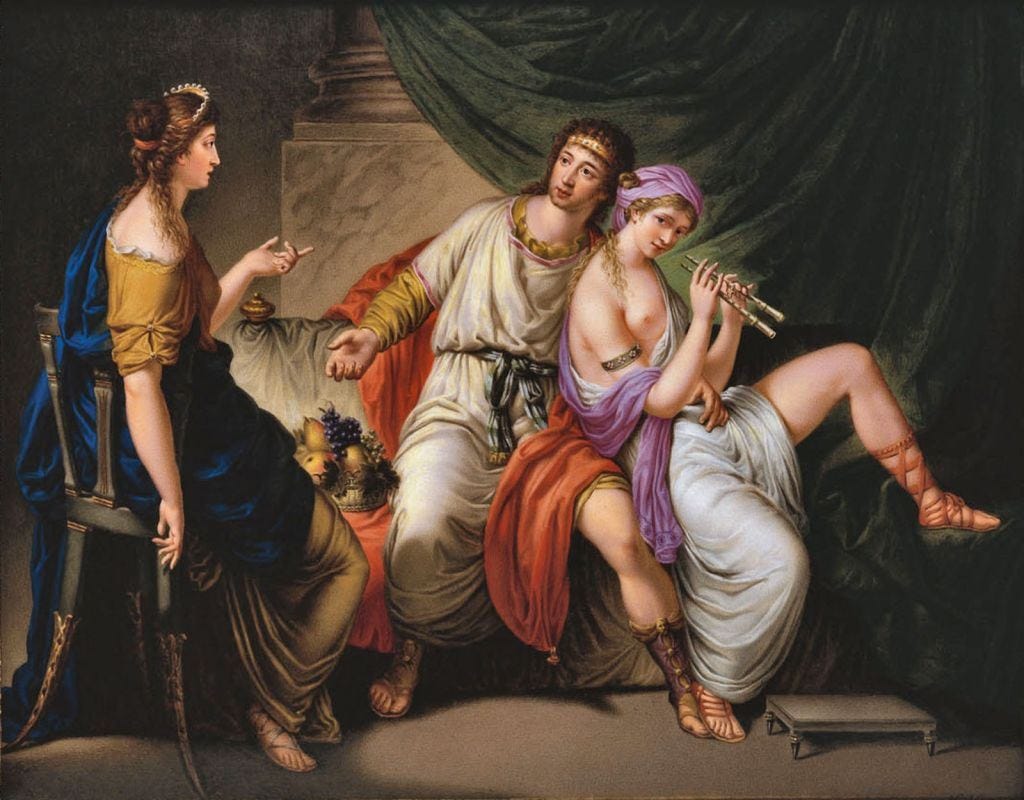
Demetrius Poliorcetes with the flautist Lamia and her Friend Demo by Franz Caucig-c.1800
This is the third in a series of famous courtesans from antiquity. In many cases the sources on which the information that we have about these famous or infamous women is somewhat scarce. However, one thing is clear, people have always loved to gossip and particularly about matters of a salacious nature.
There is much debate among historians as to the veracity of some of the accounts of these women that are found in ancient texts and that the women were more than just courtesans or whores and that many of them were intellectually accomplished, astute political operatives or successful businesswomen. I don’t see why they couldn’t have been all of these things. Human beings are complex and not one dimensional.
These disputes aside one thing is clear, throughout history women have always had a degree of agency and have used what talents they have to shape their own destinies as best they can given the opportunities and limitations of any given time.
Much of what we know about Lamia is from Plutarch’s Lives which is a collection of 48 biographies of Greek and Roman figures written in the 2nd century CE.
Lamia was an Athenian woman living around 300 BCE. She was said to have started her career as an actress and a flute player who later became a hetaira.
A hetaira was essentially a high-class prostitute but also denoted a woman with other accomplishments be they intellectual or artistic. I suppose that one could look upon them as not dissimilar to a geisha in that regard. As a class they were differentiated from common prostitutes or pornai, who worked in brothels or the streets.
According to Marguerite Johnson of the University of Newcatle ‘“Hetairai” even attended symposia, or ancient Greek drinking parties, to provide not just sex but to also perform music and even engage in debates and discussions with the participants.(1)
It is also clear from such ancient sources that exist that many hetairai were held in high esteem. From The Deipnosophists by Athenaeus who lived around the end of the 2nd Century CE and the early 3rd Century CE has this to say about hetairai:
But concerning courtesans, Ephippus, in his Merchandise, speaks as follows: And then if, when we enter through their doors, They see that we are out of sorts at all, They flatter us and soothe us, kiss us gently, Not pressing hard as though our lips were enemies, But with soft open kisses like a sparrow; They sing, and comfort us, and make us cheerful, And straightway banish all our care and grief, And make our faces bright again with smiles.(2)
Chapter 27 of Plutarch’s lives concerns Demetrius Poliorcetes and it is from this source that most of what we know about Lamia comes. The extracts below are from the translation by John & William Langhorne (1770).
Demetrius Poliorcetes (337–283 BCE) was a Macedonian Greek nobleman and military leader who became king of Asia between 306 and 301 BC, and king of Macedon between 294 and 288 BC.
According to the Encyclopedia Britannica, Vol. 7 (11th ed.). Cambridge University Press. p. 982. Chisolm, Hugh, ed. (1911). “Demetrius s.v. Demetrius I.”
“In the campaign of 306 BC, he defeated Ptolemy and Menelaus, Ptolemy’s brother, in the naval Battle of Salamis, completely destroying the naval power of Ptolemaic Egypt.” (3)
It was during or after this battle that he met Lamia. As Plutarch tells us:
Ptolemy could not stand the shock, but was defeated, and fled with 8 ships only, which were all that he saved. For 70 were taken with their crews, and the rest were sunk in the engagement. His numerous train, his servants, friends, wives, arms, money, and machines, that were stationed near the fleet in transports, all fell into the hands of Demetrius, and he carried them to his camp.
Among these was the celebrated Lamia, who at first was only taken notice of for her performing on the flute, which was by no means contemptible, but afterwards became famous as a courtesan. By this time her beauty was in the wane, yet she captivated Demetrius, though not near her age, and so effectively enslaved him by the peculiar power of her charms, that, though other women had a passion for him, he could only think of her.” (4)
It was said that she exercized so much power over Demetrius that even his father remarked on it:
“When the power that Lamia had over him was evident to all the world, Demetrius came after some expedition or other to salute his father, and kissed him so cordially, that he laughed and said, ‘Surely, my son, you think you are kissing Lamia.’”(5)
However, according to Plutarch Demetrius was indulging in sexual relations with women other than Lamia:
And Demetrius, who ought to have revered Athena, if on no other account, yet as his eldest sister (for so he affected to call her), behaved in such a manner to persons of both sexes who were above the condition of slaves, and the citadel was so polluted with his debaucheries, that it appeared to be kept sacred in some degree, when he indulged himself only with such prostitutes as Chrysis, Lamia, Demo, and Anticyra. (6)
I cannot find the source for the following anecdote concerning Demetrius and Lamia’s attitude towards the goddess Athena which is repeated in The Greek Reporter:
There are plenty of tales of the two of them cavorting together, sometimes rather sacrilegiously. For example, the Athenians tried to honor Demetrius by allowing him a symbolic marriage to their patron goddess Athena, but the Besieger didn’t think too much of marrying a statue. Instead, he and Lamia went into the temple and committed various acts said to be rather shocking to the virgin goddess. (7)
To continue with the extract from Plutarch’s lives:
But amongst the many abuses and enormities committed in their city, no one seems to have given the Athenians greater uneasiness than this. He ordered them to raise 250 talents (about $65 million) in a very short time, and the sum was exacted with the greatest rigour. When the money was brought in, and he saw it all together, he ordered it to be given to Lamia and his other mistresses to buy soap. Thus the disgrace hurt them more than the loss, and the application more than the impost. Some, however, say that it was not to the Athenians that he behaved in this manner, but to the people of Thessaly. Besides this disagreeable tax, Lamia extorted money from many persons on her own authority, to enable her to provide an entertainment for the king. And the expense of that supper was so remarkable, that Lynceus the Samian took pains to give a description of it. For the same reason, a comic poet of those times, with equal wit and truth, called Lamia an Heliopolis (a siege tower). And Demochares the Solian called Demetrius “Mythus”, that is, fable, because he too had his Lamia. (8)
The great influence that Lamia had with Demetrius, in consequence of his passion for her, excited a spirit of envy and aversion to her, not only in the breasts of his wives but of his friends. Demetrius having sent ambassadors to Lysimachus, on some occasion or other, that prince amused himself one day with showing them the deep wounds he had received from a lion’s claws in his arms and thighs, and gave them an account of his being shut up with that wild beast by Alexander the Great, and of the battle he had with it, upon which they laughed, and said, “ The king, our master, too, bears on his neck the marks of a dreadful wild beast called a Lamia.” Indeed, it was strange that he should at first have so great an objection against the disparity of years between him and Phila, and afterwards fall into such a lasting captivity to Lamia, though she had passed her prime at their first acquaintance. One evening, when Lamia had been playing on the flute at supper, Demetrius asked Demo, surnamed Mania, what she thought of her, “ I think her an old woman, sir,” said Demo. Another time, when there was an extraordinary dessert on the table, he said to her, “ You see what fine things Lamia sends me.” “ My mother will send you finer,” answered Demo, “ if you will but lie with her.” (9)
We shall mention only one story more of Lamia, which relates to her censure of the celebrated judgement of Bocchoris. In Egypt there was a young man extremely desirous of the favours of a courtesan named Thonis, but she set too high a price upon them. Afterwards he fancied that he enjoyed her in a dream, and his desire was satisfied. Thonis, upon this, commenced an action against him for the money; and Bocchoris having heard both parties, ordered the man to count the gold that she demanded into a basin, and shake it about before her, that she might enjoy the sight of it ; “ For fancy,” said he, “ is no more than the shadow of truth.” Lamia did not think this a just sentence, because the woman’s desire of the gold was not removed by the appearance of it, whereas the dream cured the passion of her lover. (10)
Athenaeus citing the playwright Machon tells the following anecdote:
Demetrius the king was once displaying Amid his cups a great variety Of kinds of perfumes to his Lamia: Now Lamia was a female flute-player, With whom ’tis always said Demetrius Was very much in love. But when she scoffed At all his perfumes, and, moreover, treated The monarch with exceeding insolence, He bade a slave bring some cheap unguent, while With his hand he felt himself, and smeared his fingers, And said, “At least smell this, O Lamia, And see how much this scent does beat all others.” She laughingly replied: “But know, O king, That smell does seem to me the worst of all.” “But,” said Demetrius, “I swear, by the gods, That ’tis produced from a right royal nut.” (11)
- Elite companions, flute girls and child slaves: sex work in ancient Athens
- The Deipnosophists by Athenaeus, Translation by C. D. Yonge 1854
- Encyclopedia Britannica, Vol. 7 (11th ed.). Cambridge University Press. p. 982. Chisolm, Hugh, ed. (1911). “Demetrius s.v. Demetrius I.”
- Plutarch’s Lives Translated by John Dryden, Edited by A.H. Clough, Boston, Little Brown & Co. 1906 -public domain
- Plutarch op. cit.
- Plutarch op. cit.
- Siege Warfare, Polygamy and Sacrilege: The Reign of King Demetrius of Macedonia — GreekReporter.com
- Plutarch’s Lives Op. Cit.
- Plutarch’s Lives Op. Cit.
- Plutarch’s Lives Op. cit.
- The Deipnosophists by Athenaeus, Translation by C. D. Yonge 1854

Glenn M Stewart
Pugilist, polemicist, Oxford Arabist, financial mastermind, international man of mystery, film producer, playwright, part-time-poet, full-time provocateur…
메타데이터
- post_id
- 1314c4e13681
- slug
- famous-courtesans-of-antiquity-lamia-1314c4e13681
- url
- https://medium.com/mmm-mondays/famous-courtesans-of-antiquity-lamia-1314c4e13681
- canonical_url
- https://medium.com/mmm-mondays/famous-courtesans-of-antiquity-lamia-1314c4e13681
- author_url
- https://medium.com/@glenn-stewartm
- status
- ok
- fetched_at
- 2026-06-11 06:59:45