What Grades of Leather Really Mean: How to Buy with Confidence
Top grain, full grain, genuine leather — which is best?
What Grades of Leather Really Mean: How to Buy with Confidence
Top grain, full grain, genuine leather — which is best?
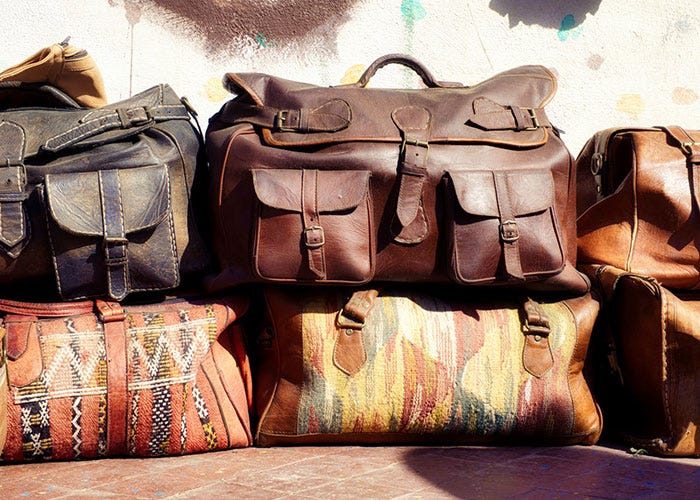
Moroccan leather goods (Photo by Travel with Lenses via Pexels)
First off, when it comes to leather, the “grades” you commonly hear about — full grain, top grain, corrected, split, bonded, suede, nubuck, and genuine leather — aren’t quality grades at all. They’re actually types, and this is a crash course in what those mean.
Now, I should say up front, tanneries do grade their stock with ranks like A, B, C, D, and TR (“tannery run,” or mixed grades), or descriptors like premium on down. But there’s no standard scale or criteria for the grading, and the end-buyer won’t typically see these anyway. If you see a numerical grade between 1K and 5K, that tells you the toughness, the higher the stronger.
Let’s begin with genuine leather, which you may have heard is the “cheapest” kind. (Makers of full and top grain products can be quick to “warn” potential customers to shy away from anything with a genuine leather stamp, which they do not sell.) But genuine leather simply means what it says — it’s real animal hide, nothing more or less.
The bad rap comes from the assumption, often accurate, that products labeled “Genuine Leather” must not be full or top grain, otherwise those labels would have been used. But that’s not always the case (and you don’t always want those types anyway). The maker of Red Wings, S.B. Foot, calls all their leather “genuine,” for example.
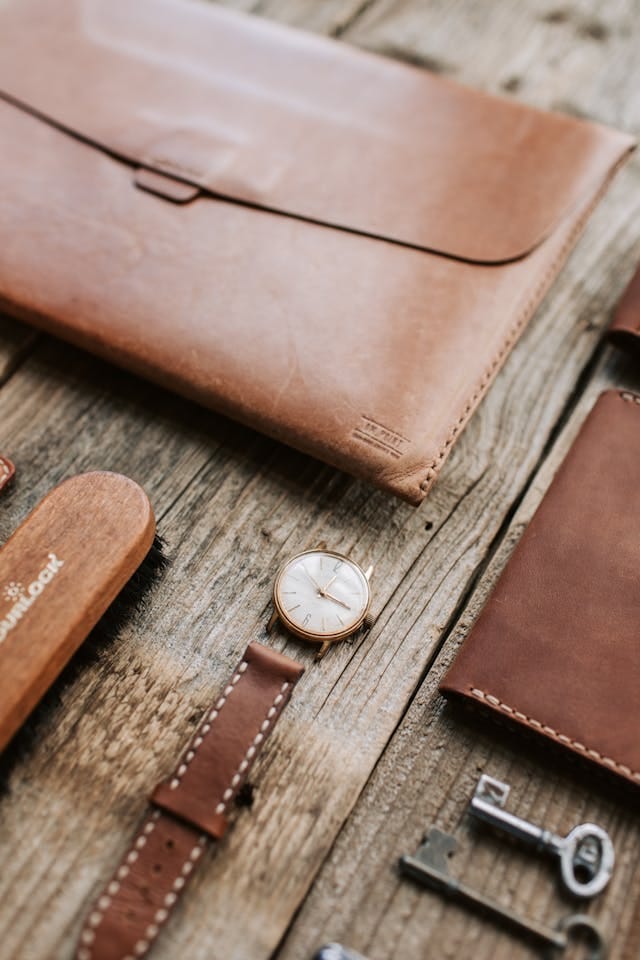
Watchbands, spectacle cases, clasp bags, and the like are often made with bottom-cut leather labeled “geniuine leather,” not because it’s “cheap” but because it’s the best choice — soft, pliable, easy to work, with a uniform look and texture and no “grain.” (Photo by Vlada Karpovich via Pexels)
So with that out of the way, the key to understanding the types of leather is the split. Wet hides are delaminated into a top “grain split” cut and a bottom “flesh split” cut, and there are no standard thicknesses. The top cut has a hair coat that’s typically removed to reveal the outer grain.
Full grain leathers are top cuts which retain the outermost surface of the hide. Shaved even, but otherwise with warts and scars and all, it looks like it came from an animal. (If the coat’s left intact, it’s cowhide.) Full grain has a lot of character, a little too much for many applications, quite frankly; and whether a deviation like a cattle brand or a scar is an imperfection or an enhancement, well, that’s entirely in the eye of the beholder. Full grain leather is very strong, and starts out a bit stiff, but with time and use it softens into a dappled sheen.
One reason the price of full grain leather rises so steeply from, say, jewelry to furniture is that you can make a lot of bangles out of A-passable snips from lower-grade sheets of leather, but you need large sheets of A-grade for the couch. Full grain leather needs conditioning a couple times a year, and articles like hats and coats will self-customize, gradually conforming themselves to the wearer’s body, which makes them incredibly comfortable despite any initial stiffness during the break-in period.
Caveat: While full grain leather is, on the whole, stronger and higher quality than other types, it doesn’t have to be. It’s entirely possible to make a “full grain” product from an imperfect hide, cut thin, using cheap-and-fast tanning and finishing processes, and some manufacturers will do exactly that in order to extract a higher price from a mid-grade or even inferior product that’s not going to deliver the comfort, beauty, and durability most buyers are looking for. This is especially true when purchasing from a random seller online, sight unseen. So if you’re going to spend the money, consider buying in-person from a shop that sources from LWG (Leather Working Group) certified tanneries.
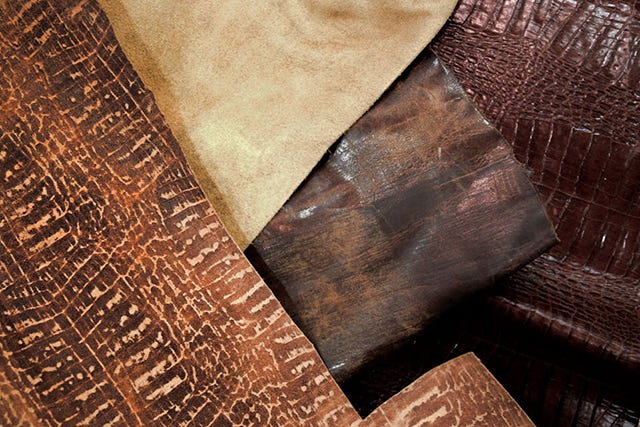
Full grain leathers are top-shaved to create an even surface and uniform thickness, but otherwise preserve the look of the animal; other grades of leather may be stamped and dyed to resemble full grain, so it’s best not to go by looks alone when determining if a product is actually full grain. (Photo by Moussa Idrissi via Pexels)
Top grain leather is the top cut that’s been sanded down, so it still has a grain to it but doesn’t look quite so much like an individual critter with all its distinct markings. It’s not as strong as full grain, but is still highly durable (around 2-3K versus a full grain’s 4-5K), doesn’t stain as easily, and it retains the natural look of the hide without being as flashy.
This is typically what you want for belts and satchels and such, when you’re after a little bit of style without going over the top, and you want the product to last and to tolerate some stress and tension. Top grain is a wonderful choice for everything from coats to upholstery, if you’re willing to spend a bit more for good looks and durability. Occasional cleaning and conditioning will help it to age well.
A top or full grain product should have a rough fibrous edge, and should behave like skin when you handle it, yielding and wrinkling when pressure is applied and naturally recovering when the pressure is released. It should warm to your touch, not feel brittle or artificial, and should have that signature earthy leather smell.
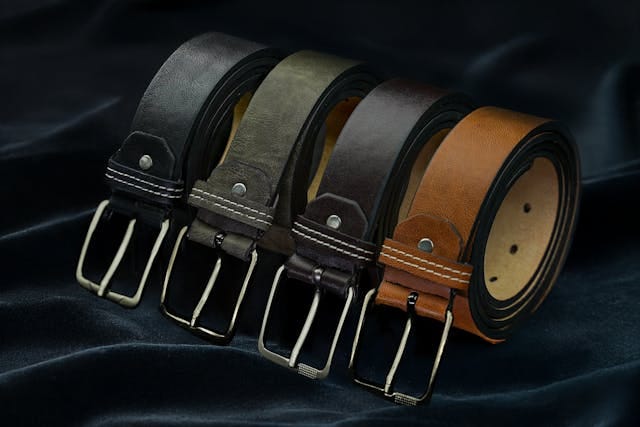
Belts made with top grain leather often pay for themselves compared to bottom cut products by offering years of service without need of replacement. (Photo by Shivam Patil via Pexels)
Corrected leathers are top grains that have had surface treatments which change their appearance. Patent leather is one of the more extreme examples with its signature glossy luster. But you can also find nubuk, which is a top grain buffed to a suede-like finish, embossed leathers that mimic full grains, especially exotics like alligator, and all sorts of other options. A natural look is fine when that’s what you want, but without corrected leathers we’d have so much less variety to choose from.
As you can imagine, caring for corrected leather depends entirely on what sort of treatment it’s had. Some corrected leathers can be conditioned just like any other top or full grain leather, while such treatment would ruin nubuk (which is cleaned by brushing and specialty sprays) and have no effect on patent leather’s impermeable surface.
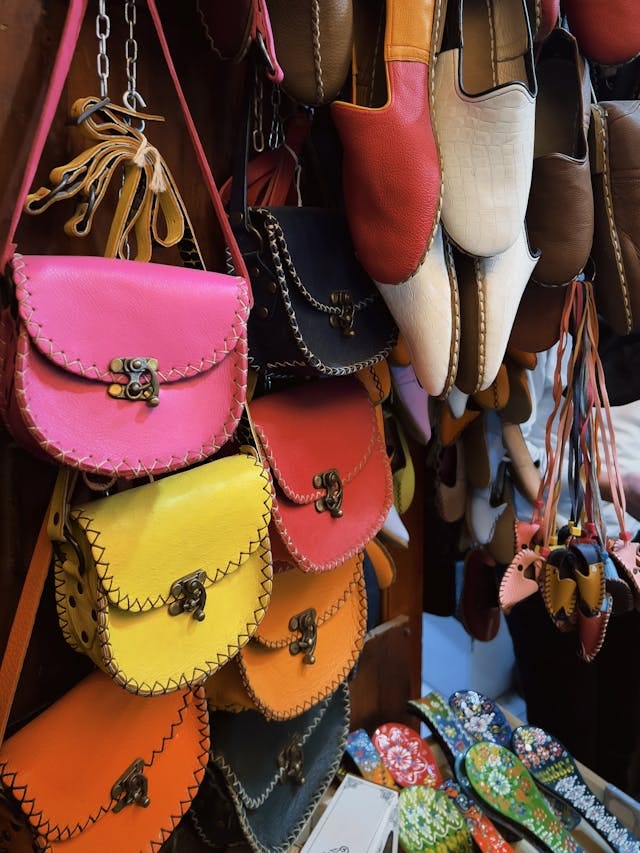
A tremendous variety of products can be made from corrected leathers with a practically infinite range of colors, finishes, and embossings. (Photo by Mehmet Turgut Kirkgoz via Pexels)
Caveat: Because these terms aren’t standardized, you may also hear “top grain” as a generic term for all top cut (grain split) leathers, which are then subdivided into “full grain,” which leaves the outer surface intact, and “corrected” for everything else. So if you’re not sure how a term is being used, it’s best to ask.
Split leather, or the bottom cut – almost always labeled “genuine” – is the softest and most pliable, but the least durable. Top grain might make a great belt, but split grain can be a better option for, say, a pair of house slippers or evening gloves. One hidden downside to using the bottom cut is that it’s not breathable, but it tends to be more stain-resistant, so as always it’s a trade-off. But it’s your best bet if durability isn’t an issue and you want a flat, even color without marbling or “depth.”
Suede (a term derived from the French word for Swedish) is a type of split leather that’s sanded and buffed to a matte finish. It’s not as strong as nubuk, is easily stained, and can’t tolerate water, but it’s wonderfully soft, which is why it’s considered a luxury material. If you do manage to get your suede goods wet, you’ll need to let them air dry at room temperature, preferably stuffed with cloth or old newspaper to retain shape.
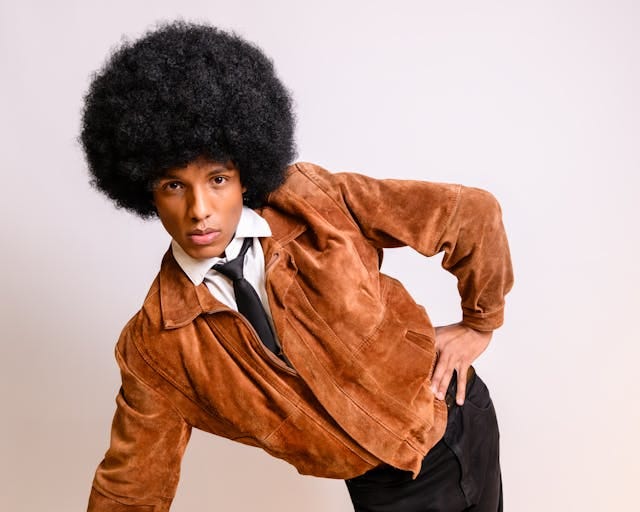
Suede has a soft and luxurious finish which makes it prized for luxury goods and high fashion. (Photo by Oscar Steiner via Pexels)
If the traditional feel and smell of real leather is important to you, you might be disappointed by a split leather product. But if you’re looking for softness and uniform color, split’s the way to go. Just be aware that it’s not going to last as long or take as much strain as a top cut product.
When we get to bonded leather, now we’re talking about “leather in name only.” It’s the equivalent of particle board, made up of scraps like top shavings and size trimmings and other unusable parts, even leather “dust,” then blended with binders to form a product utterly foreign to nature. This really is the cheap stuff. It’s prone to splitting, flaking, cracking, delaminating, or just outright falling apart. It cannot be conditioned because the binders prevent treatments from penetrating.
I tried to conjure up an instance when you might want to purchase a bonded leather product, but ultimately was unsuccessful in that endeavor. Quite frankly, you’re better off buying a plant fiber product instead if you can’t afford any leather other than bonded.
While knowing your types of leather is important, I should caution that it’s not the whole game. Not even close. The quality of the hide, the species and age and condition of the animal, the thickness of the split, and the care with which it’s tanned and finished, all are critical to the quality, look, feel, and durability of the final product.
Of these, I’ll only mention tanning here. There are two common methods. Chrome tanning with mineral salts is “fast and flexible,” creating a more pliable and water-resistant material in a relatively short time. Vegetable tanning, the more traditional method using plant-based treatments, is “slow and strong,” yielding a firmer material with an oaky fragrance that’s easy to dye. Either process can be used with fatliquoring, a process that adds natural oils to the hide, making it more tear-resistant, flexible, and soft.
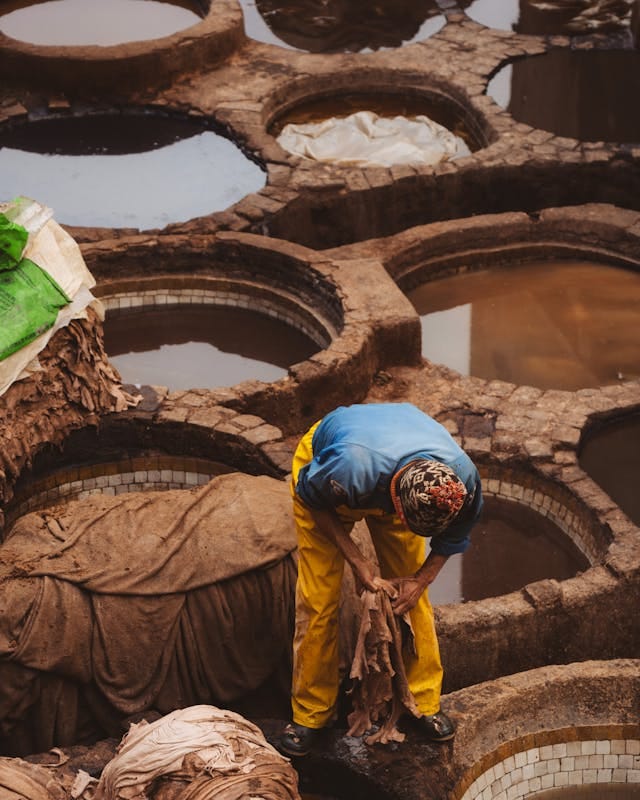
Traditional leather tanning in Morocco (Photo by Othmane Ettalbi via Pexels)
I briefly mentioned the Leather Working Group above, but I think it bears a second mention. The LWG’s mission is to promote sustainable leathermaking with a visible supply chain which does not contribute to deforestation, global warming, water contamination, animal cruelty, worker exploitation, and other harmful practices. Regardless of how you feel about the environmental issues, working with LWG-certified suppliers goes a long way toward ensuring that everything is above-board and you’re actually getting what you’re paying for.
So that’s your 101 on types of leather. Of course, there’s a lot more to it than this if you really want to dive into the craft. But for most folks, this will be enough to allow you to buy with confidence and avoid unscrupulous sellers as well as the urban legends (like “genuine leather is junk”) that could keep you from finding what you really want. Happy hunting, y’all!
메타데이터
- post_id
- 1318e5745482
- slug
- what-grades-of-leather-really-mean-how-to-buy-with-confidence-1318e5745482
- url
- https://medium.com/thinkpiece-magazine/what-grades-of-leather-really-mean-how-to-buy-with-confidence-1318e5745482
- canonical_url
- https://medium.com/thinkpiece-magazine/what-grades-of-leather-really-mean-how-to-buy-with-confidence-1318e5745482
- author_url
- https://medium.com/@ptzenki
- status
- ok
- fetched_at
- 2026-06-14 11:28:49