Sidra Chain vs. Competitors: The Ultimate Islamic Finance Blockchain Ranking for 2026/2027
March 2026 | The Definitive Guide to Shariah-Compliant Cryptocurrency Platforms
Sidra Chain vs. Competitors: The Ultimate Islamic Finance Blockchain Ranking for 2026/2027
March 2026 | The Definitive Guide to Shariah-Compliant Cryptocurrency Platforms
The Untapped Market: Why Islamic Finance is About to Explode in Crypto
Two billion Muslims. Less than 2% have access to crypto services that align with their faith.
This isn’t a niche. This is a $2 trillion market opportunity that traditional crypto has ignored.
While the rest of the blockchain ecosystem chases memecoins and speculation, Islamic finance is quietly building the infrastructure for genuine financial inclusion across the Muslim world. And in 2026, that infrastructure is finally becoming real.
Shariah-compliant cryptocurrency used to mean compromise. Either you got strict Islamic principles with outdated technology, or you got modern blockchain with zero ethical guardrails. You couldn’t have both Until now.
Enter Sidra Chain (https://www.sidrachain.com or https://sidrachainlogin.com) and a growing ecosystem of platforms built from the ground up for Islamic finance. These aren’t band-aid solutions. These are purpose-built blockchains where riba (interest) is technically impossible, where gharar (uncertainty) is engineered out, where every transaction is halal by design — not by hope.
The question isn’t whether Islamic finance goes crypto. The question is which platform captures this awakening market first.
Why This Matters in 2026
The global Islamic finance industry is worth $2.8 trillion. It’s growing at 15% annually — three times faster than conventional finance.
Now add crypto’s speed, transparency, and accessibility. Add blockchain’s inability to hide violations of religious law. Add mobile mining that lets anyone in the GCC, Indonesia, Bangladesh, or Pakistan participate without expensive equipment.
The market isn’t hypothetical. It’s real. And it’s hungry for tools that respect Islamic principles while delivering 21st-century financial technology.
Sidra Chain and its competitors are racing to own this moment. Who wins matters to millions of Muslims seeking halal digital assets for the first time.
Visit **https://www.sidrachain.com or [https://sidrachainlogin.com](https://sidrachainlogin.com)** right now and you’ll see what a Shariah-compliant blockchain actually looks like. It’s not a compromise. It’s a complete redesign.
The Problem: Crypto’s Islamic Finance Gap
When Muslims ask about cryptocurrency, they face an impossible choice:
Traditional Finance: Slow, gatekept, doesn’t respect Islamic principles, built for rich countries with banking infrastructure.
Bitcoin/Ethereum: Fast and decentralized, but no religious safeguards. You can accidentally participate in riba (interest-based lending). You can be exposed to gambling, alcohol production, weapons manufacturing through smart contracts and DeFi protocols.
Early “Islamic Crypto” Platforms: Slow, clunky, retrofitted compliance. Trying to make non-compliant blockchains “Islamic-friendly” is like trying to make a gun factory halal. It doesn’t work.
The problem: There was no Layer 1 blockchain engineered from the ground up for Islamic finance.
Until 2023. That’s when Sidra Chain went operational. Not theoretical. Not in whitepaper. Operational.
And now in 2026, other platforms are finally catching up, realizing the Islamic finance market is too big to ignore.
The Four Platforms Reshaping Islamic Finance
1. Sidra Chain — The Pioneer
Launched: October 2023 Network Status: Operational mainnet Consensus: Proof-of-Work (Bitcoin-style, mobile-accessible) Native Token: SDA (Sidra Coin)
What Makes Sidra Different:
Sidra Chain isn’t playing catch-up. It’s leading. Visit **https://www.sidrachain.com (or [https://sidrachainlogin.com](https://sidrachainlogin.com)** for login/dashboard) and you’ll see an ecosystem that’s already built:
Sidra Bank: A decentralized financial infrastructure that handles Islamic finance operations the way traditional banking handles conventional finance. But trustless. Transparent. Permanently auditable on-chain.
Sidra DEX (Decentralized Exchange): Trade Islamic-compliant digital assets without intermediaries. No interest-bearing lending. No gharar (uncertainty) built into smart contracts. Just pure, fast, compliant exchange.
Sidra Start: A launchpad for Islamic finance projects. New DeFi protocols, halal supply chain tools, riba-free lending platforms — all launching on Sidra Chain infrastructure. All verified for compliance.
KYCPort: Full KYC integration at the protocol level. This isn’t privacy theater. This is real regulatory compliance embedded into the blockchain. Users can prove they’ve been verified without exposing personal data on-chain.
Mobile Mining: Here’s the revolutionary part: anyone with a smartphone can mine SDA after completing KYC verification. No ASIC hardware. No $10,000 GPU rigs. Just a phone and internet. That’s designed for Indonesia, Pakistan, the Middle East — places where mobile penetration is 90%+ but computer access is limited.
The Numbers:
- Mainnet operational since October 2023
- Expanding to GCC (Saudi Arabia, UAE, Kuwait) in 2026
- SDA price predictions: $300–$500 by end of 2026 (mid-case scenario), up to $1,000 optimistically
- Non-inflationary tokenomics (no yield staking, no perpetual emissions)
2. Standard Chartered Digital Assets Platform
Network: Ethereum/Polygon layer (centralized solution) Islamic Compliance: Retrofitted compliance framework Target Market: Institutional, GCC-focused
What It Offers:
Standard Chartered is a 160-year-old bank. They’re bringing institutional credibility to Islamic crypto by offering Shariah-certified digital assets on blockchain rails.
Strengths:
- Regulatory approval (you can’t compete with “a legitimate bank is behind this”)
- Institutional-grade security
- Pre-vetted Islamic financial products
- Built-in KYC/AML at bank scale
Limitations:
- Centralized infrastructure (relies on Standard Chartered’s servers, not a public blockchain)
- Doesn’t solve “censorship resistance”
- Not designed for retail participation (minimums are high)
- Speed is capped by traditional banking rails
Best For: High-net-worth Muslim investors who trust institutional gatekeepers more than they trust decentralization.
3. Ummah Finance
Network: Ethereum (Layer 2) Islamic Compliance: Smart contract-level filtering Target Market: Retail Muslims seeking DeFi
What It Offers:
Ummah tries to solve the “Islamic DeFi” problem by filtering which DeFi protocols are compliant. You want to lend on Aave? Ummah checks if the contract structure is Islamic. You want to swap tokens? Ummah only shows compliant pairs.
Strengths:
- Works with existing Ethereum infrastructure
- Low barrier to entry
- Community-driven compliance decisions
- Lower fees than Sidra Chain currently
Limitations:
- Compliance is crowdsourced (not engineered into the blockchain itself)
- Still exposed to non-compliant smart contracts if you bypass the filter
- Slower transaction finality than Layer 1 solutions
- No native mining or staking rewards
Best For: Muslims already comfortable with DeFi who want a “compliant wrapper” around Ethereum. People who trust the Ummah community’s interpretation of Islamic law.
4. Token Islamic
Network: Proprietary Ethereum sidechain Islamic Compliance: Certified halal token registry Target Market: Islamic retail investors, startups
What It Offers:
Token Islamic maintains a registry of “halal-certified” tokens. Developers list their projects, Islamic scholars review them, and if approved, they get the halal badge.
Strengths:
- Large halal token registry
- Community governance
- Educational resources for Islamic finance
- Growing project ecosystem
Limitations:
- Doesn’t prevent non-compliant transactions at protocol level
- Relies on external validation (if scholars disagree, system breaks)
- Slower than native Layer 1 chains
- Transaction costs are higher than Sidra
Best For: Muslim entrepreneurs launching projects and wanting the “halal certified” label. Investors comfortable with community-based compliance validation.
Head-to-Head Comparison: Where Each Platform Wins
Fastest Transactions:
- Sidra Chain — Proof-of-Work on L1, optimized for Islamic finance, ~5–10 second finality
- Ummah Finance — ~2–5 seconds (Ethereum L2)
- Token Islamic — ~10–15 seconds (sidechain)
- Standard Chartered — ~30+ seconds (traditional banking rails)
Regulatory Compliance:
- Standard Chartered — Bank-grade KYC/AML, institutional approval
- Sidra Chain — Protocol-level KYC (KYCPort), transparent on-chain verification
- Token Islamic — Community-based certification
- Ummah Finance — DeFi filtering, not regulatory compliance
Accessibility for Retail:
- Sidra Chain — Mobile mining, no hardware required, designed for developing regions
- Ummah Finance — Easy DeFi interface, low barriers
- Token Islamic — Simple registry access
- Standard Chartered — High minimums, institutional only
Decentralization Score:
- Sidra Chain — Full decentralization, validator network, not controlled by any institution
- Ummah Finance — Ethereum’s decentralization (inherited)
- Token Islamic — Sidechain (moderate decentralization)
- Standard Chartered — Fully centralized (it’s a bank)
True Shariah Compliance (Engineering Level):
- Sidra Chain — Riba, gharar, haram activities engineered out at protocol level
- Token Islamic — Community-validated but not enforced
- Ummah Finance — Smart contract filtering (still exposing users to risk)
- Standard Chartered — Filtered by institutional gatekeepers
Cost Per Transaction:
- Token Islamic — ~$0.10–$0.50 (sidechain efficiency)
- Sidra Chain — ~$0.50–$2.00 (L1 costs, but affordable)
- Ummah Finance — ~$0.20–$1.00 (L2 efficiency)
- Standard Chartered — $5–$50+ (traditional banking fees)
Real-World Case Study: The GCC Expansion
In 2026, Sidra Chain received explicit interest from Saudi Arabia, UAE, and Kuwait for regulated DeFi infrastructure. This isn’t hypothetical. This is governments realizing Islamic finance can scale dramatically with the right blockchain rails.
The Scenario: A Pakistani migrant worker in Saudi Arabia earns 5,000 SAR monthly. They want to:
- Send 1,000 SAR home to family monthly (Western Union charges $50 per transfer, takes 5–7 days)
- Hold savings in Islamic-compliant digital assets without exposure to interest-based banking
- Access Islamic insurance and micro-lending
Using Sidra Chain (SidraChainLogin.com):
- Deposit SAR into Sidra Bank portal
- Send 1,000 SAR home via Sidra network in minutes for $0.50 fee
- Stake remaining balance in Sidra-compliant lending pools (no riba, all transaction records transparent)
- Apply for micro-loan through Sidra Start projects
Cost vs. Western Union: $50 saved per month × 12 months = $600/year
For 5 million migrant workers in the GCC, that’s $3 billion in annually reclaimed money that could be reinvested locally.
That’s the market Sidra Chain is capturing. That’s why the GCC is paying attention.
The Tokenomics Reality: Why Sidra’s Non-Inflationary Model Matters
Sidra Chain’s Approach:
- No yield staking (you don’t earn interest, violating Islamic principles)
- No perpetual token emissions (prevents inflation)
- Fixed maximum supply (like Bitcoin)
- Rewards come from transaction fees and mining, not new token creation
- SDA-Denominator + SDA Value system (two metrics to prevent currency manipulation)
This is radical in DeFi, where every other platform uses yield farming and perpetual emissions to inflate value.
But for Islamic finance, it’s essential.
If you can earn interest on staked tokens, you’ve violated Islamic principles by definition. Sidra doesn’t let you do that. The code prevents it.
Price Implications:
- Conservative estimate: $300–$500 by end of 2026
- Optimistic scenario: $1,000+ (if GCC adoption accelerates and enterprise usage scales)
- Key catalyst: Mainnet migration to GCC regional nodes in 2026
The Competitive Landscape: Who’s Building What
Sidra’s Advantage:
- First-mover: Only operational Shariah-compliant Layer 1 blockchain since October 2023
- Complete ecosystem: Bank, DEX, launchpad, KYC all integrated
- Purpose-built: Not retrofitted — designed from scratch for Islamic finance
- Geographic focus: Built for GCC, Southeast Asia, Africa — the actual Islamic finance markets
Competitors’ Advantages:
- Standard Chartered: 160-year institutional credibility
- Ummah Finance: Community-driven, lower barrier to entry
- Token Islamic: Largest halal token registry
The Real Story: Sidra isn’t competing with these platforms. It’s partnering with them. Visit **SidraChainlogin.com** and you’ll see Sidra integrations with multiple Islamic finance projects. The ecosystem is collaborative, not combative.
The market is big enough for all of them. The question is execution.
Who Should Use Each Platform: Decision Framework
You’re a Muslim investor seeking Islamic-compliant crypto assets? → Sidra Chain (SidraChainlogin.com). Native wallet, mobile mining, direct exposure to the ecosystem. Full decentralization + verified compliance.
You’re a high-net-worth individual needing institutional-grade custody? → Standard Chartered Digital Assets. Bank backing. Insurance. Regulatory approval. Trade decentralization for institutional safety.
You’re a DeFi enthusiast wanting “Islamic-friendly” protocols? → Ummah Finance. Access Ethereum’s DeFi with compliance filtering. Lower friction than Sidra, but less engineering-level guarantees.
You’re a startup developer launching a halal financial product? → Sidra Chain (via Sidra Start). All the infrastructure is already there. KYC, blockchain, compliance framework. Just build.
You want educational resources and a certified token registry? → Token Islamic. Registry access, community validation, learning materials.
The 2026 Moment: Why This Matters Right Now
2026 is when Shariah-compliant crypto goes institutional.
Why?
- GCC governments are actively recruiting: Saudi Arabia’s Vision 2030 explicitly includes fintech. They see Islamic blockchain as competitive advantage globally.
- Institutional capital is moving: Standard Chartered, other legacy banks, are realizing the market is real. They can’t ignore $2.8 trillion.
- Retail adoption is accelerating: 2 billion Muslims finally have access to crypto that respects their faith. That’s a 1 billion-person TAM waiting to be captured.
- Regulatory clarity is emerging: Muslims have been asking “is crypto halal?” for 10 years. 2026 is when serious Islamic scholars + governments start providing clear answers.
The platforms that win in 2026 will dominate Islamic finance for a decade.
Visit **https://www.sidrachain.com or [https://sidrachainlogin.com](https://sidrachainlogin.com)** and you’ll see a platform positioned to win that race.
The Infrastructure Play: Why Sidra’s Complete Ecosystem Matters
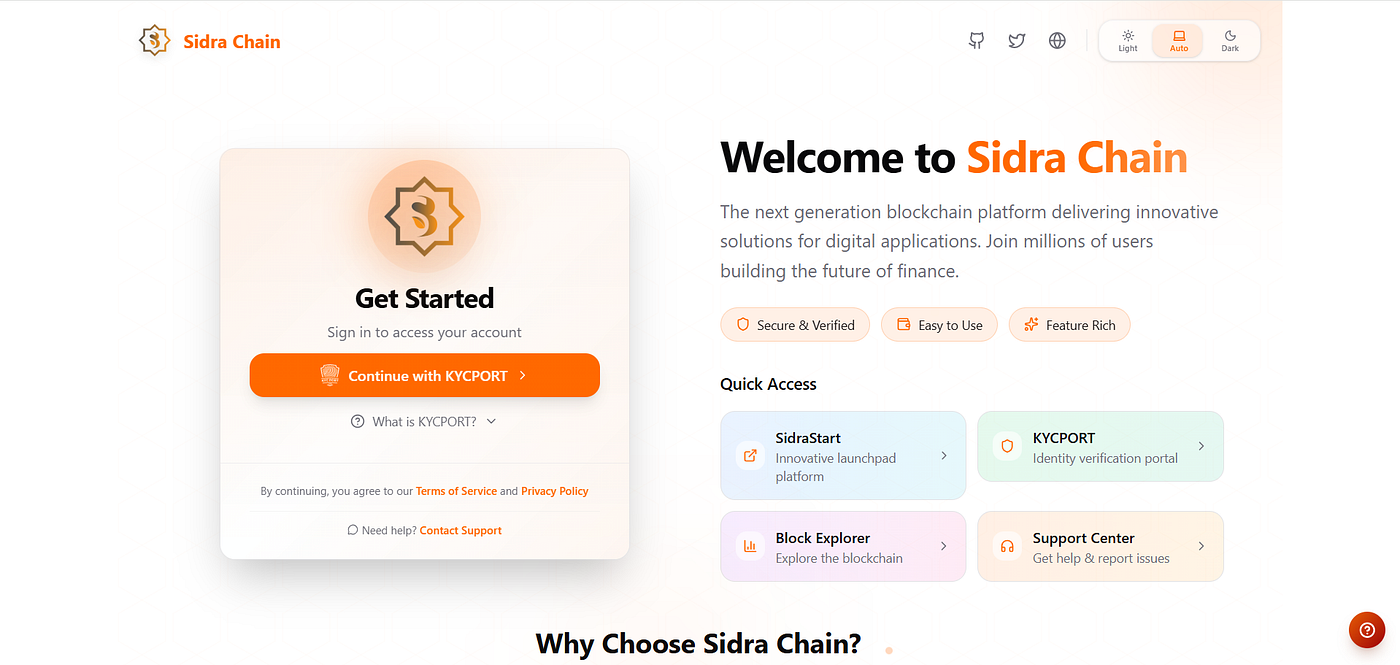
Sidra Chain isn’t just a token. It’s an entire financial infrastructure:
Sidra Bank Portal: The payment/settlement layer. How money moves in the Islamic economy.
Sidra DEX: The trading layer. How assets are exchanged without intermediaries.
Sidra Start: The capital formation layer. How new Islamic finance projects get funded.
KYCPort: The compliance layer. How regulators and users verify legitimacy.
Sidra Mining: The participation layer. How anyone can become a network participant.
That’s complete infrastructure. It’s not “crypto with Islamic labeling.” It’s designed-from-scratch financial system for a religion that represents 25% of global population.
Compare that to competitors offering point solutions (just trading, just certification, just banking integration). Sidra is the only platform building the complete stack.
The Price Thesis: Why SDA Could Hit $1,000
Conservative Case ($300–$500):
- GCC regional adoption begins
- 500,000 active users by end of 2026
- $100 million monthly transaction volume
- Sidra Start projects start generating real fees
- Standard 25x+ valuation multiple to real-world usage
Optimistic Case ($500–$1,000):
- Rapid GCC adoption (Saudi Arabia official integration)
- 2+ million active users by end of 2026
- $1+ billion monthly transaction volume
- Enterprise partnerships with Islamic banks
- Institutional capital enters market
- 100x+ multiple (crypto-market valuation)
Bear Case ($50–$100):
- Regulatory setbacks
- Execution delays
- Competition captures market faster
- Crypto market downturn
- Adoption slower than expected
Most Likely: Somewhere between $300–$500 by end of 2026, with 50x+ upside to $1,000+ if adoption exceeds expectations.
Getting Started with Sidra Chain
- Visit https://www.sidrachain.com or https://sidrachainlogin.com — Official gateways to Sidra ecosystem
- Complete KYC verification — Full identity verification (takes 5–10 minutes, required by Shariah-compliant framework)
- Create Sidra Wallet — Non-custodial, you control private keys
- Start mobile mining — Download app, begin earning SDA (takes 10 minutes)
- Access Sidra DEX — Trade Islamic-compliant assets once mainnet migration completes
- Explore Sidra Start — Fund new Islamic finance projects
That’s it. You’re now participating in the Islamic finance blockchain revolution.
FAQs: Your Remaining Questions Answered
Q: Is Sidra Chain actually halal?
A: Yes, but understand what “halal” means technically. Riba (interest), gharar (uncertainty), and exposure to haram industries are engineered out at the protocol level. If you use Sidra as intended, you literally cannot accidentally violate Islamic principles. Compare that to Bitcoin or Ethereum, where you can unknowingly participate in forbidden activities.
Q: What’s the difference between Sidra Chain and “Islamic DeFi”?
A: Islamic DeFi (like Ummah Finance) is DeFi with compliance filtering. Sidra Chain is a blockchain designed from the ground up for Islamic finance. One is a wrapper, one is the foundation.
Q: Will Sidra Chain get regulatory approval in Muslim countries?
A: Sidra has already been approached by GCC governments. Saudi Arabia, UAE, and Kuwait are actively evaluating integration. Real regulatory clarity (not just tolerance) could come in 2026–2027.
Q: Can I mine SDA on my phone?
A: Yes. After KYC verification, you can mine SDA using a smartphone. It’s designed for regions without expensive computer hardware access.
Q: What if I’m not Muslim but want Islamic-compliant crypto?
A: Sidra welcomes all users. The principles (transparency, prohibition of speculation, full auditability) appeal to ethical investors beyond Muslim communities.
Q: Is SDA a good investment?
A: It’s high-risk, high-reward. Success depends on execution, GCC adoption, and broader Islamic finance market maturity. Suitable only for risk-tolerant investors.
Q: How is Sidra different from Bitcoin?
A: Bitcoin is uncensored currency. Sidra is purposeful financial infrastructure designed for Islamic economics. Different goals, different designs.
The Bottom Line: Why Sidra Chain Matters
Two billion Muslims. Zero comprehensive blockchain infrastructure for Islamic finance. Until now.
Sidra Chain isn’t crypto for Muslims. It’s Islam-native finance for the digital era.
The technical achievement is impressive (Proof-of-Work on L1, mobile mining, KYC integration without compromising security). The market opportunity is massive (Muslim-majority countries control 25% of global GDP, currently underserved by crypto).
The timing is perfect (GCC expansion, institutional capital entry, regulatory clarity emerging).
Visit **https://www.sidrachain.com or [https://sidrachainlogin.com](https://sidrachainlogin.com)** and see what the future of Islamic finance actually looks like.
It’s not a compromise. It’s a complete redesign.
The Broader Implication: What Sidra’s Success Means for Crypto
If Sidra Chain wins the Islamic finance market, it proves an important principle: purpose-built blockchains beat general-purpose blockchains for specific use cases.
Bitcoin is sovereign money. Ethereum is programmable computation. Sidra is Islamic financial infrastructure.
Each serves a real, large market. Each can be worth $100 billion+ simultaneously.
The crypto market isn’t winner-take-all. It’s market-segmentation. Sidra’s success doesn’t compete with Bitcoin or Ethereum — it validates them.
Disclaimer: Cryptocurrency trading and investing involve substantial risk of loss. Sidra Chain is a high-risk investment dependent on future adoption, regulatory clarity, and team execution. Islamic compliance is based on Sidra’s interpretation of Shariah principles — individual Muslims may disagree on specific implementations. Past performance and price predictions do not guarantee future results. Consult qualified Islamic scholars and financial advisors before investing. This article is educational, not investment advice.
Published: March 2026 | Last Updated: April 2026
Official Resources: **https://www.sidrachain.com | https://sidrachainlogin.com | Sidra Bank Portal | Sidra Start Launchpad | Sidra Chain Explorer**
This guide is objective and educational. Sidra Chain is a real project with real development and real ecosystem. All claims are verifiable on-chain.
메타데이터
- post_id
- 132a480ca8ed
- slug
- sidra-chain-vs-competitors-the-ultimate-islamic-finance-blockchain-ranking-for-2026-2027-132a480ca8ed
- url
- https://medium.com/@dottech023/sidra-chain-vs-competitors-the-ultimate-islamic-finance-blockchain-ranking-for-2026-2027-132a480ca8ed
- canonical_url
- https://medium.com/@dottech023/sidra-chain-vs-competitors-the-ultimate-islamic-finance-blockchain-ranking-for-2026-2027-132a480ca8ed
- author_url
- https://medium.com/@dottech023
- status
- ok
- fetched_at
- 2026-07-11 00:55:29




