Bookkeeper, Accountant, or CPA?
Many business owners know they need help managing their finances.
Bookkeeper, Accountant, or CPA? The Complete Guide to Choosing the Right Financial Expert for Your Business
Many business owners know they need help managing their finances.
What they don’t know is whether they need a bookkeeper, an accountant, or a Certified Public Accountant (CPA).
The confusion is understandable. These professionals often work with the same financial data, yet their roles, expertise, and value to a business are very different.
Hiring the wrong professional can lead to unnecessary costs, missed tax-saving opportunities, compliance issues, or poor financial decisions.
So how do you know which one your business actually needs?
Let’s break it down.
Why Understanding the Difference Matters?
Imagine you’re running a growing business.
Your sales are increasing, invoices are piling up, payroll needs attention, and tax season is approaching.
At this stage, many business owners ask:
- Should I hire a bookkeeper?
- Do I need an accountant?
- Is a CPA necessary?
- Can one professional handle everything?
The answer depends on your business size, financial complexity, growth goals, and compliance requirements.
Understanding the role of each professional helps you invest in the right expertise at the right time.
Bookkeeper, Accountant, or CPA
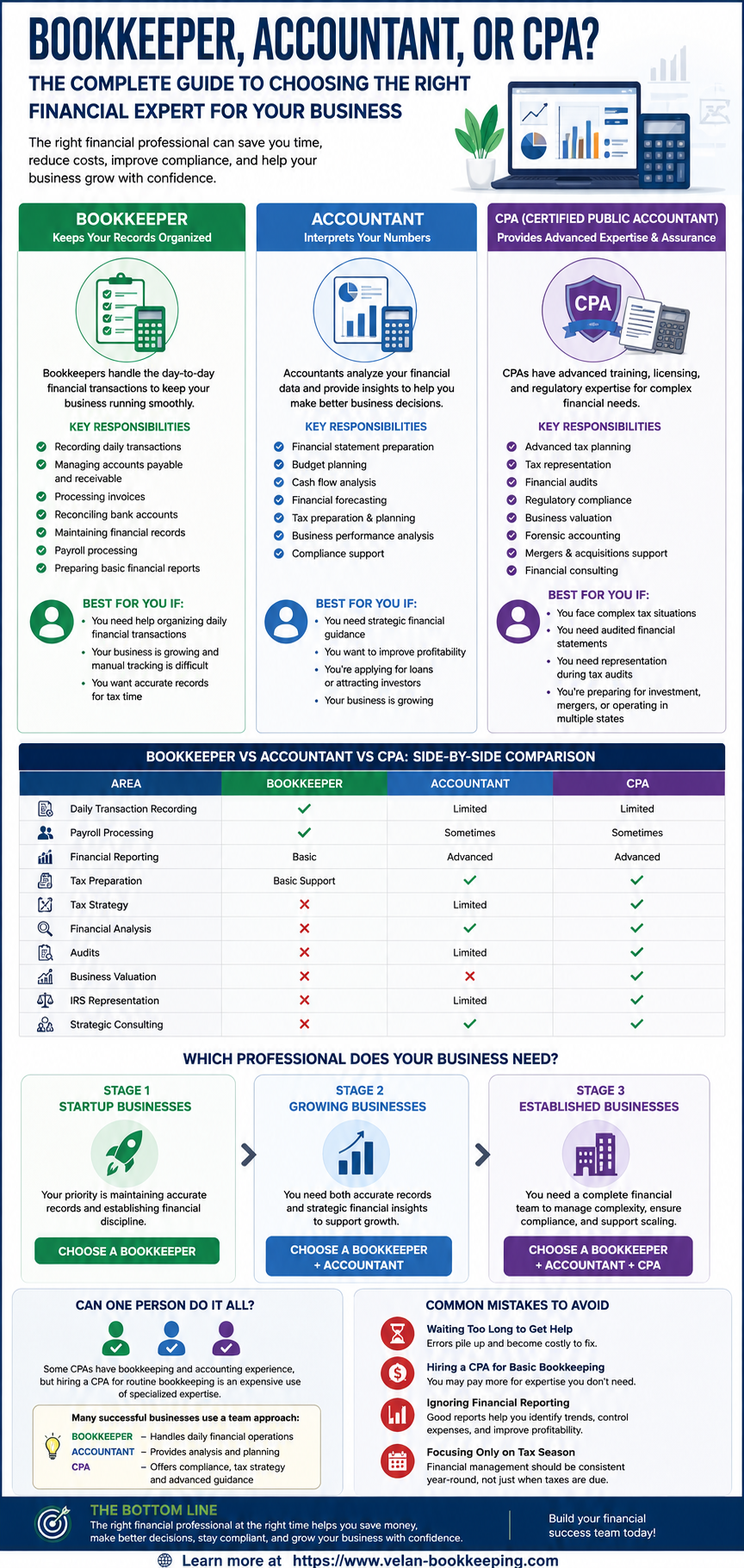
What Does a Bookkeeper Do?
A bookkeeper focuses on the daily financial activities of your business.
Think of a bookkeeper as the person responsible for keeping your financial records organized, accurate, and up to date.
Key Responsibilities of a Bookkeeper
- Recording daily transactions
- Managing accounts payable and receivable
- Processing invoices
- Reconciling bank accounts
- Maintaining financial records
- Handling payroll processing
- Preparing basic financial reports
Without accurate bookkeeping, businesses struggle to understand their cash flow, profitability, and financial position.
When Should You Hire a Bookkeeper?
A bookkeeper is usually the right choice when:
✅ You need help organizing daily financial transactions
✅ Your business is growing and manual tracking is becoming difficult
✅ You spend too much time managing receipts and invoices
✅ You want accurate financial records for tax preparation
Example
A local marketing agency generates dozens of client invoices every month.
Instead of spending hours tracking payments and expenses, they hire a bookkeeper to maintain accurate records and manage day-to-day financial activities.
What Does an Accountant Do?
While a bookkeeper records financial information, an accountant interprets and analyzes it.
An accountant helps business owners understand what the numbers mean and how to make better financial decisions.
Key Responsibilities of an Accountant
- Financial statement preparation
- Budget planning
- Cash flow analysis
- Financial forecasting
- Tax preparation
- Tax planning
- Business performance analysis
- Compliance support
Accountants transform financial data into business insights.
When Should You Hire an Accountant?
Consider hiring an accountant if:
✅ You need strategic financial guidance
✅ You want to improve profitability
✅ You need tax planning support
✅ You are applying for loans or attracting investors
✅ Your business is experiencing rapid growth
Example
A software startup wants to expand into new markets.
An accountant analyzes financial reports, forecasts future revenue, and helps management develop a growth strategy while minimizing financial risk.
What Is a CPA?
A CPA (Certified Public Accountant) is an accountant who has passed rigorous examinations, met licensing requirements, and maintains continuing professional education.
All CPAs are accountants.
However, not all accountants are CPAs.
CPAs provide a higher level of expertise, authority, and regulatory compliance support.
Key Responsibilities of a CPA
- Advanced tax planning
- Tax representation
- Financial audits
- Regulatory compliance
- Business valuation
- Forensic accounting
- Mergers and acquisitions support
- Financial consulting
When Should You Hire a CPA?
A CPA becomes valuable when:
✅ You face complex tax situations
✅ You need audited financial statements
✅ You’re preparing for mergers or acquisitions
✅ You require investor reporting
✅ You need representation during tax audits
✅ Your business operates across multiple jurisdictions
Example
A manufacturing company preparing for investment funding may need a CPA to review financial statements, ensure compliance, and provide assurance to potential investors.
Bookkeeper vs Accountant vs CPA: A Side-by-Side Comparison
| Area                        | Bookkeeper    | Accountant | CPA
| --------------------------- | ------------- | ---------- | ---------
| Daily transaction recording | ✅            | Limited    | Limited
| Payroll processing          | ✅            | Sometimes  | Sometimes
| Financial reporting         | Basic         | Advanced   | Advanced
| Tax preparation             | Basic support | ✅         | ✅
| Tax strategy                | ❌            | Limited    | ✅
| Financial analysis          | ❌            | ✅         | ✅
| Audits                      | ❌            | Limited    | ✅
| Business valuation          | ❌            | ❌         | ✅
| IRS representation          | ❌            | Limited    | ✅
| Strategic consulting        | ❌            | ✅         | ✅
Which Professional Does Your Business Need?
Stage 1: Startup Businesses
If you’re just getting started:
Choose a Bookkeeper
Your priority is maintaining accurate records and establishing financial discipline.
Stage 2: Growing Businesses
If revenue is increasing and financial decisions are becoming more important:
Choose a Bookkeeper + Accountant
The bookkeeper manages daily transactions while the accountant provides strategic insights.
Stage 3: Established Businesses
If your company is expanding, seeking investment, or facing complex tax requirements:
Choose a Bookkeeper + Accountant + CPA
Each professional contributes specialized expertise that supports sustainable growth.
Can One Person Handle All Three Roles?
Technically, yes.
Many CPAs have bookkeeping and accounting experience.
However, hiring a CPA to perform routine bookkeeping tasks is often an expensive use of specialized expertise.
Many successful businesses use a combination approach:
- Bookkeeper for daily financial operations
- Accountant for analysis and planning
- CPA for compliance, tax strategy, and complex financial matters
This structure provides the best balance between cost efficiency and expertise.
Common Mistakes Business Owners Make
Waiting Too Long to Get Help
Many entrepreneurs try to manage bookkeeping themselves until errors accumulate and become expensive to fix.
Hiring a CPA for Basic Bookkeeping
A CPA’s expertise is often unnecessary for routine data entry and transaction management.
Ignoring Financial Reporting
Accurate reports help identify trends, control expenses, and improve profitability.
Focusing Only on Tax Season
Financial management should happen year-round, not just when taxes are due.
Conclusion
Choosing between a bookkeeper, accountant, and CPA isn’t about selecting the “best” professional.
It’s about choosing the right professional for your current business needs.
- Need help managing daily financial records? Hire a bookkeeper.
- Need financial insights and business planning? Hire an accountant.
- Need advanced tax expertise, audits, or regulatory guidance? Hire a CPA.
As your business grows, you’ll likely benefit from all three working together to create a strong financial foundation.
The smartest business owners don’t wait until problems appear. They build a financial support system that helps them make better decisions, remain compliant, and grow with confidence.
메타데이터
- post_id
- 1331601ac1fa
- slug
- bookkeeper-accountant-or-cpa-1331601ac1fa
- url
- https://medium.com/@velanbookkeepers/bookkeeper-accountant-or-cpa-1331601ac1fa
- canonical_url
- https://medium.com/@velanbookkeepers/bookkeeper-accountant-or-cpa-1331601ac1fa
- author_url
- https://medium.com/@velanbookkeepers
- status
- ok
- fetched_at
- 2026-06-23 06:34:20