How to Get Around Istanbul Without Getting Lost, Overcharged or Stuck in Traffic
A practical guide to Istanbulkart, metro lines, trams, ferries, airport transfers, card payments, taxis and travel insurance.
How to Get Around Istanbul Without Getting Lost, Overcharged or Stuck in Traffic
A practical guide to Istanbulkart, metro lines, trams, ferries, airport transfers, card payments, taxis and travel insurance.
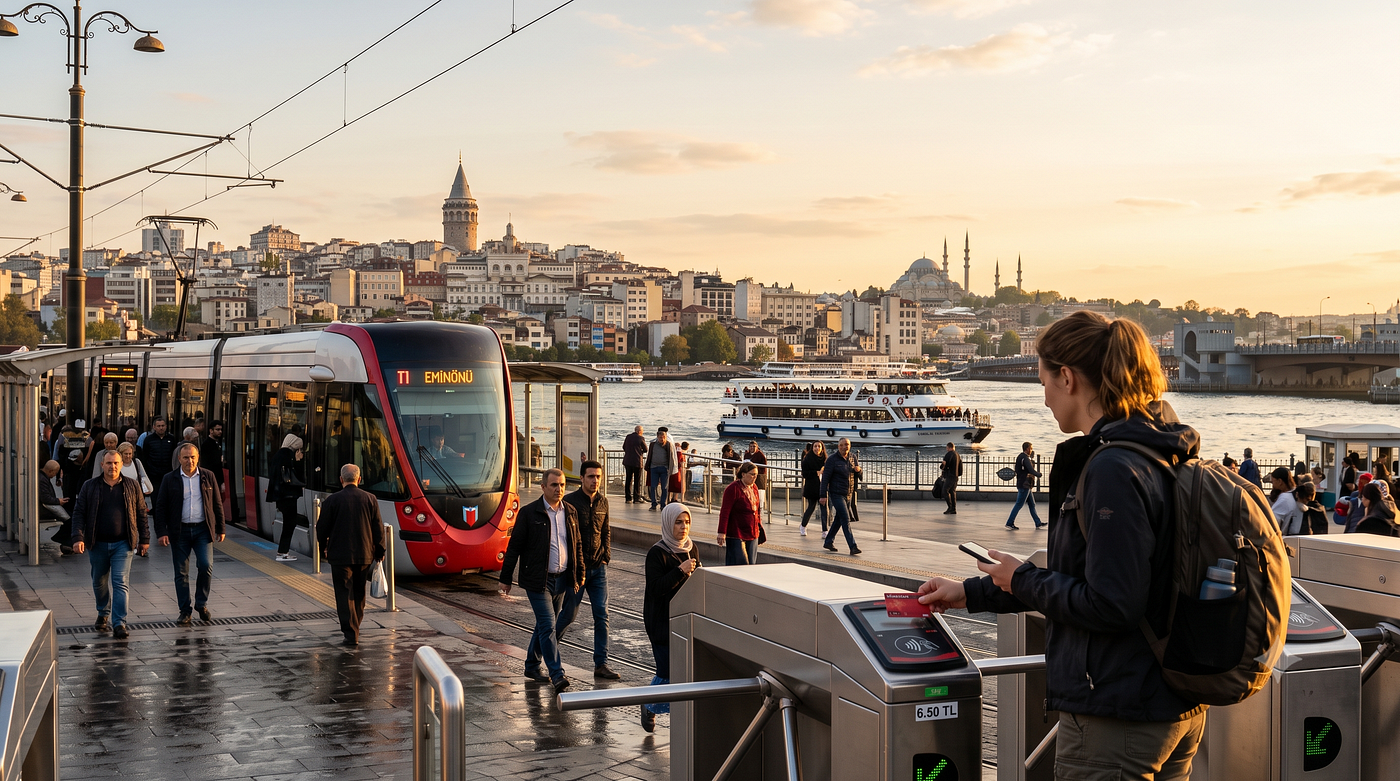
Istanbul is not a city you can understand by looking at a simple metro map.
It stretches across Europe and Asia, is divided by the Bosphorus and combines metro lines, trams, ferries, buses, underground trains, funiculars and cable cars into one enormous transport network.
At first, it can feel overwhelming. In reality, getting around Istanbul is easier than it looks — once you know which services are useful, how to pay and which mistakes to avoid.
The most important rule is simple: do not rely entirely on taxis. Istanbul’s traffic can turn a short journey into a long and expensive one. Metro trains, trams, Marmaray and ferries are often faster, cheaper and more enjoyable.
The Five Things You Should Know Before Your First Journey
If you remember nothing else from this guide, remember these five points:
- Buy an Istanbulkart or use a contactless bank card.
- Always check the final destination before boarding.
- Use ferries and rail transport whenever possible.
- When paying by card, always choose Turkish lira.
- Understand that Uber in Istanbul usually means a regular licensed taxi.
Once you know these basics, the rest becomes straightforward.
Istanbulkart: The Easiest Way to Pay
The Istanbulkart is a rechargeable card used throughout the city’s public transport network.
It works on:
- Metro trains
- Trams
- Public buses
- Ferries
- Marmaray
- Metrobus
- Funiculars
- Cable cars
Tourists normally purchase an anonymous Istanbulkart from yellow or blue ticket machines located at metro stations, tram stops, ferry terminals and airport transport areas.
The card itself and the travel balance are separate. After purchasing the card, you must load Turkish lira onto it.
To add credit:
- Place the Istanbulkart on the machine’s reader.
- Select the top-up option.
- Insert cash or choose one of the available card payment methods.
- Wait for the confirmation message.
- Do not remove the card until the transaction is complete.
Not every machine offers exactly the same payment options, so keeping some Turkish lira banknotes is sensible.
Any unused credit on an anonymous Istanbulkart is generally not refundable at the end of your visit. Add smaller amounts and top up when necessary.
One card may work for multiple passengers on some services, but purchasing one card per traveller is easier, especially when passing through gates or using distance-based transport.
You Can Also Pay With a Contactless Bank Card
Visitors can use contactless credit and debit cards directly on Istanbul’s main public transport services.
You can tap your card at the gate or reader in much the same way as an Istanbulkart. The official Istanbul tourism portal confirms that contactless cards are accepted across the public transport network.
This is useful if you only plan to make a small number of journeys or do not want to purchase a separate transport card.
For longer stays or frequent journeys, Istanbulkart may still be easier because you can see and control the balance allocated specifically for transport.
Why Revolut Can Be Useful in Istanbul
For international visitors, one of the most practical payment options is Revolut.
Revolut supports Turkish lira payments and sends an instant notification after every transaction. This is particularly helpful in Istanbul because you can immediately compare the amount charged with the amount displayed on the payment terminal.
You can exchange money into Turkish lira through the app or allow the card to convert the payment automatically.
The app also allows you to:
- Monitor your spending in real time
- Set spending limits
- Freeze your card immediately
- Use a virtual card
- Add the card to Apple Pay or Google Pay
When a terminal or ATM asks which currency you want to use, always select:
Turkish lira — TRY
Do not choose euros, pounds or your home currency. Choosing another currency may allow the merchant or ATM operator to perform the conversion using its own exchange rate.
Revolut’s exchange limits, weekend markups, ATM limits and plan conditions may apply.
Disclosure: The Revolut link above is a referral link.
Always Check the Amount Before Paying
Cards are widely accepted in Istanbul, but you should never tap your card without checking the terminal first.
Some restaurants, shops and market sellers may quote one price and then add an extra amount as a card-processing commission.
Before authorising a payment:
- Ask whether the price changes when paying by card.
- Confirm the final amount.
- Check that the payment is in Turkish lira.
- Compare the terminal amount with the agreed price.
- Request a receipt.
- Check the transaction notification on your phone.
If the amount is different, ask the merchant to cancel the transaction before you enter your PIN or tap your card.
If someone claims that the first payment failed, check your banking app before approving another transaction.
How Much Does Public Transport Cost?
As of July 2026, the standard full fare listed by Metro Istanbul for an anonymous Istanbulkart is ₺46.20.
However, this does not mean every journey has the same price.
Marmaray, Metrobus, airport services, longer ferry routes and certain special services may use different or distance-based fares. Prices can also change, so check the latest information on the official Metro Istanbul fare page.
The reader will normally display the amount deducted and the remaining Istanbulkart balance.
Make sure you have enough credit before boarding a bus because not every bus stop has a top-up machine.
The T1 Tram: The Line Most Visitors Need
The T1 Kabataş–Bağcılar tram is the most useful line for visitors staying in Istanbul’s historic centre.
It passes close to:
- The Grand Bazaar
- Sultanahmet
- Hagia Sophia
- The Blue Mosque
- Topkapı Palace
- Gülhane Park
- Sirkeci
- Eminönü
- The Spice Bazaar
- Karaköy
- Galataport
- Kabataş
To use the tram, tap your Istanbulkart or contactless card at the station entrance.
Before boarding, check the final destination displayed on the platform. The final station tells you the direction of travel.
The T1 becomes extremely crowded, particularly around Sultanahmet, Eminönü and the Grand Bazaar. Keep your phone, wallet and passport somewhere secure rather than in an open pocket.
The M2 Metro: Taksim, Galata and Modern Istanbul
The M2 Yenikapı–Hacıosman metro line connects the historic peninsula with several important areas of modern Istanbul.
Useful stops include:
- Yenikapı
- Vezneciler
- Şişhane
- Taksim
- Osmanbey
- Şişli–Mecidiyeköy
- Gayrettepe
- Levent
For Galata Tower, take the M2 to Şişhane and continue on foot.
For Taksim Square and İstiklal Street, leave at Taksim.
Gayrettepe is also an important interchange for passengers travelling to or from Istanbul Airport using the M11 metro.
Ferries Are Public Transport, Not Just Sightseeing
One of the biggest mistakes visitors make is treating Istanbul’s ferries only as tourist attractions.
Ferries are an essential part of the public transport network and often provide the most enjoyable way to cross between Europe and Asia.
Popular routes include:
- Eminönü to Kadıköy
- Karaköy to Kadıköy
- Eminönü to Üsküdar
- Kadıköy to Beşiktaş
- Kadıköy to Kabataş
You can normally pay by tapping your Istanbulkart or contactless bank card at the terminal entrance. Reservations are not usually needed for regular commuter ferries.
The views are excellent, tea and snacks are often available, and you avoid Istanbul’s road traffic.
Regular ferries are different from private Bosphorus cruises. Check the destination before entering because several ferry routes may depart from the same general area.
Current routes and departure times are available from Şehir Hatları.
Marmaray: Cross Two Continents in Minutes
Marmaray is an underground and suburban railway connecting Halkalı on Istanbul’s European side with Gebze on the Asian side.
Useful stations include:
- Sirkeci
- Yenikapı
- Üsküdar
- Ayrılık Çeşmesi
For visitors staying near Sultanahmet, Marmaray is one of the fastest ways to reach Üsküdar and the Asian side.
The train crosses underneath the Bosphorus, making the journey between Sirkeci and Üsküdar surprisingly short.
Marmaray uses distance-based pricing. Depending on the card and route, a higher fare may initially be deducted. After exiting, look for a refund machine and tap your Istanbulkart to check whether a partial refund is available.
When Should You Use a Bus?
Istanbul’s bus network reaches neighbourhoods that are not directly served by metro or tram.
To use a public bus:
- Check the route number and destination.
- Enter through the front door.
- Tap your Istanbulkart or contactless card.
- Follow the route on your phone.
- Press the stop button before your destination.
Buses are useful, but they are affected by traffic. A journey that looks short on the map may take much longer than expected.
During peak hours, choose the metro, tram, Marmaray or ferry whenever possible.
Use the Funiculars to Avoid Istanbul’s Hills
Istanbul is a very hilly city, and some short transport lines can save you a difficult walk.
The F1 funicular connects Kabataş with Taksim. It is especially useful if you take the T1 tram to Kabataş and want to continue to Taksim Square.
Other useful services include:
- The historic Tünel between Karaköy and Beyoğlu
- The TF2 cable car between Eyüpsultan and Pierre Loti
- The F4 funicular between Aşiyan and Boğaziçi University
These services form part of the city’s public transport network.
Travelling From Istanbul Airport — IST
The M11 airport metro provides a fast rail connection from Istanbul Airport.
For Taksim and the modern city centre, take the M11 towards Gayrettepe and transfer to the M2 metro.
The M11 also provides connections towards Halkalı on Istanbul’s western side.
HAVAİST airport buses serve several areas of the city and may be more convenient when travelling with large luggage or arriving outside normal metro hours.
Always check the current route because airport shuttle stops and schedules can change.
Travelling From Sabiha Gökçen Airport — SAW
The M4 metro line connects Sabiha Gökçen Airport with Kadıköy on the Asian side.
From Ayrılık Çeşmesi, you can transfer to Marmaray and continue towards the European side.
From Kadıköy, you can take a ferry to:
- Eminönü
- Karaköy
- Beşiktaş
- Kabataş
HAVABUS airport coaches also operate towards Kadıköy and Taksim.
What You Should Know About Uber in Istanbul
Uber is available in Istanbul, but it does not work exactly as many international visitors expect.
The application generally connects passengers with local licensed taxis. In many cases, the vehicle arriving will be a normal yellow Istanbul taxi rather than a private Uber car.
Before entering:
- Check the vehicle registration number.
- Confirm the driver’s name.
- Review the estimated price.
- Follow the journey on your phone.
- Check the final amount before approving payment.
- Keep the journey inside the application.
If a driver asks you to cancel the Uber booking and pay directly, you will lose some of the tracking and payment records provided by the app.
Traffic, tolls and route changes may also affect the final price.
The Grand Bazaar Is Not Automatically Cheap
The Grand Bazaar is an extraordinary place to visit, but it should not automatically be considered a destination for cheap shopping.
Many shops are aimed primarily at tourists, and opening prices can be extremely high. Some sellers also use persistent or high-pressure sales tactics.
A seller offering tea, showing several products or spending time with you does not create an obligation to buy.
To avoid overpaying:
- Never accept the first price.
- Compare similar products in several shops.
- Decide your maximum price before negotiating.
- Confirm the currency being used.
- Ask whether paying by card changes the price.
- Agree on the final amount before presenting your card.
- Check the payment terminal carefully.
- Walk away if the seller becomes too persistent.
Negotiation is expected, but you should never feel pressured or uncomfortable.
Five Simple Routes for First-Time Visitors
Sultanahmet to Taksim
Take the T1 tram to Kabataş and transfer to the F1 funicular.
Sultanahmet to Kadıköy
Take the T1 tram to Eminönü and then a ferry to Kadıköy.
Sirkeci to Üsküdar
Use Marmaray to cross underneath the Bosphorus.
Taksim to Galata Tower
Take the M2 metro to Şişhane and continue on foot.
Eminönü to Pierre Loti
Take the T5 tram towards Eyüpsultan and then the TF2 cable car.
Do You Need Travel Insurance for Istanbul?
Even a short city break can be affected by an unexpected medical problem, lost baggage, a cancelled flight or a missed connection.
Depending on the selected policy, travel insurance may provide benefits for:
- Emergency medical treatment
- Hospitalisation
- Emergency assistance
- Lost or delayed baggage
- Covered flight delays or cancellations
- Missed connections
- Trip interruption
- Medical evacuation or repatriation
Before purchasing a policy, make sure that Turkey and any countries where you have a flight connection are correctly included.
Keep medical reports, receipts, police reports and airline confirmations because they may be needed when submitting a claim. If you experience an emergency, contact the assistance company shown on your insurance certificate as soon as possible.
Travel insurance does not cover every unpleasant experience. It will not normally reimburse you simply because you paid too much in the Grand Bazaar, accepted an unfavourable exchange rate or disagreed with a taxi driver about the price.
It covers specific unexpected events according to the benefits, limits and exclusions of the selected policy.
For more information about available protection and what to check before travelling, read this detailed guide to travel insurance for Istanbul from SoEasy Travel Insurance.
Always review the coverage table and policy wording before purchasing a plan.
Final Advice
The best way to move around Istanbul is usually to combine several forms of transport.
Use the tram for the historic centre, the metro for Taksim and the modern districts, Marmaray for a fast journey between continents and ferries when you want to avoid traffic while enjoying the Bosphorus.
Keep an Istanbulkart or contactless card ready, pay in Turkish lira and always check the amount before approving a transaction.
After your first few journeys, Istanbul’s transport network will stop feeling complicated. It will become part of the experience — and often one of the best parts of visiting the city.
메타데이터
- post_id
- 1344f824a608
- slug
- how-to-get-around-istanbul-without-getting-lost-overcharged-or-stuck-in-traffic-1344f824a608
- url
- https://medium.com/@ionut_33966/how-to-get-around-istanbul-without-getting-lost-overcharged-or-stuck-in-traffic-1344f824a608
- canonical_url
- https://medium.com/@ionut_33966/how-to-get-around-istanbul-without-getting-lost-overcharged-or-stuck-in-traffic-1344f824a608
- author_url
- https://medium.com/@ionut_33966
- status
- ok
- fetched_at
- 2026-07-28 08:53:04