The Easiest Way to Make Money With AI (Without Coding or Capital)
Most people are either overcomplicating AI or barely using it — the real money lies somewhere in between.
The Easiest Way to Make Money With AI (Without Coding or Capital)
Most people are either overcomplicating AI or barely using it — the real money lies somewhere in between.
Why Everyone Feels Behind in AI

Every day, there’s a new AI tool, a new model, a new post telling you that you’re already late.
If you’ve been following this space even casually, there’s a good chance you’ve felt this quiet pressure building in the background — like everyone else has figured something out that you haven’t.
And when you actually try to use AI, you usually end up in one of two places:
- You use it for basic things, writing emails, summarizing articles, maybe generating some ideas
- Or you go too deep, trying to understand tools, workflows, coding, automation… and it quickly gets overwhelming
Both paths feel active. But neither really leads anywhere meaningful in terms of making money.
That’s where most people get stuck.
If you’re being honest, you’re probably somewhere in between — not a complete beginner, but not building anything real either.
This article is for that middle ground.
Because the real opportunity with AI isn’t at the extremes. It’s in a simpler, more practical layer that most people ignore.
2. Core Idea: AI Is a Tool, Not a Business
The biggest mistake people make right now is treating AI like the business itself.
It’s not.
AI is just a tool. A very powerful one, but still just a tool.
You don’t make money because you’re “using AI.” You make money when AI is applied to something that already works as a business model.
A simple way to think about it:
AI + the right industry = results
And this is exactly where things go wrong for most people.
They focus too much on the tool, which AI to use, how advanced it is, what it can do — instead of asking a more important question:
Where does this actually make sense to use?
Because here’s the reality:
AI can make things faster, cheaper, and easier. But it doesn’t remove the core challenges of a business.
If the underlying model is expensive, risky, or complex — AI won’t magically fix that.
And that’s why you see so many people trying different “AI side hustles” without getting real results.
Not because AI doesn’t work.
But because they’re using it in the wrong place.
3. Industry Reality Check (What Works vs What Doesn’t)
Before talking about what works, it’s more useful to look at what doesn’t — especially from a beginner’s perspective.
Because a lot of popular “AI business ideas” sound good on the surface, but break down when you look at how they actually operate.
3.1 Physical Products (Ecommerce, Dropshipping)
This includes things like Amazon FBA, dropshipping, or selling your own products online.
AI has definitely made parts of this easier.
You can:
- Generate product descriptions
- Create ad copy
- Design product images
- Analyze trends faster
A few years ago, this would’ve required a team. Now, one person with the right tools can do it.
But the core problems are still there:
- You still need to source or manufacture a product
- You still need to handle shipping and logistics
- You still need to pay for inventory or deal with suppliers
None of that goes away.
So even if AI improves the “online” side of the business, the real-world complexity and cost are still there.
For someone starting with no capital, this is a difficult place to begin.
3.2 Investments (Stocks, Crypto, Real Estate)
Another area where AI is being heavily used is investing.
AI can:
- Analyze large amounts of data
- Spot trends
- Generate reports
- Even automate certain trading strategies
On paper, it sounds ideal.
But the structure of the industry doesn’t change.
- You still need money to invest
- You still carry all the risk
- And most importantly, you still have to deal with uncertainty
Even with the best tools, you’re putting real money on the line in markets you don’t control.
And for beginners, that combination — capital + risk — is usually what leads to losses, not profits.
3.3 Software / SaaS
This is probably the most hyped category right now.
With AI, you can:
- Generate code
- Build prototypes
- Design interfaces
- Launch something much faster than before
What used to take months can now take days.
But here’s what doesn’t change:
- You still need users
- You still need distribution
- You still need to turn it into something people actually pay for
Building the product is only a small part of the equation.
The harder part is:
- Getting attention
- Acquiring users
- Retaining them long enough to become profitable
Most software businesses don’t make money immediately. Many run at a loss in the beginning.
So even though AI has made building easier, it hasn’t made the business side any simpler.
3.4 Services (Freelancing, Agencies)
Services are probably the most practical option out of all of these.
With AI, you can:
- Build websites
- Write content
- Edit videos
- Design graphics
Things that used to take months to learn can now be done much faster.
But two things still remain:
- You need to find clients
- You need to maintain those relationships
AI doesn’t bring you clients automatically. And it doesn’t manage expectations, communication, or trust.
Also, most service-based work is still tied to your time.
More clients = more work.
So while AI improves delivery, it doesn’t remove the dependency on effort.
At this point, a pattern starts to emerge.
Across all these industries, AI helps with execution. But it doesn’t eliminate the underlying constraints — money, risk, time, or complexity.
And that’s the part most people overlook.
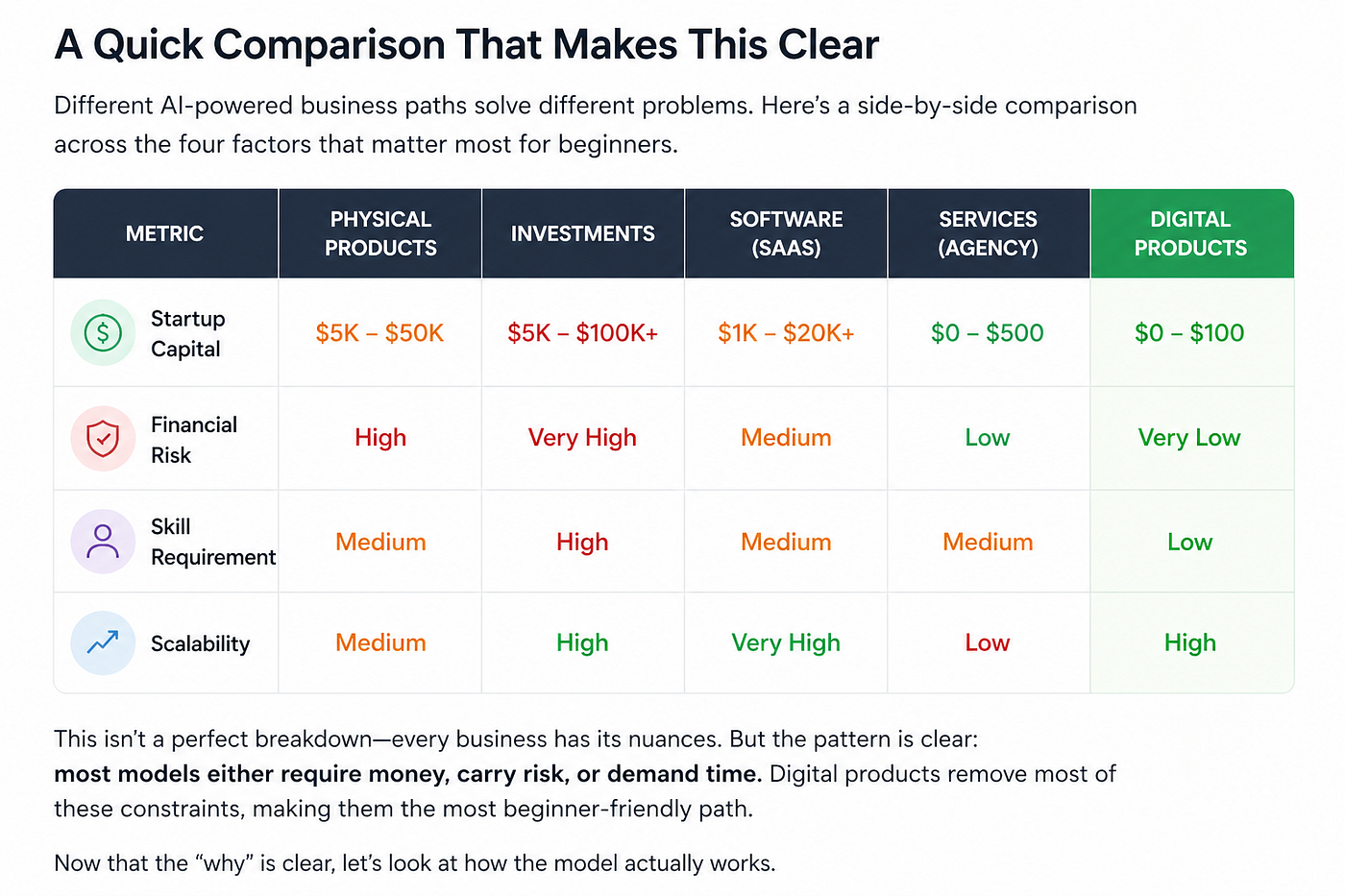
A simple comparison of common AI business models,most require capital, carry risk, or depend on time, while digital products remove many of these constraints.
4. Pattern Recognition: What Actually Matters
If you step back and look at all the industries we just covered, a pattern becomes obvious.
- Physical products need capital and logistics
- Investments need capital and carry risk
- Software needs distribution and time to become profitable
- Services need clients and ongoing effort
AI improves parts of each model — usually the execution layer.
But it doesn’t remove the core constraints.
- It doesn’t eliminate financial risk
- It doesn’t remove the need for customers
- It doesn’t break the link between time and income (in most cases)
This is where most people misjudge AI.
They expect it to fix the hardest parts of a business, when in reality it mostly speeds up the easier parts.
So instead of asking:
“What can AI do?”
A better question is:
“Where does AI remove most of the friction without adding new problems?”
That’s the shift that leads to better decisions.
5. The Better Model: Digital Products
If you apply that thinking, one model stands out quickly — digital products.
5.1 What This Actually Means
A digital product is anything you can create once and deliver digitally.
For example:
- A PDF guide
- A template or toolkit
- A short course or video training
- A checklist, system, or framework
At its core, it’s simple:
Solve one specific problem → package the solution → deliver it digitally
There’s no inventory, no shipping, no physical constraints.
Someone buys it, and it gets delivered instantly.
5.2 Why This Model Fits Beginners
Compared to the ind ustries above, this model removes most of the friction:
- No upfront investment required
- No manufacturing or logistics
- No cost per unit sold
- High margins (almost everything is profit)
- Scales without increasing workload
If 10 people buy, or 1,000 people buy — the effort on your side is almost the same.
That’s a very different structure from services or physical products.
And more importantly:
If something doesn’t work, you haven’t lost money. You can adjust, improve, or try again.
That makes it one of the lowest-risk ways to start.
5.3 Where AI Fits In
This is where AI actually becomes useful in a meaningful way.
AI can help with:
- Researching a topic quickly
- Structuring information into something usable
- Writing and organizing content
- Speeding up the entire creation process
What used to take weeks can now be done in hours.
But it’s important to be clear about one thing:
AI doesn’t replace thinking.
You still need to:
- Choose the right problem
- Understand who it’s for
- Decide what actually makes it valuable
AI handles execution. You handle direction.
And that combination is what makes this model practical for beginners.
6. The 3-Step System (How It Actually Works)
Once you understand the model, the process itself is straightforward.
Step 1: Find Demand (Not Passion)
This is where most people go wrong.
They start with what they like, instead of what people are already trying to solve.
The market doesn’t reward interest. It rewards solutions.
So instead of choosing something broad like:
- Fitness
- Productivity
- Making money
You go specific.
For example:
- How to reduce knee pain for beginner runners
- How to manage screen time for remote workers
- How to organize notes for students preparing for exams
The more specific the problem, the clearer the demand.
A simple way to think about it:
If people are already searching for a solution, they’re more likely to pay for a better one.
Step 2: Build Using AI
Once the problem is clear, creation becomes much easier.
AI can:
- Gather and summarize information
- Structure it into sections or steps
- Help write and format the content
Instead of starting from scratch, you’re working with a system that accelerates the process.
The goal isn’t to create something “perfect.”
It’s to create something:
- Clear
- Useful
- Focused on solving one problem
At the end of this step, you should have a product that’s ready to be shared or sold.
Step 3: Distribution (Not Selling)
This is another place where people overcomplicate things.
You don’t need to become a salesperson.
You need to be visible where buyers already exist.
There are platforms where people go specifically to find solutions — templates, guides, tools, courses.
Your role is simple:
Have the right product in the right place at the right time
That’s distribution.
Not persuasion.
You’re not convincing someone they have a problem. You’re offering a solution to someone who already knows they have one.
And that difference matters.
At this point, the model is clear:
- Low cost to start
- Low risk to test
- Scalable if it works
- Supported by AI for speed and execution
The remaining questions are usually not about “how it works,” but about doubts and edge cases, which is where most people hesitate.
7. Objections People Have (Before They Even Start)
By this point, the model usually makes sense on paper.
But this is also where most people pause — not because the process is unclear, but because of a few common doubts.
Let’s address the obvious ones directly.
“I don’t have money”
That’s exactly why this model exists.
Unlike physical products or ads-driven businesses, you’re not paying for inventory, tools, or distribution upfront.
You can create and test ideas without putting capital at risk.
The constraint here isn’t money. It’s clarity and consistency.
“I don’t have skills”
A few years ago, this would’ve been a valid concern.
Today, it’s less of a blocker.
AI can help with:
- Structuring ideas
- Writing content
- Organizing information
But there’s an important distinction:
You don’t need expert-level skills. You do need a basic understanding of the problem you’re trying to solve.
If you can think clearly about a problem, you can build something useful around it.
“What if it becomes saturated?”
This question comes up in almost every online model.
And it’s fair.
But saturation usually happens at the broad level, not at the specific level.
“Fitness” is saturated. “Fixing lower back pain for desk workers in their 30s” is not.
The more specific you go:
- The less competition you face
- The more relevant your product becomes
Also, most people don’t execute consistently enough to create real saturation.
These objections don’t disappear completely.
But they become manageable once you understand what actually matters.
8. Important Mistake: Using Generic AI
Even after understanding the model, a lot of people struggle with execution.
One of the main reasons is the way they use AI.
Most people rely only on general-purpose tools — the kind that can “do everything.”
The problem is:
When a tool tries to do everything, the output is often too generic.
And generic content has two issues:
- It’s easy to find elsewhere
- It doesn’t feel worth paying for
That’s why many AI-generated products don’t perform well.
Not because the idea is bad, but because the execution feels replaceable.
A better approach is to think in terms of specific tools for specific tasks.
- Tools for writing
- Tools for design
- Tools for formatting or presentation
Each one is optimized for a particular outcome.
The difference shows up in the final product.
Less time fixing outputs. More time refining the idea.
9. Timing: Why This Window Matters
Every online opportunity follows a similar pattern.
- Early stage → low competition, high opportunity
- Growth stage → increasing competition
- Saturation → lower margins, harder entry
We’ve seen this with:
- Dropshipping
- Amazon FBA
- Content creation platforms
Digital products — especially with AI — are still in a relatively early phase.
Demand is growing quickly.
More people are:
- Learning online
- Looking for specific solutions
- Willing to pay for speed and clarity
But supply hasn’t fully caught up yet.
There are still gaps:
- Problems people are trying to solve
- Solutions that haven’t been packaged well
That gap is where the opportunity exists.
It won’t stay open forever.
As more people understand the model, competition will increase.
Which means timing becomes a factor — not in a dramatic sense, but in a practical one.
Starting earlier gives you more room to experiment, learn, and position yourself before things get crowded.
By now, the model, the process, and the constraints are clear.
What’s left isn’t really about understanding — it’s about deciding whether to act on it or not.
10. Reality Check (Before You Overestimate This)
At this point, it can start to sound simpler than it actually is.
So it’s worth grounding this properly.
This is not a “create once, make money instantly” setup.
It’s a low-risk, iteration-based model.
That means:
- Your first product will likely not be great
- Your second might be slightly better
- Somewhere along the way, something starts working
The advantage here isn’t instant success.
The advantage is that:
- You’re not losing money while learning
- You’re improving with each attempt
- You can keep testing without pressure
Most people fail in other models because they run out of money or time.
Here, the main constraint is whether you’re willing to keep refining.
So a more accurate expectation is:
Build → test → adjust → repeat
Instead of:
Build once → expect results
That shift matters more than anything else.
11. Conclusion
If you strip everything down, the idea is simple.
- AI is not a business
- It’s a tool that amplifies what you’re already doing
And the outcome depends less on the tool, and more on where you apply it.
Most popular paths still carry:
- Cost
- Risk
- Complexity
AI makes parts of them easier, but doesn’t remove those fundamentals.
Digital products are different in one key way:
They remove most of those constraints.
- No inventory
- No upfront investment
- Minimal ongoing cost
- Ability to scale without increasing effort
And when you combine that with AI handling a large part of the execution, the model becomes accessible in a way it wasn’t before.
Not easy — but accessible.
12. Before You Move On
You don’t need to plan everything out perfectly.
A more practical approach is to start small:
- Pick one specific problem
- Try building a simple solution around it
- See how people respond
That alone will teach you more than consuming more content about it.
If you had to start from zero today — no coding, no money — what kind of digital product would you create first?
Or maybe this doesn’t fit your situation.
What’s the biggest thing stopping you right now?
If this helped, here’s what you can do next:
- Clap for the article so more people can discover it
- **Follow me** for practical, no-fluff breakdowns on AI and online business
- Drop a comment — what would you build first with AI and zero capital?
메타데이터
- post_id
- 134eb9ba71c3
- slug
- the-easiest-way-to-make-money-with-ai-without-coding-or-capital-134eb9ba71c3
- url
- https://medium.com/@amitXD/the-easiest-way-to-make-money-with-ai-without-coding-or-capital-134eb9ba71c3
- canonical_url
- https://medium.com/@amitXD/the-easiest-way-to-make-money-with-ai-without-coding-or-capital-134eb9ba71c3
- author_url
- https://medium.com/@amitXD
- status
- ok
- fetched_at
- 2026-07-14 10:14:39