Building a RAG Platform on AWS- Offline Ingestion + GenAI Deployment 🚀
In this article, I’ll walk through a production-oriented AWS architecture for building an end-to-end RAG ingestion and retrieval platform…
Building a RAG Platform on AWS- Offline Ingestion + GenAI Deployment 🚀
In this article, I’ll walk through a production-oriented AWS architecture for building an end-to-end RAG ingestion and retrieval platform using:
- Amazon Web Services S3
- Amazon Web Services Lambda
- Amazon Web Services Step Functions
- Amazon Web Services ECS Fargate
- Amazon Web Services ECR
- Amazon Web Services Bedrock
- FastAPI
- Vector Databases
- Hybrid Retrieval
High-Level Architecture
The architecture below separates:
- ingestion
- orchestration
- processing
- retrieval
- online inference
into independently scalable components.

Document Upload
      ↓
Amazon S3
      ↓
Lambda Trigger
      ↓
AWS Step Functions
      ↓
ECS/Fargate GenAI Workers
      ↓
Chunking + Embeddings
      ↓
Vector Database
      ↓
FastAPI Runtime APIs
      ↓
Amazon Bedrock LLM
Step 1 — Document Upload to S3
S3 acts as the durable ingestion layer.
Typical uploads:
- PDFs
- DOCX
- PPT
- Excel
- images
Example:
s3://enterprise-rag-documents/hr/policy.pdfS3 provides:
- durability
- versioning
- lifecycle policies
- scalable object storage
This becomes the central source for ingestion workflows.
Step 2 — Event-Driven Ingestion with Lambda
Whenever a document is uploaded, S3 emits an event notification.
Lambda functions receive:
- bucket name
- file path
- metadata
Example payload:
{
  "bucket": "enterprise-rag-documents",
  "key": "hr/policy.pdf"
}
Lambda is intentionally lightweight.
Its responsibilities:
- validate uploads
- extract metadata
- trigger orchestration
- initiate processing pipelines
Why Heavy Processing Should NOT Run in Lambda
Many teams initially attempt to:
- parse PDFs
- run OCR
- generate embeddings
inside Lambda.
This quickly becomes problematic because:
- OCR is compute-heavy
- embeddings are latency-intensive
- large PDFs exceed memory limits
- execution timeouts occur frequently
Lambda works best as: ✅ a trigger layer ✅ lightweight routing layer
— not as the primary GenAI execution engine.
Step 3 — Orchestration with Step Functions
Step Functions manage workflow orchestration.
This layer coordinates:
- execution sequencing
- retries
- state tracking
- failure handling
- parallel task execution
Typical orchestration stages:
Validate File
      ↓
Extract Metadata
      ↓
Chunk Document
      ↓
Generate Embeddings
      ↓
Store in Vector DB
      ↓
Update Metadata
One major advantage of Step Functions is observability.
Instead of debugging logs across multiple services, teams gain:
- visual workflow tracking
- retry visibility
- execution history
- operational transparency
This becomes critical in enterprise environments.
Step 4 — ECS/Fargate for GenAI Processing
The actual GenAI processing happens inside ECS workers.
This includes:
- PDF parsing
- OCR
- structure-aware chunking
- embedding generation
- metadata enrichment
- vector DB ingestion
ECS/Fargate is ideal because it supports:
- long-running jobs
- scalable containers
- heavy compute workloads
- autoscaling
- Docker-based deployment
Why ECS Works Better for Enterprise GenAI
GenAI workloads are fundamentally different from lightweight APIs.
A single ingestion task may require:
- OCR models
- PDF parsers
- embedding pipelines
- NLP preprocessing
- image extraction
These workloads demand:
- higher memory
- longer execution windows
- scalable compute
This is exactly where ECS excels.
Chunking Strategy Is Extremely Important
One of the most underestimated parts of RAG systems is chunking.
Naive chunking:
500 characters per chunkoften performs poorly in enterprise environments.
Production systems require:
- section-aware chunking
- title-aware chunking
- semantic chunk boundaries
- table-aware extraction
- metadata lineage
- parent-child chunk relationships
Why?
Because retrieval quality directly impacts hallucination rates.
Bad chunks → poor retrieval → hallucinated answers.
Metadata Is Critical
Every chunk should carry metadata such as:
{
  "doc_id": "policy_001",
  "page": 12,
  "section": "Leave Policy",
  "department": "HR"
}
Metadata enables:
- filtering
- traceability
- citations
- RBAC access control
- source attribution
Without metadata, enterprise RAG systems quickly become unmanageable.
Embedding Generation
Once chunking completes, embeddings are generated.
Typical models:
- Titan Embeddings
- OpenAI embeddings
- MiniLM
- Bedrock embedding models
Each chunk becomes a high-dimensional vector representation stored in a vector database.
Vector Database Layer
The vector database powers semantic retrieval.
Common choices include:
- Pinecone
- OpenSearch
- pgvector
- Weaviate
- FAISS
This layer stores:
- embeddings
- metadata
- chunk references
and enables efficient similarity search.
Why Hybrid Retrieval Is Better Than Pure Vector Search
A common misconception:
“Semantic search alone is enough.”
In production systems, hybrid retrieval usually performs significantly better.
Typical architecture:
BM25 + Vector Search + RerankingWhy?
Semantic search struggles with:
- exact invoice numbers
- policy IDs
- compliance references
- transaction IDs
- exact keyword matching
Hybrid retrieval combines:
- semantic similarity
- keyword precision
to improve grounding accuracy.
FastAPI as the Online Runtime Layer
FastAPI exposes GenAI APIs such as:
POST /chat
POST /search
POST /summarize
Responsibilities include:
- query embedding
- retrieval orchestration
- prompt construction
- Bedrock invocation
- response formatting
Runtime RAG Query Flow
The online inference flow looks like this:
User Query
      ↓
FastAPI
      ↓
Hybrid Retrieval
      ↓
Top-K Chunks
      ↓
Prompt Construction
      ↓
Amazon Bedrock
      ↓
Grounded Response
This ensures responses remain grounded in enterprise knowledge.
Why Docker + ECS + ECR Matter
Production GenAI systems require reproducible deployments.
Containerization enables:
- consistent environments
- scalable deployments
- CI/CD automation
- dependency isolation
- autoscaling
Typical deployment flow:
Git Push
     ↓
CI/CD Pipeline
     ↓
Docker Build
     ↓
Push to ECR
     ↓
Deploy to ECS
This provides enterprise-grade deployment maturity.
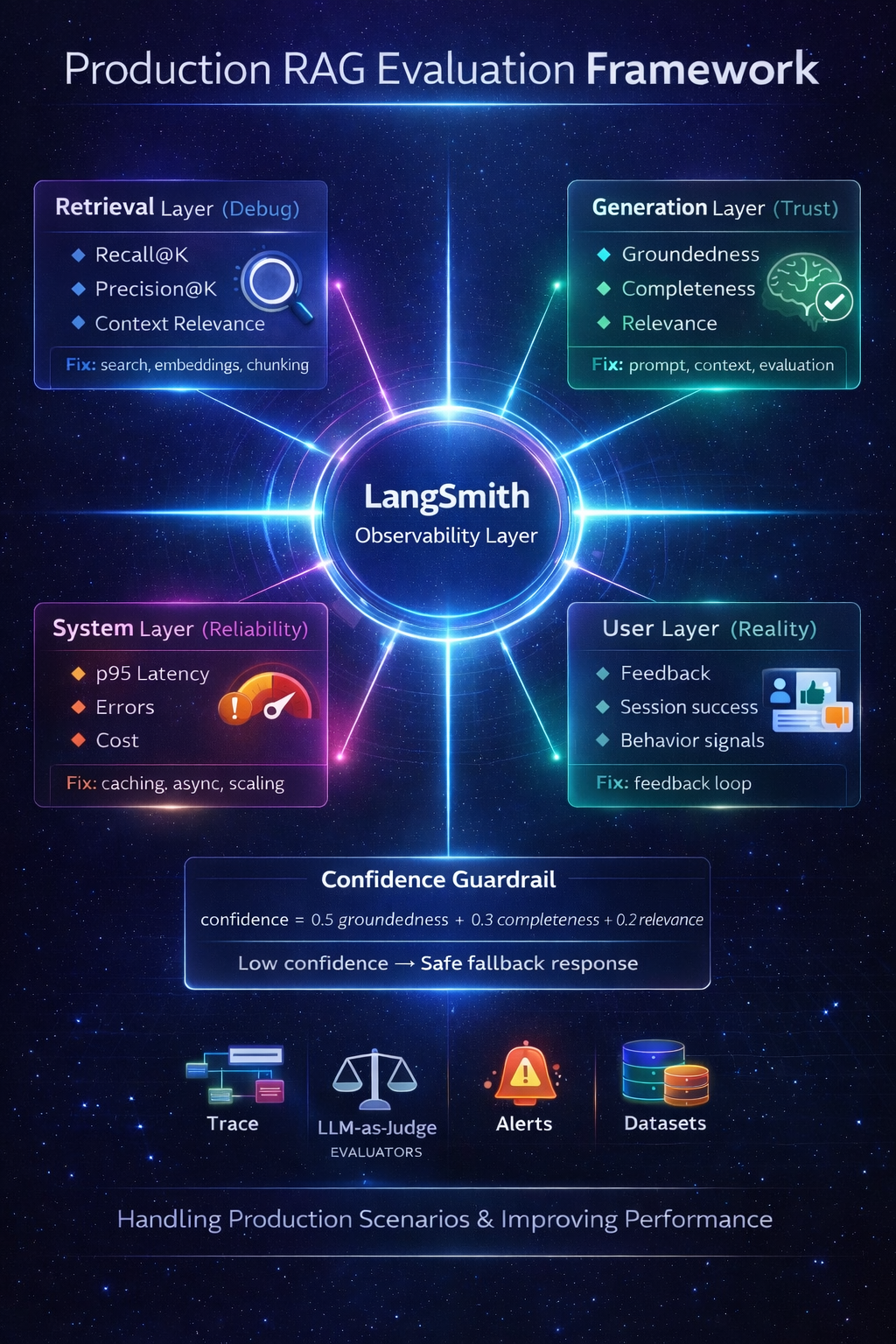
Observability Is Essential
Production RAG systems require deep monitoring.
Important metrics include:
- p95 latency
- embedding failures
- OCR failures
- queue depth
- retrieval latency
- token usage
- hallucination rates
Typical tooling:
- CloudWatch
- LangSmith
- tracing systems
- structured logging
Without observability, debugging GenAI systems becomes extremely difficult.
Final Thoughts
Modern enterprise RAG systems are no longer just about prompt engineering.
They require expertise across:
- AI engineering
- cloud architecture
- retrieval systems
- distributed systems
- orchestration
- infrastructure scalability
The future of GenAI belongs to engineers who can combine:
- LLM systems
- scalable cloud platforms
- retrieval engineering
- platform engineering
- operational reliability
into production-ready AI architectures.
메타데이터
- post_id
- 13803ba0ee89
- slug
- building-a-production-grade-rag-platform-on-aws-13803ba0ee89
- url
- https://medium.com/@namrata.gaddameedi414/building-a-production-grade-rag-platform-on-aws-13803ba0ee89
- canonical_url
- https://medium.com/@namrata.gaddameedi414/building-a-production-grade-rag-platform-on-aws-13803ba0ee89
- author_url
- https://medium.com/@namrata.gaddameedi414
- status
- ok
- fetched_at
- 2026-06-09 15:37:30