The Krater and the Cups: The Theory That Solves the Mystery of 200 Holy Grails
The quest for the Holy Grail is perhaps the most enduring romance of the Western world. For centuries, seekers, scholars, and storytellers…
The Krater and the Cups: The Theory That Solves the Mystery of 200 Holy Grails
The quest for the Holy Grail is perhaps the most enduring romance of the Western world. For centuries, seekers, scholars, and storytellers have fixated on finding a single, unique, and powerful relic — the cup of the Last Supper, the chalice that caught Christ’s blood. But what if this focus on a single object is fundamentally misplaced? What if the true Grail is not a solitary cup, but an entire communion, a “Multi-Grail Reality”?
By viewing the legendary Grail not as a chalice but as a Krater — the large, central serving bowl used in ancient Jewish and Greco-Roman feasts from which wine was ladled — the entire legend unlocks a profound spiritual meaning that perfectly aligns with Christ’s own words.
The Vine and the Branches: A Spiritual Blueprint
In ancient dining, the Krater was the source, the center of the communal meal. The individual drinking cups, or chalices, drew their substance from it. If the original “Graal” was this communal Krater, then the famed “Holy Grail” is not one of 12 or 13 individual cups, but the central vessel itself.
This immediately brings to mind the Gospel of John (15:5): “I am the vine, you are the branches.”
- Christ is the Vine/Krater (Graal): The source of spiritual life, the unifying container of grace and purpose.
- The Disciples are the Branches/Cups: They are extensions of the source, drawing their entire purpose and substance from the central vessel.
In this light, the legendary power of the Grail is not held by a piece of pottery or metal, but by the communion itself. The true Grail is the body of Christ, the Church, and the central, unifying source from which all believers are filled with grace.
The Power of Plurality: A “Multi-Grail” Reality
The legendary Grail is said to imbue its holder with spiritual power. Within this new framework, it becomes clear why Christ’s disciples shared in his purpose and ability — they were not merely recipients; they were filled cups from the same source.
This reinterpretation elegantly solves one of the great mysteries of the Grail quest: the sheer number of contenders. Historians estimate there are over 200 supposed Holy Grails across Europe.
Instead of rejecting them all, this theory embraces them. If the Krater served Christ and his twelve disciples (including Judas, or perhaps the vessel used to catch the blood on the cross), then at the Last Supper, there were at minimum 14 “Holy Grails”: the central serving bowl and the 13 individual cups.
- The elaborate, ornate Valencia Chalice (an ancient agate cup) could plausibly be the “Grail of Jude” or another apostle, reflecting a vessel of some wealth.
- The simple, humble wooden cup, popularized by Indiana Jones and the Last Crusade, could be the “Grail of Peter,” proving that the value lies in its sacred use, not its material wealth.
Every claimed Grail, from the onyx vessel of the Chalice of Doña Urraca to the medieval Nanteos Cup, gains new, internal logic. They are not fakes; they are simply the Grail of Thomas, the Grail of Simon, or the cup of another apostle — each a legitimate vessel, filled from the one true source.
The Living Grail: Apostolic Succession and the Eucharist
This symbolic framework leads to a powerful and theologically profound extension: the concept of the Holy Grail as a continuous, living reality within the Christian faith.
In historic Christian traditions, the authority given by Christ to his apostles is passed down through Apostolic Succession to the priesthood. A key aspect of this authority is the power to consecrate the bread and wine, transforming them into the Body and Blood of Christ during the Eucharist (Communion).
If the power of the original cups was their connection to the Krater, then any chalice, properly consecrated by a priest acting under this valid apostolic authority — a lineage that symbolically traces back to one of the original apostles — becomes a part of that same sacred tradition.
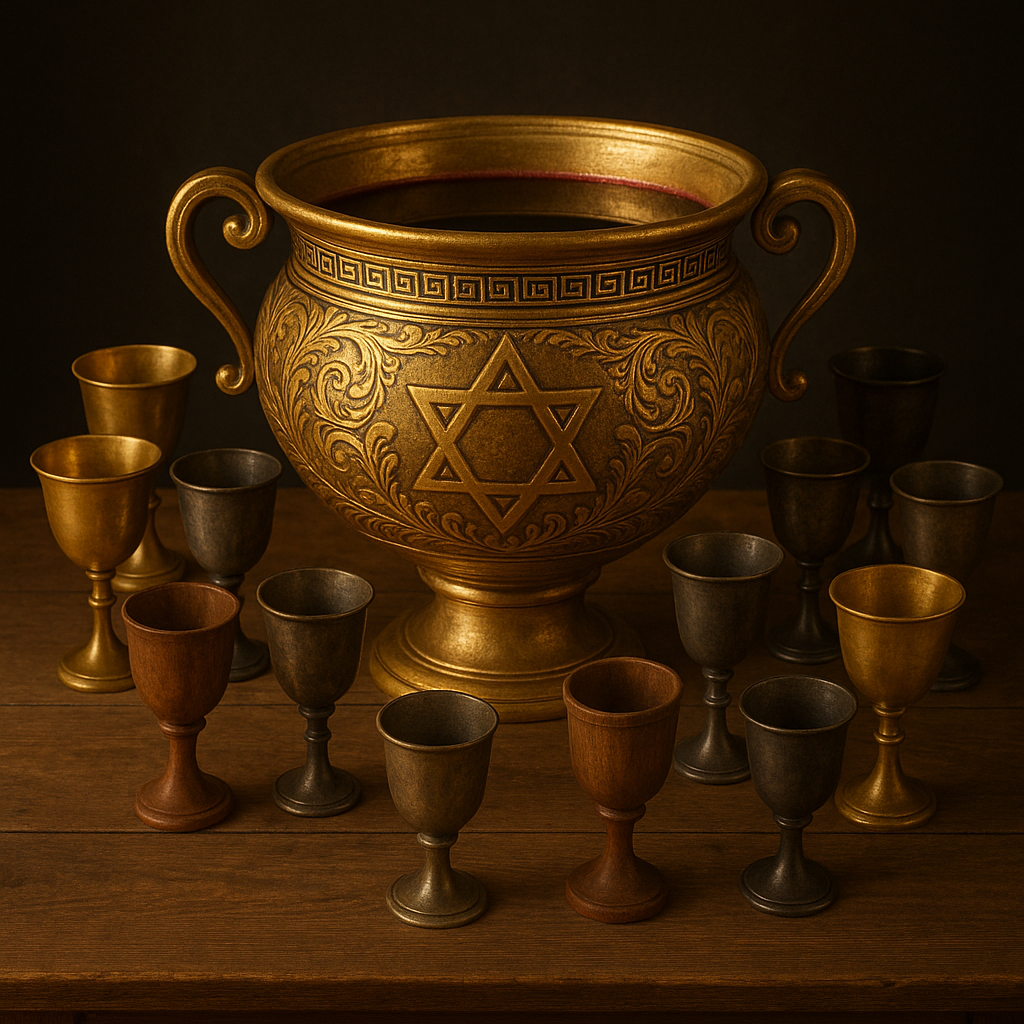
The Krater represents the original institution of the New Covenant. The Apostolic Cups were the initial “Grails.” And the subsequent, consecrated chalices of the Church are the spiritual heirs.
The search for the Holy Grail is not about finding a lost relic. It is about participating in an ongoing sacred act. Every properly consecrated chalice used in a valid celebration of the Eucharist is a “Holy Grail” in a profound spiritual sense.
The quest is over. The Grail is not lost — it is continually poured out and shared, found not in a museum vault, but on the altar of a church near you.
메타데이터
- post_id
- 138e9fc25afb
- slug
- the-krater-and-the-cups-the-theory-that-solves-the-mystery-of-200-holy-grails-138e9fc25afb
- url
- https://medium.com/@r.g.pope.nyc/the-krater-and-the-cups-the-theory-that-solves-the-mystery-of-200-holy-grails-138e9fc25afb
- canonical_url
- https://medium.com/@r.g.pope.nyc/the-krater-and-the-cups-the-theory-that-solves-the-mystery-of-200-holy-grails-138e9fc25afb
- author_url
- https://medium.com/@r.g.pope.nyc
- status
- ok
- fetched_at
- 2026-07-15 19:43:36