LLM vs RAG vs MCP: The Missing Architecture Layers Every AI Engineer Must Understand
Why your AI application works in a demo, fails in production, and how LLMs, RAG, and MCP solve different problems.
LLM vs RAG vs MCP: The Missing Architecture Layers Every AI Engineer Must Understand
Why your AI application works in a demo, fails in production, and how LLMs, RAG, and MCP solve different problems.

The AI industry has a habit of throwing acronyms around like confetti.
A few months ago, everyone was talking about LLMs.
Then came RAG.
Now every AI startup, platform team, and infrastructure vendor is talking about MCP.
Many engineers assume these technologies compete with each other.
They don’t.
In reality:
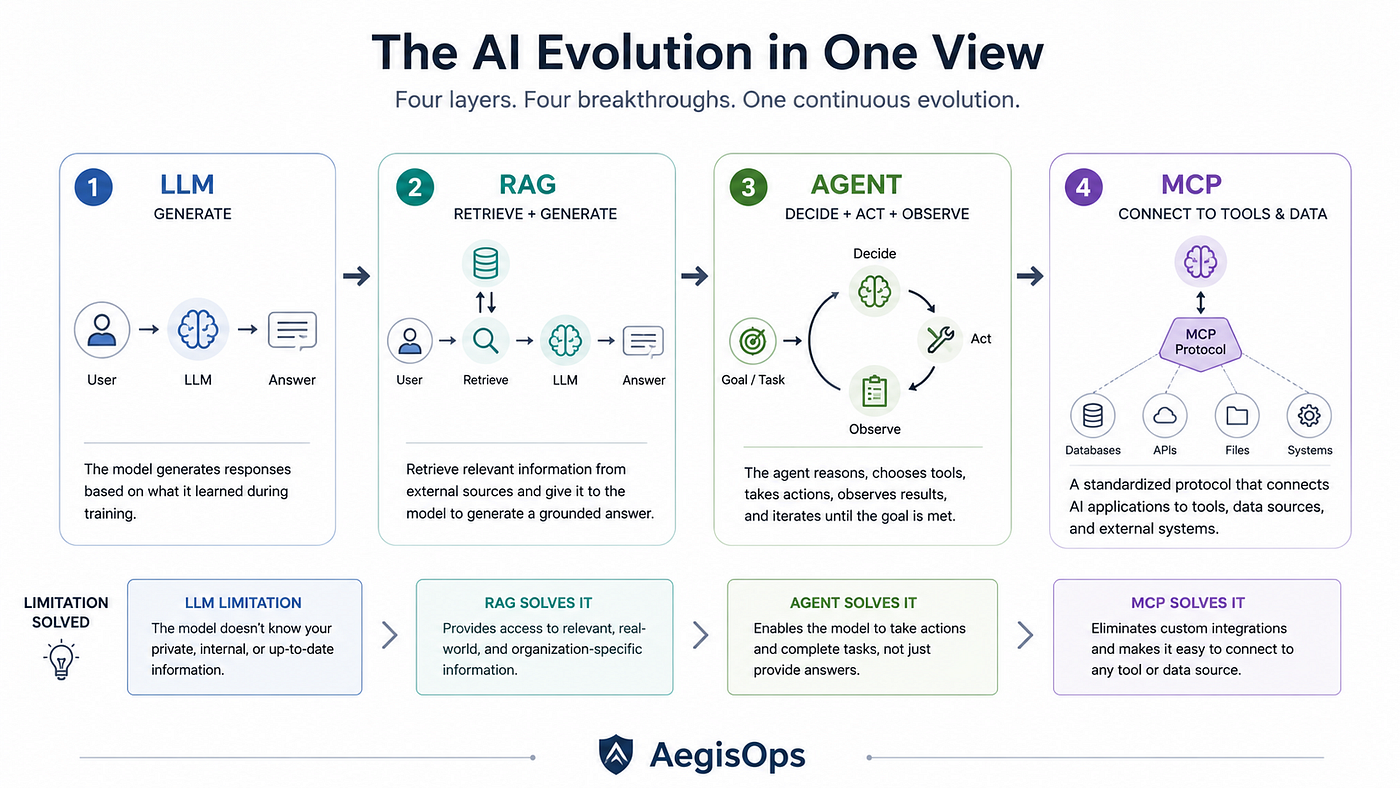
LLM, RAG, and MCP are different layers of an AI architecture stack.
Understanding how they fit together is becoming as important as understanding:
- Containers vs Kubernetes
- VM vs Container
- API Gateway vs Service Mesh
- CI vs CD
For Cloud Engineers, DevOps Engineers, Security Engineers, Platform Engineers, and AI Engineers, this distinction is critical because production AI systems increasingly require all three.
The Evolution of AI Systems
Phase 1: LLM-Only Applications
The earliest AI applications were simple.
User
  ↓
LLM
  ↓
Response
Example:
User: Explain Kubernetes
LLM: Generates explanation
This works because Kubernetes knowledge existed inside the model during training.
But what happens when the user asks:
What's the status of my production cluster?The model has no idea.
Why?
Because the information wasn’t available during training.
This exposed the first major limitation of LLMs.

Layer 1: Understanding LLMs
What is an LLM?
A Large Language Model (LLM) is a neural network trained on massive amounts of text data to predict the next token.
Popular examples include:
- OpenAI GPT models
- Anthropic Claude models
- Meta Llama models
- Google Gemini models
The model stores knowledge in its parameters.
Think of it as:
A brilliant engineer who learned from billions of documents but cannot see your current environment.
Strengths of LLMs
Natural Language Understanding
Convert this Docker Compose file to Kubernetes manifestsCode Generation
def hello():
    print("Hello World")
Documentation Creation
Generate Terraform documentationReasoning
Compare EKS and GKELimitations of LLMs
1. Knowledge Cutoff
Models don’t automatically know:
- Today’s incidents
- Current infrastructure state
- Latest tickets
- Recent deployments
2. Hallucinations
The model may confidently invent:
- APIs
- Commands
- Configuration parameters
3. No Direct Access to Systems
The model cannot inherently access:
- Kubernetes
- AWS
- GitHub
- Databases
- Jira
4. No Enterprise Context
The model doesn’t know:
- Internal documents
- Runbooks
- Policies
- Security controls
This created the need for the next layer.
Layer 2: RAG (Retrieval-Augmented Generation)
RAG was introduced to solve the knowledge problem.
Instead of relying solely on training data:
User Query
     ↓
Retriever
     ↓
Relevant Documents
     ↓
LLM
     ↓
Answer
The model receives external context before generating a response.
Example: AI-Powered Kubernetes Support
Without RAG:
User:
How do we deploy applications?

LLM:
Generic deployment guidance
With RAG:
User:
How do we deploy applications?

Retriever:
Fetches internal deployment standards

LLM:
Answers using company-specific process
Now the response becomes organization-aware.
Typical Enterprise RAG Sources
Documentation
- Confluence
- Wiki pages
- Internal guides
Source Code
- GitHub repositories
- Terraform modules
- Helm charts
Security Policies
- CIS benchmarks
- Internal standards
Operational Data
- Runbooks
- Incident reports
- SOPs
RAG Architecture
Documents
    ↓
Chunking
    ↓
Embeddings
    ↓
Vector Database
    ↓
Similarity Search
    ↓
Relevant Context
    ↓
LLM
Common vector databases include:
- Pinecone
- Weaviate
- Qdrant
- MongoDB Vector Search
- OpenSearch
What RAG Solves
✅ Current knowledge ✅ Enterprise knowledge ✅ Reduced hallucinations ✅ Private data access
What RAG Does NOT Solve
This is where many architectures fail.
RAG provides information.
It does not perform actions.
Example:
User:
Restart my failed pod
RAG can retrieve the runbook.
But it cannot execute:
kubectl delete pod
This leads us to the newest layer.
Layer 3: MCP (Model Context Protocol)
MCP is becoming one of the most important standards in AI infrastructure.
Developed by Anthropic, MCP provides a standardized way for AI models to connect to external tools, systems, and services.
Think of MCP as:
The Kubernetes API for AI tools.
Why MCP Exists
Before MCP:
Every integration required custom code.
AI → GitHub API
AI → Jira API
AI → Kubernetes API
AI → Slack API
AI → AWS API
Each connection was different.
Each needed separate maintenance.
This created integration chaos.
MCP Standardizes Tool Access
Instead:
AI Model
     ↓
MCP Client
     ↓
MCP Servers
     ↓
External Systems
Now every tool follows a common protocol.
Example MCP Ecosystem
Claude
   ↓
  MCP
   ↓
 ├── Kubernetes MCP Server
 ├── AWS MCP Server
 ├── GitHub MCP Server
 ├── Jira MCP Server
 ├── Slack MCP Server
 └── PostgreSQL MCP Server
The AI gains the ability to interact with systems safely and consistently.
What MCP Enables
Infrastructure Operations
Get pod status
Scale deployment
Read logs
Check nodes
Cloud Operations
List EC2 instances
Check EKS clusters
View IAM policies
DevOps Automation
Create pull request
Review code
Trigger pipeline
Security Operations
Check vulnerabilities
Audit permissions
Analyze incidents
Real Kubernetes Example
Without MCP
User:
How many pods are running?

LLM:
I cannot access your cluster.
With MCP
User:
How many pods are running?

MCP:
Queries Kubernetes API

LLM:
You currently have 437 running pods.
Now the AI becomes operationally aware.
LLM vs RAG vs MCP

The Production AI Stack
Modern enterprise AI increasingly looks like this:
                     User
                      │
                      ▼
                AI Assistant
                      │
       ┌──────────────┼──────────────┐
       ▼              ▼              ▼
      LLM            RAG            MCP
       │              │              │
       │              │              │
Knowledge      Enterprise Docs    Tools
Reasoning      Runbooks           APIs
Code Gen       Policies           Systems
                                  Actions
Kubernetes Analogy
For Platform Engineers, here’s an easier way to think about it.
LLM = Container Image
Contains built-in capabilities.
RAG = Mounted Volume
Provides external data.
MCP = Kubernetes API
Provides interaction with the environment.
Container Image
      +
Persistent Volume
      +
Kubernetes API
      =
Production Application
LLM
+
RAG
+
MCP
=
Production AI SystemSecurity Considerations
Security teams should pay special attention to MCP.
LLM Risk
- Hallucinations
- Data leakage
- Prompt injection
RAG Risk
- Sensitive document exposure
- Vector database security
- Retrieval poisoning
MCP Risk
- Unauthorized actions
- Excessive permissions
- Credential management
- Tool abuse
The principle of least privilege becomes essential.
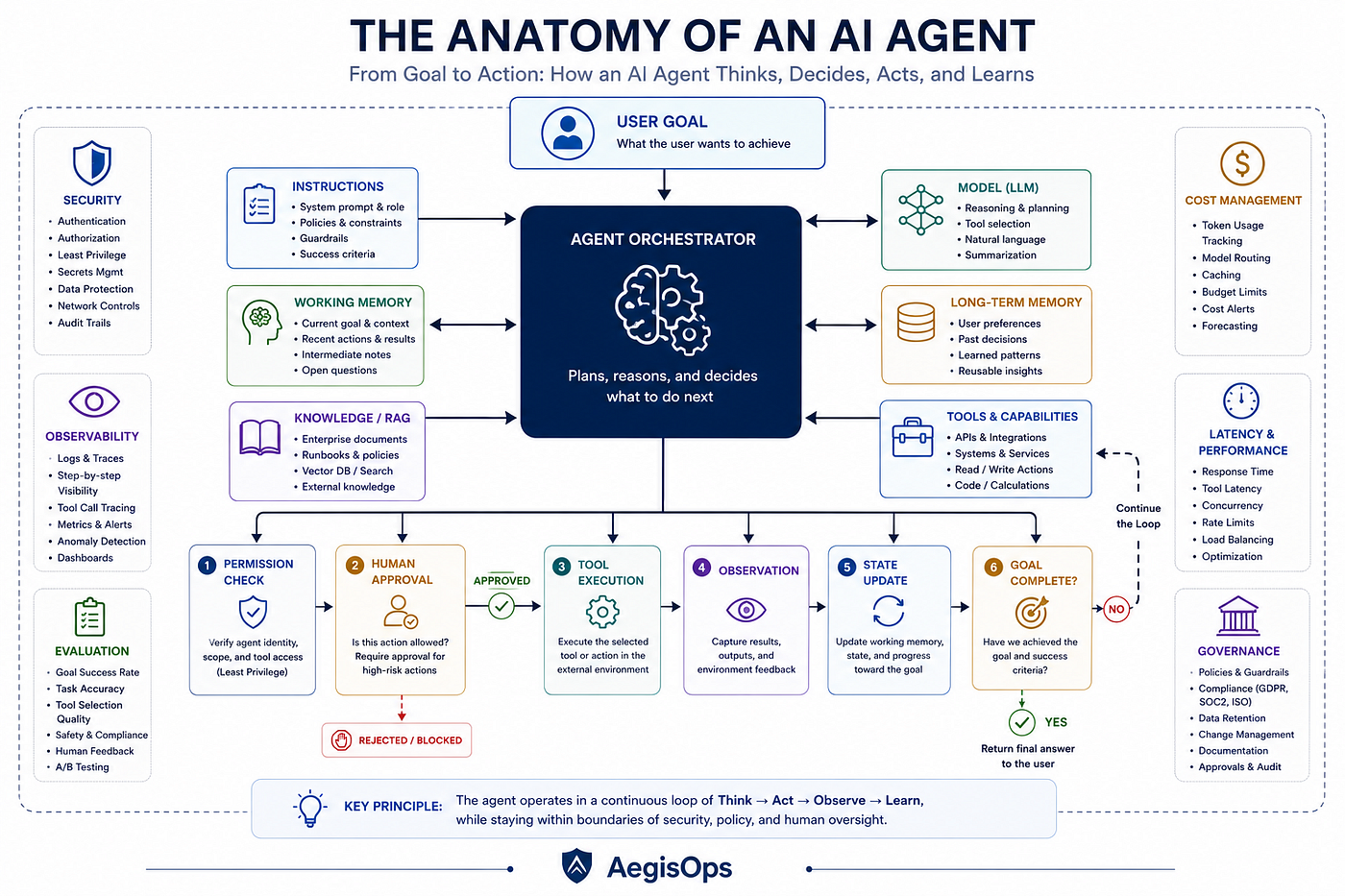
AI Agent
    ↓
MCP Server
    ↓
Read-Only Kubernetes Access
is far safer than:
Cluster AdminThe Future: Agentic AI
The industry is moving toward autonomous AI agents.
Those agents require:
Brain
LLM
Memory
RAG
Hands
MCP
Without all three, the agent remains incomplete.
LLM = Think
RAG = Know
MCP = Act
This is rapidly becoming the dominant architecture pattern for enterprise AI systems.
Final Thoughts
One of the biggest misconceptions in AI today is treating LLM, RAG, and MCP as competing technologies.
They’re not competitors.
They’re complementary layers.
A production-grade AI platform typically requires:
- LLM for reasoning and language understanding
- RAG for enterprise and real-time knowledge
- MCP for tool integration and action execution
For Cloud, DevOps, Security, Platform, and AI Engineers, mastering these three layers will be as important over the next few years as learning Kubernetes was during the cloud-native revolution.
The organizations that understand how to combine LLMs + RAG + MCP effectively will build AI systems that are not only intelligent, but also context-aware, secure, and operationally useful.
LLM gives AI the brain. RAG gives AI the memory. MCP gives AI the hands. Together, they transform a chatbot into an enterprise-grade AI agent.
AI #LLM #RAG #MCP #ModelContextProtocol #GenerativeAI #AIAgents #PlatformEngineering #DevOps #CloudComputing #Kubernetes #MLOps #ArtificialIntelligence #CloudNative #SRE #DevSecOps #PlatformOps #MachineLearning #OpenAI #Anthropic #InfrastructureAsCode #AgenticAI #AIArchitecture #EnterpriseAI #TechLeadership
메타데이터
- post_id
- 13a45b2d82cd
- slug
- llm-vs-rag-vs-mcp-the-missing-architecture-layers-every-ai-engineer-must-understand-13a45b2d82cd
- url
- https://medium.com/aegisops/llm-vs-rag-vs-mcp-the-missing-architecture-layers-every-ai-engineer-must-understand-13a45b2d82cd
- canonical_url
- https://medium.com/aegisops/llm-vs-rag-vs-mcp-the-missing-architecture-layers-every-ai-engineer-must-understand-13a45b2d82cd
- author_url
- https://medium.com/@cloudsignal
- status
- ok
- fetched_at
- 2026-06-21 07:44:09